Is China socialist? Increasingly, Western left intellectuals and media figures such as Jason Hickel, Aaron Bastani and Vijay Prashad have been declaring it so, urging that we learn from and emulate China's success.
The figure of Russian revolutionary Nikolai Bukharin is often invoked to justify and explain this position. It is argued that since Deng Xiaoping opened China to the market, it has developed a ‘market socialist’ economy that has adopted the structure of Bukharin’s New Economic Policy (NEP). By contrast, a different group argues that China is a form of ‘state capitalism’, drawing on another concept Bukharin was crucial in developing within Marxist theory.
Despite how often his legacy is invoked, surprisingly little attention has been paid in this debate to Bukharin’s actual writings. As such, state capitalism, socialism and the NEP are utilized in vague, contradictory and misleading ways that fail to clarify China’s political structure. This has wider implications for the left, as it illustrates a lack of clarity about what socialism or capitalism even are, which fundamentally undermines our political analysis and movement.
This piece will attempt to address this confusion by returning to Bukharin’s theories to clarify these concepts and restore them as usable categories. It will illustrate that despite superficial similarities, China does not resemble his theorization of the NEP or its historical development. Instead, it will show that, with relatively minor adjustments, Bukharin’s conception of state capitalism (particularly its ‘second round’) is the best way of characterizing modern China.
As increasing parts of the left encourage us to look to China for inspiration and use its example to constrain socialist horizons to the market, how we understand China’s political structure is no longer simply academic. How we relate to China and whether its politics are something to be emulated are key questions for the left, and answering them is crucial for clarifying what socialism is for us as we look to address the damage wrought by capitalism and build something beyond it. Bukharin's work can be helpful for answering these questions, but not in the way those who typically invoke him claim.
Bukharin's NEP and Market Socialism
We control the main commanding heights, we organize what is essential.[1]
The NEP emerged in 1921 after seven years of constant war that had battered the Russian economy. Lenin thereby proposed it as a way of revitalising production and rebuilding trust and support for the USSR amongst the Russian peasantry.[2] This would involve an end to forced requisitioning of grain, returning control over land to the peasants and allowing both peasants and private capitalists to operate and sell their produce on the open market.
This prompted significant critique across the socialist movement, with claims that the NEP represented a betrayal of the revolution. Figures like Proebrazhensky and Trotsky criticized the policy as an undue concession to capitalists and the successful peasant farmer - termed ‘Kulaks ’- who were hampering the growth of socialism, advocating for a rapid return to collectivization and planning.[3] Meanwhile, rival left parties like the Menshevik Fyodor Dan and capitalists abroad (whether positively or negatively) declared the NEP represented the return of capitalism and failure of Bolshevik communism.[4]
In this context, Bukharin emerged as the leading defender and proponent of the NEP to explain why it was still in continuity with the communist project. In a series of writings from 1921-29, Bukharin laid out the key parameters of the NEP, clearly defining its trajectory towards communism.[5] For Bukharin, the fundamental features of the NEP were as follows:
- State control of advanced urban industry and banks - the “commanding heights” in Lenin and Bukharin’s phraseology.
- Private capitalists allowed to operate but only temporarily and in limited contexts
- Peasant control of land and the right to market produce but state ownership of land
- Gradual expansion of state planning and control over the economy and collectivization of agriculture via coops, squeezing out the peasant and private capitalist
- Continued financial and organizational support to international socialism
The NEP came to define Bukharin and vice versa. In the political contests between Stalin and Bukharin, and Trotsky, Zinoviev and Kamanev, Bukharin led the defense of the NEP against Trotsky's critiques. When Stalin turned on Bukharin, he continued to defend the policy, resulting in his removal from power.[6]
In the modern day, a growing group on the left argues China is following Bukharin’s road to socialism. They argue Bukharin’s NEP was a market socialist system that represented a ‘lost alternative’ to the disasters of Stalinist planning.[7] After a Maoist period in which China emulated Stalin’s failed strategy, China under Deng is presented as having taken the Bukharinist approach: initiating a ‘long NEP’ by privatizing large parts of the economy but retaining the “‘commanding heights” of industry under state control.[8] They argue this strategy has succeeded, allowing China’s ‘socialist’ system to survive the USSR’s collapse and become the world’s largest economy.[9]
The most systematic attempt to make this case has been Maxence Poulin, who explicitly compares the economic structures of modern China and NEP Russia and claims they essentially follow the same market socialist logic.[10] However, he is not alone in drawing on this analogy with influential socialist writers and media figures such as Branko Milanovic, Peter Nolan, Stephen Cohen, Jason Hickel, Vijay Prashad, Aaron Bastani, Jostein Hauge, Gabriel Rockhill, John Ross and Carlos Martinez, all essentially making the same argument.[11] They are joined by a group of influential liberal-left writers like Isabella Weber, Mariana Mazzucato and Adam Tooze who, whilst agnostic on (or uninterested in) the question of whether China is socialist, emphasize and celebrate the CCP’s 'enlightened’ economic development strategy and suggest it is achieved through the relative freedom of the state from capitalist influence due to its imitation of the principles of the NEP.[12] In turn, such figures draw on the writings and pronouncements of Chinese intellectuals and CCP officials, which have often referenced Bukharin to justify CCP policies since Deng.[13]
This has created a growing perception of China as a progressive socialist force and led to a not insignificant portion of the left looking to China for direction on how to develop a socialist economy.[14] ‘Market socialism’ as a distinct ‘blueprint’ for socialism has grown in popularity on the left in recent years.[15] Those who advocate it do so on the assumption of the ‘realism’ of markets and the fundamental infeasibility - both politically and practically - of non-market forms.[16]
China is the key reference point for this process. Its developmental successes are alleged to prove the innate superiority of markets for the management of the economic system and the ways and limits to how socialists might use state power to manipulate it for our social goals. Bukharin then becomes the leading tribune of a new type of market-based socialism that China is pioneering. Any concerns he had about the risks this entailed are erased. Both Bukharin and China are invoked chiefly to limit socialist horizons to the market.
This idea is so popular because it is so appealing to the Western imaginary. To a Western public surrounded by capitalist failures, China looks like the antidote. Its rapid development, growth, and technological modernity - its skyscrapers, high-speed rail, and drone light shows, all captured in a thousand ‘chinamaxxing’ Instagram reels - become the foil to stagnating Western productivity and living standards.[17] To a Western left mired in the failure of social democracy and lacking an alternative, China's Communist party-state becomes perhaps the only leftist ‘success’ to point to.
But is this real? Is China a genuinely socialist project the left can emulate? Or has the marketisation process fundamentally changed China into a capitalist state, defined less by social welfare than by inequality and exploitation?
By examining the theories of Bukharin more closely and interrogating to what degree China actually fits his conception of a socialist transition, we can get closer to the answer.
State Industry and Private Capital
“The task is to use them and force them out”[18]
That the Soviet state continued to control urban industry and limit private capital was a key element of Bukharin’s defence of the NEP as a socialist project. Under this system, the state would control basically all large-scale industry in the cities and all banks.19 This would ensure the workers' state and Communist Party would retain directional control over the economy and market production, enabling them to pursue socialist goals. By retaining state control of all the banks, all domestic capitalists and peasant producers would become dependent on the workers' state for financing.[19] This would give it supreme leverage and control over industry, in precisely the same way private banks in the capitalist world hold influence over industries they invest in. Industrial and financial dominance would allow the soviet economy to be increasingly “oriented toward satisfaction of mass demand as opposed to the capitalist ‘quest for profit.’'’[20] This is what he and Lenin meant by holding the ‘commanding heights.’
On the face of it, modern China seems to fit very closely with this definition. The CCP has since the 1990s engaged in the policy of ‘grasp the large and release the small’, privatising many of its previous holdings but maintaining control of large companies in strategic sectors.[21] Today, in total, the state controls companies accounting for roughly 40% of Chinese GDP and has at least some ownership share in those representing 68% of it.[22] The CCP-state also dominates finance, controlling all of China's 5 major banks and 14/17 of its biggest.[23] Party cells also operate in all large private companies and exert significant authority there too. On this basis, Poulin argues China is fundamentally in line with the Soviet NEP.[24]
However, a closer look at Bukharin’s writing, along with the details of Chinese state control and its trajectory over time, undermines this image. Bukharin was very clear that private capital would be massively constrained under the NEP. Private capitalists were to be allowed primarily “idle or poorly operating enterprises” badly damaged by the civil war that the state could not afford to repair. Even these would be leased from the state and subject to revocation.[25] Otherwise, they could only operate in the carrying trade between the peasant rural zone and the city. No large private capitalist farms would be permitted, only small peasant holdings. Capitalists and peasants who employed labour (the kulaks) would be strictly barred from activity in the soviets or party membership and thus prohibited from influence over the state.[26] The workers' state would thereby retain separation from, and dominance over, capital.
Most crucially, Bukharin was very clear that the NEP represented a transition period towards a fully planned economy.[27] As Lars Lih has noted, Bukharin was with the mainstream of the Bolshevik party on this issue.[28] Whilst some historians like Stephen Cohen and Moshe Lewin have suggested Bukharin ultimately became committed to permanent market presence in the socialist republic, there is no actual evidence for this in his writings, as Lewin admits.[29] Whilst Bukharin does not fully specify the timeline for this process, he was clear that the NEP would represent a relatively rapid transition to socialism. In this sense, the concept of a ‘long NEP’ is a contradiction in terms.
China simply does not resemble this picture. Since the 1990s, the CCP has presided over a steady and consistent move away from state control of industry. In 1996, aping the process in the USSR and Eastern Bloc, Chinese President Jiang Zemin engaged in a mass sell-off of Chinese state-owned enterprises, often to former managers (the ‘guanying’) at cut prices.[30] years on, China has steadily moved from an industry that was 100% state owned to now only controlling 40%. There is no sense this process is temporary or being reversed. Xi Jinping has repeatedly stressed the continued primary significance of the market and private industry saying “We should let the market play the decisive role in allocating resources.”[31]
At the same time, the CCP has significantly marketised the state industry it does control. Since 1996, it has shifted from total state ownership of industry to a shareholder model, selling off increasing shares of the companies it continues to control to the private sector. Of the 40% of industry the state ‘owns’, only 62.5% are actually fully owned by state bodies.[32] The remainder are listed alongside private companies on domestic and international stock exchanges, seeking out and securing significant domestic and international capital investment.[33] Moreover, since 1999 the CCP has increasingly shifted from majority ownership of companies to minority shares, moving away from controlling industry to acting as another beneficiary in private capitalist industry. Finally, the CCP has reduced both state funds to and state taxes on these firms and relaxed control over management.[34] State firms must increasingly be solvent and self-sufficient, and if not, must borrow in much the same way as private businesses.[35] This forces firms to focus on how attractive they are to international capital and to be oriented to and dependent on the market. It also allows them to operate like private fiefdoms of their management.[36]
All this has resulted in a state industry that is almost as ruthlessly focussed on the market, profit and efficiency as the private sector. The initial 1996 privatisation and marketisation of SOEs, ended the egalitarian pay and job security of the Mao era and led to mass unemployment as 27 million workers were dismissed from 1998-2002.[37] Since Zhu Rongji’s reforms in the early 2000s, SOEs have been restructured to prioritise profits - adopting Western-style management structures and paying out huge dividends to leading officials and shareholders, often above those found in private industry. Chinese state banks usually pay out a Return on Equity of 15-20%.39 In essence, we have a state industry with a hard budget constraint that overwhelmingly pursues profit rather than social goals in the same way as private industry.[38]
Private capitalists also have far more power and influence over the state than Bukharin specifies. Increasingly, Chinese capitalists and businessmen are granted positions as delegates to the Chinese People’s Policy Consultative Conference (CPPCC), where they can suggest legislation to the Communist Party.[39] More significantly, since 2001 private capitalists and the senior managers of their businesses have also been allowed to be members of the CCP itself and increasingly represent the most wealthy, politically dominant portion of its membership.[40] In most major private companies, the CEO and senior management are the secretaries of the company party cell. The party is thus not an external regulating force. Private capitalists are its representatives and constitutive units. Major private capitalists like billionaires Jack Ma, Wang Jianlin and Chen Dongsheng hold Communist Party membership.[41]
Similarly, within state industry, it is not rank-and-file workers or some external monitoring force but the leading officials themselves who are the controlling party force in the company. Indeed, Xi Jinping has mandated that the chair of SOEs be the Party secretary for the company.[42] The marketised nature of these firms means SOE managers overwhelmingly represent the interests of capital within the party much like private capitalists.
The result is that state and party bureaus are very much market-oriented bodies focused on the interests of capital in much the same mould as SOEs. The party-state acts much like a large capitalist corporation. Party officials are assessed, paid and promoted almost entirely based on their achievement of growth targets in the areas they manage and the attraction of investment.[43]
The elites of the state corporation and private capitalists are thus fused into one capitalist class through the medium of the party. There is a revolving door between senior positions in Chinese state industry, private capitalist corporations and the institutions of international capital. Figures like Zhu Min, who worked first for the World Bank, then two Chinese state banks before finally becoming Deputy MD of the IMF, are illustrative in this regard.[44] Private capitalists are able to use their wealth to gain state power and influence, and in turn, leading state officials and SOE managers use their positions to gain wealth and build private empires. The particularly notable example is the family of Rong Yiren, son of a major pre-revolution capitalist who, under Deng, was allowed to establish CITIC, a nominally state -controlled trading company under Rong’s control which channeled Western investment into China.[45] He extracted billions from this company and gained significant political influence in the CCP, eventually becoming Deputy Vice Premier of the Chinese state. In turn, he established his son Larry Yung as the head of its lucrative Pacific branch, who extracted enough wealth to become a major private real estate capitalist, now one of the wealthiest men in China.[46] Even government officials who are banned from operating commercial enterprises often use their position to support family members who do. Xi Jinping has helped his sister Qi Qiaoqiao and wider family network build a fortune holding major shares in Chinese companies extracting billions from international oil and rare mineral trades, activities facilitated by the state.[47]
Rather than the Communist party-state controlling and regulating capital, it has become a body made up of private and state capitalists guided by the market. Instead of moving steadily towards a planned economy oriented towards workers’ needs, the economy and state itself is increasingly marketised and focused on profit.[48]
Workers’ Control
“Our state is a state of the working class”[49]
Whilst not commonly emphasised as an element of his thought, Bukharin was also very clear that the state and its industry under the NEP must have a significant degree of working-class direction and control. State control of the economy on its own was not enough. Capitalism also saw significant state power over industry. Following the logic of Lenin’s State and Revolution he argued that if the USSR was to be distinct from the capitalist state, the USSR must be a “workers state” - a “democracy of the toilers.” For Bukharin, this was a body whose government and industry were based on “workers’ trade unions, peasant cooperatives and committees” and under the control of workers and staffed by them - where workers “electors and, even more, of the deputies” were involved “in the real, genuine work of managing the state.”[50] In private industry, workers would retain a significant degree of control over the workplace, and the law would massively restrict private capitalists' right to exploit them.
Historians of the NEP have typically dismissed this commitment by Bukharin and other Bolsheviks as relatively threadbare during the NEP years. Many accounts suggest the power of workers over the Soviet state and industry had more or less ended by 1920 - with the restriction of the operation of non-Bolshevik parties and the imposition of one-man management over factories.[51]
Undoubtedly, like all Bolsheviks, Bukharin’s conception of workers' democracy was limited. He certainly emphasised that the Communist Party should be the vanguard of the working class, repeatedly commending the decision to restrict the access of the Socialist Revolutionaries and Mensheviks to the soviets on the grounds that they were “petit bourgeoisie” parties.[52] He also marked the decision to implement one-man management by ‘specialists’ over the factory committees as a necessary measure to raise productivity due to the low skill level of the Russian working class.[53]
However, it would be wrong to dismiss his commitment to workers’ control entirely or suggest that workers had no power over industry under the NEP. Indeed, as recent historiography has illustrated, workers retained significant control over their factories and industries well into the late NEP.[54] Whilst state factories now had appointed managers, workers retained significant power over who was chosen. Workers’ unions elected many of the officials on the planning bodies that selected managers, and usually the local branch proposed the workers from the factory floor chosen for management roles.[55] Around 75% of workers regularly participated in mass factory meetings where they examined managerial decisions, put forward proposals and directly elected representatives to factory councils. These councils met regularly with management, scrutinized their work and pressed them on workers’ demands. Obstructive managers were often dismissed under council pressure. Whilst non-Bolsheviks and increasingly non-Stalinists were severely limited from participation in the soviets in the NEP, in the factory councils Left SRs, Mensheviks, rival Bolshevik factions and non-aligned workers continued to be elected and hold significant influence.[56] Factory councils elected worker delegates to ‘Rabkirin’, a ministry specifically set up to monitor and censure state managers deemed to be violating workers’ interests or managing poorly.[57] Workers also elected 50% of the Rates and Conflict Commission (RKK), a body that scrutinised manager decisions and received and decided on workers’ requests for changes in pay, working conditions and production decisions. All of this gave workers significant power over their workplaces. Wages increased consistently over the NEP years, with management and the RKK submitting to most pay increase requests from 1920-26. Pay distribution was also very equal.[58] Rank-and-file workers had a huge amount of control over the pace and intensity of work and usually set the production quotas expected from them.[59]
Bukharin repeatedly expressed support for this system and emphasized its importance. In 1918 he stressed that whilst he supported state direction of the economy, it must be led by worker initiative, saying "There must be a conductor's baton, but it must be moved by the workers themselves."[60] As the NEP began, he repeatedly emphasized that the workers must have influence and control over the state and industry, or it would cease to meaningfully be a workers’ state. He stressed the importance of workers' power to recall any delegates they elected to factory committees or soviets on demand and have power over managerial appointees and repeatedly pushed for the revitalization of soviet activities wherever they had dissipated.[61] Bukharin also advocated that this workers’ power and influence steadily expand as Soviet state education policies raised the standard of workers’ labour and knowledge until distinctions of rank, management and specialisms were abolished. He envisaged a world soon in the future when “every worker were of the same high cultural level” and therefore “leading responsibilities could be accepted in turn or only for a certain interval of time.”[62]
When Stalin moved to break this system through the imposition of the Five Year Plans, the restriction of party democracy, and the stripping of the powers and autonomy of factory council bodies, Bukharin repeatedly opposed this.[63] He complained of the rise of an overly authoritarian party-state, the erection of "bureaucratic barriers” and removal of worker autonomy, stating that “we have overcentralised everything to an excessive degree.” He suggested there should be a greater push to revitalise worker control and soviet activity: “Should we not take a few steps in the direction of the Leninist commune-state?”.[64]
So what of China? A variety of left figures have recently argued that China is democratic in a similar way. Jason Hickel and Pawel Wargan have suggested China operates a form of socialist democracy whereby the public are allowed significant input into government policy through the state structures of the CPPCC, the national congresses and public consultation - including meetings and anonymous suggestion boxes.[65][66] Joseph Fewsmith has suggested this is an increasing trend in China’s political landscape, with the CCP attempting to expand ‘consultative democracy’ in which citizens are asked to feed into decisions to build and maintain the CCP’s legitimacy.[67]
Immanuel Ness makes a similar claim for workers' democracy in urban industry, suggesting that workers have significant power over their workplaces via the CCP-affiliated All China Federation of Trade Unions (ACFTU). He points to the high union density in China - 75% of Chinese workers are union members - and suggests this empowers Chinese workers.[68] Ness also suggests the unions themselves are very democratic and responsive bodies, highlighting the presence of elections for local officials.[69] Finally, he claims workers have significant influence over the workplace via the Chinese Labour Dispute Arbitration Commission (LDAC). Chinese workers have raised 3,162,000 cases via arbitration bodies from 2018-22 to complain of contract violations by private employers. Ness stresses that these disputes are resolved very favorably for workers, with the majority of those finalized ruled in their favor.[70] Do we have here something similar to the RKK of the NEP?
Not really. The RKK was a specific body designed to decide on proactive pay claims and other disputes and production decisions raised by workers at the point of production. Workers' delegates on that body ensured a significant degree of direct influence over factory management, and disputes were resolved quickly. The LDAC is staffed by state appointees and operates primarily as an external body to enforce labour contracts like a Western industrial tribunal. Cases take very long, often multiple years, to be resolved, leading to significant dropout rates. Indeed, around a quarter of cases end this way.[71] Success enables Chinese workers to reclaim unpaid wages and welfare and dispute unfair dismissal but not to create systematic change: increase pay, modify the pay structure of their companies or change other areas of workplace management. Victory in these cases represents merely an assertion of the official rights of Chinese labour to salaries and labour conditions which are no more generous than the average capitalist nation of a similar level of development. Crucially, official victory does not always mean practical implementation of the decision, with state officials often refusing to either reverse a dismissal or enforce repayment of wage arrears.[72] The main thing that CLAB cases illustrate is the widespread nature of contract violation by employers.
Ness’s other claims are equally dubious. Elections in Chinese trade unions are not anywhere near as democratic as he implies.75 In many factories, the candidates for union election are preselected by management or HR bodies with the predictable result that workplace union officials are often also management or HR.[73] The higher ranks of the ACFTU unions are dominated by CCP appointees and are bound to carry out orders by party discipline. ACFTU is therefore not accountable to workers on the factory floor. Likewise, trade union rights are also actually far weaker than in the West. Chinese workers have no official right to strike via their unions and so have had to engage in all labour struggles outside union channels.[74] They also have no right to free association with non-ACFTU unions.[75] China thus has had thousands of wildcat strikes every year since the 1990s; more than any other country on earth.[76] Whilst these strikes have been very powerful and have forced major concessions, the very fact they cannot and do not take place within Chinese unions illustrates the lack of power workers have over them or official state structures.[77] When ACFTU involves itself in these disputes, it is chiefly to arbitrate between management and workers rather than represent workers’ interests. It usually encourages workers to end strike action and moderate wage demands.[78]
There is no equivalent to the Soviet factory council in Chinese industry. There used to be. Under Mao, workers were able to elect representatives to the Staff and Workers Congress (SWC). The SWC was officially the highest authority in the factory and had power over wages and bonuses, work norms and factory rules, benefit allocation, and could scrutinize managers and state officials. It secured workers guaranteed employment for life, subsidized housing, and a significantly equal salary distribution.[79] However, since the reform and opening up period, power in the factory has been conclusively passed directly to state industry managers. Whilst the SWC still nominally exist in most factories, they have had their powers over wages, workplace rules, and bonus schemes stripped and are rarely allowed to hold meetings. When they do, they are stuffed with managerial and technical staff appointed by the Director.[80] Managers are also no longer appointed from workers themselves but rather college-educated middle class. Managers have used this newfound power to become increasingly authoritarian in the workplace and to privilege access to senior positions to friends and family. The practice of relatively equitable salaries and distribution of bonuses (‘drizzles on all’) was ended alongside secure employment, subsidized housing and other benefits. Surveys show “having a good personal relationship with the leader” has become the thing workers consider most important to advancement.[79]
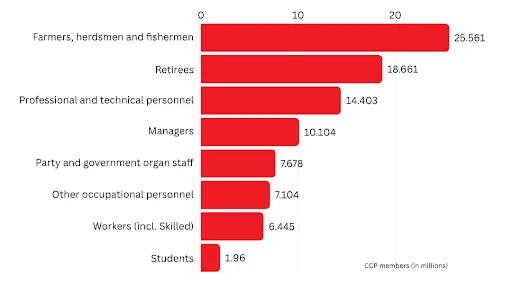
The institutions of the Chinese government are hardly bastions of worker democracy or power either. In the official organs of state governance, the National People’s Congresses and CPPCC, all candidates are thoroughly vetted by the CCP beforehand and pre-chosen by the party structure. Most crucially, the CCP itself is a top-down rather than bottom-up structure and is no longer a party composed of the working class. 90 million Chinese people are members of the party; however, only 6.4 million are workers, with the vast majority being managers, technical personnel, and industrial and agricultural capitalists.[81] Moreover, its officialdom is primarily appointed from above or horizontally by self-selection of the preexisting party hierarchy in the area.[82] When it is elected directly, the candidates are usually selected from above in much the same way. This very much insulates party officialdom from accountability to the working class.[83]
Party officials are thus both able and incentivized to leverage their positions of power to extract wealth from the state and the working class in their area. Corruption is rampant within the Chinese state, from practices like blatant theft of state funds through to misallocation of bonuses and supplementary income.[84] CCP officials often loot state assets. As we have seen, many officials operating as state managers bought state industry and housing at cut-down prices when they were privatised in the 1990s. In the modern day, CCP officials work with private capital, offering developers privileged cheap access to state funds and land in exchange for kickbacks and then subsequently collecting bonuses for raising investment and growth rates.[85]
This is not to say the CCP is entirely unresponsive to workers’ actions or interests; all states must manage such things or face destruction. However, the CCP operates so as to limit such responsiveness to the bare minimum through consultative and nonbinding forms of workers’ participation. There is no real sense that workers' power is advancing.
China thus cannot be considered a workers’ state by Bukharin's definition.
Equality and Welfare
“Differences in levels of culture and material circumstances will be abolished.”[86]
Bukharin is often presented as the principal defender of wage inequality within the Bolshevik party during the NEP. Cohen and Lewin both stress his justification of and support for the move during the early NEP to hire capitalist technical specialists and accept inequality of pay between them, skilled workers, and the rank and file. Cohen summarises Bukharin’s thought as opposed to a “poor peasant socialism” committed to “equality in poverty”.[87]
For its defenders, Deng's reforms have inculcated the same basic logic. Inequality and the market are allowed in order to encourage productivity and gain the support of highly qualified technical personnel to invigorate Chinese industry and develop the productive forces. As Bukharin advocated, they argue, the aim has always been a long-term move towards economic equality. Deng suggested that the reform would mean “some people can get rich first,” implying a long-term move to equality, as Bukharin advocated.[88] In the modern day, China’s defenders emphasize the huge increase in material welfare and reduction in poverty in China as a result of the huge growth in its economy.[89]
Hu Jintao's ‘Harmonious Society’ and, most significantly, Xi Jinping's ‘Common Prosperity’ drive have also been viewed as delivering on the promise of increasing equality. Wealth equalisation has increasingly been included as a target for local CCP cadres by the leadership.[90] In the last two decades social security and healthcare access provided by the state have been increased with the roll-out of state subsidised rural healthcare insurance and increased investment in education and pensions. Perhaps most significantly, commentators have stressed that China is increasingly abolishing the Hukou system, culminating in a major announcement in May this year that it has been fully terminated.95 Hukou has historically acted to limit social benefits access to your place of household registration rather than work, which thereby limits the 170 million Chinese rural citizens working in the cities accessing the more generous state benefits there.[91]
Does this match Bukharin's conception of the NEP? Only, I think, if we mangle Bukharin's thought and misrepresent both the NEP and China's current trajectory. Bukharin’s commitment to long-term inequality has been significantly overstated. Whilst he justified payment of higher salaries to technicians and skilled workers as an expediency measure to invigorate productivity after the destruction of the Civil War, he did not present this as a long-term policy and was keen to limit it even at the time. He repeatedly stressed that inequality between salaries and, in general, must be minimized.[92] The salaries of state ministers and officials were deliberately capped at roughly a skilled worker’s wage. Whilst specialists could receive much higher wages, these had to be explicitly ratified by the soviets on a case-by-case basis.[93] Bukharin also advocated the use of high taxes on private capitalists and wealth in general to ensure inequality was reduced.99 By the end of the NEP the USSR’s Gini coefficient was very low, at 0.25.[94]
Crucially, Bukharin also repeatedly emphasized the short-term nature of this inequality. The aim was to ensure relatively rapid “movement in the direction of economic equality” as communism was developed.[95] State education of workers was to quickly “overcome all the cultural inequalities” and ensure workers could fully run industry themselves. This would enable a steady equalization of wealth and salaries until the USSR had achieved “equality in the material conditions of life.” The two were mutually dependent because, for Bukharin, the structural reason for pay inequality was the need to maintain the support of "irreplaceable" technical specialists who had unique knowledge workers did not.[96] As soon as workers possessed this knowledge, such specialists would have no leverage over the working class, and inequality could be dispensed with.
The worker's state would also guarantee an increasing volume of universal benefits to the working class. This would include state subsidized healthcare, education and housing.[97] Through this, Bukharin emphasized that differences in levels of culture and material circumstances would be abolished. Likewise, in the countryside, Bukharin stressed that state policy must be directly oriented towards equalization of wealth and the abolition of inequality. The state was to give financial support to develop the farms of poorer peasants and cooperatives primarily with “special protection, privileges and support, material and otherwise” until “they overtake the prosperous rural upper stratum”.[98]
Such an emphasis is not present in China. China is a hugely unequal country with income inequality similar to the level found in the United States and a Gini of 46.6 - greater than many capitalist countries at a similar level of development. The wealthiest 10% earn about 41% of national income and hold 67% of its wealth.[99] This has been prompted by the growth of private industry with significantly unequal salaries, by the marketisation of the economy and growth of Western-style stock markets, and most significantly by the rampant looting of state assets in the 1990s. The mass sell-off of state housing and industry at low prices massively enriched a select group of party officials.[100][101]
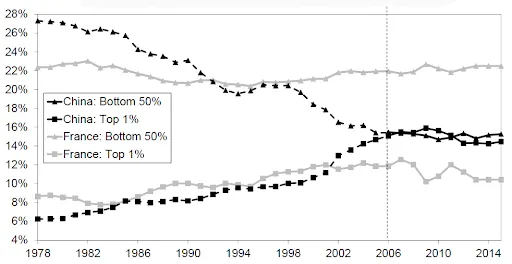
There has been little indication that the CCP will change this. Whilst there have been some rhetorical moves to emphasize the importance of increasing equality recently, this has not resulted in a significant change in practice. Inequality has at best stabilized at a high level in the last 2 decades.[edb7ce] There have been minimal attempts to raise workers’ salaries, equalize incomes, or redistribute wealth through taxes. Chinese worker salaries are about average for capitalist nations at their relative level of development, and their minimum wage level is relatively ungenerous.[102] Despite rhetorical attention to them, equality goals are still deprioritized relative to the standard targets of development in cadre evaluation.[103] Xi’s much trumpeted ‘Common prosperity’ policies have largely been confined to the initial demonstration region of Zhejiang, and even these are relatively limited in scope.[104] Indeed, Xi has been clear that they will not put a huge burden on private enterprise and do not mean ‘egalitarianism, encouraging laziness or fostering dependence on others.’ Initial proposals to tax high income have been quietly shelved in response to capitalist opposition.[105]
China also does not provide particularly generous or universal welfare systems. Despite improvements since 2006, China's welfare system remains less generous than many capitalist nations at a similar level of development, with welfare spending below the OECD average.[106] Healthcare insurance and unemployment benefits are limited, tied to one's work, and remain patchy in coverage, particularly in rural areas.[107] Xi has repeatedly opposed universalist forms of welfare on the grounds that it would undermine productivity, saying China must “prevent falling into the trap of welfarism that breeds laziness.”[108] Even the much trumpeted ‘ending’ of the Hukou system is only partially realized in practice.[109] Whilst it has become increasingly easy to access an urban hukou and welfare coverage in smaller towns and cities, rural migrant labour still struggles to do so in major cities. The insecure nature of most migrant labour also means accessing many welfare programs is difficult because of how tied it is to employment. The notable improvements in working-class conditions across China since 1980 - including pay rises, reductions in prices, or limited expansions to welfare systems - have come via the usual patterns of capitalist development. A market-based boom in production, an increase in national income and an increase in the availability of goods, alongside workers’ class struggle, have forced some concessions in the form of wage increases and welfare systems; a pattern seen in many capitalist countries. Crucially, this has not been a proactive element of CCP policy based on an ideological or political commitment to working-class welfare.[110] Bukharin's commitment to economic equality is not present here.
Agriculture and the Rural Coop
Under a dictatorship of the proletariat the growth of cooperation in fact signifies the growth of socialism.[111]
The agricultural question held a key importance to Bukharin and the NEP because of the huge controversy over the decision to return lands to the peasantry. Critics of the policy emphasized that in a rural country like Russia, the decision to effectively privatize the land put the socialist project at huge risk.[112] Action to immediately re-collectivize the land was thus of crucial importance.
Bukharin stressed this was the wrong approach. For him the very fact of Russia’s rural nature and the isolation of the workers’ state and industry meant such an attempt to engage in mass collectivization would be even more risky than allowing some peasant control. The Bolsheviks had come to power through the ‘smychka’, an ‘alliance’ between the workers and the peasantry. To attempt to force the peasantry into collective farms would violate this alliance and cause mass peasant resistance and hamper production.[113] However, this was not because Bukharin opposed the fundamental goal of collectivisation; he simply believed a slower and more democratic process was necessary to preserve the political strength of the workers’ state.
This is what the NEP would provide. Firstly, by retaining state ownership of the land, the workers' state would be able to steadily enforce collectivization as and when it had the political power to do so.[114] Secondly, the state would impose significant taxes on kulaks to equalize wealthier and poorer peasants and prevent the development of large privately held capitalist farms.[115] Thirdly, the workers' state would aggressively finance and develop rural cooperatives and collectives to steadily socialise agricultural production, particularly favouring those run by poorer peasants.[116] Fourthly, the workers' state would allow and encourage democracy in the coops with the aim of utilising this to undermine the power of kulaks, strengthen the poorer peasant majority and transform all peasants into collective workers. The cooperatives would be voluntarily joined and democratically run by elected peasant delegates and accountable to them to help encourage a collective approach to land management. In turn, the Bolsheviks would compete in these elections to steadily expand communist and poorer peasant influence over the peasantry.[117]
Some have argued that China is moving in this direction. Like the NEP, China's land is still legally the property of the state, with farmers holding land on lease.[118] On this basis, Samir Amin, Elias Jabbour, Alexis Dantas and others have stressed that China’s rural economy is socialist, with Poulin arguing that it is aligned with the NEP. The Chinese state uses this control to provide a right to land for rural citizens, redistributing land to landless peasants when requested.[119] Others have emphasized how the Chinese state has directly facilitated the mass growth of cooperatives in rural China in the last two decades.[120] Through offering favorable credit, China has expanded the number of registered cooperatives from 26,400 in 2007 to 1.93 million in 2017, with 100 million members, representing 46.8% of Chinese farmers.[121]
However, a closer look reveals that this process does not really resemble Bukharin's vision for socialist agriculture under NEP. Whilst land is nominally still nationalized, in reality it has been steadily privatized since the reform period began. Whilst land is technically held on lease, since the late 1990s leases have been allowed for 30 years and are often automatically renewed upon expiry.[122] As such, these leases are increasingly held for such long periods that they are effectively privately owned and can be inherited and sold on, creating a large rural land market.[123] The state retains the right to reclaim land when it needs to, but it chiefly uses these powers to dispossess small peasants and facilitate the creation of private capitalist urban developments, not to form collective farms. The state also does not use taxation in the manner Bukharin intended. Since the 2000s, China has abolished all taxes on the peasantry and any redistributive framework.[124]
Most significantly, there has been no real move towards collectivisation of agriculture. The much vaunted cooperative sector exists more on paper than in reality. Whilst officially some 50% of Chinese farmers work in a ‘cooperative’, in truth the vast majority are fronts or regular private businesses listed as such solely to claim extremely favourable low-interest loans provided by the state for cooperatives. The vast majority of those which claim coop status are structured like this.[125]
Of those that do exist, little real democracy operates within them, with a core group of wealthy members dominating all decision-making.[126] This core uses their larger wealth, experience, and better contacts with the party-state to pressure less powerful and wealthy ‘common members’ to accept their decisions. There is no equality of shareholding. Core members utilize their dominance to extract the vast majority of the dividends, usually receiving from 50-90% of coop profits despite representing 3-15% of the membership. These cooperatives are closer to regular capitalist private enterprise than collectively owned production. Certainly, these are not the cooperatives Bukharin had in mind for the NEP.
International Solidarity
Our party would be treacherous and disloyal to the interests of our own working class and peasantry were it to cease being a party of international revolution.[127]
One of the main consistent threads in Bukharin's thought was a commitment to internationalism as the lifeblood of socialism. As the leading figure in the Bolshevik left during the 1910s, he opposed the First World War as an imperialist capitalist war. He was the leading Bolshevik opponent of the 1917 Brest-Litovsk treaty with Germany on the grounds that it meant abandoning the workers’ movement in Central and Eastern Europe to the Kaiser, and a strong proponent of post-war Soviet efforts to support revolutionary movements across the continent. Whilst Bukharin is sometimes presented as having walked back on this in the mid-1920s, in truth he continued to have an internationalist focus. He was a leading figure in the Comintern - the Soviet body tasked with coordinating the communist parties across the world - for the whole of his political life and actively encouraged the raising of funds to support the British general strike of 1926.[128]
China, by contrast, provides no equivalent support to international socialism. It does engage in significant infrastructure projects in Marxist-Leninist states like Cuba and North Korea and for those of the ‘Pink tide’ like Venezuela, all of which lack access to Western markets.[129] These, however, operate as regular loans and investments in return for interest or a share of profits and are chiefly a result of the mutual hostility between these states and the US and China’s desire to secure markets for its goods rather than any ideological reasons.[130] China’s relations with these countries are not particularly distinct from its relationship with Iran or Pakistan, for example.[131] In fact, its positioning towards these latter two states is more openly positive than with neighboring Vietnam despite the latter being governed by a Communist party.[132] Certainly China puts no emphasis on maintaining its allies as ‘communist’ states. It has been one of the chief forces encouraging Cuba’s recent move away from economic planning and opening up to the market, for example, and has done so partly with the explicit aim of securing Chinese state companies, private capitalists and the state itself more control over Cuban markets, infrastructure and natural resources.[133] Beyond this, China does not attempt to provide finance or support to the workers or socialist movement in any state on earth. There is no CCP equivalent of the Comintern, for example. The focus of China's foreign policy is the development and growth of Chinese power and industry, regardless of the politics of the state or movement they work with.
In truth, China has been directly or indirectly involved in financing the suppression of liberatory movements internationally in the last 40 years. China invests heavily in Israel, funding the construction of infrastructure projects in the settler colonial state, including a major port in Ashdod just north of Gaza and the Tel Aviv light rail system. Chinese corporation Shanghai International Port Group operates Israel’s airport in Haifa.[134] China has purchased billions in military equipment and tech transfers from the Israeli state and private weapons manufacturers.[135] All this has provided direct financial support to a country engaging in genocide and colonialism against the Palestinian people. In the Congo, Chinese corporations run intensely exploitative mining operations for Cobalt, owning 80% of the processing plants. These subject workers to awful living and working conditions, engage in widespread union busting, and violation of labour rights.[136] In Zambia, the Niger Delta, South Sudan and Pakistan, Chinese corporations aggressively extract minerals, oil and gas, exploit the labour they employ there and work with the local state to suppress worker resistance.[137]
State Capitalism
“The state increasingly becomes a direct exploiter, organising and directing production as a collective, joint capitalist.”145
If China is not a market socialist state undergoing an NEP-style transition, then what is it? State capitalism is often used as the alternative conceptual framework to characterize the structures of China's political economy.146 However, despite his crucial role in developing the concept, Bukharin's work is rarely engaged with in this context.147 Partly because of this, state capitalism is under-defined and applied by different writers in wildly diverging and contradictory ways. It has been used to refer to countries which have significant numbers of state-controlled firms, those with large-scale ‘Keynesian’ state investment, any act of state regulation of private capital, any public-private partnerships, a state-controlled economy which nonetheless possesses a market, or simply as a moniker for countries with ‘non democratic’ state structures by contrast to the West. Typically it is held up in contrast to and in conflict with supposedly ‘market capitalist’ or ‘liberal capitalist’ economies.148
But economies typically designated ‘socialist’ or ‘market capitalist’ also always possess large state control, regulation and direction of the economy. Almost every revolutionary socialist project has in some sense possessed a market, and the ‘authoritarian vs democracy’ distinction obscures the significant ways in which Western states operate in an authoritarian manner, as states categorized as both have utilised and continue to utilise the state for capitalist ends. Indeed, countries as diverse as the US and USSR have been referred to as ‘state capitalist’. State capitalism as a category becomes undefined, and its analytical use undermined.149
This confused situation has not been helped by the emphasis within Marxist studies of state capitalism on Lenin’s theorisation of the concept. This is despite the fact that Lenin's major work on the topic, Imperialism, the Highest Stage of Capitalism, is very underdeveloped.150 Lenin intended it primarily as a pamphlet to introduce the more detailed works of contemporaries, not as a developed elaboration. Lenin’s conception of it was also relatively contradictory. At various points he characterised the nascent Soviet state as “state capitalist” or containing significant elements of state capitalism alongside socialist and even feudal elements.151 He thereby muddied the concept and erased clear distinctions between capitalism and socialism. Modern uses of the concept often inherit this conceptual confusion.
The result is that there is no clear definition of state capitalism as a distinct form of capitalism, a lack of a theory of why and in what contexts it emerges and how it impacts class struggle, and no clear distinction between it and socialist projects that utilise the state. In this context, for lack of a clear alternative, presenting China as socialist becomes as defensible as any other conception. The question ends up being whether one trusts the stated intention of the Chinese state to ‘build socialism’, not any analysis of the structure of China's economy, which all agree is state-dominated.
Another group of writers have attempted to resolve this conceptual impasse by synthesising these two concepts: presenting China as either a new form of economy or a hybrid in flux - where capitalist and socialist elements compete over and within the state.152 However, this presents even more problems than it solves and has huge ramifications for leftist theory and political practice. If we can't draw a clear line between a socialist state and a capitalist state, how do we clarify what capitalism and socialism even are? If socialism can be fought for by undefined groups of officials within the state, then what remains of class struggle or any wider revolutionary politics? Confusion about the nature of China becomes a broader confusion for the left over our goals and tactics.
Returning to Bukharin’s work can help address this conceptual confusion. This is because, unlike Lenin, he developed a very specific and distinct model of state capitalism as a political-economic form held up in contradistinction to the NEP.153 This concept can offer some clear insight into China's political economy.
Drawing on Marx, Engels and Rudolf Hilferding, Bukharin acknowledged the state had always played a key role in the development of capitalism.154 However, for him, state capitalism was a novel and heightened form of this existing state involvement that had emerged in the specific context of a multipolar world of conflicting capitalist states of the late 19th and early 20th centuries.155 Bukharin argued that as capitalism developed within the major imperialist countries in the West and as productivity increased and capital accumulated, there was a resulting glut of capital and goods seeking profitable employment and purchase in domestic markets. This meant inter-capitalist competition for domestic markets and resources became increasingly intense, encouraging European capitalist elites to seek out more profitable markets and cheaper resources and labour abroad - leading to the spreading of capitalism across the globe.156 To help facilitate this process, finance capital and the banking sector became increasingly significant to enable capitalists to move capital across borders and seek out more profitable investments.157 As all countries across the world were absorbed into one world market and capitalist expansion reached its limit, competition in turn became increasingly intense and zero-sum for these global resources and markets in a mirror of the domestic situation. The financialisation of the global economy increased the regularity and intensity of market crises on a world scale.158
Chart detailing Bukharin's basic model of State Capitalism from 'Economics of the Transition Period'.
In this context, Bukharin argued that Western capitalist elites were increasingly turning to the “mailed fist of state power” - using the state as a tool to coordinate their activities, ameliorate competition and crises domestically and strengthen their competitiveness relative to other capitalist powers on the world market.159 This was a necessity if capitalists wished to survive this competition and maintain profits. This included, in particular, utilising tariffs to lock rival powers out of their domestic markets and thereby guarantee high profits domestically, and more generally, expanding militarism: the utilisation of the state military to increase capitalists’ colonial holdings, defeat rival powers, and conquer new markets and resources across the globe, which Bukharin and others in the socialist movement marked as the key driver of the First World War.160 It also included the growth of direct state involvement in the economy itself. This included increased both state investment and regulation to prevent financial crises, including by managing demand and propping up failing industries, and to promote technological development. It saw increasing direct state ownership of industries, the growth of the “mixed enterprise” - partnerships between state and private capitalists and the use of the state to pull together large combines of private capitalists into big monopoly companies: “state capitalist trusts.” These thereby acted to organise the “anarchy” of the domestic market, monopolise industries, extract super profits for their capitalist owners and in turn increase competitiveness on the world market.161 This involved an increasingly significant role for central banks to fund and manage this process, leading to finance capital becoming fused with the state.162 163
Chart explaining Bukharin's analysis of the structural shift in the world economy from industrial capitalism to state finance capitalism from 'Economics of the Transition Period'.
Increased militarism and war further intensified this trend towards state organisation of the capitalist economy. State direction and involvement were necessary to organise military conflict and stabilise and protect supply lines from rival capitalist powers in wartime, state finance was necessary to fund war and guarantee continued investment in these firms where private capital might baulk at the risks of war; and state regulation of competition and consumption through enforced monopolies, norm setting, and rationing was necessary to prevent market crises that would destabilise the domestic economy and social fabric and undermine the war effort. The rise of conflicting imperial economic zones excluding non-domestic capitalists via tariffs and military would further shrink the market available to rival capitalists and thereby intensify the trend to monopoly and conflict.164
To help pursue this conflict and competition, state capitalism became increasingly authoritarian, intervening to discipline labour by utilising the power of the military and police to crush workers’ movements, strikes and protest.165 It restricted workers’ rights and forced unions into a position of dependence on the state and fused them into the apparatus of business.166 State capitalism turned socialist parties and trade unions into “a simple appendage of the state apparatus” - corporatist bodies and shop unions increasingly subservient to capital, infected with jingoism and "yellow social democracy” and actively participating in suppression of wages for the benefit of the national ‘war effort’.167 All this operated in order to lower labour costs and maximise the competitiveness of domestic industry on the world market and thereby industry profits. The resulting suppression of wages generated problems of underconsumption within the domestic state capitalist economy.168
Long term, however, the rise of state-capitalist competition threatened the whole system. Bukharin argued that whilst in the short term, military violence can be profitable for certain sections of capital, in the long term rampant military conflict between state-capitalist powers would destroy capitalist industry and production networks and absorb larger and larger quantities of capital, commodities and workers in the unproductive pursuit of war. This he termed ‘Negative Expanded Reproduction.’ The increasing costs of conflict would squeeze the working class and intensify class conflict, and as a result capitalism would be weakened and workers increasingly encouraged to challenge it; the mass conscription and militarisation would give them the weapons and training to do so.169 Ultimately socialism would emerge from the destruction of state capitalism.170
Chart explaining Bukharin's concept of negative expanded reproduction from 'Economics of the Transition Period'.
Crucially, Bukharin clearly distinguished state capitalism and its state ownership and involvement from socialism and socialist state control under the NEP. Where the NEP’s workers state was defined by workers’ control and direction, state capitalism entailed the dominance of capitalists and capital over positions of power in the state and state industry. Where under socialism there was a steady expansion of workers-state control over the economy, state capitalism saw only a shift in the organisational form of capitalist dominance. Whereas the NEP would see an increasing move towards equality and an orientation towards production for social benefit, state capitalism was defined by the maintenance of stark inequality and pursuit of profit for the state-capitalist elite.171 Under state capitalism the state itself became a giant corporation, run by a new type of capitalist, the state ‘verbandkapitalist’ or ‘syndicate capitalist’, who subsisted on and extracted the profits of state industry for their own benefit.172
On this basis, Bukharin criticised Lenin’s conception of the USSR under the NEP as in some sense containing both a socialist and a ‘state capitalist’ element.
State capitalism under the dictatorship of the proletariat-this is an absurdity, soft-boiled boots.173..."Noncapitalist capitalism"- this is the height of confusion174
For Bukharin, NEP and state capitalism had two utterly distinct logics and structures and were two distinct phases of historical development. An economy could not be both capitalist and socialist simultaneously. It was one or the other. It was either controlled by the working class and oriented to its needs or not.175
Chart distinguishing between state capitalism and socialism from 'Economics of the Transition Period'
Bukharin’s model of state capitalism illustrates the logic of China’s economy far more clearly than it does the NEP. In China we have a large and influential state and state industry, both of which are structured like capitalist enterprises oriented overwhelmingly towards growth and profit on the world market and minimising cost.176 The party state is controlled at the top by a combination of the owners and managers of private capitalist industry and the directors and leading officials of the marketised state and its industry. State officials work in tandem with private capitalists to extract as much wealth as possible for themselves via salaries, bonuses, kickbacks and state asset sell-offs.
China’s state capitalism has emerged in a context of increasing multipolarity, competition and conflict over the world market with rival capitalist powers - including most notably the US. This globalisation process has brought about an attendant financialisation that has provoked financial crises of increasing intensity. China’s state financial system has proven more adept than Western states at managing the resulting market anarchy.177 Market conflict has also led to rising militarism - including raising military spending to 293 billion in 2021, expanding its fleet to 420 ships (the largest on earth), increasing construction of hypersonic missiles, and the establishment of military bases in Djibouti and Equatorial Guinea, with more expected in Pakistan and Sri Lanka. This has been followed by increasing assertiveness around Taiwan, with regular flights over the island and a greater deployment of ships in the area.178 China’s militarism is certainly not yet remotely on the scale of the US state; competition is still primarily being carried out via the market, including state attempts to carve out market zones through tariff wars rather than strictly military conflict. Nonetheless, as its economic power expands, direct or proxy wars with the US and other rivals are increasingly likely.179 Notably, as Illias Alami, Adam Dixon and Thea Reafrancos emphasise, the US and European states have responded by expanding their own state capitalist capacity and locking China out of their markets to compete with its state capitalism in much the manner predicted by Bukharin.180
To help maximise Chinese corporate profits and competitiveness on the world market, the Chinese state works to limit welfare support to the bare minimum, and Chinese corporatist unions limit workers' power on the shop floor. This limits working-class wealth, which results in a widely acknowledged underconsumption and overcapacity problem.181
Nonetheless, there have been significant challenges to the use of state capitalism as a designation for the PRC. Critics have highlighted that State capitalism in socialist theory is typically associated with a stagnant domestic economy, which doesn’t match China’s situation. China has a marketised state industry with state officials overwhelmingly focused on growth and profit through a productive and dynamic private capitalist industry that includes being a world leader in several modern industries like the EV market and solar panel production, and has developed major rivals to US AI in Deepseek.182
David McNally questions Bukharin’s deterministic assertion of State capitalism’s inevitable, unstoppable intensification on the global level and its eventual replacement by socialism. He points to the fact that the last 50 years have been defined by neoliberal capitalism, privatisation and the end of ‘formal’ colonialism, not the steady rise of either capitalist state power or socialism.183 Leo Panitch and Sam Gindin have stressed that Bukharin’s model of a competing imperial nation-state capitalist world system does not correspond to a world still fundamentally dominated by one imperial hegemon: the United States.184
However, these criticisms don’t undermine the fundamentals or use of the model. The fact that China clearly has developed a more marketised and dynamic state industry than Bukharin thought possible merely reveals what is already obvious: that state capitalism - certainly in China's context - can be more durable and strong than 20th century socialists originally imagined.
Likewise, by removing the determinism of Bukharin’s original account we can retain its key insights. Rather than viewing state capitalism as a definitive, last stage of capitalism on the road to socialism, we can instead understand it, in Alami and Dixon’s frame, as an “immanent potentiality” or tendency in capitalism that emerges in specific contexts of challenge, multipolarity or crisis, but which can be reversed in times of hegemonic stability.185 State capitalism is the form capitalism takes in a multipolar context in which capitalist states are threatened by rival capitalist or socialist polities. The key drivers that Bukharin identifies are still present, even if the guarantee of a socialist future is not.
Indeed, there is some evidence that Bukharin himself came to accept much of this towards the latter stages of his life and revise his theories. As the original socialist revolutionary wave abated in the 1920s and Bukharin observed the increasing stability and productivity of the state capitalist nations, he began to revise his dismissive attitude towards its dynamism. Increasingly, he expressed a horrified fascination with the massive economic and technological growth of US and German state capitalism and its relative effectiveness at handling market crises.186 This came with an increasing fear that it was more durable than he originally anticipated and a socialist future less certain.187 This new form of state capitalism Bukharin termed the “second round”, a far more advanced and dangerous form than that seen in the First World War.188 It is perhaps this form that best describes the current development of capitalism, in China and globally.
Regardless, the crucial point is that state capitalism, as Bukharin described it, is on the rise. It is an undeniable fact of the modern global economy. State involvement and control over the economy is everywhere on the march, and China is at the vanguard of this process.189 Contra Panitch and Gindin, the idea that the US remains the undisputed hegemon is becoming harder and harder to maintain. China’s state capitalist economy is better suited to global market capitalist competition and financial anarchy for the reasons Bukharin identified, and as such it is in many areas outcompeting Western states and driving them to imitate China's structures. We are conclusively entering a world economy which mirrors the 20th century, with China and the US in particular challenging one another for global dominance of the capitalist system. Tariff wars are accelerating as the two powers attempt to cut each other out of their markets and carve out economic zones; military build-up is increasing, and open conflict is occurring with growing intensity. Whilst neither China nor other Western countries possess formal colonies in the 19th-century form, this does not affect the fundamental dynamics of global capitalism, with major capitalist centres competing to dominate global markets and extract resources from peripheral nations.
Crucially, it seems clear that these tendencies will continue to accelerate in the future. With the intensification of the climate crisis, the next 50 years are likely to be defined by increasingly muscular and authoritarian states attempting to manage natural disasters and refugee crises, secure key resources and markets, maintain capitalist production and suppress political challenges to their rule.190
Bukharin emerges as the theorist not just of China, but of our age. He provides us with a very clear and useful definition of state capitalism and the designation of capitalist relations to the state in the context of multipolarity and intensifying capitalist conflict. This model both describes China’s structure and the broader dynamics of contemporary global capitalism and distinguishes them from socialism.
It is certainly far more convincing as a description of the Chinese political economy than the NEP.
Conclusion
Bukharin’s writings clearly illustrate why China isn't socialist, or undergoing a NEP-style transition to communism. Contrary to how he is commonly invoked on the left, Bukharin’s conception of the NEP is very distinct from the economic structure of China, with its market, private industry and inequality far more limited and its state, worker and cooperative control far more significant. Most crucially, where Bukharin clearly marked out the imminent transition to a planned economy, China has no such emphasis or direction. Whilst Bukharin is often presented as representing an alternative, market form of socialism to the hegemonic Stalinist planning system of the 20th century, his actual thought illustrates an overwhelming continuity with the mainstream of Bolshevism.191 This is not to dismiss the possibility of a form of “market socialism” in general, but simply to illustrate that neither China nor Bukharin’s thought should be characterised in this way.192
Instead, with some minor developments, Bukharin's theory of state capitalism provides a far more useful lens through which to analyse the nature of the Chinese state and the contemporary direction of global capitalism. His model is far clearer than many modern theorists, distinguishing state capitalism from either state involvement in the construction of socialism or the state's role in the development and maintenance of capitalism in general. It illustrates the key contours of China's economic structure - with its powerful set of state industry monopolies and large private capitalist sector oriented towards profit and the world market, its low domestic consumption and state suppression of worker movements, its increasing bellicosity, and its dominant coordinating state based on an alliance of private capitalists, managers of state and private industry, and military officials. Moreover, he shows why state capitalism has re-emerged in both East and West as a form in the modern day, through the return of global competition and conflict between rival capitalist centres in our multipolar world.
Bukharin’s theories can also help clarify bigger conceptual and strategic questions for the left. In a context in which the NEP, socialism and state capitalism are used in contradictory and confused ways, his analysis can help distinguish them.
Bukharin provides a useful conception of socialism as a political-economic structure in which the state and industry are run by and democratically accountable to the working class, not a separate wealthy class of private or state capitalists, where the state directly supports socialism across the globe rather than suppressing it, and where it is oriented towards rapidly reducing inequality, replacing production for the market and profit with production for social benefit. Such an emphasis can help us to clarify what we are trying to build and what we are trying to overcome. As state involvement in capitalist production expands everywhere, it is crucial that we are able to distinguish this from socialism.
In turn, Bukharin’s predictions about the developments of state capitalism can provide us a guide for the future direction of class politics in ways contemporary state capitalist theorists are yet to fully grapple with.193 As his theories suggest, we should expect to see the continued rise of state involvement in and organisation of capitalist production, both in China and across the globe, in response to intensifying conflict over markets between Western states and China and other imminent threats to capitalism like the climate crisis. Crucially, this rise of state involvement will not make these states ‘socialist’. Instead, this will likely entail a maintenance of capitalist relations of production and inequality, an increasing suppression of democracy and working-class movements, and rising militarisation as states gear up for conflict.
Whilst we should dispense with his determinism, as Bukharin highlighted, the intensification of military conflict will in turn likely weaken capitalism in the East and West and open up challenges to its rule. The destruction of war and the process of expanded negative reproduction will likely cause severe strain to the capitalist profit system and leave it vulnerable to challenge. Alongside this, the attendant rise in the cost of living and the state’s militarised taxes on the working class - in the form of both money and military conscription - are likely to intensify class conflict and hand workers the weapons and training to challenge it. The rise of the naked power of the state over production is likely to point to the feasibility of production organised by workers and in their interest. In sum, globally the left should both anticipate and look to organise a class politics oriented towards and against militarism and the state.
Finally, Bukharin should give pause to those on the left who suggest that China's model is something for us to draw on in particular. That the leading supporter of the use of the market in the Bolshevik project was nonetheless hugely concerned about its potential impacts and preoccupied with limiting it and any inequality it generated challenges the increasing numbers of the left who view it as a neutral institution easily mobilised for socialist goals or easily mastered by a large party-state. If it can be used, Bukharin provides a guide for both how it can and why it must be constrained. His emphasis on the vital importance of workers' control at the point of production and direct involvement in state governance as the key determinant of whether state control is socialist or capitalist should encourage us to prioritise this element as we attempt to build socialism.
Whilst China and the socialist project undertaken there is hugely valuable and must be learnt from, it is chiefly in the negative. The increasing left fascination with it and attempt to use it as a ‘socialist success story’ speaks more to the lack of successful alternative leftist projects in the last few decades, which few have come to terms with. The failure of the Latin American Pink tide and social democratic projects across Europe has left many slightly desperately reaching around for something to give us comfort, mobilise us and provide direction. Pointing to Chinese capitalist development is easier than coming to terms with our political weakness and lack of clear strategy. However, abandoning this naive vision of China has positives. It helps us clarify what socialism is, abandon false illusions, and expand the horizons of socialism beyond the market. China is not coming to save us. We will have to do that ourselves.
Liked it? Take a second to support Cosmonaut on Patreon! At Cosmonaut Magazine we strive to create a culture of open debate and discussion. Please write to us at submissions@cosmonautmag.com if you have any criticism or commentary you would like to have published in our letters section.
-
Bukharin, Nikolai I. 1982. “Concerning the New Economic Policy and Our Tasks (1925).” In Selected Writings on the State and the Transition to Socialism, edited by Richard B. Day. Armonk, New York: M. E. Sharpe Inc, 189.
↩ -
Lenin, Vladimir. 1965. Lenin’s Collected Works. Moscow: Progress Publishers. https://www.marxists.org/archive/lenin/works/1921/oct/17.htm#fw01; Fitzpatrick, Sheila. 1994. The Russian revolution. N.p.: Oxford University Press, 95.
↩ -
Day, Richard B. 1982. “The New Leviathan: Bukharin’s Contribution to the Theory of the State and the Transition to Socialism.” In N. I. Bukharin, Selected Writing on the State and the Transition to Socialism. Armonk, New York: M. E. Sharpe, Inc, 95-6.
↩ -
Dan, Fedor. 1922. “Two Years of Wandering.” korolevperevody.co.uk, Francis King's translations site. https://www.korolevperevody.co.uk/dan-nep.html.
↩ -
For these see Bukharin, Nikolai I. 1982. Selected Writings on the State and the Transition to Socialism. Edited by Richard B. Day. Armonk, New York: M. E. Sharpe Inc.
↩ -
Cohen, Stephen F. 1975. Bukharin and the Bolshevik Revolution: A Political Biography, 1888-1938. New York: Vintage Books,156-7; Fitzpatrick, The Russian revolution, 124-9.
↩ -
The classic articulation of this view was that of Soviet historians and Bukharin scholars Stephen Cohen and Moshe Lewin see Cohen, Bukharin; Cohen, Stephen F. 2009. Soviet Fates and Lost Alternatives: From Stalinism to the New Cold War. N.p.: Columbia University Press and Lewin, Moshe. 1974. Political Undercurrents in Soviet Economic Debates: From Bukharin to the Modern Reformers. Princeton, New Jersey: Princeton University Press.
↩ -
Milanovic, Branko. “The Long NEP: China and Xi,” Global Inequality and More 3.0, accessed July 28, 2026, https://branko2f7.substack.com/p/the-long-nep-china-and-xi.
↩ -
Measured in Purchasing Power Parity. By nominal measures the US remains the larger economy. Jacques, Martin. 2019. “This decade belonged to China. So will the next one.” The Guardian, December 31, 2019. https://www.theguardian.com/commentisfree/2019/dec/31/decade-china-west-china-ascent.
↩ -
Poulin, Maxence. 2021. “Comparative Analysis of the Economic Structure of the Socialist Market Economy of China and the New Economy Policy.” International Critical Thought 11, no. 4 (December): 519-534. 10.1080/21598282.2021.2007502, 519.https://www.theguardian.com/commentisfree/2019/dec/31/decade-china-west-china-ascent.
↩ -
See Cohen, Soviet Fates, 24. Martinez, Carlos. 2025. The East Is Still Red: Chinese Socialism in the 21st Century. N.p.: Praxis Press, chap. 1; Rockhill, Gabriel. 2025. Who Paid the Pipers of Western Marxism? N.p.: Monthly Review Press, 339-40; Ross, John. 2021. China's Great Road: Lessons for Marxist Theory and Socialist Practices : Articles 2010-2021. N.p.: Praxis Press, 49; Nolan, Peter. The Political Economy of Collective Farms. Taylor & Francis Group, 2019, 3-5; Milanovic, Branko. “The Ideological Implications of China’s Success,” Global Inequality and More 3.0, accessed July 28, 2026, https://branko2f7.substack.com/p/the-ideological-implications-of-chinas; Prashad, Vijay. “First We End the War, Then We Restart the Factories: The Fifty-First Newsletter (2025)” Tricontinental, accessed August 14, 2026, https://thetricontinental.org/newsletterissue/industrialisation-global-south/; Hauge, Jostein. “This Is Why I’m Chinamaxxing,” The Global Currents, accessed July 28, 2026, https://www.theglobalcurrents.com/p/this-is-why-im-chinamaxxing; Hickel, Jason and Wargan, Paweł. “Building Whole-Process People’s Democracy in China,” Progressive International, accessed July 28, 2026,
https://progressive.international/blueprint/cb7dbaf4-b106-4105-8bde-fdab4bfc2fe8-building-whole-process-peoples-democracy-in-china/en/, 16-17; Novara Media, “Two Weeks In China Blew My Mind,” YouTube video, accessed July 28, 2026, https://www.youtube.com/watch?v=JMNIQDLrVp0.
↩ -
The metaphor of the ‘commanding heights’ is present everywhere in their understanding of China. See Weber, Isabella. 2021. How China Escaped Shock Therapy: The Market Reform Debate. N.p.: Routledge, 3,7,269; Adam Tooze, “Chartbook 458 Postscript - A conversation with Barnaby Raine about politics, economics, continuities of violence and hyper-agency.” Chartbook, https://adamtooze.substack.com/p/chartbook-458-poscript-a-conversation; Mazzucato, Mariana. “IDS Annual Lecture with Mariana Mazzucato,” Institute of Development Studies, accessed July 28, 2026, https://www.ids.ac.uk/events/ids-annual-lecture-with-mariana-mazzucato/; Novara Media, “Top Economist EXPOSES The Broken System | Ash Sarkar Meets Mariana Mazzucato” YouTube video, accessed July 28, 2026, https://www.youtube.com/watch?v=--gxiYuHqDQ.
↩ -
White, James D. 1991. “Chinese Studies of Bukharin.” Soviet Studies 43 (4): 733-47. doi:10.1080/09668139108411958, 736-44; Cohen, Soviet Fates, 24; Ducange, Jean-Numa, and Nathan Sperber. 2023. “Marxism in China, Marxist analyses of China: Twenty-first century challenges.” Actuel Marx 73 (1): 10-20. 10.3917/amx.073.0011, 15; Weber, How China Escaped Shock Therapy, 157-8, 179-80, 288-9. Both Cohen and Weber emphasises how, by their own admission, key intellectuals involved in the market reform debate in China like Zhang Musheng drew on Bukharin's work in their advocation of marketisation.
↩ -
China is presented increasingly positively in left media spaces - with figures like Hasan Piker and Yanis Varoufakis and media outlets like Novara Media becoming increasingly positive about China’s socialist potential. Even figures like David Harvey who once included Deng Xiaoping as one of his architects of global neoliberalism have been more circumspect about China recently. See See AntiFragile Mindset, “Yanis Varoufakis: I Believe China Is the Only Hope | LATEST INTERVIEW Trump Thiel Wall Street AI CBDC” YouTube video, accessed August 17, 2026, https://www.youtube.com/watch?v=F5kdc_I8kkQ; Li Jingjing, “Hasan Piker on his China trip and why understanding China matters” YouTube video, accessed August 25, 2026, https://www.youtube.com/watch?v=j6tQyXheY6I; Harvey, David. 2007. A Brief History of Neoliberalism. N.p.: Oxford University Press; David Harvey, “The Significance of China,” Anti/Theses, November 26, 2020, https://www.antiper.org/2020/11/26/harvey-significance-china/.
↩ -
This has been promoted by Jacobin and the Nation’s Bhaskar Sunkara in his forthcoming book “the Blueprint” which makes the case for a ‘feasible’ socialism in the market socialist mould. It has also included a return to popular consciousness on the left of the market socialist writings that surrounded the collapse of the USSR including Roosevelt, Frank, and David Belkin. 1994. Why Market Socialism? Voices from Dissent. Edited by Frank Roosevelt and David Belkin. N.p.: M.E. Sharpe; Wright, Erik O. 2020. Envisioning Real Utopias. N.p.: Verso; Roemer, John E. 1996. Equal Shares: Making Market Socialism Work. Edited by John E. Roemer and Erik O. Wright. N.p.: Verso Books.
↩ -
This atmosphere was illustrated quite starkly by the response across the left to Zarah Sultana’s rather flippantly worded pledge to ‘nationalise everything’. Commentators across the left rushed to dismiss this idea as fundamentally unfeasible economically. For example, Owen Jones (@owenjonesjourno), "It's fair to say that Jeremy Corbyn doesn't agree," X (formerly Twitter), December 2, 2025, 10:36 AM, https://x.com/owenjonesjourno/status/1995789219382350270; Novara Media. “Nationalise Everything? It doesn’t work like that.” Poster, 20 Jan, 2026. YouTube video, accessed July 30, 2026. https://www.youtube.com/shorts/zyp-V2iabYY; Jones, Owen. 2025. “Your Party’s antics assume a luxury the left does not have: time.” The Guardian, 12 1, 2025.
↩ -
There is a growing group of Western social media content creators whose main focus is illustrating the technological development and hypermodernity of China often with reference to the West.
↩ -
Bukharin, Nikolai I. 1982. “The Road to Socialism and the Worker—Peasant Alliance (1925)” In Selected Writings on the State and the Transition to Socialism, edited by Richard B. Day. Armonk, New York: M. E. Sharpe Inc, 264.
↩ -
Bukharin, “Concerning the New Economic Policy”, 200-05, Bukharin, Nikolai I. 1982. “A New Revelation Concerning the Soviet Economy or How to Destroy the Worker—Peasant Bloc (On the Question of the Economic Basis of Trotskyism) (1925)” In Selected Writings on the State and the Transition to Socialism, edited by Richard B. Day. Armonk, New York: M. E. Sharpe Inc, 159-62.
↩ -
Bukharin, Nikolai I. 1982. “The Theory of “Organized Economic Disorder” (1929)” In Selected Writings on the State and the Transition to Socialism, edited by Richard B. Day. Armonk, New York: M. E. Sharpe Inc, 332.
↩ -
Li, Huaiyin. 2023. The Master in Bondage: Factory Workers in China, 1949-2019. N.p.: Stanford University Press, 219.
↩ -
Qian, Jun and Gu, Xian and Zhao, Linda and Zhu, Wu and Allen, Franklin and Cai, Junhui and Liu, Mark H., Centralization or Decentralization? The Evolution of State-Ownership in China (October 20, 2024). Available at SSRN: https://ssrn.com/abstract=4283197 or http://dx.doi.org/10.2139/ssrn.4283197, 39;
↩ -
Stent, James. 2016. China's Banking Transformation: The Untold Story. N.p.: Oxford University Press, 7, 9-11.
↩ -
Poulin, New Economy Policy, 525-6, 531.
↩ -
Bukharin, Nikolai I. 1982. “The New Course in Economic Policy (1921)” In Selected Writings on the State and the Transition to Socialism, edited by Richard B. Day. Armonk, New York: M. E. Sharpe Inc, 103; Bukharin, The Road to Socialism, 264.
↩ -
Ibid., 251
↩ -
Bukharin, The Road to Socialism, 232; Bukharin, Concerning the New Economic Policy, 189.
↩ -
Lih, Lars T. 2023. What Was Bolshevism? N.p.: Brill, 324-6.
↩ -
Lewin, Soviet Economic Debates, 46-7. Lewin specifically says that he “never fully spelled out a concept of a "socialist market.””
↩ -
Bramall, Chris. 2009. Chinese Economic Development. N.p.: Routledge, 420-22; Li, Master in Bondage, 219-22.
↩ -
Jinping, Xi. 2021. “The "Invisible Hand" and the "Visible Hand."” The National People's Congress of the People's Republic of China. http://en.npc.gov.cn.cdurl.cn/2021-12/07/c_687863.htm.
↩ -
Qian, Jun et al., Centralization or Decentralization?
↩ -
Stent, China’s Banking Transformation. 195-8.
↩ -
Bramall, Chris. 2009. Chinese Economic Development. N.p.: Routledge, 333.
↩ -
Li, Master in Bondage, 209-15.
↩ -
Stent, China’s Banking Transformation, 3, 6-9, 115.
↩ -
Li, Master in Bondage, 216, 221-4; Bramall, China’s Economic Development, 420-2.
↩ -
For the concept of the soft and hard budget constraint see KORNAI*, J. (1986), The Soft Budget Constraint. Kyklos, 39: 3-30. https://doi.org/10.1111/j.1467-6435.1986.tb01252.x. For the impact of Kornai and the concept on China’s market reform process see Isabella Weber, How China escaped Shock Therapy, 185-9.
↩ -
Fewsmith, Joseph. 2014. “Political Consultation and Consultative Politics in China.” In China's Political Development: Chinese and American Perspectives, edited by Kenneth G. Lieberthal, Cheng Li, and Yu Keping. N.p.: Bloomsbury Academic, 160.
↩ -
Yang, Li, Filip Novokmet, and Branko Milanovic. 2021. “From workers to capitalists in less than two generations: A study of Chinese urban top group transformation between 1988 and 2013.” The British Journal of Sociology 72, no. 3 (May): 478-513. 10.1111/1468-4446.12850; Reid, Mark. “The Rise and Fall of Participatory Management in the People's Republic of China, Part 3: From Market Reforms to the Restoration of Capitalism.” Cosmonaut, July 2026, https://cosmonautmag.com/2026/07/the-rise-and-fall-of-participatory-management-in-the-peoples-republic-of-china-part-3-from-market-reforms-to-the-restoration-of-capitalism/
↩ -
“陈东升.” n.d. 泰康资产. Accessed September 20, 2026. https://www.taikangasset.cn/publicinformation/basicinfo/companyoutline/masterresume/2018/06/28/809.html?utm_source=chatgpt.com; BaiduWiki. n.d. “Chen Dongsheng Founder and Chairman of Taikang Insurance Group Co., Ltd.” BaiduWiki. https://baike.baidu.com/en/item/Chen%20Dongsheng/947075; Wanda Group. n.d. “Wang jianlin.” Wanda. https://www.wanda-group.com/mobile/aboutwanda/Chairman/; Brant, Robin. 2018. “Why is Jack Ma a member of the Communist Party of China?” BBC. https://www.bbc.co.uk/news/business-46353767.
↩ -
Brødsgaard, and Beck. 2026. “The Party in Chinese Private Business.” Journal of Current Chinese Affairs 0, no. 0 (May): 1-26. 10.1177/18681026261445459.
↩ -
Ang, Yuen Y. 2016. How China Escaped the Poverty Trap. N.p.: Cornell University Press, 30. Even bureaus officially set up to achieve social goals are often called on to prioritise investment targets. For example in Jiangxi Province in 2013, the Party Committee called on bodies like the Youth League, Women’s Federation, Association for Culture, and Association for the Handicapped to focus on attracting inward investment.
↩ -
Stent, China’s Banking Transformation, 113. The two banks in question were The Bank of China and Peoples Bank of China.
↩ -
J. Unger, “The strange marriage between the state and private business in Beijing”, in J. Unger (ed.), Associations and the Chinese State: Contested Spaces, Armonk, NY, ME Sharpe, 2008, 117-148.
↩ -
Yiu, Enoch, and Peggy Sito. 2014. “Yung family finds there is life after Citic.” South China Morning Post. https://www.scmp.com/business/companies/article/1620200/yung-family-finds-there-life-after-citic.
↩ -
Vision Times News. 2026. “Xi Jinping’s Family Used Proxies to Dominate Oil, Rare Earths, and Key Industries.” Vision Times, 2 2, 2026. https://www.visiontimes.com/2026/02/02/reports-allege-xi-family-used-proxies-to-dominate-oil-rare-earths-and-key-industries.html.
↩ -
There have been some attempts to grapple with these issues by those who defend the idea of China as pursuing a socialist NEP. Poulin acknowledges the relatively minor status of Chinese state industry and its significantly marketised nature. However, he claims that the USSRs state industry was also market oriented and that the difference in the size of the private sector is just a function of the shift of formerly peasant labour into a growing privately owned light industry sector. He claims that if the USSR had pursued a ‘long NEP’ it would have developed the same structure. Martinez likewise admits that private capital is far more significant than the NEP allowed but stresses that ultimately the logic is the same because they only retain their wealth if they submit to the CCPs authority. However, this is unconvincing. The idea that if the USSR retained the NEP it would have steadily become more privately controlled goes against Bukharin’s expressed plans for the NEP - the restriction of private capitalist industry and relatively rapid expansion of state control in all areas. Such a counterfactual has little basis in reality. The idea that Soviet state industry under the NEP operated under the same marketised logic as China's SOEs is impossible to maintain as they were far more controlled by the working class and oriented to its interests. See Poulin, “China and the New Economy Policy”, 525-6, 529-30; Martinez, The East is Still Red, Chap 1.
↩ -
Bukharin, The Road to Socialism, 270.
↩ -
Bukharin The Road to Socialism, 269-71.
↩ -
See Farber, Samuel. 1990. Before Stalinism: The Rise and Fall of Soviet Democracy. N.p.: Verso, 22-31,69; Rabinowitch, Alexander. 2008. The Bolsheviks in Power: The First Year of Soviet Rule in Petrograd. N.p.: Indiana University Press, 295-308; Sirianni, Carmen. 1982. Workers Control and Socialist Democracy: The Soviet Experience. N.p.: NLB, 219; Mandel, David. 2011. “The Factory Committee Movement in the Russian Revolution.” In Ours to Master and to Own: Workers' Control from the Commune to the Present. N.p.: Haymarket Books, 118-28; Liebman, Marcel. 2017. Leninism Under Lenin. N.p.: Haymarket Books., 222-31, 70.
↩ -
Bukharin, The Road to Socialism, 225.
↩ -
Bukharin, The Road to Socialism, 274-80.
↩ -
See Murphy, Kevin. 2007. Revolution and Counterrevolution: Class Struggle in a Moscow Metal Factory. N.p.: Haymarket Books, 82-185; Koenker, Diane. 2005. Republic of labor : Russian printers and Soviet socialism, 1918-1930. N.p.: Cornell University Press, 109-42; E.H. Carr and Carr, Edward H., and Robert W. Davies. 1969. Foundations of a planned economy, 1926-1929. Vol. 1-2. London: Macmillan, 511. 271-624.
↩ -
Koenker, Republic of Labor, 117–122.
↩ -
Murphy, Revolution and Counterrevolution, 159-69.
↩ -
Gimpel'son, E. G. 1984. “On Workers' Control After Passage of the Decree on Nationalizing Industry in the USSR.” Soviet Studies in History 23 (2): 34-53. 10.2753/RSH1061-1983230234. 47-50; Perrins, Michael. 1980. “Rabkrin and Workers' Control in Russia 1917-34.” European History Quarterly 10 (2): 225-246. 10.1177/026569148001000204, 236-8. Indeed, the Ministry itself mandated that their direct operations in factories be conducted largely through worker delegates.
↩ -
Murphy, Revolution and Counterrevolution, 92-93, 97-101; Koenker, Republic of Labor, 127
↩ -
Koenker, Republic of Labor, 124-6
↩ -
Cohen, Bukharin, 74-5.
↩ -
Bukharin, The Road to Socialism, 269-71, 288.
↩ -
Bukharin, The Road to Socialism, 277; Bukharin, The Imperialist State, 17, 20; Bukharin, Nikolaĭ. 1979. The Politics and Economics of the Transition Period. Edited by Kenneth J. Tarbuck. Translated by Oliver Field. N.p.: Routledge & Kegan Paul, 144-5. In the latter Bukharin projects a future dialectical ‘synthesis’ of the collegial democratic worker council management of the revolutionary period and the militarised worker-elected managerial structure of War communism as management becomes less ‘harsh’ and utilises less ‘compulsory discipline’’ and as workers ‘in ever-increasing numbers, start to take an interest in and learn industrial management.’
↩ -
Murphy, Revolution and Counterrevolution, 191-7
↩ -
Bukharin, Nikolai I. 1982. “Notes of an Economist (At the Beginning of a New Economic Year) (1928)” In Selected Writings on the State and the Transition to Socialism, edited by Richard B. Day. Armonk, New York: M. E. Sharpe Inc, 327-8.
↩ -
Wargan & Hickel, People’s Democracy.
↩ -
Jie, Xiong, and Tings Chak. 2024. “Reviving Erhai Lake: A Socialist Approach to Balancing Human and Ecological Development.” Wenhua Zongheng, A Journal of Contemporary Chinese Thought 2, no. 2 (December): 11-26. https://thetricontinental.org/asia/wenhua-zongheng-2024-2-reviving-erhai-lake/.
↩ -
Fewsmith, “Political Consultation”, 156-8.
↩ -
Ness, Immanuel. 2026. Dialectics of Chinese Labor: Trade Unions under Market Socialism. Leiden, Netherlands: Brill, 8.
↩ -
Ness, Chinese Labor, 37.
↩ -
Ibid., 145-7
↩ -
Ness, Chinese Labour 145-7. From 2018-2022 around 72.5% were finalised, 24.4% were closed without resolution and 3.1% delayed for further arbitration.
↩ -
Friedman, Eli, and Ching K. Lee. 2010. “Remaking the World of Chinese Labour: A 30-Year Retrospective.” British Journal of Industrial Relations 48, no. 3 (August): 507-533. 10.1111/j.1467-8543.2010.00814.x, 517-18, 522, 529
↩ -
Chang, Cheng, and Fang L. Cooke. 2018. “Layers of union organising and representation: the case study of a strike in a Japanese-funded auto plant in China.” Asia Pacific Journal of Human Resources 56, no. 4 (April): 492-517. 10.1111/1744-7941.12181, 4-7, 10; Ren, Hao, Zhongjin Li, and Eli Friedman, eds. 2016. China on Strike: Narratives of Worker's Resistance. N.p.: Haymarket Books, 72. When they are elected democratically it is usually as a concession during strike action.
↩ -
Ness dismisses the importance of the right or fact of striking as a Western obsession. Ness, Dialectics of Chinese Labor, 32, 37.
↩ -
Friedman & Ching, Remaking the World of Chinese Labour, 522.
↩ -
Lin, Kevin, Eli Friedman, Rosa Liu, and Ashley Smith. 2024. China in Global Capitalism: Building International Solidarity Against Imperial Rivalry. N.p.: Haymarket Books, Chap. 1.
↩ -
Ness has dismissed such activities as the manipulative actions of Western-backed NGOs based in Hong Kong with no real popular support. Ness, Dialectics of Chinese Labor, 99.
↩ -
Cheng and Cooke, “Layers of union organising”, 18-20.
↩ -
Li, Master in Bondage, 212-16
↩ -
Andreas et al. “staff and workers’ congress”, 73-8; Reid, “The Rise and Fall of Participatory Management, Part 3”.
↩ -
Yang, Novokmet and Milanovic, “From workers to capitalists”, 19-26; Reid, “The Rise and Fall of Participatory Management, Part 3”.
↩ -
Sperber, Nathan. 2023. “Party and state in China, Beyond the Soviet Model.” New Left Review 142, no. July/Aug (July): 29-53, 33-5, 37-50; Ang, Poverty Trap, 106-08.
↩ -
Xinhua News Agency, “(shouquan fabu) 2019 nian zhongguogongchandang dangnei tongji gongbao” (授权发布)2019 年中国共产党党内统计公报 [(authorized release) 2019 Statistical Bulletin on the Communist Party of China], June 30, 2020 https://www.xinhuanet.com/politics/2020-06/30/c_1126178928.htm
↩ -
Stent, China’s Banking Transformation, 135-6, Ang, Poverty Trap, 113-27.
↩ -
Stent, China’s Banking Transformation, 135-6, Ang, Poverty Trap, 113-27.
↩ -
Bukharin, Road to Socialism, 279.
↩ -
Cohen, Bukharin, 142, 176; Lewin, Soviet Economic Debates, 46-7.
↩ -
Weber, How China Escaped Shock Therapy, 244.
↩ -
World Bank Group. 2022. “Lifting 800 Million People Out of Poverty – New Report Looks at Lessons from China's Experience.” World Bank. https://www.worldbank.org/en/news/press-release/2022/04/01/lifting-800-million-people-out-of-poverty-new-report-looks-at-lessons-from-china-s-experience.
↩ -
Yu, Jianxing, Jianan Ge, Yueqian Xu, and Biao Huang. 2025. “Debating China’s common prosperity with evidence from policy practice.” Journal of Chinese Governance 10, no. 4 (April): 511-531. 10.1080/23812346.2025.2484881, 518-21.
↩ -
Li, Master in Bondage, 237; Mazzocco, Ilaria. 2022. “How Inequality Is Undermining China's Prosperity.” CSIS. https://www.csis.org/analysis/how-inequality-undermining-chinas-prosperity.
↩ -
Bukharin, Road to Socialism, 280.
↩ -
Douds, Lara. 2018. Inside Lenin's Government: Ideology, Power and Practice in the Early Soviet State. N.p.: Bloomsbury Academic, 48-9, 104.
↩ -
Novokmet, Filip, Thomas Piketty, and Gabriel Zucman. 2018. “From Soviets to oligarchs: inequality and property in Russia 1905-2016.” The Journal of Economic Inequality 16:189-223. 10.1007/s10888-018-9383-0, 213, 219; Murphy, Revolution and Counterrevolution, 123-6; Liebman, Leninism under Lenin, 352. Only 4 countries today have lower Gini.
↩ -
Bukharin, Road to Socialism, 279-81.
↩ -
Ibid, 277-81.
↩ -
Jahn, Hubertus F. 1990. “The Housing Revolution in Petrograd 1917-1920.” Jahrbücher Für Geschichte Osteuropas 38 (2): 212-27, 213-21; Murphy, Revolution and Counterrevolution, 99-100;
↩ -
Bukharin, Road to Socialism, 247.
↩ -
Piketty, Thomas, Li Yang, and Gabriel Zucman. 2019. “Capital Accumulation, Private Property, and Rising Inequality in China, 1978–2015.” American Economic Review 109, no. 7 (July): 2469-2496. 10.1257/aer.20170973, 2482, 2472.
↩ -
Targa, Matteo, and Li Yang. 2024. “The impact of Communist Party membership on wealth distribution and accumulation in urban China.” World Development 181 (May): 1-24. 10.1016/j.worlddev.2024.106660, 2-3.
↩ -
LSE Business Review. 2019. “Income inequality is growing fast in China and making it look more like the US” LSE Blogs. https://blogs.lse.ac.uk/businessreview/2019/04/01/income-inequality-is-growing-fast-in-china-and-making-it-look-more-like-the-us/
↩ -
Ngerng, Roy. 2026. “Are China’s Wages and Workers Better Off Than Taiwan? – Part I.” Ketagalan Media. https://ketagalanmedia.com/2026/03/16/are-chinas-wages-and-workers-better-off-than-taiwan-part-i/.
↩ -
Ang, Poverty Trap, 110-24.
↩ -
Yao, Jielu, and Christine Wong. 2026. “Who Will Deliver Common Prosperity in China? A Look at Policy Instruments.” The China Journal 96 (June): 28-63. 10.1086/741565, 28-31, 39-52.
↩ -
Jianxing Yu et al. “Debating China’s common prosperity”, 519, 523-4.
↩ -
OECD (2016), Society at a Glance 2016: OECD Social Indicators, OECD Publishing, Paris, https://doi.org/10.1787/9789264261488-en. 109; OECD (2024), Society at a Glance 2024: OECD Social Indicators, OECD Publishing, Paris, https://doi.org/10.1787/918d8db3-en,102.
↩ -
Mazzocco, “Inequality is Undermining China’s Prosperity”; Kevin Lin et al. China in Global Capitalism, Chap 1.
↩ -
Yao and Wong, “Common Prosperity in China?”, 28.
↩ -
Friedman, Eli. 2026. “China’s Hukou System Is Stubbornly Resistant to Reform.” Jacobin. https://jacobin.com/2026/06/china-hukou-mobility-services-inequality.
↩ -
Ang, Poverty Trap, 206-08, 213; Li, Master in Bondage, 238-44; Li, Friedman, and Ren, China on Strike; Friedman, China in Global Capitalism.
↩ -
Bukharin, Road to Socialism, 245.
↩ -
Cohen, Bukharin, 130.
↩ -
Bukharin, Platform of the Opposition, 116. The results of Stalinist collectivization appear to vindicate Bukharin here.
↩ -
Bukharin, Road to Socialism, 234.
↩ -
Bukharin, New Economic Policy, 199, 205
↩ -
Bukharin, Road to Socialism, 247-9.
↩ -
Bukharin, Road to Socialism, 287-8.
↩ -
Jabbour, Elias, Alexis Dantas, and Carlos J. Espindola. 2022. “ON THE CHINESE SOCIALIST MARKET ECONOMY AND THE ‘NEW PROJECTMENT ECONOMY.” World Review of Political Economy 13 (4): 502-30. 10.13169/worlrevipoliecon.13.4.0502, 509; Poulin, “China and the New Economy Policy”, 521-3; Arrighi, Giovanni. 2007. Adam Smith in Beijing: Lineages of the Twenty-First Century. N.p.: Verso, 361-7; Amin, Samir. 2005. “China, Market Socialism, and U.S. Hegemony.” Review (Fernand Braudel Center) 28 (3): 259-79, 274-5.
↩ -
Bramall, Chinese Economic Development, 345.
↩ -
Al-Assam, Ali, and Choo-Chen Sim. 2026. “The cooperative sector in the People's Republic of China, Development, characteristics, and growth.” In Global Cooperative Economics and Movements: A Research Companion, edited by Jerome N. Warren, Kemi Ogunyemi, Asia Guerreschi, and Maciej Szulc, 219-235. Milton Park, Abingdon-on-Thames: Taylor & Francis Group; Peng, Yuan. 2019. “Global Growth of Cooperatives in the Context of Social and Solidarity Economy - Practice and Story from China.” United Nations. https://www.un.org/development/desa/cooperatives/wp-content/uploads/sites/25/2019/03/Cooperatives-China.pdf, 3-4, 7.
↩ -
Liang, Qiao, George Hendrikse, Zuhui Huang, and Xuchu Xu. 2014. “Governance Structure of Chinese Farmer Cooperatives: Evidence From Zhejiang Province.” Agribusiness 31, no. 2 (August): 198-214. 10.1002/agr.21400, 53.
↩ -
Bramall, Chinese Economic Development, 344-5, 358.
↩ -
Friedman, China in Global Capitalism, Chap 1.
↩ -
Chen, A. 2014. “How Has the Abolition of Agricultural Taxes Transformed Village Governance in China? Evidence from Agricultural Regions.” The China Quarterly 219:715-735. 10.1017/S030574101400071X, 715-17.
↩ -
Qiao et al. “Chinese Farmer Cooperatives”, 203-09; Hu, Zhanping, Qin F. Zhang, and John A. Donaldson. 2017. “Farmers’ Cooperatives in China: A Typology of Fraud and Failure.” The China Journal 78 (July): 1-24. 10.1086/691786. The latter analyses 50 coops across China marked ‘model’ by the government. They find that only 2 were real coops, the rest being private businesses or fronts, 1-24.
↩ -
Qiao et al. “Chinese Farmer Cooperatives”, 203-09.
↩ -
Bukharin, The Road to Socialism, 290.
↩ -
Cohen, Bukharin, 82, 215-17, 291-4; Murphy, Revolution and Counterrevolution, 85-6.
↩ -
Zuppello, Maria. 2026. “China Strengthens Its Influence in Cuba’s Strategic Nickel Sector.” Dialogo Americas. https://dialogo-americas.com/articles/china-strengthens-its-influence-in-cubas-strategic-nickel-sector/; Martinez, Carlos. 2026. “China and Cuba’s solar revolution: solidarity in practice.” Morning Star. https://morningstaronline.co.uk/article/china-and-cubas-solar-revolution-solidarity-practice; Shankar, Priyanka. 2026. “North Korea needs China for survival, but why does Beijing need Pyongyang?” Al Jazeera. https://www.aljazeera.com/news/2026/6/8/north-korea-needs-china-for-survival-why-does-beijing-need-pyongyang; Federici, Joseph, Nicole Morgret, Benton Gordon, and Graham Ayres. 2026. “China-Venezuela Fact Sheet: A Short Primer on the Relationship | U.S.- CHINA | ECONOMIC and SECURITY REVIEW COMMISSION.” U.S.-China Economic and Security Review Commission. https://www.uscc.gov/research/china-venezuela-fact-sheet-short-primer-relationship.
↩ -
He, X., Hu, J. (2026). Exploring a Climate-Linked Debt Restructuring Framework for China’s Lending to the Global South. In: Huang, Y., Wang, M. (eds) China and Global South Development. Springer, Singapore. China has at points forgiven significant amounts of debt from nations in debt to it but in the main it opts to restructure debts from countries it invests in to maintain political influence and ensure future profits.
↩ -
Ahmad, Khalil. 2026. “Pakistan's Relations with China: A Deepening Strategic Partnership.” Advance Social Science Archive Journal 5, no. 1 (January-March): 592-602; Al-Azzawi, Jasim. 2026. “Iran is China's indispensable partner, but Beijing will never fight its war.” Middle East Monitor. https://www.middleeastmonitor.com/20260711-iran-is-chinas-indispensable-partner-but-beijing-will-never-fight-its-war/.
↩ -
Heijmans, Philip, Reedah Wahid, Jon Herskovitz, and Nguyen X. Ouynh. 2026. “Tensions Between Vietnam, China Grow in South China Sea, Ship-Tracking Data Show.” Bloomberg.com. https://www.bloomberg.com/graphics/2026-south-china-sea-tensions-vietnam/.
↩ -
Gil, Albert. 2026. “Off the Rails? How to Think About Cuba’s Economic Reforms and Market Openings Under Socialism.” Cosmonaut. https://cosmonautmag.com/2026/09/off-the-rails-how-to-think-about-cubas-economic-reforms-and-market-openings-under-socialism/; Nash, Paul. 2013. “How the Chinese are Helping to Transform Cuba, Again.” Diplomatic Courier. https://www.diplomaticourier.com/posts/how-the-chinese-are-helping-to-transform-cuba-again; Hearn, Adrian H. 2016. Diaspora and Trust: Cuba, Mexico, and the Rise of China. N.p.: Duke University Press, 29-64; Pradas, Dariel. 2025. “Foreign Companies Still See Opportunities in Cuba.” Havana Times. https://havanatimes.org/features/foreign-companies-still-see-opportunities-in-cuba/; Editorial Team. 2025. “Díaz-Canel bets on the Chinese reform to pull Cuba out of the crisis.” CiberCuba. https://en.cibercuba.com/noticias/2025-10-23-u1-e42839-s27061-nid313415-diaz-canel-apuesta-reforma-china-sacar-cuba-crisis; Editorial Team. 2025. “The Cuban regime is negotiating with China for the restructuring of its debts.” CiberCuba. https://en.cibercuba.com/noticias/2025-09-08-u1-e208512-s27061-nid310540-regimen-cubano-negocia-china-reestructuracion-sus
↩ -
Li et al., China in Global Capitalism, Chap 1.
↩ -
Yuan, Dezhang. 2026. “Sino-Israeli Paradiplomacy.” Cosmonaut. https://cosmonautmag.com/2026/07/sino-israeli-paradiplomacy/.
↩ -
Bwenda, Christian. 2018. “you can go accuse us where you want… » : violations of human rights by chinese mining companies established in Democratic Republic of Congo case of china non ferrous Métal mining Corporation à Mabende.” SOMO. https://www.somo.nl/communities-suffer-deeply-under-chinese-mining-operations-in-dr-of-congo/.
↩ -
Arboleda, Martin. 2020. Planetary Mine: Territories of Extraction Under Late Capitalism. N.p.: Verso Books, 48.
↩