The past two decades have witnessed a meteoric rise of Marx’s status within the history departments of the US academy. With the slow-motion collapse of US empire and the rise of street movements among hyper-exploited strata of the racialized working classes has come a renewed interest in investigating the structural processes of capitalist society. The most prominent of these groups is the New History of Capitalism (NHC), led by scholars like Sven Beckert, Seth Rockman, and Edward E. Baptist. What distinguishes the NHC from previous approaches to capitalist society is its thesis that capitalism is founded upon coercion, exploitation, and conquest. In particular, historians associated with the NHC are keen on connecting the emergence of race in modernity with the rise of markets. To this end the NHC historians are open to synthesizing aspects of Marx’s analysis of capital into their work, breaking from those historians allergic to Marx on account of his alleged economic determinism. Their work has done much to reframe the centrality of slavery within capitalist development and yield important data for economists and historians alike.
However, the NHC historians' appropriation of Marx is not uncritical. These historians conceptualize themselves as advancing beyond what they perceive as Marx’s hard limits. While rejecting the tendency among particular Marxist historians of separating slavery and capitalism as distinct modes of production, the NHC historians generally push back on a history of capitalism that incorporates necessity, opting for a more “contingent narrative” of capitalist development.[1] On the immediate surface this theoretical lynchpin in which the necessity of capitalist development is rejected appears to grant the historian and the reader the freedom to explore alternate pathways of development that may have proven more peaceful; moreso, these exercises may expand the horizon for those of us in the present imagining new possibilities of political formation in the midst of imperial catastrophe and climate collapse.
Yet this theoretical concession yields only an abstract freedom that leaves unanswered why—in spite of the apparent exit ramps the NHC historians imagine—we have arrived at our present terminus. Marxists outside the academy with a history within the abolitionist struggle have pointed out the theoretical limits of the NHC: we may reject the notion of necessity, but such a rejection only further reifies and fetishizes those very categories we intended to crack open and free.[2] As Hegel writes in the Lesser Logic, those who focus on the possible at the expense of the actual discount the specific relations that explain why the actual—which sublates the possible as a moment within itself—is actual rather than merely possible.[3] I may insist on the possibility of the Paris Commune expanding beyond the walls of Paris and extending to Berlin; but the educated person, familiar with the relations that render impossible my socialist daydream, would spend little time on the empty possibility, directing their attention to the actuality of the Paris Commune’s failure and investigating the reasons for that failure.
Just as the hypothetical revolutionary accepts the necessity for the Paris Commune’s failure, so must the ostensible historian accept the necessity of capital’s development. The achievement of freedom lies in understanding freedom as the truth of necessity. Embracing history as a field of scientific inquiry means being true to its scientific end of taking hold of the seemingly contingent and grasping its necessity. Far from foreclosing what is possible, beginning with the necessary better positions us to identify the actually existing revolutionary possibilities as they bubble up from the contradictions of the present.
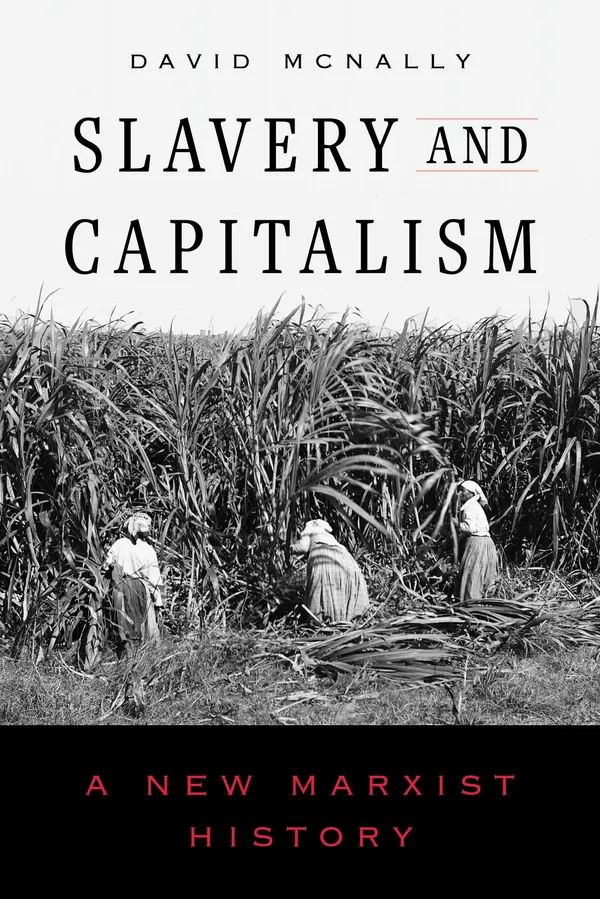
One of the most exciting US historians who embodies the best of what the US Marxist tradition has to offer is University of Houston professor David McNally. In his latest book, Slavery and Capitalism: A New Marxist History, McNally seeks to critique the essential theses of the NHC, re-introducing readers to how Marx offers the best conceptual tools with which to demystify the relationship between capitalism and slavery. Most exciting in McNally’s survey is his integration of some of the best work conducted within the Marxist-Feminist and Black Radical traditions, reframing capital as a totality whose “parts” such as race, class, and gender are less discrete parts that compete with one another and more moments through which capital reproduces itself through time and space. “Slavery and Capitalism argues that the question of the capitalist nature of New World slavery can only be resolved at the level of totality,” writes McNally, “the fundamental law of reproduction of capitalism—production and appropriation of surplus value by commodity-producing units locked in market competition—can only be adequately conceptualized in such terms. And such a system is always an organic one, undergoing internal transformations triggered by its contradictory laws of motion.”[4]
McNally situates his work as a broadside against the whole of the NHC, with its disinterest in the theory of capitalism in relation to its broader mission of understanding slavery’s role within the development of capitalism. While the NHC historians have acquired historical and economic data that has no doubt proven invaluable in measuring and quantifying the dynamics of capitalist development, their broader disinterest in capital’s “laws of motion” means that “description… [often] masquerades as analysis.”[5] When one’s analysis takes for granted the forms of capitalist society, the historian’s conclusions will remain stuck within the horizons of capital. McNally contends that the NHC tends to place more emphasis on how financial instruments within the sphere of circulation were used to buy and sell slaves than on why these instruments appear and what their purpose is within the broader totality: “the result is an account of capitalism’s ills as a story of market deception, fraud, and credit swindles. One historian working in this register has even claimed that ‘at its core, capitalism was little more than a confidence game.’”[6] The NHC historians’ aversion towards theory and the dialectical relationship between part and whole, process and totality, in favor of description is tantamount to reifying and fetishizing the categories and forms of modern capitalism.
Race vs. Class?
What distinguishes McNally’s account from the NHC is the role activity holds. Generally, because historians associated with the NHC take for granted the forms through which capital valorizes itself, the question concerning where these forms come from remains unanswered. The end of analysis is to investigate the relationships between these forms and how they influence one another and the system as a whole. Their approach is one of influence because, for McNally, these historians take these forms as self-standing, self-sufficient categories that remain static and opposed to one another even as they’re formally treated as dynamic. Within this horizon, the historian can only conclude that capitalism is a mere “confidence game” if their point of investigation begins within the sphere of circulation and leaves untouched its origin. In contrast, the categories of production, circulation, rent, and wages attain a dynamic character within McNally’s analysis because he begins from the activity that produces and renders necessary the development of these categories within the totality of which they are part. Through McNally’s analysis, the NHC’s analysis in which the slave and master are often treated as self-sufficient albeit related categories is reframed. For McNally, the slave produces not just the master and himself but the production, circulation, rent, and wages through which the master reproduces their conditions. All of these categories find their origin in the dynamic struggle over labor. Slave and master are not merely related, but constitute one another in concrete identity.
McNally uses Hegel’s master-slave dynamic to outline his methodology in the introduction:
The agency of the enslaved subject is not a preexisting attribute, but a historical and relational one, formed in action. At moments of self-assertion, writes Hegel, the bondperson, overcoming fear of the master, ‘posits himself as a negative in the order of things, and thereby becomes for himself, someone existing on his own account.’[7]
Marx takes this and arrives at the profound insight that subaltern agency arises precisely out of activity and class struggle. Human beings become agents through their self-activity.
These notions of class struggle and self-activity are crucial for how one approaches the categories of political economy: race, class, gender; land, labor, property. Often within socialist circles race and class and gender are taken as a priori categories that remain over and against one another. Yet this approach fundamentally reifies these categories and leaves its origin in labor mystified. Central to McNally’s (and Marx’s) methodology is understanding labor as the third term that mediates these categories. Throughout the seventeenth and eighteenth centuries, modern race emerged as a mode of social formation and social-discipline. The Barbados slave codes of the 1660s were adopted by Jamaica, Antigua, South Carolina, and parts of Georgia in recognition of the expanding black proletariat, a product of the staggering growth of the Atlantic plantation-complex that soon became its presupposition.[8]
To be black in the New World meant being a slave i.e. a commodity, an abstract store of labor-power divested of culture, history, and nation. To be black meant to be a member of the subaltern class whose end was production in the sugar plantations. Race and class are not two categories to be balanced, but two distinct moments mediated by the activity of labor, the struggle and control over which led to the emergence of social forms like the slave codes that facilitated the reification of race as a mode of class domination and articulation. In J. Sakai’s more colorful terms, “wising up on race only means seeing all the class issues that define race and charge it with meaning. Why should it be so hard to understand that capitalism, which practically wants to barcode our assholes, has always found it convenient to color-code its classes?”[9]
Taken this way, race is not merely a superstructure sitting upon the economic base; nor is it even a self-standing category sitting alongside and influencing class. Race and class are the vanishing moments through which capital as totality actualizes itself. To be black, to be in the fields, came to mean being a proletarian; to be a proletarian working in the fields came to mean being black. As Cedric Robinson puts it, only under capital does the Yoruban, Moor, Ethiope, and Angolan disappear in “Black” or Negro:
The Negro suggested no situatedness in time, that is history, or space, that is ethno- or politico-geography. The Negro had no civilization, no cultures, no religions, no history, no place, and finally no humanity that might command consideration… the Negro constituted a marginally human group, a collection of things of convenience for use and/or eradication.[10]
To bracket race and class from each other is to sunder the life and motion that constitutes their respective meanings.
The logic between race and class applies to gender. McNally builds on the theoretical insights of the Marxist-Feminist tradition to articulate the double oppression of enslaved women. Not only were enslaved women expected to labor just as much as men, but were expected to produce the most important commodity of all: labor-power.
Enslaved women were often paid to give birth to children who would either go on to become slaves on the plantation or sold off. As other studies have shown, bodily reproduction is crucial not just for the capital’s sphere of production but also circulation. Slaves as commodities are oriented towards the production of more commodities—whether that be sugar, cotton, or children—with the end of capital’s valorization. The class struggle then was not merely over remuneration, but over the commodification of the body i.e. the very conditions of remuneration, whether in the wage-form or otherwise. The struggle over bodily autonomy was one waged by enslaved women that didn’t just define but indeed constituted the relationship between master and slave.[11] Like race, sexuality in the plantation complex is not just one sphere that has become subordinated to the economic sphere, but rather a particular moment through which capital as totality constitutes itself in its regulation of social reproduction and labor.
In McNally we find a favorable application of Marx’s core thesis that labor is what makes the human being. Class, race, and gender are not elements to be shuffled and re-shuffled, categories whose existence precedes their relationships. To abstract “capital” beyond the particular moments through which it finds its articulation is to be left with nothing at all. To focus on how one element comes after another is to forget that the subject’s activity is what mediates these moments. What constitutes the simplicity of activity is the infinitely-layered manifold of race, class, gender, culture, and so on. All of these moments mirror back to the totality. This is why, for Marx, the political is economic and the economic political. In labor, I do not just reproduce the particular sphere which I find myself in; nor am I simply reproducing myself or my oppressor; through the simplicity of my activity, I am reproducing the whole of my society in all its fetishized forms, appearances, and moments which we take to be separate “spheres.”[12]
History as Reform or Revolution? Abolition as the Key
McNally’s centering of activity helped articulate reservations I felt towards the new crop of economic historians. There’s a sense in which even those historians most sympathetic to Marx’s thinking are writing from a “perspective from nowhere.” What unites the thousands of pages written by Marx is one single mission—the liberation of the international working-classes. Throughout his career, Marx investigated the motion of the laws of capital with the end of aiding the liberation of the oppressed. Every page of each volume of Capital is written to reveal how and why capital operates the way that it does with the end that those reading may contest and overturn the system. Marx’s analysis is only prescient because he actively recognizes and embodies the perspective from which he is critiquing—the proletariat i.e. the universal class, whose world-historic mission is the abolition of class society as such.[13]
What distinguishes the NHC’s Marx from McNally’s Marx is the reason for his focus on capital’s dynamics. For the former, Marx is a sociologist from whom one can learn a great deal about the inner-workings of capitalist society. The revolutionary ends for which he was writing can cleanly be bracketed out from his empirical discoveries. Yet for the latter, the power of Marx’s analysis lay in the revolutionary ends in which they are embedded and find their meaning. You cannot separate these revolutionary goals from his analysis. To do so is to remove the motor that powers the dynamics of his analysis. Capital is as much a manual for revolution as it is a critique of economics, history, aesthetics, and so on. To conduct a revolutionary critique means to aim for the totality; that means one need not append a moral, racial, or sexual critique to the work because already embedded within the work are the seeds for those very critiques.
Because the new historians of capitalism do not consciously grasp the perspective from which they conduct their historical critique, how these findings cash out for those of us stuck in the nightmarish present are indeterminate. The most one can hope for reading these historians is a renewed multiracial social democratic politics that aims for a more equitable distribution of our imperial gains. But for reasons beyond the scope of this essay, such a politics is both undesirable and impossible.[14] Undesirable because it leaves unanswered what becomes of the many millions of people in Africa, Asia, and South America upon whose backs a renewed imperial machine that hardens our imperial borders and reinvigorates the privileges of citizenship would fall on. And impossible because at this stage, international capital has so exhausted itself that the possibility of a new New Deal that has a sufficient amount of profit to redistribute appears remote. Here one sees how the theoretical aversion towards necessity, or at least the assumption that necessity and contingency stand over and against one another, lead to the closure of political possibility. Only in grasping the seemingly contingent as necessary, by allowing the dynamics and processes of capitalist development to unfold, can one grasp what political action is actually possible to advance the cause of transition.
This line of thought is drawn out in how these historians end their respective studies. Those studies affiliated with the NHC tend to end either by citing the adaptability of capital in overcoming its own crises or obliquely stating the parallels between our time and then. Sven Beckert ends his Empire of Cotton in the modern day, noting the decadence of various state cotton markets on government subsidization in contrast to previous forms of government regulation and “shifting recombination of various systems of labor” during global cotton’s ascendency in previous centuries. Beckert claims that one of the essential features of capitalism is “its ability to constantly adapt.”[15] Walter Johnson, who tends to have a sharper eye for the contradictory forces at the heart of antebellum plantation political economy, ends his River of Dark Dreams stating:
It should perhaps give us a moment of pause that the vision of political economy espoused by the [pro-slavery and pro-secession] filibusters and the reopeners… seems to describe our own world better than the notion to which it was opposed: the idea that ‘freedom’ is the natural and inevitable condition of mankind.[16]
It is undeniable that these surveys help us to better understand the history of the present and its past. But we only understand the present to the extent that we consciously hold in our mind the end of a socialist society towards which we’re striving. This end permeates each and every part of our study as Marxists, and orients it toward a concrete end or goal. Without such an absolute end in mind, the reader desperate to better understand the past in order to transcend the present political dead end is left to ask how this all cashes out beyond the abstract knowledge that the past informs the present. We default to a left-progressivism that leaves us where we started.
Contrast that with McNally, who ends his historical study of transatlantic slavery connecting Marx’s radicalism with his demand for abolition. McNally notes that what distinguishes Marx’s approach to the US Civil War and slavery wasn’t the prescience of his economic analyses, but its “revolutionary abolitionism” that early on placed him in a very small minority within not only the European and US world, but even among his fellow socialists, themselves already a minority.[17] Marx had the radical vision that allowed him to understand far earlier than his fellow socialists that if labor was to fully emancipate itself it must mount its cause on the death of slavery. Abolition wasn’t just morally right, but politically necessary. McNally cites Marx’s famous passage from the pivotal chapter “The Working Day” in Capital Volume One: “Labour in the white skin cannot emancipate itself where it is branded in a black skin. However, a new life arose immediately from the death of slavery. The first fruit of the American Civil War was the eight hours agitation.”[18]
By McNally’s estimation, Marx’s crucial realization in his late career during the 1860s and 1870s was that “slave movements and anticolonial revolts” could and did ignite firestorms of rebellion against the international capitalist system. Marx sided with the North against the South, seeing the South as the ally of counterrevolution everywhere and the number one enemy of “insurgent labor” everywhere. Marx went on to incorporate his insights gathered from the Civil War to advance a greater emphasis on the colonial struggle in Ireland, which he thought was “a prerequisite of the liberation of the working class in England, just as Black emancipation was for white workers in the United States.”[19] McNally approvingly cites the work of Kevin Anderson, whose scholarship on the late-Marx’s growing appreciation for the anticolonial struggles in China and India have piqued the interest of anti-imperial activists.[20]
McNally’s work on slavery’s past informs slavery’s present. The more privileged strata of today’s oppressed can only free themselves when they free those most marginalized and targeted by the state: the undocumented, the incarcerated, gay and trans people. In a period of ascendent fascism—where ICE terrorizes and abducts subaltern populations, the prison industrial-complex has never been more prosperous, both sides of the political aisle are signing onto crack down both at home and abroad—historical works like McNally’s have never been more necessary. The demand for abolition and an explicitly revolutionary end for historical inquiry grounds his critique of the NHC: “Histories of slavery and capitalism built largely on stockpiling economic data can do important work, but obsessive quantification tends to mute the groans and cries of human suffering—and thus to evade the idiom of horror.”[21]
McNally’s work gives the US Left (or what may qualify for one) a clear, concrete demand: to center abolition in its political program. The proletariat will remain unfree until every prisoner’s cell doors swing open, every undocumented immigrant is freed, and all weapons of the state used to terrify the oppressed into submission are surrendered.
Easier said than done, of course. There exists tremendous pressures both from within and without the political Left to sacrifice opposition to imperialism, genocide, and policing for “bread and butter” issues.[22] These calls for “realism” come from those quarters of the Left that see the hallmark of success as getting socialist candidates elected into office. Many socialists fear that by emphasizing our opposition to the violence of the US state and advocating for the nearly two million incarcerated that we will scare off voters, that we will be called unserious or unrealistic. We must face down these fears. The goal of the socialist movement is not to chase down a constituency, but to make the constituency. The mission must be one that centers worker self-activity, helping the millions of oppressed workers inside and outside the nation-state that they are the ones who make society. The end of the socialist movement is not to win in the society of enslavement, but to build the just society already latent, struggling to be born.
McNally’s study in its immediate appearance is a historical survey on how slavery and capital have grown together as understood within the Marxist framework. But at its core it is a work about historical honesty. We must be honest about why we continue to gaze into the evils that came before us and remain with us. To say that we collect the economic data and tour the historical archives only because we wish to furnish a disinterested view of the facts or to show how the past is related to the present falls short of the implicitly radical aim of scientific history. To posit a logic that grounds the past and present in the self-activity and labor of humanity is to already go beyond the immediate appearance of the facts. The NHC historians would doubtless assent to the radical claim history makes. Yet the political indeterminacy their work tends towards reflects their aversion to taking capitalism seriously as a necessary totality demanding transcendence. McNally’s bracing work is a call for the historian to heed. It is a call to be honest that the society which we labor for must be far larger and greater than the implementation of this or that progressive program on the level of the nation-state. Prosperity grounded in oppression no matter how far away is an untrue prosperity. The suffering capital inflicts is global; thereby the socialist movement that transcends and counters capital must be so as well.
In the epilogue of his book, McNally asserts our responsibility to do justice to the ghosts of the past by honoring their cry for repair. The responsibility the socialist holds is one that “names crimes and depicts sufferings..and captures aspirations for freedom—subterranean and overt—that have yet to be realized.”[23] The temptation of the US socialist is to avert one’s eyes from the horrors of the past and present and default to a politics of electoral reform. Electoral reform is no doubt a necessary moment, but only just that, a moment. The progressive historian undermines their work when they chalk up the many millions made dead by capital to historical contingency, rather than the necessary workings of a monstrous globe-spanning machine whose rapacious hunger has only grown despite the many millions its already feasted upon and continues to feast on. Only when the historian seeks to grasp the necessary processes undergirding capitalism’s historical development may they discover a political horizon that goes beyond the present moment.
Liked it? Take a second to support Cosmonaut on Patreon! At Cosmonaut Magazine we strive to create a culture of open debate and discussion. Please write to us at submissions@cosmonautmag.com if you have any criticism or commentary you would like to have published in our letters section.
-
Sven Beckert and Seth Rockman, eds., Slavery’s Capitalism: A New History of American Economic Development (University of Pennsylvania Press, 2016), 9.
↩ -
Richard Hunsinger, “A Black Reconstruction: Readings on the Capitalism and Slavery Debate: New History of Capitalism, Nick Nesbitt, and Denise Ferreira da Silva,” a single hail from below (Substack), 2025, https://richardhunsinger.substack.com/p/a-black-reconstruction-readings-on.
↩ -
G. W. F. Hegel, The Encyclopaedia Logic: Part I of the Encyclopaedia of the Philosophical Sciences with the Zusätze, trans. T. F. Geraets, W. A. Suchting, and H. S. Harris (Cambridge University Press, 1991), 214.
↩ -
David McNally, Slavery and Capitalism: A New Marxist History (University of California Press, 2025), 8.
↩ -
Ibid, 7.
↩ -
Ibid, 9.
↩ -
Ibid, 3-4.
↩ -
Ibid, 85.
↩ -
J. Sakai, "When Race Burns Class: Settlers Revisited (An Interview with J. Sakai)," https://kersplebedeb.com/posts/raceburn/.
↩ -
Cedric J. Robinson, Black Marxism: The Making of the Black Radical Tradition (University of North Carolina Press, 2021), 81.
↩ -
McNally, 131-133.
↩ -
McNally has written an excellent critique of the intersectional approach. See: David McNally, “Dialectics and Intersectionality: Critical Reconstructions in Social Reproduction Theory,” in Social Reproduction Theory: Remapping Class, Recentering Oppression, ed. Tithi Bhattacharya (Pluto Press, 2017), 94-111.
↩ -
Karl Marx and Friedrich Engels, The Marx-Engels Reader, ed. Robert C. Tucker (W. W. Norton, 1978), 193.
↩ -
The work that addresses both questions which remains one of the most expansive of its kind is István Mészáros’s Beyond Capital: Toward a Theory of Transition.
↩ -
Sven Beckert, Empire of Cotton: A Global History (Alfred A. Knopf, 2014), 440-442.
↩ -
Walter Johnson, River of Dark Dreams: Slavery and Empire in the Cotton Kingdom (Harvard University Press, 2013), 420.
↩ -
McNally, 234.
↩ -
Ibid, 239.
↩ -
Ibid, 243.
↩ -
See Kevin Anderson’s The Late Marx's Revolutionary Roads: Colonialism, Gender, and Indigenous Communism.
↩ -
McNally, 246.
↩ -
Richard Hunsinger and X. Rivera Maya, “Public Safety or Self-Defense?,” Negation Magazine, September 2025, https://www.negationmag.com/articles/public-safety-self-defense
↩ -
McNally, 247.
↩