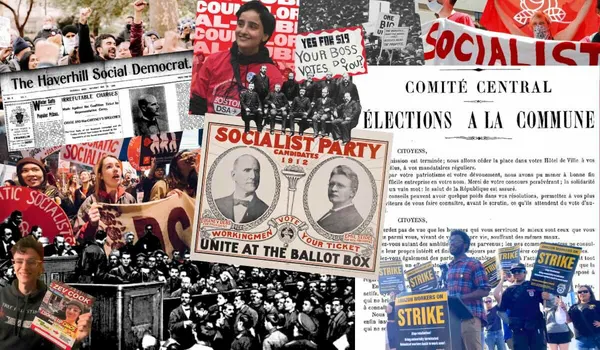
Central Mass & Worcester DSA recently considered and ratified two documents, a resolution on “Principles for Socialist Electoral Work” and a chapter bylaws amendment establishing an Electoral Policy. Together these will govern the chapter’s engagement with electoral work, both campaigning and parliamentary practice.
Our DSA chapter covers Central Massachusetts and is centered on the city of Worcester. The chapter is bordered to the east by Boston DSA, to the west by River Valley, to the south by Connecticut and Rhode Island, and to the north by Southern New Hampshire DSA. We organize in a particularly proletarian part of New England with a history of a vibrant and varied industry built around manufacturing, in particular the metal trades in Worcester, paper in Fitchburg, furniture in Gardner, plastics in Leominster, and optics in Southbridge. Economic restructuring and the decline in industrial production in the Northeast has made education, healthcare, and local government the largest employers in Worcester County in recent years, followed by finance, biotechnology, and transportation and logistics. The eastern part of our chapter, centered around Marlborough, is part of the MetroWest area’s economy and focused on technology. While Worcester was historically a hostile environment for unions, the union density is currently above the national average, at around 12.6%. Politically, the state and region are dominated by the Democratic Party, which, while at times paying lip service to demands for progressive reforms, serves only the capitalist class. Of the seventeen state house districts entirely within our chapter’s area, eleven are held by Democrats and six by Republicans, who are sidelined and irrelevant in state politics.
Our chapter has a long-standing commitment to labor work, in particular salting and strike support. Over the last year, we took initial steps into tenant organizing by focusing on a large local building complex, where we are organizing tenants to struggle against the landlord with the goal of forming a tenants union. Our political education work has also deepened, in particular with a six-part Foundational Marxist Curriculum that was very well attended by our chapter members.
The chapter emphasizes collective decision-making by the entire membership, combining active deliberative democracy with a centralized approach that favors steering committee-led committees over autonomous working groups. While very few of our chapter’s members are caucused, most of the active membership and chapter leadership consider themselves revolutionary Marxists of various stripes. Many are members of Red Line, a broad left-wing coalition that includes caucused and uncaucused members across several DSA chapters in New England. Red Line’s points of unity are principled electoral work, socialist organizing in the labor movement, and a strong commitment to member democracy in a multi-tendency DSA. After increasing our membership roughly 20% in the six months prior to election day in 2024 and by another roughly 80% in the year since, we have begun to transition out of being a small chapter. Now, while not neglecting other organizing, we are preparing to enter into electoral work and hope our perspective may be of interest to other chapters developing their own approach to this work.
Our Proposal
The Principles orient our electoral work, by developing a vision and a common understanding of the entire chapter. They describe in brief our understanding of the nature and limits of democracy under capitalism, the specific purpose of socialist electoral work, and the opportunity it presents. They lay out our intent to run agitational campaigns for seats in legislative bodies at the state and municipal levels. Our candidates—nominated to run, not endorsed after the fact—will stand for election on socialist platforms that build on the chapter’s political program and that are developed and democratically approved by our membership.
Where the Principles provide the guiding philosophy, the Electoral Policy provides the minutiae of the necessary processes. It lays out how we will put our Principles into practice, combining our general understanding of socialist electoral work with strategic and tactical conclusions derived for the specifics of our chapter. It codifies:
- criteria for district and target research, such as class composition and other demographic information and opportunities to run a slate of candidates together;
- a process for member ratification of our nominated candidates and drafting socialist platforms for each body we contest that build on the chapter’s political program;
- considerations for suitable potential candidates, that they be active and experienced members, politically educated, in agreement with our theory of change, and committed to building and promoting DSA as their political home, and will not unilaterally make endorsements of other candidates or receive contributions to a candidate’s committee;
- expectations of elected officials, including not keeping more than a median workers’ income, not caucusing with non-socialists, and not taking a “position or vote for funding of or support for US militarism or imperialism, the Zionist apartheid regime, policing or the US criminal-legal system generally, any associated lobbying or interest groups, or rollback of the rights of oppressed peoples and workers, including any restriction of workers’ self-organization, strikes, boycotts, or other workers’ collective action”; and
- a process for independently organizing around ballot questions, provided it is with a socialist message that advances our political work, program, and organization;
- structures to implement the above, including a Program Committee that houses platform committees for each body on which we have elected officials and that coordinates with them, as well as a firewalled Electoral Committee that houses a related independent expenditure political action committee (IE PAC) that will raise funds, hire staff, order print literature, and run all canvasses and other campaign activities in support of the election of our nominated candidates, while avoiding when reasonably possible the use of services, including VoteBuilder and ActBlue, effectively controlled by another political party or whose use benefits another party, in favor of alternatives.
We did not develop a general position on ballot lines and contented ourselves to clarify what they mean for the electoral work, municipal and state legislative, that is possible exclusively within the geographic jurisdiction of our chapter. Debate, however, showed that most of us reject an overly narrow approach. Having their own ballot line did not insulate the Socialist Party of America (SPA) from the pressures of opportunism, and use of another party’s ballot line does not take all agency from candidates and doom them to opportunism and instant failure. But nor is running in another party’s primary a victimless crime—it hinders our ability to build an independent profile and present ourselves as the alternative to the capitalist two-party system. It might also foster misunderstandings or illusions outside our organization—or even within it—namely that our political project is to remake one of the capitalist parties into a socialist party by and for the working class.
Ultimately, with nonpartisan municipal elections in our state, we see no reason to run municipal candidates registered with another party. Likewise, state legislative primaries here offer nothing comparable to the widely broadcast debates or other early media coverage of primaries for higher offices. Thus, we see no great benefit to limiting the reach of our state legislative campaigns to those workers who turn out for (or who we can motivate to turn out for) another party’s primaries.
We see our stance on ballot lines as being distinct from that adopted by much of the rest of DSA. Resolution 7, which passed with roughly 54% support at 2025 DSA National Convention, says that formally “DSA’s approach is the party surrogate, acting as a party but without a dedicated ballot line.” Reflecting the popular fixation, since Seth Ackerman’s 2016 article, on legal obstacles to a party of our own with its own ballot line, R7 dedicates two of its five whereas clauses and three of its ten namesake “Principles for Party-Building” to justifying this claimed agnostic stance on ballot lines. For many years now, of course, DSA chapters engaged in electoral work have actually dedicated themselves in their practical activity almost exclusively to supporting candidates who have decided to run in Democratic Party primaries or registered Democrats running their campaigns with Democratic Party tech tools in nonpartisan races. We break from this “dirty stay” approach of “using existing [Democratic Party] apparatus without necessarily seeking to transform [realign] the Democratic Party… [and simultaneously] avoiding or at least not taking necessary steps to build a new socialist party.” Instead we put forward a different electoral approach set by our members that focuses on an electoral strategy and organization defined by the chapter itself rather than by candidates and their campaigns. It is therefore our intention to run our municipal and state legislative candidates in general elections as independents (or what is called “unenrolled” in Massachusetts).
Our Strategy
There are four main ways in which we believe our approach is unique within DSA:
(1) We focus our campaigns on promoting socialism, DSA, and our chapter, rather than on winning seats
Tactics must be subservient to guiding principles and not the other way around. We stress that electoral work is a tool for political aims: our primary goal is not to win offices but to spread socialism and further the political independence of the working class. DSA should not be listed as one of many endorsements or buried in the small print of a “Paid for by” line; our candidates must run as proud socialists and DSA members first, nominated by our chapter, running under a common brand, focused on organizing the working class, and distinct from left liberals who campaign only on reforms.
We aim to use agitation and political indictments not only to stir indignation but to promote a socialist understanding by connecting capitalism to the concrete, everyday abuses, outrages, and concerns of workers; exposing misdirection and deception by bourgeois parties and the ways legislation and the state serve particular economic interests; and highlighting and broadening local conflicts, struggles, strikes, and protests. We aim not only to draw attention to these issues or provide theoretical insights but to earn workers’ support by providing the most energetic and effective political leadership as the most determined fighters for the class.
(2) We choose candidates as representatives of the program we put forward as a chapter, rather than endorsing candidates who have already decided to run
Starting from the idea that Worcester DSA should recruit candidates rather than candidates recruiting Worcester DSA, we dispense with questionnaires on candidates’ individual views and the whole customary chapter endorsement process. This process often not only tails candidates who have already made up their minds on running and fosters an individualistic philosophy of elections but leads to a consecutive lowering of standards, toward embracing those who are more or less radical liberals as somehow “better” than (i.e., not yet so corrupted as) the establishment Democratic Party candidates, which may initially be true to an extent but is not sufficient for socialist electoral work.
Instead of attempting to patch over this problem through the common formulation of “running more cadre candidates” (in fact, changing essentially nothing other than endorsed candidates’ level of involvement in DSA), we democratically develop a socialist platform for each elected body we intend to contest and then democratically select experienced members of our chapter to stand as representatives of that platform. Collective decision-making on collective action is a core part of our project as organized socialists in DSA. We make clear that to decide to run for public elected office without the nomination of the chapter is a rejection of what makes us a socialist organization instead of a federation of well-meaning individual activists.
(3) We run our own campaigns under the effective control of the chapter, rather than acting as a volunteer pool or donor list for candidates
We overcome some constraints of state laws that frustrate the efforts of organized groups to hold politicians accountable through a related IE PAC, which will almost entirely take the place of the fundraising and spending that candidates themselves would normally control. By establishing an IE PAC under a chapter Electoral Committee that is firewalled from the rest of the chapter, especially the Program Committee that actually interacts with candidates and electeds, we aim to keep campaign funds and decisions under chapter, not candidate, control—during and after campaigns and even if a politician breaks from us or our members decide to break from them.
(4) We develop our priorities and plans as part of the chapter, rather than commending or denouncing candidates’ votes after the fact
We understand that for our democratic decision-making to mean something, to have real stakes, all members must make a good-faith effort to carry out collective decisions on collective action, and we expect an even higher standard of our candidates and elected officials. To that end, we established a Program Committee, which implements the chapter political program and the platform on which candidates run. Under the Program Committee, we also created a framework for platform committees for each body we contest that will include our elected officials. Working bodies in the spirit of the Paris Commune, these committees will be accountable to the membership and will perform delegated daily work in relation to legislation and other political activities.
Theoretical and Historical Investigation
When considering our electoral work, we did not immediately jump to seeking candidates to endorse but started with a discussion of our goals and how best to achieve them. In the plainest terms, our goals are socialism and building a socialist movement capable of contesting for working-class power. Our approach is driven by these overarching goals, and we see participation in electoral work as providing valuable opportunities that must not be surrendered. Electoral strategies are not ends in themselves or tools for temporary electoral or policy gains. They are subordinate to higher, political aims. For this reason, we intend to run working class representatives from and of DSA to:
- reach large numbers of working class people with our socialist message;
- combat ruling class narratives and make the case against capitalism and for socialism;
- advance and lead struggles to raise class consciousness and challenge the existing system;
- recruit to our organization, grow our capacity, and develop cadre; and
- organize a mass base in the working class for socialism, as well as a mass party that fights for it.
We studied past writings and classic works on the foundations of the bourgeois state, politics, and socialist engagement with elections, relying on texts such as:
- Marx, Karl and Friedrich Engels. “Address of the Central Authority to the League, March 1850.” In Marx/Engels Collected Works, vol. 10, 277-287. Lawrence & Wishart, 1978.
- Varlin, Eugène, et al. “Appel du comité central de la garde nationale le 25 mars 1871” [Appeal of the Central Committee of the National Guard of March 25, 1871]. Gallica. https://gallica.bnf.fr/ark:/12148/bpt6k112793c/f109.item. Facsimile of the appeal as published in Élections Des 26 Mars Et 16 Avril 1871: Affiches, Professions De Foi, Documents Officiels, Clubs Et Comités Pendant La Commune, 107-108 (1871).
- Engels, Friedrich. “Introduction to Karl Marx’s The Class Struggles in France, 1848 to 1850 (1895).” In Marx/Engels Collected Works, vol. 27, 506-524. Lawrence & Wishart, 1990.
- Luxemburg, Rosa. “Reform or Revolution.” In The Essential Rosa Luxemburg, pp. 41-104. Haymarket Books, 2008.
- Lenin, V.I. “Preface to the Russian Translation of W. Liebknecht’s Pamphlet: No Compromises, No Electoral Agreements.” In Lenin Collected Works, vol. 11, 401-407. Moscow: Progress Publishers, 1962.
- Debs, Eugene V. “Danger Ahead.” In Writings and Speeches of Eugene V. Debs, pp. 333-336. Hermitage Press, 1948. Transcription of the article as originally published in International Socialist Review (1911).
- Lenin, V.I. “The Election Campaign and the Election Platform.” In Lenin Collected Works, vol. 17, pp. 278-286. Progress Publishers, 1968.
- Lippmann, Walter. “On Municipal Socialism, 1913: An Analysis of Problems and Strategies.” In Socialism and the Cities, edited by Bruce Stave, 184-96. Kennikat Press, 1975.
- Lenin, V.I. “The State and Revolution.” In Lenin Collected Works, vol. 25, 381-492. Moscow: Progress Publishers, 1964.
- Lenin, V.I. “Several Conclusions” in “‘Left-Wing’ Communism: an Infantile Disorder.” In Lenin Collected Works, vol. 31, 90-104. Progress Publishers, 1966.
- Badayev, A. The Bolsheviks in the Tsarist Duma. Martin Lawrence, 1929.
We believe it is important too to review the history of past socialist electoral work, including, in this country, the swift rise and fall of the Social Democratic Party in Haverhill in our own state, the presidential runs of Eugene Debs, the nearly 40 years of Socialist Party mayors in Milwaukee, and the pressures to liquidate politically into a left wing of the campaigns of William Jennings Bryan, Robert M. La Follette, and Franklin D. Roosevelt.
What is the scoreboard here for socialism? With hindsight and thought toward our own future efforts, we arrive at a sober assessment of the inherent limits of elections as a means to transform society in general and of certain electoral tactics in particular. We believe socialists are at their best when they connect electoral campaigns and legislative activity to organizing and mobilization outside the halls of government. Socialists should engage in struggles for reforms to build toward a socialist party and workers’ movement that can seize political power for the working class and carry out the democratic socialization of ownership of the means of production.
Unfortunately, however, tactics have often seemingly been driven by a singular focus on seeking reforms within capitalism as an end in itself, often under the influence of middle-class professionals or in systematic class collaboration with petty bourgeois elements. This vulgar electoralism that sees seats as synonymous with political power, reforms as the purpose of it, and electoral maneuvering as the key to achieving both is rooted in the failure to accept that reforms are a product of class forces and class struggle. Historically, instances of this seem to have eventually led non-socialist reform-minded voters, and then socialists themselves, away from an earlier, admittedly quite narrow, interest in socialists winning elections and toward merely working to support and sway capitalist politicians and parties. After enough electoral victories subsequently give way to the absorption of popular reform planks into capitalist reform politics, this is a path that can only culminate in the disintegration of the organized socialist movement into reform-minded pressure groups.
We drew historical information of value on these challenges and on the electoral project of the Socialist Party and early Communist Party from books such as:
- Bedford, Henry F. Socialism and the Workers in Massachusetts, 1886-1912. The University of Massachusetts Press, 1966.
- Kipnis, Ira. American Socialist Movement, 1897-1912. Haymarket Books, (1952) 2005.
- Zumoff, Jacob A. The Communist International and US Communism, 1919-1929. Haymarket Books, (2014) 2015.
- Stave, Bruce M. Socialism and the Cities. Kennikat Press, 1975.
To engage the chapter’s members in the process of deciding our electoral strategy and to provide them with a broad theoretical and historical understanding of this topic, our Political Education Committee in turn ran:
- a five-part reading group in advance of 2025 DSA National Convention that extensively covered electoral debates leading up to and during the first decade of the SPA;
- a 30-minute political education session at our chapter’s September General Meeting on the early U.S. socialist movement and debates over the value of political action;
- a 90-minute stand-alone presentation and discussion in November on the Marxist theory of the state, focused on the modern state as a product of capitalism and its role as an instrument of the bourgeoisie and making central the point that the bourgeois state apparatus cannot just be captured by the working class but has to be smashed; and
- another 90-minute stand-alone presentation and discussion in early December on political struggle and party-building, focused especially on understanding the phrase from the Communist Manifesto that “every class struggle is a political struggle.”
These political education events were each attended by roughly 10-15% of our membership.
Practical investigation
We also investigated and evaluated the electoral work of other DSA chapters, not only through theoretical engagement but actual participation. Besides North Jersey DSA, who we joined remotely for some virtual phone banks in Jersey City, NJ, we appreciate members from the following chapters who hosted or met with us when we sent out travel contingents to join canvasses, mostly for candidates but also a ballot-question campaign endorsed by other chapters in the Northeast:
- Boston DSA in Somerville, MA
- Connecticut DSA in Hamden, CT
- Maine DSA in Portland, ME
- NYC-DSA in New York, NY
- Rhode Island DSA in Providence, RI
- River Valley DSA in Agawam and Amherst, MA
Making an effort to seriously reflect and have our takeaways inform our approach, these electoral treks were followed by extensive debriefs, reports, and further discussion at meetings of our chapter’s Political Committee, an already existing committee which was charged with organizing members for general political action outside of tenant and labor work. We focused on how chapters were interacting with candidates’ campaigns and how the campaign literature presented candidates, as well as DSA and socialism (if at all). We asked what purpose DSA members saw in their chapters’ electoral work and in their engagement with each particular campaign, where we were being sent to knock doors in, and which voter strata were reached or (if shared with us) targeted. We learned where volunteers came from, their background, and what volunteers were told before launching each canvass. In short, while the treks offered a chance to train more of our members and expose them to the logistics of campaign operations, we took greatest interest in the political character of the technical aspects of each campaign and the decisions made by candidates and chapters about how to run them. Nearly 10% of our membership signed up for an electoral trek in the course of our investigation.
We also benefited from and are grateful to Austin, Cleveland, Green Mountain, New Orleans, River Valley, Tacoma, Twin Cities, and many other DSA chapters, from which either current or past candidates or chapter leaders dedicated significant time talking with members of our chapter about their electoral work or who hosted observers from our chapter at electoral or general meetings that considered endorsements or report backs on electoral work. We especially appreciated opportunities to learn about Boston DSA’s endorsement process and socialists in office committees, Buffalo DSA’s difficulties after India Walton’s defeat, Chicago DSA’s Socialists in Office Committee, Bob Murrell’s independent campaign for New Orleans City Council, NYC-DSA’s endorsement process and electoral working group structure, Pittsburgh DSA’s political action committee and challenges to their ballot question work, Seattle DSA’s ballot question work and electoral strategy reading group, and Zev Cook’s campaign for Tacoma City Council.
Drafting, Ratification, and Beyond
Based on our investigation and starting from broad agreement on purpose but with real deliberation about the best ways to achieve it, a mix of both new and long-standing members spent a total of nearly twenty hours in regular meetings over the past several months debating and drafting our “Principles for Socialist Electoral Work” and Electoral Policy. Our members ratified the Principles overwhelmingly—50 to 2—in a live vote at our October General Meeting, and the Electoral Policy was ratified unanimously at our October and November General Meetings. Both General Meetings had the participation of nearly 20% of our chapter membership.
More than simply offering critiques of the work of others, our goal has been to integrate lessons from elsewhere and the past to actively contribute our own efforts toward building an alternative model of socialist electoral work here and in the present. We believe this Worcester model—principled, programmatic, and partyist—builds on classical approaches to electoral work and meaningfully breaks from the current orthodoxy in DSA.
Starting from our Principles and Electoral Policy, the same members who drafted these proposals compiled a wide selection of other socialist party programs, past and present, as well as relevant information and statistics on all districts our chapter touches. The information gathered includes the poverty rate, median household income, owner-occupancy rate, educational attainment, age and racial demographics, population density, and the DSA member density of each legislative district and each municipality with representative forms of elected local government.
We then prepared an initial draft of an electoral work plan and a program, collaboratively editing and developing them through line-by-line review and discussions across five meetings in the span of an intensive period of two and a half weeks. Our minutes show that these meetings totaled just over ten hours. Both drafts were finalized in time for the submission deadline for our Local Convention in December, with the draft program submitted through a standalone resolution and the draft electoral work plan incorporated by our chapter’s Steering Committee into their consensus draft of the proposed Tasks for 2026. The Tasks are part of the Reflections, Analysis, and Tasks (RAT) document, which is the result of an existing annual process by which our membership collectively debates and decides on chapter work for the year ahead. This was followed by two weeks of member review and amendment drafting, during which time one amendment to the draft electoral work plan and three amendments to the draft program’s demands were submitted, as well as further amendments to these amendments. At the Convention itself, we debated and unanimously approved our chapter’s first plans for electoral work and our first chapter political program as amended.
There was some debate over whether we should seek to run candidates in 2026, but we decided to ease into this by first further developing our members’ campaign skills and our own apparatus for electoral campaign work. Our plans for 2026 are therefore to critically support an expected statewide ballot question that would cap, with quite generous exceptions, rent increases at the inflation rate. We will complement this with our own public policy question, put forward in a handful of targeted working-class state house districts in which we hope to grow our membership and organization. The language, as amended at our local convention, would instruct state representatives to support a universal right to publicly-owned housing, to be met by new construction and renovations funded by taxes on vacant properties, short-term rentals, mansions, and wealth and inheritances exceeding $5 million. Though legally non-binding, we believe simultaneously offering our question will better allow us to put forward our own alternative, socialist vision for housing and polarize on class lines.
We, of course, have no expectation of easy victories in any of our electoral endeavors and are cognizant that our work is very much in its beginnings. Our approach is slow and deliberate, and we know it will take years until the actual implementation will show its practical strengths and weaknesses. On the basis of what is set out in our Principles and Electoral Policy, we hope our work will eventually be able to stand on its own feet and speak for itself. But in the spirit of comradely discussion and as part of a culture of healthy strategic debate in the country’s largest socialist organization, we share now this perspective and invite feedback.
Liked it? Take a second to support Cosmonaut on Patreon! At Cosmonaut Magazine we strive to create a culture of open debate and discussion. Please write to us at submissions@cosmonautmag.com if you have any criticism or commentary you would like to have published in our letters section.