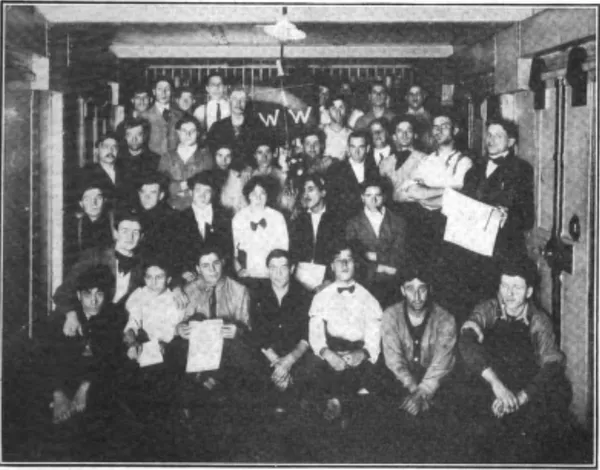
It’s always a tragedy when someone who has dedicated time to fighting for socialism and the advancement of the working-class falls into reactionary ideals. Throughout history there have been instances of devoted socialists, communists, and anarchists betraying the fight against capitalism and fascism. Jay Lovestone is one example. In his opposition to the Communist Party USA (CPUSA), Lovestone eventually found himself working for the CIA, sabotaging left-wing labor unions and other communist/socialist movements around the globe through the AFL-CIO.[1] Neoconservative commentator David Horowitz is another. Horowitz considered himself a leftist for nearly two decades before his politics drastically shifted in the mid-1970s.[2] A largely forgotten, but pertinent historical example of this phenomenon is that of Filippo Boccini.[3] Once an anarchist and an organizer for the Industrial Workers of the World (IWW), Bocchini fell into a pit of reactionary ideals as a result of the aftermath of the Little Falls, NY Textile Strike of 1912-1913, along with the larger geopolitics of the mid-to-late 1910s.
An immigrant to the US, Bocchini was born in Onano, in the Viterbo region of Italy, in February of 1887. He initially trained for a life of the cloth before attempting to join Italy’s paramilitary police before finally landing in the Army Sanitary Corps. Eventually, Bocchini developed a political affinity for anarchism. In 1911, he journeyed to the United States, staying primarily in Philadelphia, Pennsylvania.[4] His anarchist ideals were solidified in conjunction with the beginning of the Italo-Turkish War in late-1911, which Bocchini wholly opposed. Bocchini later found himself involved with the efforts of IWW, though according to historian Stefano Luconi he was never a card-carrying member of the Union.[5] While looking for a job in Rochester, New York, Bocchini learned of a textile strike in Little Falls, New York, likely after seeing a story about it in an IWW publication.
The Little Falls Textile Strike began as a result of legislation passed in response to the Triangle Shirtwaist Factory fire, which limited the work week for women and children in various industries from sixty-hours a week to fifty-four. When the mainly immigrant women who worked in two of the city’s textile mills found their pay reduced, in spite of the fact that wages in these mills were already subpar, they responded by initiating a walkout on October 9, 1912. The walkout quickly developed into a full blown strike.[6] The strike received support from the Schenectady, New York branch of the Socialist Party and, soon after, the Wobblies.[7]
Though not an official member of the IWW, Bocchini traveled to Little Falls to aid in organizing the strike effort.[8] After weeks of meddling and provocation, the Little Falls police attacked strikers outside the mills and, soon after, raided the strike headquarters on October 30. Multiple strikers and two police officers were injured. Several of the strikers were arrested, including Filippo Bocchini, who was charged with assault for allegedly shooting one of the officers and inciting a riot, likely due to his status as a “dangerous immigrant.”[9] Bocchini and others who were arrested sat in the Little Falls jail for months before being given a proper trial, with Bocchini’s own trial not officially commencing until March 1913.[10] After four months of questioning and deliberation, and attempts at appeals, Bocchini was found guilty. In July, he was sentenced to one year and three months of hard labor in Auburn Prison, an infamously brutal maximum-security prison in Auburn, New York.[11] This is where Bocchini’s political decline began.
Despite numerous campaigns organized by the IWW both during and after the strike calling for solidarity with the incarcerated, Bocchini left prison with a chip on his shoulder and a hostility toward the workers of Little Falls.[12] He reportedly felt betrayed by the Slovakian and Polish workers involved in the strike. This feeling of betrayal came from, according to Luconi’s research, a combination of said ethnic groups (with the help of the union) having reached a settlement and effectively ending the strike, as well as a perceived lack of solidarity between ethnic groups. The Italian anarchist publication Cronaca Sovversiva further solidified this understanding, claiming that Bocchini was imprisoned because of the “indifference, passiveness, and apathy of the proletariat that allowed and encourage his prosecution.”[13] Upon his release from prison in July 1914, Bocchini returned to Philadelphia to continue the anarchist cause with a fiery and sectarian passion, going so far as to claim that anarchists were “the only true enemies of the liberal-bourgeois order.”[14] Bocchini’s political fervor soon devolved and his anarchist anti-capitalism began to transform into more reactionary tendencies, fueled by his anger with the Slovak, Polish, and other groups of non-Italian ethnic workers from the Little Falls Strike.
With the advent of the First World War, Bocchini began to develop a nationalistic tendency in his worldview. This, however, was not uncommon within the Italian diaspora in the United States, even before the First World War. Its advent was the previously mentioned Italo-Turkish War of 1911. The war produced ideological schisms within the community regarding Italy’s geopolitical position. Historian Philip A. Bean, for example, uses the conditions of the Italian and Italian-American enclaves of Utica, New York to explore the divide on whether or not Italy was justified in seizing Libya in the Battle of Tripoli, citing how some in the diaspora viewed war, overall, as “banditry,” while others considered Italy’s annexation justified due to the country’s own historical hardships as a “proletarian nation.”[15] The First World War created similar splits, although at least based on certain sources, nationalistic attitudes prevailed and even many who considered themselves to be left-wing, socialists, and the like, advocated for war against Austria and for Italian intervention.[16] For many, succumbing to this nationalist fervor was merely the first step toward adopting full-blown Fascism. Bocchini was one of many to fall into that reactionary pit. Luconi aptly describes Bocchini’s practices after embracing fascism:
Bocchini made a similar political journey from nationalism to fascism. He joined the fascio of Philadelphia, which was established in 1921, and, after moving temporarily to Scranton in 1928, he began to contribute pro-Fascist articles to Voce Italiana [the Italian Voice], a local Italian-language newspaper. Once Bocchini was back to Philadelphia in January 1929 and got a job with the editorial staff of L’Opinione, then the only Italian-American daily in Pennsylvania after La Voce de Popolo had ceased publication in 1917, he continued to support the Italian Fascist regime in his new post, on the admission of the Italian authorities themselves.[17]
Beyond his contributions to various newspapers, Bocchini was featured on the Philadelphia radio station WRAX at various points from the early 1920s up to at least 1933.[18] He also found himself involved with the Khaki Shirts, one of many Fascist organizations in the United States that emulated the Blackshirts in Fascist Italy and the Brownshirts in Nazi Germany, in addition to the “Star Shirts of America,” an offshoot of the Khakis, through which he was involved in at least one clash with anti-fascists in Hammonton, New Jersey, not too far from Philadelphia.[19]
Bocchini’s Fascist tendencies reached an apex when, in 1934, he ran for the Pennsylvania State House of Representatives on the ticket of the Fascist Party of Pennsylvania, of which he was the founder. Similar to the Nazis, Bocchini’s platform coopted left-wing rhetoric and ideals, this time with the purpose and goal of adapting the Fascist corporatism of Mussolini to Pennsylvanian conditions. In line with the ideals that some had concerning similarities between the New Deal and Mussolini’s corporatism, Bocchini urged his fellow Italians to become United States citizens so that they may have a direct say in the political proceedings of the country, for the primary purpose of improving relations between the US and Fascist Italy, a sentiment initially adopted by the Italian Fascist government itself. Bocchini’s campaign for the Pennsylvania House was ultimately unsuccessful.[20]
Not much else is known publicly about Filippo Bocchini. Though there are archives that likely have information on his later life, as can be found cited in some of Luconi’s work, Bocchini’s presence, at least based on publications released thus far, fades after his 1934 electoral failure.[21] Without a deep dive into the archives, it’s nearly impossible to discover if Bocchini remained on the Fascist path during the Second World War or if he eventually left that faction. Nonetheless, Bocchini’s shift from a union-supporting, Wobbly-adjacent anarchist to Fascism by way of nationalism serves as a warning against succumbing to reactionary ideals and rhetoric.
Bocchini’s dissatisfaction and disenchantment with these other radical groups represents a pattern of disillusionment with US radical movements that Italian and Italian-American left-wingers dealt with, according to Luconi. Luconi argues that “after an early fascination with the United States, whose liberties seemed to offer a fitting context for the establishment of a socialist society, disillusionment eventually set in and even made some of the subversives receptive to nationalistic feelings.”[22] This pattern came about as a result of a misconception that, similarly to the idea that the US was the “land of opportunity” for employment and financial prospects, so too was it ripe with opportunity for revolutionary development towards socialism. Luconi explains how, despite claims of the conditions within the US being perfect for developing a powerful socialist movement, the reality was that, due to factors including the hyperdevelopment of industrialism and the police apparatus designed to defend this hyperdevelopment, the conditions for building a revolutionary movement in the United States were far less than ideal.
Bocchini’s dissatisfaction with the US political-economic system and workers of other ethnicities parallels the experiences of one Edmondo Rossoni. Rossoni was an Italian radical who began his political and philosophical journey as a socialist, specifically a revolutionary syndicalist. From 1903 to 1908, Rossoni was active in various strikes, worked with numerous branches of the Chamber of Labor throughout Italy, and was involved with groups such as the Italian Socialist Party, before going into exile.[23] After two years, Rossoni took up residence in the US and became involved with the IWW and the Italian Socialist Federation. As explained by Luconi, Rossoni eventually became disenchanted with the possibility of revolution in the US for two reasons: the capitalist state apparatus, and, similarly to Bocchini, a perception of Italian workers being slighted by workers of other ethnicities and nationalities.
On the matter of revolutionary potential, after two years in the US, Rossoni wrote in L’Internazionale, the publication of Parma, Italy’s Chamber of Labor: “Slavery was abolished on paper . . . ! Only for Blacks, however, not for the wretched ‘company of the dead’ of white emigrants”[22] Further, on the matter of ethnic tension, Rossoni had at first held a revolutionary optimism concerning the possibility of a solidaristic, multi-ethnic and -racial working-class revolution, which he believed was exhibited by the 1912 Bread and Roses Strike in Lawrence, Massachusetts. Shortly after though, Rossoni’s views shifted as, similar to Bocchini, he witnessed what he believed to be an indifference to Italian and Italian-American workers. This experience would prompt a shift in Rossoni’s perspective from that of revolutionary syndicalism to an attempt at synthesizing syndicalism with nationalism, a path that eventually led him to Fascist ideology. Rossoni returned to Italy in the late 1910s, eventually joining the Fascist Party and even served as the Minister of Agriculture and Forestry under the Fascist regime from 1935 to 1939.[24]
There’s an inherent irrationality to these ideals, as seen by Bocchini’s hostility toward non-Italian workers in Little Falls following his unfortunate imprisonment. As mentioned already, there were several campaigns carried out by the IWW to help those who faced legal battles in the aftermath of the strike, likely with the aid of people of various ethnic backgrounds, with many articles in newspapers such as the Industrial Worker mentioning Bocchini, among others, by name. The proletarian response to his trial and later imprisonment may not have been as significant as the response to Joseph Ettor and Arturo Giovannitti’s legal troubles during and following the Bread and Roses Strike earlier that same year, but numerous efforts were still made on his behalf.[25] Bocchini, in addition to those who espoused the idea that others were indifferent to his plight, failed to recognize the continued problems that workers in Little Falls faced after the settlement was reached.[26]
This is not to deny the importance of identity or to dismiss any frustrations that Bocchini dealt with. To be framed and subsequently incarcerated for over a year would frustrate anyone. Bocchini had the double jeopardy of being an immigrant and a Wobbly sympathizer, which no doubt influenced his sentencing. That such frustrations were enough to thrust the former anarchist into the arms of nationalism and Fascism, though, sheds light on the irrational, immaterial basis of these ideals. Bocchini’s nationalism began as a misguided understanding of what could be Italy’s path to autonomy, self-determination, and working-class prosperity, which could have been akin to that of the national liberation struggles in Vietnam and Cuba a few decades later. What separates national liberation struggles from Bocchini’s view is that the nationalism of Vietnam and Cuba was revolutionary, it represented a genuine movement against colonialism, imperialism, and ultimately, capitalism. There was a true class consciousness to these movements even before they were infused with the ideals of socialism. They were liberatory in their very foundations. Bocchini’s nationalism held no true revolutionary foundation, rather it simply aimed to bolster Italy’s image and canvas for fascism.
*For more information on Bocchini’s involvement in the Little Falls Textile Strike and the strike itself, see the author’s book Women, Immigrants, and the Working-Class Battle in Little Falls, New York: The Textile Strike of 1912-1913. Available on Amazon and Algora Publishing’s website.
Liked it? Take a second to support Cosmonaut on Patreon! At Cosmonaut Magazine we strive to create a culture of open debate and discussion. Please write to us at submissions@cosmonautmag.com if you have any criticism or commentary you would like to have published in our letters section.
-
Jeff Schuhrke, “Reckoning with the AFL-CIO’s Imperialist History,” Jacobin, January 9, 2020, https://jacobin.com/2020/01/afl-cio-cold-war-imperialism-solidarity.
↩ -
George Packer, “Why Leftists Go Right,” The New Yorker, February 14, 2016, https://www.newyorker.com/magazine/2016/02/22/why-leftists-go-right.
↩ -
It needs to be noted that different spellings of the name “Filippo Bocchini” are used in different sources. For consistency’s sake, this article will stick with the aforementioned spelling. Any deviation will only be used if it appears in a direct quote.
↩ -
Stefano Luconi, “From Left to Right: The Not So Strange Career of Filippo Bocchini and Other Italian-American Radicals,” Italian American Review 6 (Autumn–Winter 1997–1998), 62-63. Luconi’s works are integral for understanding Bocchini’s development beyond his involvement in the Little Falls Strike.
↩ -
Luconi. 64.
↩ -
Robert E. Snyder, “Women, Wobblies, and Workers’ Rights: The 1912 Textile Strike in Little Falls, New York.” New York History 60, no. 1 (1979): 30-36. http://www.jstor.org/stable/23169970.
↩ -
Philip S. Foner, “Little Falls, Patterson, and Other Struggles,” in Women and the American Labor Movement: From Colonial Times to the Eve of World War I (London: Collier-Macmillan, 1982), Chapter 24, 441-443; Brendan Maslauskas-Dunn, “In November We Remember: The Centennial of the 1912 Little Falls Textile Strike,” Industrial Worker, November 2012. https://www.scribd.com/document/111724371/Industrial-Worker-Issue-1750-November-2012.
↩ -
One source indicates that Bocchini viewed this event as an opportunity to highlight the nature of class warfare and promote the prospects of a socialist revolution. Luconi, 64-65.
↩ -
“Serious Riot Occurs In Strike At Little Falls,” The Utica Observer, October 30, 1912. https://nyshistoricnewspapers.org/?a=d&d=tuo19121030-01.1.4&e=-------en-20--1--txt-txIN----------; Phillips Russell, “The Strike at Little Falls.” The International Socialist Review, Vol XIII, No. 6. December 1912. 457. https://www.marxists.org/history/usa/pubs/isr/v13n06-dec-1912-ISR-gog-ocr.pdf.
↩ -
“Trial Starts In Little Falls.” Industrial Worker, March 6, 1913. https://www.marxists.org/history/usa/pubs/industrialworker/iw/v4n50-w206-mar-06-1913-IW.pdf.
↩ -
Luconi, 64.; “I.W.W. Leaders Go To Prison.” The Sun (New York, NY), July 15, 1913. https://nyshistoricnewspapers.org/?a=d&d=sun19130715-01.1.3&e=-------en-20--1--txt-txIN----------.
↩ -
“Aid Indicted Men.” Industrial Worker, January 23, 1913. https://www.marxists.org/history/usa/pubs/industrialworker/iw/v4n44-w200-jan-23-1913-IW.pdf; Phillips Russell. “The Fourteen In Jail.” The International Socialist Review, Vol. XIII, No. 8. February 1913. 598-599. https://www.marxists.org/history/usa/pubs/isr/v13n08-feb-1913-ISR-gog-ocr.pdf; “Massachusetts Protests” and “New York Aroused.” Industrial Worker, March 6, 1913. https://www.marxists.org/history/usa/pubs/industrialworker/iw/v4n50-w206-mar-06-1913-IW.pdf.
↩ -
Quoted in Luconi. “Crossing Borders on the Picket Line: Italian-American Workers and the 1912 Strike in Lawrence, Massachusetts.” Italian Americana 28, no. 2 (2010): 156. http://www.jstor.org/stable/41426589.
↩ -
Luconi, 65; Luconi, “Crossing Borders on the Picket Line: Italian-American Workers and the 1912 Strike in Lawrence, Massachusetts.” Italian Americana 28, no. 2 (2010): 156. http://www.jstor.org/stable/41426589.
↩ -
Philip A. Bean, “Leftists, Ethnic Nationalism, and the Evolution of Italian-American Identity and Politics in Utica’s ‘Colonia.’” New York History 87, no. 4 (2006): 441-442. http://www.jstor.org/stable/23183387.
↩ -
Bean, 444-446.
↩ -
Luconi, “From Left to Right: The Not So Strange Career of Filippo Bocchini and Other Italian-American Radicals,” 67.
↩ -
Luconi, “The Voice of the Motherland: Pro-Fascist Broadcasts for the Italian-American Communities in the United States,” Journal of Radio Studies 8, no. 1 (Summer 2001), 68; Jack McKinney, “A Guide to Ethnic Radio, or... Now, A Few Words From the Old Country,” Philadelphia Daily News, February 6, 1980.
↩ -
“50 Khaki Shirts Invade Hammonton With Stilettos, Wind Up In Court,” Atlantic City Press (New Jersey), August 27, 1934; “‘Star Shirts’ Raided in N.J.,” Lancaster New Era, August 27, 1934; For more information on the Khaki Shirts and other such organizations, see “Races: Shirt Business,” Time Magazine, May 7, 1934, https://time.com/archive/6778735/races-shirt-business/.
↩ -
Luconi, “From Left to Right: The Not So Strange Career of Filippo Bocchini and Other Italian-American Radicals,” 67-68.
↩ -
Luconi himself has even stated that his research didn’t include looking into Bocchini’s life outside of his fascist activities in an email correspondence we had in May of 2025.
↩ -
Luconi, “The ‘Land of the Free’? The United States in the Eyes of Italian American Radicals.” 100.
↩ -
John J. Tinghino, “Rossoni the Young RebeL” in Edmondo Rossoni: From Revolutionary Syndicalism to Fascism (New York: Peter Lang, 1991). Chapter 1, 6-14.
↩ -
Luconi, “Crossing Borders on the Picket Line: Italian-American Workers and the 1912 Strike in Lawrence, Massachusetts,” 156-157.
↩ -
Ibid, 156.
↩ -
J.S. Biscay, “Little Falls Mill Owners Breaking Promises to Strikers,” The Buffalo Socialist, February 8, 1913. https://www.marxists.org/history/usa/pubs/buffalo-socialist/v1n36-feb-08-1912-Buf-Soc.pdf.
↩