Over the years, Slavoj Žižek has returned repeatedly to two themes: (1) the need for a radical left capable of addressing the disaffected working classes drifting toward right-wing populism, and (2) his critique of liberal multiculturalism, which he sees as disarming political struggle by reducing it to moral injunctions.
In the “post-ideological” mood that followed the fall of the Berlin Wall, as the left shrank before triumphalist narratives of corporate globalization heralded as humanity’s final horizon, academic philosophy grew complacent about capitalism, pedestrianly drifting, for the most part, between fashionable post-structuralist-inflected localisms and bloodless proceduralist universalisms, not rarely veering into assorted post-political ethical turns. Against that background, Žižek’s emphatic – and theoretically daring – reassertion of radical leftist politics cut through the haze like a sudden gust of fresh air.
This broader intellectual rupture found its theoretical anchor in his distinctive conception of emancipatory politics. Throughout the 1990s-2000s, he consistently conceived his political (indeed, revolutionary) subject – unconventionally, through the prisms of Lacanian psychoanalysis, German Idealism, pop culture, and dirty jokes – as a non-substantial, negative movement that encompasses all its determinate content, shaking any identitarian structure: “the emerging emancipatory universality,” he writes still in 2014, “is the universality of those who cannot find their ‘proper place’ within their particular world, the lateral link of the excluded in each life world.”[1] Read against the principal theses on the Lacanian/Hegelian subject articulated in his early major works – from The Sublime Object of Ideology (1989) onward –, these lines reveal a striking continuity, despite the dizzying breadth of topics he treats across dozens of books and the occasional subtle revision along the way.
Radical Turns Restrictive
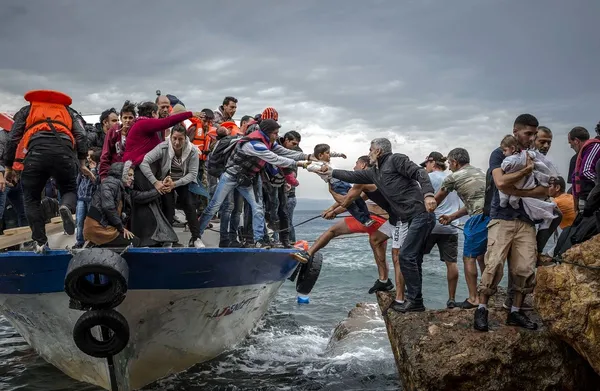
However, beginning in the mid-2010s, the universal negativity that once sustained his radical philosophy became somewhat stratified. What increasingly stands out since then is the point at which his proclaimed radicalism turns cautious, managerial, even faintly conservative. The rhetorical markers of early Žižek remain in place, yet the political horizon contracts around defending an embattled European normality. Nowhere is this clearer than in his writings on migration, from his 2015 piece on the “refugee crisis” in Europe[2] to his more recent interventions and commentaries.
In a piece written in the aftermath of New York’s recent mayoral race, he argues that “only a radical leftist can win over working-class Trumpians – a constituency whose distrust of the establishment remains entirely justified.”[3] Yet in another recent piece, he advances the argument – disturbingly consonant with right-wing populist rhetoric – that supporting undocumented migrant workers merely aids “big capital,” which profits from cheap labor and wage arbitrage, and simultaneously fuels “support for Trumpian populists.”[4]
These stances, of course, are hardly new. In his 2016 book consecrated to today’s “troubles with the neighbors”[5], he devotes considerable energy to attacking both humanitarian anti-border advocates and proponents of hardline anti-allochthon policies. And it is under the flag of a revolutionary break with capitalism that these alternatives are seen as a double blackmail.
Curiously, however, Žižek’s tendency to equate radical politics with the disruption of the ideological coordinates that make the current social order appear “natural” is fundamentally at odds with the border logic that he takes for granted and that underpins his reflections on migration. What makes this inconsistency more than a simple policy disagreement is that it cuts directly against Žižek’s own earlier theoretical framework.
The shift allows him to defend the egalitarian fantasy of “Norway” – social welfare, secular norms, symbolic equality, even if the vision only partially corresponds to reality – but solely for already-European subjects, while dismissing the same aspirations as naïve or illegitimate when articulated by (mostly Muslim) refugees. To put it bluntly, the egalitarian assertion once pulsing in the subject’s constitutive discord is thereby denied to migrants. While we can concede that radical human possibilities are primarily realized through struggle rather than mere fantasy, it is Žižek’s selective recognition that is troubling, a double standard that reveals how much his 2015 Kehre has domesticated the radical kernel of his earlier theory.
To begin with, Žižek overlooks the fact that migration itself often entails a kind of ontological crack, closely akin to the sort of rupture he claims radical politics must affirm. It could be argued, for example, that it unsettles national identities and disturbs the imagined homogeneity of ethnic communities, forcing people to confront the real conditions of their lives. Yet when addressing the issue, Žižek repeatedly adheres to a logic of containment, management, and preservation of existing European norms and regulations that sit uneasily with his more general celebration of radical rupture. Migration – even at this level of abstraction – exposes a limit-case where the radical logic of symbolic disruption collides with a stabilizing border logic of the very destructive system Žižek is otherwise committed to criticising.
As a material manifestation of late neoliberalism’s contradictions, migration cuts across borders, labor markets, property regimes, social hierarchies, and collective imaginaries. It doesn’t just expose the falsehood of a cohesive social whole; through the exploitation, inequality, and arbitrariness built into relations of employment, legal regimes, urban planning, welfare politics, and cultural production, it politicizes the entire social field. Questions of belonging, rights, and recognition no longer remain abstractions, but surface at the fault lines of class, work, and citizenship, directly challenging the social cohesion Žižek, oddly enough, seeks to defend.
For a decade or so, despite persuasive refutations to his core arguments, the Ljubljana philosopher has stubbornly stuck to the same inconsistent position: he theoretically embraces radical rupture of all substantial-organic ties yet refuses it when it could come from below, in the form of migrant mobility. In the 2016 book, while he correctly notes that global capitalism precipitates exodus through war, climate catastrophes, and corporate extraction, his political realism ultimately legitimizes the very mechanisms that engender these conditions.
Checkpoint Capital
If Žižek recognizes that contemporary migration is a structural consequence of capitalism, militarism, and climate change, why treat it like some temporary crisis to be managed by Western powers? Moreover, at a more fundamental level, from his own Marxist/internationalist standpoint, isn’t it incoherent to treat borders as a fixed constraint that the left must accommodate? Instead of the neutral terrain on which we manage the unfortunate side effects of globalization, isn’t the nation-state border regime the very violent enforcement arm of global inequality?
In responding to critics[6], Žižek writes that capitalism “cannot afford” the same freedoms and rights for all people and must therefore rely on migrant labor while simultaneously restricting migrants’ movement. But this framing subtly naturalizes the border regime as if it were a regrettable necessity of the system rather than one of its active tools.
The issue is not simply that capitalism cannot afford equal rights for everyone, but that it needs the border to produce differential rights, to manufacture a segmented, precarious labor force whose vulnerability can be exploited. Capital does not merely fail to grant rights; it withholds them to depress wages, fracture worker organization, and prevent the solidarities that might challenge its power. Without a rightless stratum of migrant labor, entire sectors of accumulation – from agriculture to logistics to care work – would collapse. This is the political economy post-2015 Žižek never fully engages with, let alone confronts. By speaking of what capitalism “cannot afford,” he recasts a structural strategy of domination as a fiscal limitation rather than a weapon in the class struggle.
Civilized Alibi
That blind spot is all the more ironic because earlier Žižek analyzed this very mechanism with far greater acuity. In the early 1990s, he spelled out that the fascist dream of a capitalism scrubbed clean of its “excess” rests on a delusion: that the excess is imported from outside, “the work of an alien intruder.” Get rid of the intruder, the fantasy promises, and the social body will heal, order will return, harmony restored, and everyone will be put back “in his own place,” safely pinned to an organic hierarchy capitalism itself constantly destabilizes.[7]
Also worth mentioning is a 2007 essay against the populist temptation, where he reminded that “the influx of immigrant workers from post-Communist countries is not the consequence of some multiculturalist tolerance – it effectively is part of the strategy of capital to hold in check the workers’ demands.”[8] Likewise, in First as Tragedy, Then as Farse, published two years later, he explicitly acknowledged “how getting hold of ‘papers’ opens up [for the immigrant] the space for further political self-organization and activity.”[9] He further insisted, in the same text, that the real political breakthrough would involve showing workers who oppose immigrants that their anger is misplaced and offering them a realistic alternative political direction.
All of this makes his later pivot not just unexpected, but effectively a non sequitur in relation to his previous work. With the Syrian war unfolding, ISIS expanding, the 2015 Paris attacks shaking Europe, and far-right parties gaining ground, it is as if Žižek suddenly decided that the “immigration question” demanded a fundamentally new approach. However, his (not totally unjustified) allergy to liberal multiculturalism, identity politics, and most strands of decolonial theory prevented him from conceiving racial equality and cross-border citizenship as preconditions for class consciousness among white American and European workers. For all his talk about bringing class struggle back, there is remarkably little attention to workers themselves, their organizations, their interests, the ways they could collectively exercise their power today.
In the already-mentioned reply to his critics[10], Žižek pushes the whole thing to a disturbing endpoint: because immigrants already suffer restricted mobility as a consequence of their class position, he claims, these limits should become official policy. The trick is to turn a de facto limitation into a de jure one: since they cannot move around freely as “we” do, let us codify their immobility, impose new controls, decide “whom and how many to accept, where to relocate them, etc.” With a rhetorical question – “Is demanding radical freedom of movement, precisely because it does not exist within the existing order, a good starting point for the struggle?” – he implies a negative answer. Yet this is precisely where the underlying political economy becomes mystified. A true materialist answer should rather be that capital represses workers’ movement across borders because controlled illegality is profitable, because deportability weakens collective bargaining, because zoning rights and residency categories suppress unionization, because the stratification of rights is itself a form of labor discipline.
From then on, Žižek kept getting the contradiction backward: contrary to what he seems to believe, the utter impossibility of open borders within multinational capitalism is precisely why it is strategically essential for radical left politics today. As Žižek very well knows, every serious anticapitalist movement in the past has pressed on the system’s constitutive impossibilities. From the abolition of slavery to equal civil rights, from the eight-hour day to reproductive freedom... a demand is “impossible” right up until the moment it forces a breakthrough.
Here as well, Žižek once understood this. In 1998, countering the right’s warnings about endangered national or ethnic particularity, he maintained that the left should articulate “impossible” universal demands to politicize the field and disrupt the police order sustaining the status quo.[11] From that vantage, no-borders should stand today as the paradigmatic “impossible” demand, precisely because border control has become the central point of international negotiation and the clearest expression of politics reduced to social Polizei.
By treating radical freedom of movement of workers across borders as a naïve moralism, Žižek now misrecognizes a structural antagonism as an ethical impasse. He fails to see how borders are not inert features of the contemporary world, but pressure points where the global order actively cracks. “No-borders” is therefore not simply a moral slogan of beautiful souls or an ethical posture of infantile leftists; it is a strategic strike on one of capitalism’s most vital infrastructures.
All in all, Žižek worries that open migration would merely fuel the far right. But this accepts, rather than interrogates, the political framing of neoliberal states and their media apparatus. It treats right-wing ressentiment as a natural (“understandable”) reaction to immigrants instead of a manufactured one. This perspective obscures the fact that borders themselves are a form of global apartheid, that they function as a global caste system, and that the resurgence of the far right tracks not the arrival of migrants but the long arc of deindustrialization, austerity, union collapse, destruction of alternative urban solutions and proletarian public spheres, and the deliberate scapegoating of migrants by political and business elites.
Far-right localisms do not erupt because outsiders arrive; they tend to emerge from a specific political economy: the proprietary classes’ monopoly in the violent control of labor relations, combined with the erosion of workers’ collective power and, crucially, the production of a rightless labor stratum whose insecurity can be weaponized. The populist anti-migrant backlash Žižek fears is therefore not an organic expression of popular anxiety but a political technology of rule. To treat this backlash as something that must be appeased is to capitulate to its terms. The task should not be to manage or preempt far-right panic but to confront it directly: politically, materially, and organizationally. Otherwise, the left abandons the terrain of universal emancipation Žižek once championed to those who define “the people” in exclusionary, racialized terms.
When Žižek highlights tensions between Western secular norms and conservative (non-European) religious practices, he reframes migration as a matter of moral psychology rather than of political economy, failing to see that the whole cultural “incompatibility” discourse is nothing but a distraction. When austerity regimes, agribusiness supply chains, economic immiseration, military interventions, and climate disasters uproot millions, the relevant question is not whether refugees share “European values” but whether the systems displacing them will ever be confronted. While Žižek does call upon such confrontation, in practice, he offers no concrete strategy beyond a further militarization of borders and technocratization of migration control, the very infrastructure that perpetuates the crises he purports to oppose.
Blaming The Broken
Though Žižek, as noted, regularly invokes the systemic violence of global capitalism, his post-2015 writings tend to follow these acknowledgments with a familiar qualification: we should not, according to him, be “too indulgent” toward non-European states in the South, since these countries also bear responsibility for today’s humanitarian catastrophes, including the so-called “immigration flows.” The implication is that Western imperialism may be a major factor, no doubt, but it is not exclusively to blame.
This gesture is revealing. It shifts the analysis away from the structural determinants Žižek himself has just named and reintroduces a moralized, quasi-civilizational framing of the periphery’s “failures.” Instead of examining how colonial borders, debt regimes, proxy wars, resource dependency, and externally imposed economic models produce state fragility and population upheaval, the burden is subtly redistributed onto the “poor countries” themselves. What appears as balance or nuance is in reality a transference of responsibility from the global system to its most damaged sites.
His recent remark[12] on the limitations of historical anti-colonial struggles, which most often ended up giving way to authoritarian and corrupt regimes, performs a familiar ideological move earlier Žižek most likely wouldn’t fail to call-out: it isolates the outcomes while erasing the conditions that produced them; it treats authoritarianism in developing countries as an internal failure of post-colonial movements rather than the predictable result of a violently structured global order.
A few points need to be made here. First, the new states inherited colonial borders, extractive economies, and militarized administrative structures designed for domination, not democratic governance. Almost every post-colonial regime that slid into authoritarianism did so under the combined pressures of Cold War proxy conflicts, IMF structural adjustment, multinational extraction, and elite sabotage backed by Western governments. To point to the collapse of decolonization without naming the global forces that orchestrated or exploited that collapse is to misdescribe the whole causal chain.
Secondly, the “authoritarian outcome” argument retrospectively conflates the limits of decolonization with the limits of anti-colonial aspiration. Anti-colonial struggles were not doomed because their vision was necessarily flawed or naïve; for the most part, they were crushed, contained, or co-opted because imperialist powers, acting in defense of the global capitalist order, could not tolerate successful experiments in economic sovereignty and redistribution. Whenever anti-colonial movements had room to maneuver – as in early Tanzania (Ujamaa era), Burkina Faso under Sankara, Kerala’s left governments, or the Mozambican and Vietnamese experiments – they achieved tangible egalitarian gains. Where these projects were rolled back, the causes were overwhelmingly geopolitical rather than cultural.
What is striking – especially coming from a self-described radical leftist – is that, given their histories of fascism, racial apartheid, mass incarceration, authoritarian neoliberalism, and now the resurgence of the far right, Europe and North America hardly provide a clean counterexample of political virtue. Yet it is mostly non-Western countries that are treated as intrinsically prone to corruption or despotism. This selective framing allows for the revival of a civilizational hierarchy Žižek otherwise claims to reject, one in which the political failures of the periphery are read as endogenous, while those of core societies are contextualized, historicized, or excused.
In the same vein, the statement that immigrants threaten democratic values (or basic rights) is simply false. Žižek seems to deny intercultural working-class solidarities that already exist and slips into a civilizational frame that unintentionally echoes liberal-nationalist talking points. The whole “clash of cultures” narrative is a political smokescreen that obscures the underlying relations of class power.
Subject at the Gates
In his eagerness not to idealize immigrants as all nice and peaceful and respectful of human rights, Žižek ends up underestimating their capacity for self-organization and agency, the everyday solidarities forged in megacities, slums, migrant camps, and informal labor markets. He resists conceding that migrants can be political subjects in their own right: builders of new urban networks, participants in labor struggles, entrenched defenders of public spaces, and creators of new interracial working-class identities.
Refusing to romanticize migrants is one thing, but Žižek’s framing reduces them to objects of humanitarian administration rather than agents actively reshaping the political terrain of contemporary society. His claim that open borders would “suspend democracy” rests on an assumption that should itself be the object of critique: that democracy is by definition the property of a territorially bounded citizenry. This is not a neutral observation but an ideological presupposition. Borders do not protect democracy; they produce exclusions that make formal democracy compatible with profound material inequality.
What Žižek calls “democratic consultation” is already structured by a regime in which millions who sustain European economies have no political voice. Migrant workers build infrastructure, harvest food, care for children and the elderly, deliver goods, and pay taxes, all while remaining legally precarious and politically invisible. A democracy that depends on a subordinated population with diminished rights is but a sham democracy.
The status quo Žižek worries about being altered without consultation was never really democratically chosen, was it? The wars for oil, extractive trade regimes, agribusiness land seizures, and climate disasters that generate mass displacement were in no way the result of popular will but of state and corporate decisions taken far above any democratic forum. To then use “democratic legitimacy” as an argument for excluding those displaced by this global order is to naturalize the results of deeply anti-democratic processes in the first place.
Historical precedent also undermines Žižek’s reasoning here. Expansion of political rights has never proceeded by first integrating the excluded and then granting them a voice. Workers, women, racial minorities, and colonized subjects all won political recognition by contesting the boundaries of the demos itself. Political participation is transformed through struggle, not granted ex post by a pre-existing citizenry. Why should migrants – structurally present, economically indispensable, and politically silenced – be the only group required to wait for prior approval?
Open borders do not suspend democracy; they challenge the narrow, exclusionary form that democracy has taken under global capitalism. They force us to confront who actually composes the polity, whose labor sustains it, and whose rights are systematically denied. Far from being an anti-democratic imposition, the demand for free movement of workers is one of the few demands capable of democratizing the political community beyond its historically nationalist and racialized limits.
By turning the universal subject into a culturally European one and restricting egalitarian desire to insiders, Žižek abandons the emancipatory horizon his early theory promised. The task is not to defend “Norway” for some but to build solidarity within and against the violent economic and military structures that make Norway impossible for all.
A more rigorous universalism requires not a culturalist retreat – be it in the form of a idealization of cultural otherness or of a collapse into European provincialism – but the renewal of a critical tradition that: (1) refuses to treat European radical norms (égaliberté) as an ontological property or inheritance; (2) conceives emancipation as a transformation of subjectivity and objective conditions rather than a defense of cultural apartheid; (3) identifies the structural forces driving global displacement instead of psychologizing refugees; and (4) confronts the misalignments – and the possibilities of mutual critique and recalibration – between Enlightenment universality and peripheral experiences without relinquishing universalism itself as an imperial privilege.
This renewed critical tradition compels us to understand universal categories not as European legacies but as products of global asymmetries – a critical, non-identitarian universalism that refuses the false choice between wholesale decolonial rejection of “the West” and Žižekian “Eurocentrism,” insisting instead on universality grounded in the perspective of global justice and emancipation.
Ground-Level International
In practice, this means that while we can agree with Žižek that neoliberal multiculturalism is an inadequate response to migration, and that both xenophobic nationalism and naïve liberal humanitarianism should be rejected, we must not let fear of right-wing backlash dictate our strategy. Rather than choosing between social chaos and top-down crisis management, we should embrace bottom-up, democratic, grassroots internationalism in the form of migrant mutual aid networks, urban solidarity initiatives, and cross-border labor struggles.
Recently, widespread collective resistance to federal immigration enforcement has taken shape in the U.S., sparking mass protests, mutual aid efforts, community support for affected families, and nationwide solidarity actions, demonstrating how locally rooted networks can confront exclusion and police brutality. Žižek, however, underestimates the formative dimension of such struggles. Far from the “pathetic humanist engagement”[13] he portrays them to be, these practices do not merely respond to indifference and state violence but actively shape political subjectivities, collective capacities, and new horizons of emancipation.
Only by building bottom-up, cross-border networks within today’s urban landscapes riven by inequality, precarity, and ecological hazards can we confront the systemic forces driving flight and immiseration, reclaim the universalist, emancipatory horizon of radical politics, and avoid reproducing the very structures of oppression and economic triage we seek to overturn.
Liked it? Take a second to support Cosmonaut on Patreon! At Cosmonaut Magazine we strive to create a culture of open debate and discussion. Please write to us at submissions@cosmonautmag.com if you have any criticism or commentary you would like to have published in our letters section.
-
Absolute Recoil. Towards a New Foundation of Dialectical Materialism, London/New York: Verso, 2014, 261.
↩ -
“The Non-Existence of Norway: On the Refugee Crisis,” London Review of Books, vol. 37 no. 17, Sept. 10, 2015. https://www.lrb.co.uk/the-paper/v37/n17/slavoj-zizek/the-non-existence-of-norway
↩ -
“Mamdani’s Big Bet,” Project Syndicate, Nov. 10, 2025. https://www.project-syndicate.org/commentary/mamdani-democratic-socialists-and-us-political-realignment-by-slavoj-zizek-2025-11
↩ -
“The Family Values of the Radical Left: Two Films Display Stolen Virtue,” UnHerd, Oct. 20, 2025. https://unherd.com/2025/10/the-family-values-of-the-radical-left
↩ -
Refugees, Terror and Other Troubles with the Neighbors. Against the Double Blackmail, Brooklyn, NY: Melville House, 2016.
↩ -
“In the Wake of Paris Attacks the Left Must Embrace Its Radical Western Roots,” In These Times, Nov. 16, 2015. https://inthesetimes.com/article/breaking-the-taboos-in-the-wake-of-paris-attacks-the-left-must-embrace-its
↩ -
Tarrying with the Negative. Kant, Hegel, and the Critique of Ideology, Durham: Duke University Press, [1993] 2004, 210.
↩ -
“A Leninist Gesture Today: Against the Populist Temptation,” in Sebastian Budgen, Stathis Kouvelakis and Slavoj Žižek, eds., Lenin Reloaded. Toward a Politics of Truth, Durham/London: Duke University Press, 2007, 77-78.
↩ -
First as Tragedy, Then as Farse, London/New York: Verso, 2009, 119.
↩ -
“In the Wake of Paris Attacks...”
↩ -
“A Leftist Plea for ‘Eurocentrism’,” Critical Inquiry, vol. 24, no. 4, Summer, 1998, 1009.
↩ -
“The family values of the radical Left.”
↩ -
Ibid.
↩