Ever since the most radical days of the Cold War, the term terrorism has seen a rapid rise in common parlance. Originally starting as a term used to describe the Reign of Terror in the French Revolution, terrorism is now an everyday term used to control thought (or a control-term) in political, social, and ideological discussions. This has only intensified since the September 11 Attacks and the start of the Global War on Terror (GWOT). When the term terrorism or terrorist is used, it is easy to take the term at face value. However, especially with respect to recent events in Palestine and Yemen, and the lingering memory of the Islamic State’s attacks around the world in the 2010s, terrorism does not exist as a purely neutral term. Instead, it is now a term with one purpose: to denote which group is worthy of condemnation and which is not. Subsequently, an organization that objectively engages in terrorism can still be denoted as an organization worthy of support (and thus is not considered a terrorist group). At the same time, another organization that is comparatively more benign can be decried as a violent terror group and be met with condemnation.
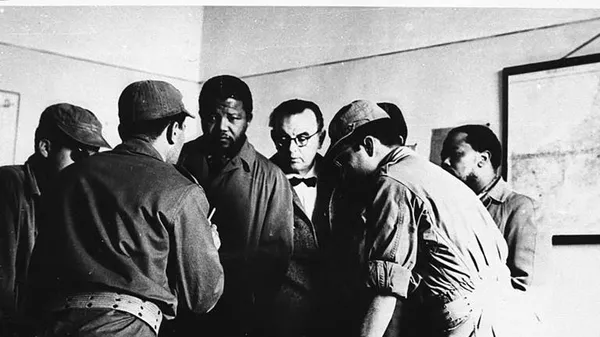
Consider Nelson Mandela. Mandela was officially listed as a terrorist in the 1980s by America and the UK[1] since the African National Congress had by then endorsed militant action against the South African government. From an objective perspective, it is undeniably true that Mandela and the resistance against Apartheid utilized terrorism. For Mandela, the path was through an incremental buildup of violence against the state, starting from disrupting infrastructure and moving toward greater levels of violence and attacks.[2] Yet, despite this, if someone states that Mandela was a terrorist, it is assumed that this statement acts as a condemnation of Mandela and not a neutral observation. This is no accident. It is a result of decades of rhetoric surrounding terrorism designed to make it equivalent to evil and, in doing so, control opinions and perceptions surrounding government interests. The object of this essay is to find the consequences of the use of the term ‘terrorism’ as a control-machine, analogous to Burroughsian ideas of language as virus, and doing so argue for an understanding of the term that does not exist as a moral qualifier, such that one day it would be possible to say that Nelson Mandela was a terrorist without condemning Mandela in the same breath.
Defining Terrorism
Of course, accomplishing a goal such as this must begin by establishing a definition of the term terrorism, a matter of which there are many competing views. These views include definitions that hold terrorism as a fundamentally progressive act. Peter Heehs, for instance, defined terrorism as “the use of violence” in limited and controlled forms against an oppressive state “to bring about political, social or other change.”[3] By framing terrorism as something which opposes oppression, terrorism becomes a revolutionary and generally progressive phenomenon. It stands to reason that Heehs’ definition would raise eyebrows today, especially after 9/11. And while it is useful for grasping that terrorism is not always seen as evil, it cannot answer for terrorist movements which have championed the cause of oppression, instead of opposing it. Such a definition that holds terrorism as wholly good must be set aside.
A more ‘official’ definition of terrorism is an act which involves or threatens serious violence against a person and/or property, the endangerment of life, or creating a risk to public health to influence the public or the government and/or to advance a political goal. Or so the Terrorism Act tells us.[4] This definition bears some resemblance to the view of Richard Jackson, who critiques defining terrorism as an ideology in and of itself[5] or as something that only non-state actors can perform.[6] Though Jackson does not believe a universal definition of terrorism can ever be established, the above definition, theoretically speaking, avoids many of the holes that competing definitions fall into, as it neither precludes states from engaging in terror nor assigns any specific ideology to the act. Jackson would be quick to point out that how the UK has applied this definition leaves consistency to be desired, and he would be right, but as a theoretical starting point, it is as good a foundation as any. Simplifying this definition somewhat, we can establish a definition of terrorism as the use and threat of violence for political ends.
Terrorism as pejorative
One of the first instances of an understanding of terror as a neutral, or even positive act comes from the trial of the Russian terrorist Vera Zasulich in 1878. After attempting to assassinate a local official, Zasulich was asked why she did not fire a second shot against the target when he survived the first. She responded with ‘I am a terrorist, not a murderer!’[7] During her trial, many of the jury and observers were visibly sympathetic to Zasulich and later had her acquitted.[8] It is clear that in this context, the concept of terrorism was not seen as a negative concept in and of itself, and thus did not exist as a control-term. The central idea, that political violence is legitimate, is therefore nothing new. Afterall, thinkers like Marx and Lenin laid this out quite clearly, as did Frantz Fanon in his call for the intensification of political violence against colonialism in ‘The Wretched of the Earth’. Same for Mao’s call for the people of China to begin the violence of the Cultural Revolution by ‘bombarding the headquarters’ and the call for a transnational jihad against enemies both near and far by various proponents of jihad in the Muslim world, such as Sayyid Qutb or Osama Bin Laden. What makes the Zasulich case notable is that it is a very early example where the term ‘terrorist’ is used, but without any negative connotations. Imagine if Luigi Mangione today were to proclaim in his trial that he was a terrorist and quite proud of it. Undoubtedly, many would turn against him. At some point, the global perspective on the term had changed. As Jenny Teichmann explains, by the 1980s, most commentators saw terrorism as pejorative, and most terrorists did not identify with the term, in stark contrast to Zasulich.[9]
And so, in common parlance today, the concept of terrorism is not only a term used to describe a group which uses violence for political ends, but also takes on a secondary meaning. It is a title that indicates which organizations are worthy of condemnation and which are not, or which groups a government favours and those which it opposes. In the case of South Africa, Mandela and others like him were branded as terrorists for their opposition to the South African government. South Africa, at the time, was a critical piece of Cold War infrastructure, being a citadel with nuclear weapons that provided support to anti-Communism by attacking African revolutionaries.[10] It stands to reason, then, that as far as America or the UK were concerned, any revolutionary movement that stood opposed to Apartheid would have to be branded as terrorists. But it goes without saying that terrorism in the case of African resistance to apartheid could hardly be classified as unjustified or indeed wrong.
Their Terrorists and Our Freedom Fighters
Make no mistake, despite Mandela’s status as an icon for peace in the West, the African National Congress (ANC) was indeed very militant. In 1980, one guerrilla attack led to an attack on an oil refinery, causing R58,000,000 of damage.[11] From 1981-1982, over 60 attacks were launched on police stations, railways, and energy infrastructure.[12] And from 1984-1986, 33 black policemen were killed, and 584 were injured by ANC attacks.[13] True, the ANC avoided attacks on civilian targets (though not all anti-Apartheid groups had this as a focus). And true, compared to the death tolls of other Cold War insurgents (as shall be seen), the ANC pales in comparison. But this, according to a neutral definition of terrorism, does not mean the ANC ceases to be a terrorist organization. So we can settle the score with regard to terror by concluding that not all terrorism is immediately morally condemnable; an important starting point to establish the issues with how terrorism is used and understood.
On the other hand, organizations that acted as terrorists, but against pro-Soviet revolutionaries, received tacit support and were not considered terrorists. During the Mozambican Civil War, white settler colonies like South Africa and Rhodesia, with notable (though indirect) American backing, supported the creation of the RENAMO terrorist group.[14] RENAMO’s terror attacks were responsible, by some estimates, for up to 95% of civilian abuses in the war, killing around 100,000 people.[15] Yet RENAMO, despite certainly using violence to achieve political ends, was never classified by the West as a terrorist group. I highlight RENAMO as it is understudied, but there is an endless trove of such examples. Ranging from the obvious case of the ‘brave mujahedin fighters of Afghanistan’ to American diplomatic support for Khmer Rouge guerrilla remnants. Nor are the Americans the only guilty party. The United Kingdom, for instance, utilized MI6 in the 1990s to support the Libyan Islamic Fighting Group (an organization which would go on to swear fealty to al-Qaeda) in its then failed insurgency against the Libyan government.[16]
Controlling the use of the term ‘terrorism’ in this way is a very simple tool to explain to the public why opposition to this or that group is necessary, while keeping the field open for support for groups not designated as terrorists. In the climate of the 60s and 70s, where urban guerrillas regularly launched terror attacks in multiple First World countries, where images of Palestinian communists blowing up (empty) planes in the Jordanian desert were plastered everywhere, terrorism began to be used more and more as a convenient ideological term used to indicate to the public who and what needed to be defeated. Before this point, terrorism’s use as a term was rare. This only increased again after 9/11 and the rise of transnational jihadism.[17] Alongside groups, countries like Cuba can be deemed as ‘state sponsors of terror’, even when what terror they are currently sponsoring is a mystery. Ever since the end of the Cold War, Cuba’s involvement in sponsoring foreign revolutionaries has been muted at worst. Yet Cuba remains on the US State Department List of ‘state sponsors of terrorism’. Terrorism is thus invoked whenever a country or a group needs to be condemned, regardless of how much it applies. The association of the term with 9/11 in cultural memory can quickly convert the public to attack the condemned. The term terror thus continues to exist as a control-term, used to control and influence opinions.
Consider the case of Libya. During the First Libyan Civil War (and subsequent NATO intervention), terrorism was ever-present in NATO’s rhetoric in justifying intervention. This included bizarre logical leaps, which alleged that intervention was necessary because if there were none, then al-Qaeda would lead the charge in Libya against the government.[18] And secondly, if there were no intervention and Libya won, perhaps Libya would continue to fund terrorist movements throughout the world.[19] Conversely, in Obama’s speech on the intervention in Libya, Libyan rebels were not framed as terrorists, even though they certainly fit the bill. Instead, they were considered freedom fighters.[20] This is despite the fact that many pogroms would be launched by these groups against black Libyans, resulting in events such as the murder of 50 black people in Derna[21] and the ethnic cleansing of the city of Tawergha.[22] It would not be long until events such as the Benghazi attack, the rise of the Islamic State in Libya, that the moniker ‘terrorism’ would be back on the table, even though the LIFG mentioned earlier also took part in the events of 2011. What this reflects is how terrorism as a term can be selectively applied and withheld to reinforce whatever cause is being championed and whatever organization is demonized.
Terrorism and the Erasure of Nuance
Terrorism as pejorative can also be used to erase detailed analysis of whatever group is considered “terrorist”. A group being condemned as a terrorist organization serves as a way to more or less shut down any discussion about the role said group plays in society, outside of what is seen as its negative aspects. This, in turn, cements terrorism as a control-machine, as it not only can be used to control opinion but also to erase history at a whim. Consider the Lebanese terrorist group Hezbollah. Most Western countries consider Hezbollah a terror group. It is correct that Hezbollah can be classified as a terror group, since it uses violence to achieve political ends. But when Hezbollah is described as a terror group, a consequence is that a discussion on its nuances is erased.
The base of support for Hezbollah is, by and large, Lebanon’s working class and poor, with 81% of its supporters coming from such a background.[23] The poorest classes of Lebanon have been hurt by the political-economy of the Washington Consensus, with increasing inequality and poverty as a result of its policies. This drove many of Lebanon’s underclasses to Hezbollah, which utilizes "mosques and religious centres as civil courts and establishes religious school networks, hospitals, orphanages, social service centres, media outlets, boy scouts, civil defence and mujahedeen fighters all organised independently from central state power."[24] Per Salamey and Pearson, Hezbollah thus becomes a proletarian party which stands opposed to the wealthy middle classes of Lebanon, by providing a welfare-para-state which can give access to free education and public healthcare.[25] The ‘bazaar bourgeoise’ is no doubt part of this movement too, but this does not mean Hezbollah shies away from implementing populist pro-worker policies. In doing so, Hezbollah is able to expose issues such as government corruption and other harmful policies[26] while preventing the emergence of "privatisation efforts that targeted public programmes."[27] The growth of this ‘revolutionary welfare economy’ combined with the success of Hezbollah’s guerrilla tactics even dissuades other forms of terrorism, like suicide bombings.[28] This role played by Hezbollah in Lebanon is generally not very well known. When was the last time a BBC panellist discussing the organization extended more effort to describing Hezbollah other than calling them Shia terrorists and Iranian proxies? Due to terrorism’s status as a moral qualifier, that is where the discussion begins and ends.
Another example comes from India’s own homegrown terrorist movement, the Naxalites. Ever since 1967, starting with the Naxalbari uprising, India has been the home of a large Maoist insurgency, one that continues to this day. This insurgency is led by the Communist Party of India (Maoist) (CPI(M)), which is considered by India a terrorist organization. The Naxalites rarely enter Western discourse, but when they occasionally do, they have the blessing of being twin-boogeymen in Western minds. Not only are they Maoist, but they are terrorists too! Subsequently, discussions on the successes of the CPI(M) have little room to bloom outside of those spaces already amenable to it. It goes undiscussed that the Naxalite base comes from the tribal populations of central and eastern India, who, in many ways, were driven toward the Naxalites due to the repressive and exploitative policies of the Indian state toward them.[29] Naxalite activity, however, had profoundly positive consequences on these tribal regions. In one case in the 1980s, the Indian government declared its intention to build a national park in the Dandakaranya region, which would involve the destruction of 60 villages.[30] Naxalite resistance pushed out the government and prevented the destruction of these villages alongside the redistribution of 300,000 acres of land by 2000.[31] The success of this land reform program pushed the Naxal-administered areas toward establishing a series of ‘Jantana Sarkars’ or people’s governments based on the experience of the Vietnamese and Chinese revolutions[32] which implemented a bottom-up democratic structure.
This is not to say either the Naxalites or Hezbollah are perfect. But it is nevertheless true that through the utilization of the term ‘terrorism’, their complexities are erased, their positive contributions, which any serious study of any such group would have to consider, go missing. As such, the historical reality and nuances of terrorists are completely erased. Terrorism, thus, is not just a term for describing what is bad, but a linguistic control machine which erases history and present reality.
Burroughs and Terrorism: A Control Machine
Terrorism’s role in contemporary politics fits within the framework of Burroughsian concepts of language. In his writings, William Burroughs developed the concept of language existing as a virus from outer space, a virus which orders reality on the lines of a totalitarian occupation by control.[33] For Burroughs, words were never free from a wholly neutral existence, and as Wood describes’ Burrough’s view on the issue ‘It is exceptionally difficult for any resistant message to avoid complicity with the dominant communication systems in whose language it is composed.’[34] Indeed, the only point of language, like a virus, is to replicate itself.[35] Terrorism demonstrates the viral properties of language as its spread causes consensus that whatever it describes is bad. Once this consensus is established, it has the goal of replicating itself and infecting more minds. No government, after all, would condemn this or that organization as a terrorist group without a desire to see that label spread and stick in the public consciousness.
Controlling perceptions of the world translates to control over what the world can be. What is worse is that it is a form of control that reinforces itself and replicates itself. Get anyone on the street to view the invasion of Iraq as combating terrorism, and they’re liable to apply that framework to any war where the West decides to pilfer and ravage any one country. This form of narrative control is perhaps the strongest and oldest manifestation of language as a virus. It certainly has all the properties of any good virus. It is dead without a host (what use is a narrative without anyone around to believe in it? The only good it has then is for some hypothetical historian of politics to poke and prod at its corpse and stick it in a PHD), it is a piece of information (a virus is small genetic information, terms like terrorism are perhaps more complex in how they act as information, by no means are they small. But they certainly are information), and it cannot reproduce without a host (a narrative of terrorism as pejorative needs believers to reproduce itself. Without a host, a narrative is just a simple sentence about an event. With a host that well and truly believes in it, it can duplicate itself to apply to any other event you want). But what makes it so strong? Well, as was said previously, control over how the world is perceived translates to control over what is possible to achieve in this world. When your virus is strong enough that the narratives and perspectives it produces can get people to start calling the rape of Iraq a form of twisted self-defence against the terrorists, then you surely do not have much to fear from them anymore.
Throughout the comparisons made to Burroughs’ ideas of language, the term control has been thrown around, and it is worth considering how Burroughs’ idea of control fits in with terrorism. For Burroughs, control is that which ‘seeks to control the very creation of propositions, striking pre-emptively in the attempt to determine what it will be possible to think and say.’[36] Control over communication is part and parcel of any self-respecting control machine, as Burroughs lays out: ‘Everyone must be forced to receive communications from the control machine. It will readily be seen that any control measure expands the range of enforced communication.’[37] Terrorism as a pejorative certainly ensures that it determines what is possible to think, as will be explained below, and it is jointly through communication networks that consensus on who is a terrorist is achieved. Hence, Burroughsian concepts of control-machines apply to terrorism as pejorative.
Upon spreading like a virus, terrorism as pejorative imposes control over thought. But here, terrorism as a control-term takes on a far more insidious role, deeper than just political alignments. The nature of a term like terrorism means its nuances can rarely be discussed in public. Academic writings can and have been written on these issues, but the public is far more likely to engage with statements made by government officials and media personnel who will refrain from providing a balanced account. Subsequently, the history and complexities of these terrorist organizations are erased. Even discussing the positive impacts of designated organizations becomes taboo. It is unthinkable and completely outside the framework of acceptable discourse. Any discussion on any organization deemed terrorist becomes unthinkable, beginning and ending with ‘but they are terrorists!’ and any other attempt to further the debate is seen as borderline insane. This is what makes the modern use of the term terrorism fit into Burroughs’ ideas of the ‘totalitarian control systems of all shapes and sizes.’[38] It is totalitarian because terrorism is transformed into a wall outside of which public discourse is forbidden to wander, whilst also acting as if any area outside this wall does not exist at all. Like Burroughs’ idea of control, terror as pejorative restricts what it is even possible to think.[39] Anything outside of it is not allowed exist, hence it is totalitarian.
Perhaps the only way to escape the totalitarianism of this pejorative control machine is to rethink terror completely. To escape the influence of imposed opinions and perceptions through the use of these control-terms, it is necessary to simply stop associating terrorism with pejoratives. To say that terrorism is a tool like any other, that can be used for good (Mandela) or bad (ISIS). The consequences of the current use of terror as pejorative have been to legitimize imperial ambitions against whatever entity is deemed unfriendly by authorities, while selectively protecting their (often murderous) bedfellows. This, in turn, paves the way for control over thought and opinions, a control so absolute that it can erase historical and present reality and disallow any discussion outside of what is deemed acceptable. By treating terror as a neutral term, a certain amount of ‘noise’ will be introduced into the signal, as Burroughs would say.[40] The intended meaning of terror as pejorative is disrupted and becomes open-ended, which prevents terror from existing as a control-term. Its power is erased, as is the power of those who use terror as a pejorative to control opinion power.
Liked it? Take a second to support Cosmonaut on Patreon! At Cosmonaut Magazine we strive to create a culture of open debate and discussion. Please write to us at submissions@cosmonautmag.com if you have any criticism or commentary you would like to have published in our letters section.
-
Elleke, B. (2005). Postcolonial Terrorist: The example of Nelson Mandela. Parallax. 11(4). Pg.46.
↩ -
Ibid. Pg.54.
↩ -
Ibid. Pg.48.
↩ -
Terrorism Act 2000. c.11. Available at: https://www.legislation.gov.uk/ukpga/2000/11/pdfs/ukpga_20000011_en.pdf (Accessed 12 June 2025).
↩ -
Groups which believe in terrorism as an end in and of itself do exist, but are far and few in between. Perhaps the only notable examples are Neo-Nazis influenced by James Mason.
↩ -
Jackson, R. (2008). An Argument for Terrorism. Perspectives on Terrorism. 2(2). Pg.26.
↩ -
Schmid, A. (2016). The Trial of Vera Zasulich in 1878. In Graaf, B. Schmid, A. (Ed.), Terrorists on Trial. Leiden University Press. Pg.60.
↩ -
Ibid. Pg.70-71.
↩ -
Teichman, J. (1989). How to Define Terrorism. Philosophy, 64(250). Pg.507.
↩ -
Mamdani, M. (2002). Good Muslim, Bad Muslim: A Political Perspective on Culture and Terrorism. American Anthropologist, 104(3). Pg.768.
↩ -
Welsh, D. (2009). The Rise and Fall of Apartheid. Jonathan Ball Publishers. Pg.330.
↩ -
Ibid. Pg.331.
↩ -
Ibid. Pg.336.
↩ -
Mamdani, M. (2002). Good Muslim, Bad Muslim: A Political Perspective on Culture and Terrorism. American Anthropologist, 104(3). Pg.769.
↩ -
Ibid.
↩ -
Forte, M. (2012). Slouching Towards Sirte: NATO’s War on Libya and Africa. Baraka Books. Pg.79-80.
↩ -
Jackson, R. (2008). An Argument for Terrorism. Perspectives on Terrorism, 2(2). Pg.28.
↩ -
Mohlin, M. (2014). Cloak and Dagger in Libya. In Engelbrekt, K. Mohlin, M. Wagnsson, C. (Ed.), The NATO Intervention in Libya. Routledge. Pg.211.
↩ -
Ibid. Pg.212.
↩ -
Obama, B. (2011). Remarks by the President in Address to the Nation on Libya. 28 March. National Defense University.
↩ -
Forte, M. (2012). Slouching Towards Sirte: NATO’s War on Libya and Africa. Baraka Books. Pg.226.
↩ -
Ibid. Pg.229-230.
↩ -
Salamey, I., & Pearson, F. (2007). Hezbollah: A Proletarian Party with an Islamic Manifesto. Small Wars & Insurgencies. 18(3). Pg.422.
↩ -
Ibid. Pg.424-425.
↩ -
Ibid. Pg.431.
↩ -
Ibid. Pg.426.
↩ -
Ibid. Pg.428.
↩ -
Ibid. Pg.430.
↩ -
Roy, A. (2010). Walking with the Comrades. Kasama. Pg.5-6.
↩ -
Ibid. Pg.14.
↩ -
Ibid.
↩ -
Ibid. Pg.15.
↩ -
Wood, B. (1996). William S. Burroughs and the Language of Cyberpunk. Science Fiction Studies. 68(23).
↩ -
Ibid.
↩ -
Land, C. (2005). Apomorphine Silence: Cutting-up Burroughs’ Theory of Language and Control. Epherma. 5(3). Pg.453.
↩ -
Moore, N. (2007). Nova Law: William S. Burroughs and the Logic of Control. Law and Literature, 19(3). Pg.441.
↩ -
Burroughs, W. (1979). Ah Pook is Here. Pg.8.
↩ -
Wood, B. (1996). William S. Burroughs and the Language of Cyberpunk. Science Fiction Studies. 68(23).
↩ -
Moore, N. (2007). Nova Law: William S. Burroughs and the Logic of Control. Law and Literature, 19(3), Pg.459.
↩ -
Ibid. Pg.454.
↩