Introduction
Since the U.S. and Israel began their war of aggression against Iran in late February, the explanations and justifications of the Trump administration have fluctuated rapidly. It can be difficult to determine what is true and what is false amidst a sea of disinformation and contradictory statements. What is certain is that the war is an act of unbridled aggression on the part of the United States and Israel that has killed thousands and displaced millions, and that revolutionary defeatism is our obligation as communists in the United States (and other allied countries, such as the United Kingdom, where Yassamine Mather lives).
Yassamine Mather is a scholar at Oxford University as well as acting editor of Critique: Journal of Socialist Theory and regular contributor to the Weekly Worker. She has published extensive articles on Iranian history and politics, and was a member of the Fedayeen (minority), a group that opposed both the Shah and Khomeini/the Islamic Republic. I had the opportunity to interview her on March 25, 2026, and the following is the transcript of our conversation.
Interview
Lydia: Welcome back, Yassamine! The first question I have is about the contradictory statements [made by Donald Trump] on all aspects of the war. In terms of recent developments, the weekend threats to obliterate Iranian power plants shifted to claims denied by Iranian officials that productive negotiations are taking place, but also the explanations of the war’s aims to begin with. Marco Rubio initially stated on March 2 that “We knew that there was going to be an Israeli action. We knew that that was going to precipitate an attack on American forces.” That was then denied by Trump.
Early on, the justifications also centered on regime change in connection with the recent protests, and figures like Reza Pahlavi were brought out frequently. But that has mostly stopped, and the U.S. instead claims that it attacked preemptively on intelligence that Iran would attack the US – which of course, is not at all a credible claim. What do you think of these conflicting claims, and of the role that Israel played in the decision?
Yassamine: First of all, thank you very much for inviting me again. It’s very difficult to put all this in historic terms, because we live right now in this instantaneous world where on X Trump says something, then Rubio goes to a live press conference and says something completely different. Iranian leaders– those that have survived assassination– also use X, or Trump uses Truth Social, while Iranian leaders use X to reply.
We are in a fog of misinformation in many ways, and it’s difficult to tell who actually believes what they are saying– this applies to both Iranians and the U.S. government. [The information available] also changes constantly, so as soon as you’re trying to find out what the first reason for this war is, there are four more being added. It’s regime change, it’s nuclear, it’s missiles, it’s just to teach them a lesson. And as you said, [they claim] Iran could have attacked– attacked who?
The Arab countries of the Persian Gulf had been negotiating with Iran and with the U.S. before all this started, to convince Trump not to attack, because as they’ve been saying in the past 48 hours, they knew what would happen. The Qatari minister is very clear. He said, “We warned you that this would happen,” that [Iran would close] the Strait of Hormuz, the economies of these countries [would be devastated], and so on. The Omanis also said that a deal was very close the day the war started– there was agreement at least on the nuclear issue. But then we have the Rubio claim that Israel was going to go to war anyway, so it’s very hard, really, to understand.
I think a couple of things are important to pull out of this fog of misinformation. One is that it is surprising that the Islamic Republic has lasted in terms of continuing in this war for 25 days now. It’s also quite clear that the initial Trump attack– decapitation of the Islamic Republic, Khamenei as well as quite senior revolutionary leaders– was sold by Israel to Trump as, “This is it. The regime will collapse.” Now, those of us who have been wanting the regime to collapse for decades know that it’s not that easy. We don’t want their kind of regime change. We want a regime change from below.
But those of us who studied the Islamic Republic know how complicated its structures are, how interconnected the layers of Revolutionary Guard, judiciary, political authority, and financial authority. [They have the ability to] reproduce themselves. Contrary to what people think, it was never a hierarchy like, say, Saddam’s regime, where you decapitate the head of the state and the state collapses. It’s more like layers and layers of people, some of whom are actually ready to die because of Shia Islam. Some of them still have the ideology, while others have become multimillionaires and live in another world. In the case of Khamenei himself, he didn’t care [about dying.] It was no big intelligence discovery; he was staying in the house where he usually stays, and his family were around him. So it’s not exactly that you need to have sophisticated AI or satellite imagery to tell you this. He was there.
In this complicated world, I think that some of the bluffs that Trump has said have really come back to hit him badly. I know he said this war might last 4 or 5 weeks, but he was also surprised even when the war started, because his assumption was that taking serious naval power to the area, threatening Iran with bombing, would be enough to get what he wanted in the negotiations. So that was a bluff that didn’t work. Then his bluff was that we will do this, that, or the other, and none of them seem to have worked.
Not that the price hasn’t been absolutely horrendous for Iran, and we shouldn’t underestimate that, but somehow, as far as I can see, the regime is stable, they are not going to sustain this war for long, but they have quantity as opposed to quality in terms of missiles. The large number of drones, the fact that they can reproduce these drones, and the fact that they apparently can still use missiles despite the U.S. repeatedly saying that they have obliterated the missile launchers, means that [Trump] has to keep changing the story. And this story, [as you mentioned Trump said on the weekend], was that “in 48 hours we’ll destroy the infrastructure, power plants, everything.” My understanding is that even in the middle of a war, you're not supposed to make those claims. I’m not a legal expert, but as far as I know, that’s not done.
But anyway, the Iranians called his bluff. They didn’t open the Strait of Hormuz. It’s quite a complicated situation what’s happening with the Strait of Hormuz– if we have time I’ll go into detail– but we probably don’t know if Trump is making these statements because he’s worried about markets, he’s worried about internal consumption. Is he making these statements while conscious that it’s not actually happening on the ground, that it will not happen on the ground? I don’t know. I actually believe it when Iran says that they haven’t called for discussions or ceasefire talks. I think that there are mediators that are going between the two countries, but as far as Iran is concerned, they regret the ceasefire they accepted in June 2025. They think that it allowed Israel to strengthen its forces, to come back to use the intelligence it had gathered. I don’t think they’re going to repeat that mistake. They have clear, black and white demands for this set of ceasefire talks, and at the moment it would be difficult for the U.S. to accept them. I know that Trump, on Truth Social, will produce his own version [of events], but eventually these things do get out, you can only lie so much.
I don’t think the Iranians can sustain this for long. I might be wrong, I’m not a military expert. I know people, even those opposed to the regime, have rallied to the government’s side– to the country’s side, rather than the government’s side. However, the destruction is unbelievable. Forget about what they make the headlines. It’s not the heads of the Revolutionary Guards, it’s not the missile launchers– of which Iran has, apparently, quite a lot, many of which are underground and include quite a lot of mobile services.
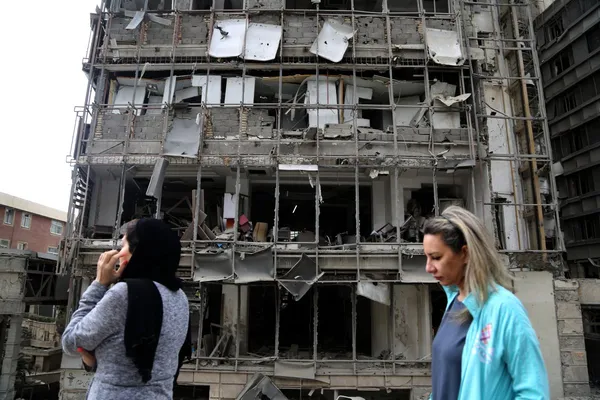
What has been destroyed are homes and about 60,000 factories. The bigger one is the oil plant in Pars, but there are so many other factories. Some smaller in towns such as Qom, some bigger, in and around Tehran, in and around Isfahan, and of course, it’s not just that people can’t work during the war. These jobs are lost forever. A bit like Gaza, Israel is destroying a lot of the health infrastructure. Hospitals have been deliberately targeted. They claim that it’s because the IRGC is in there, but I don’t believe it. A number of pharmaceutical plants have been destroyed, and again, I’m sure they have some kind of excuse, but as far as I can see, [Israel’s aim is] to destroy healthcare so that there are prolonged deaths after the war. If people don't have hospitals, if there are no medical facilities, if the pharmaceuticals are destroyed, if there are still sanctions, then more people will die. It’s heartbreaking when you read what’s going on inside Iran.
Lydia: There definitely is a sense in which the genocide in Gaza has prepared the world not to be shocked by the number of deaths and amount of destruction. There have been at least 1400 civilians killed [per Washington-based Human Rights Activists News Agency as of March 25, 2026, a total of 3291 killed, including 1167 military personnel, 1455 civilians, and 669 unclassified deaths] in Iran, and then recently too, Israel has been attacking southern Lebanon with about a million people displaced as well and at least 1000 killed. How do you think that Gaza has set a precedent for this situation? And what do you think Israel’s wider aims are?
Yassamine: Between October 2023 and the U.S.-Israeli war in 2025, Iranians like me were going on and on about Gaza. Some Iranians, even Iranians supposedly on the left, were saying, “Why do you bother about the Palestinians? It’s not our problem. Our problem is defending the Iranian working classes.” And what people like me would argue was that the existence of the state of Israel first of all strengthens all of the Arab dictatorships, and also in a funny way strengthens the Islamic Republic, because having failed a lot of the goals of the Iranian revolution, its only raison d’etre was that it is the only country that is opposing Israel, especially after the Abraham Accords.
You’re absolutely right that the genocide in Gaza has completely changed the mindset of people. First of all, anyone opposed to the Gaza war is accused of antisemitism. If you’re opposing Israel, you must be an antisemite; despite the fact that, in the UK, at least in the campaigns I am involved in, there is a far larger percentage of Jewish anti-Zionists as opposed to Arab or Muslim anti-Zionists. The Palestine Solidarity Campaign is dominated by people of Jewish origin.
But also, I think before Gaza, a lot of people did not expect much of the United States, but there was this illusion that we have these nice Western European countries who love human rights, who defend women’s rights in Afghanistan, in Iran, in Palestine. All of these countries really failed during the Gaza conflict in that, fearful of Biden, genocide Joe, and now genocide Trump, they did nothing, with the honorable exception of Spain and occasional statements by Ireland. But these are minor countries in Europe. So you have France, Germany, the UK, Italy, following the line about Israel having the right to commit genocide and the right to be sold arms, the right to invest in French and British companies, and so on. So all this talk about respecting human rights, being concerned about women’s rights, went out of the window; they can’t even talk about that, even when it comes to Iran. How can they talk about it when they are witnessing tens of thousands of women and children being slaughtered in Gaza? This normalizes barbarism.
And I think the other thing that was normalized during Gaza was assassination. Haniyeh was assassinated, Nasrallah was assassinated. Before that, in 2020, Trump assassinated Suleimani. These are all people who were disliked tremendously. However, you can’t assassinate leaders of other organizations because you don't like them. These are not even like the Al Qaeda leaders– these people, whether you like it or not, have a base, they have organizations, they have people who support them and would replace them. Now it is claimed that assassination is OK because there are Israeli hostages in Gaza; that makes it OK to assassinate Haniyeh, or assassinate Nasrallah. This became the norm. That has normalized the idea that this is no longer the leader of a political organization you don’t like, you can go and assassinate a religious leader with a following beyond the borders of his country, as well as the leader of another country, Khamenei.
Where is the condemnation of this? Have you heard any European country, any human rights organization, saying that yes, he was a terrible man. (I would say he wasn’t my favorite, but intellectually he was miles, miles ahead of Reza Pahlavi and the others that Trump has in mind). But yes, he was a dictator, he was a man whose politics and ideology have had disastrous consequences for generations of Iranians. But I wanted the overthrow of the Islamic Republic and his trial, I didn’t want him assassinated. In fact, his assassination has made him popular. Have you seen the demonstrations in Pakistan? Have you seen the people in Iran, some who tell me they went to the demonstrations against the regime in January, and now are going to the funerals of the leaders who have been assassinated? What does that say about the governments who do this kind of thing? Assassination became the norm.
And again, the school– the first day, where they killed 168 children in a school. Where is the condemnation? I read some headlines that talked about this bomb, but it’s like, I don't know, maybe it was a thunderstorm. No one mentions the country that was responsible, the Tomahawk that descended on this school. And again, Gaza made us immune, has made the world media immune. In Britain, the national TV organization, the BBC, was questioning every step of the Iraq war in 2003. I visited the US at the time, and lots of people in the US were saying, “You’re so lucky, you all listen to this British Broadcasting Corporation that questions Bush’s agenda, it questions 45 minute bomb threats to Europe, all that kind of thing. And it did it not with slogans. It found the scientists who were challenging the campaigns waged by Bush and Blair. Now, they replaced the guy who was in charge– they had an inquiry that blamed the BBC, the BBC was the “guilty party,” it was called the Hutton Report. After that, who in [British media] would be brave enough to say that it was a Tomahawk missile that fell on 168 children? After the US admitted it, it might be the last item [mentioned in some reports], but it never made the headlines.
And I think Turkey, for example, which is now quite opposed to this war, is well aware that this will not stop with Iran; it’s just the beginning. And you rightly asked about Israel. I think Israel knew that the demonstrations and the violence [in January] would not be enough to overthrow the Islamic Republic, but that it was good enough to fool Trump. As far as Israel is concerned, their declared aim is at times about nuclear weapons– we’ve heard this so many times that it goes through one ear and out the other. But they want a Greater Israel. You have the Abraham Accords, where all these other rich but less populated countries would become allies of Israel, and they would support the existence and dominance of Zionism in the region. For that reason, countries that have large populations like Iran– 90 million, or like Turkey– again a very large country [89 million], are threats to that policy. As long as they are countries– never mind who rules them– as long as they are not divided into little Arab, Turkish, Kurdish, Baluchi (in the case of Iran), etc. regions, they are rivals both economically and politically, and they will not allow this Greater Israel plan to become the future of the Middle East.
Lydia: It seems like Iran has defied people’s expectations in terms of military performance, but again, a lot of it is because they have a larger supply of these missiles that are much cheaper to produce than U.S. or Israeli weapons. I guess the question is, how long can the Iron Dome hold out in comparison to Iran’s ability to produce these relatively cheap missiles? And then, how long can Iran keep the Strait of Hormuz blocked?
I was also wondering— It does seem like Iran’s government had developed a complex bureaucracy, and they were not dependent on one head of state. I wonder how these countries [the U.S. and Israel] that seem to have a fair amount of intelligence in Iran, as there seem to have been a number of spies that made their way into Iran, could have been so ignorant of the structure of the government?
In addition, what do you think about the claims that some of the IRGC units were acting independently, that parts of the Iranian government were not on the same page as well?
Yassamine: The interceptors themselves are more expensive than what Iran produces. It’s quite a big gap, maybe 10 to 1, maybe more. And then if you use a plane to attack Iran, that’s even more expensive, the fuel is expensive. There are different layers of drones that Iran has produced. They seem to have innumerable numbers. Apparently, they are producing them as the war is going on. And they have launchers for these that, first of all, are underground; some are mobile. Mobile launchers are very difficult to follow and destroy.
Iran is also a huge country, and looking for these launchers is more difficult in a mountainous country that has forests on one side, deserts on another side, and in between, lots of agricultural and other land. It’s not that easy. Having said that, at the end of the day, we are looking at two of the most powerful military forces of the 21st century, the U.S. and Israel combined.
I know Haaretz last week mentioned the use of nuclear weapons, because the only country in the region that has nuclear weapons is Israel. But I don’t think they are stupid enough to do that. Having said that, the fact that this came up is proof that the situation is not as good for Israel as they pretend it to be.
We were told before June, and especially before this war, that the Iron Dome would protect Israel. Definitely, there are hundreds of drones that have been destroyed by the expensive Israeli interceptors, but there are also many drones that actually did reach their destinations, including the one that didn’t fully reach the town of Dimona, which is a nuclear base, but got close to it. It’s not as straightforward as the U.S. says, and it’s interesting also that the missiles seem to have a longer reach than what the U.S. and Israel calculated. The U.S. and Israel were under the impression that Iran would not be able to reach 2800 km– their estimation was half of that. Iran denies [the missile fired at Diego Garcia military base], but I think we can say for sure that the missile fired at Diego Garcia was a long-range missile. If they didn’t know about these longer-distance missiles, then clearly Iran has missile programs that their radars, satellites, etc., did not pick up.
I don’t want to make predictions, but I would say that as this war goes on, Iran is the underdog; there is no doubt. It is facing two of the largest militaries in the world. They can’t have ground troops inside Iran, but they can have Marines landing in Kharg Island. That in itself, symbolically, would be bad, in that there would be troops on Iranian territory. Psychologically, I think that’s quite significant. But beyond that, I really don’t know. My guess is that Iranians can’t last very long, and that’s why Trump bluffs. There is a lot of fake media coming out of Iran that we shouldn’t take seriously either. I know on the left, we tend to look for the bright side of these things, but it’s wrong to bring about false hope. For example, I have read claims that Iran has brought down so many F-35 planes, and there are fake images– these are not true. At the end of the day, it’s a country that has been under sanctions for decades. Russia and China haven’t given it powerful weapons.
In terms of the Strait of Hormuz, again, there are so many lies that I don’t know what to believe. Iran was saying that they’re allowing ships that are not from enemy countries. But is there a clear definition of who is an enemy country? For example, if you are Qatar, and you want to take helium out, or grains in, are you considered a friendly country, while Iran has bombed you for having U.S. bases? I don’t know. Will Iran allow Saudi Arabia to use the Strait of Hormuz? We are in very strange territory there.
What I do know is that some countries and some shipping companies went into direct negotiations with Iran last week and got their ships moved. So we know that two million was paid for a tanker, I think going to India– whether this was the shipping company or Modi who paid this, I have no idea. And two million isn’t a lot of money, but basically Iran is charging people [to pass through the Strait]. There are also rumors that France, Germany, and Britain are negotiating in secret with Iran to allow their ships to move, and just stop American ships. Again, we don’t know. To be honest, Iran hasn’t actually stopped the Strait of Hormuz. When it comes to the mines, I’m not really sure because I think mines can be detected and moved out. My guess is that the ships that have been hit have been hit by drones, and Iran can continue attacking with drones, but all of this– the fluctuations in markets, the fuel prices– have to do with a simple threat. Whether that threat will materialize or not, we don’t know. It’s a very muddy situation without a clear cut enough idea of what is going on to be able to say how long they can keep it closed.
It’s quite clear that although Iran called Trump’s bluff by not opening up the Strait of Hormuz, leading him to have to change his story, I think they would take the risk that would come with a serious attack. And even the statement today that the Strait is open to countries that are not Iran’s adversaries makes the situation more complicated.
[On the complex bureaucracy of the Iranian government]-- I think unless you were part of what the regime calls nezam, the system, you might not have been aware of the many layers of the bureaucracy. One thing that I kept saying at Communist Forum and in Weekly Worker is that the Iranian left had a very superficial opinion of the Islamic Republic. They kept saying, “It's going to collapse because it's not popular and there has been infighting.” There are differences between the factions, but they rally together when they are threatened. They won’t risk the overthrow of not only the Islamic Republic but also the income they have from corruption. So that factions rally together– it doesn't mean their differences go away, but their differences can be worked out.
The role of the Supreme Leader isn’t well understood. Khamenei was not Saddam Hussein. It wasn’t that what he said, everyone just said “Yes, boss!” and followed. His role was the negotiator and mediator between all these factions and layers. That was what he was good at. And I think there’s a lot of doubt about the successor because we haven’t seen him, he might be in a coma, he might be in the hospital, he clearly has some serious injuries that prevent him from appearing even in a photo, nevermind a video. But his nomination, as far as [the Islamic Republic] is concerned, may not even be permanent, but it serves as a show of continuity. The continuity proves that nothing has changed, which allows for the layers of bureaucracy to find other ways of mediating their differences, negotiating their different interests.
My guess is that the intelligence that [the U.S. and Israel] have is not as high level as some people assume because if they had an intelligence person that was in the IRGC, as some people claim– a specific person I won’t name has actually been accused of being a Mossad spy– I think they would have known better. Unless it is the case that Israel knew but did not share the information with the U.S. because it wasn’t in their interest. In their interest was to get the U.S. involved, to destroy the country. And again, there are reports of various parts of IRGC working independently of each other. It’s clearly true that the local commanders have a level of independence. What level of independence I don’t know, because I’m not privy to that kind of information, but for example, if their leader is being attacked, they don’t need to wait for authority from Tehran to respond. And that in itself gives them more mobility. This is something they must have developed in the war with Iraq, to which many comparisons have been made; they developed this non-centralized way of fighting, which has helped them. But I don't want to give the impression that this will save them, because at the end of the day, we are facing unequal forces.
Lydia: I really enjoyed the article that you wrote on revolutionary defeatism, and then revolutionary defencism [in Iran]. What would you say that revolutionary defeatism means for people in the U.S., allied countries, or Israel right now, and what does revolutionary defencism mean in Iran?
Yassamine: I consider myself someone living in the UK now. We must want the defeat of US and Israeli imperialism. If they win this war, the global south will be in a far worse situation. This barbarism will continue.
In terms of defencism, wars create unfamiliar situations. I hear every day from Iran how people are helping each other, how the queues for giving blood are getting longer and longer, how shopkeepers are putting notices on their windows saying, “If you can’t afford to pay, don’t worry, come and get what you need.” The sense of cooperation that has risen because of the war is, to my view, amazing. But the left can build on that in revolutionary defencism. You must try to build local support. This happened during the 12-day War. Neighborhood councils were created, and people were sharing food, looking after the elderly. But then you add political demands to this. Why did we have the protests of January 2026 that paved the way for this war? Let’s not forget this. It was inequality, it was corruption, it was the huge, privatized wealth of those in the Islamic Republic or associated with the Islamic Republic. So you must call for expropriation. It’s not rocket science– you have to ask for expropriation of privatized wealth. The workers have been telling us for at least two decades that their terrible economic and political situation is because of privatization.
But also– imagine that there is really a war, with troops on the ground. We can’t ignore that possibility. The Islamic Republic will not allow neighborhood councils to defend themselves. We must call for the militia. It’s not an easy call to make in the middle of the war, but you do need a popular militia for the Iranian working class against both enemies.
Liked it? Take a second to support Cosmonaut on Patreon! At Cosmonaut Magazine we strive to create a culture of open debate and discussion. Please write to us at submissions@cosmonautmag.com if you have any criticism or commentary you would like to have published in our letters section.