I’m not a conspiracy theorist, but…
People will utter that refrain preemptively to prepare the audience. They know what they’re saying is true, but the implications are something that makes people uncomfortable. A “conspiracy theorist” is a pejorative in American society. People who are “conspiracy theorists” invoke someone who is susceptible to reject facts or follow dangerous ideologies. A 1967 CIA cable titled, “Countering Criticism of the Warren Report” provides an explanation:
… Presumably as a result of the increasing challenge to the Warren Commission's Report, a public opinion poll recently indicated that 46% of the American public did not think that Oswald acted alone, while more than half of those polled thought that the Commission had left some questions unresolved. Doubtless polls abroad would show similar, or possibly more adverse, results.
This trend of opinion is a matter of concern to the U.S. government, including our organization. The members of the Warren Commission were naturally chosen for their integrity, experience, and prominence. They represented both major parties, and they and their staff were deliberately drawn from all sections of the country. Just because of the standing of the Commissioners, efforts to impugn their rectitude and wisdom tend to cast doubt on the whole leadership of American society... Conspiracy theories have frequently thrown suspicion on our organization, for example by falsely alleging that Lee Harvey Oswald worked for us. The aim of this dispatch is to provide material for countering and discrediting the claims of the conspiracy theorists, so as to inhibit the circulation of...such claims in other countries. Background information is supplied in a classified section and in a number of unclassified attachments.
The bourgeoisie have always viewed so-called “conspiracy theorists” as a threat to the institutional legitimacy of the state itself. There are strong pressures to denounce these renegade histories, a desire to signal that you have some degree of institutional belief in the legitimacy of American “Democracy”. Is it a surprise that majorities of all demographics doubt the conclusion of the Warren Commision Report - except for white people with a college education?
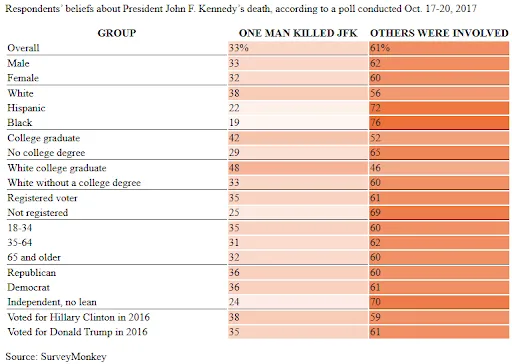
Do they really believe that? Or are they inclined to answer a certain way when speaking with a pollster? It’s difficult to say.
Conspiracy theories, misinformation, and disinformation are treated as a danger, emanating from a political extreme or radical position. Certain establishment news outlets have entire sections dedicated to tracking conspiracies. The bourgeoisie is terrified that with the internet and social media, people no longer believe in the corporate news and academia. The American people no longer respect the bourgeoisie’s “integrity, experience, and prominence” and for particularly good reasons. The contradictions in class society have accelerated this collapse of belief, particularly among America’s youth.
In response to these trends, the bourgeoise has tightened their fist. Social media apps like Twitter and TikTok were privatized and placed in the hands of military-intelligence connected executives. In turn, the algorithms have become increasingly censorious, forcing the working-class users to invent all sorts of creative linguistic innovations to continue to have their voices heard.
My main concern is that many socialist organizations, writers and influencers shy away from so-called “conspiracy theories.” The people are yearning for truth. They want to know why things are the way they are. They’re open to reexamining American history to understand how we got here. More people are beginning to correctly conclude that American “Democracy” is a lie, the corporate press and parties only serve the interests of the rich, and oftentimes, that the perpetrators of some of America’s foremost high crimes are from the imperial state itself. If socialists do not offer a political indictment of these high crimes, or find a way to connect these actors, organizations, events, to our theories of political economy then we leave that counter-history space open. People who want to know why America’s relationship with Zionism is what it is, who Jeffrey Epstein was, who assassinated JFK, who was responsible for the 9/11 attacks, and on and on. If socialists do not investigate hidden histories and do not offer any analysis of substance about them, then people who are pursuing those answers will find them on the political right. Fascists will seize this terrain and guide people towards an analysis skewed with ethno-nationalistic mysticism.
Some argue that these deep dives into investigating the clandestine organizations, bourgeois criminality, and the lumpen parastate are somehow a diversion away from dialectical materialism. I’d argue that this “anti-conspiracy” leftist thought is a type of economism that only believes in blind economic forces. Understanding the intentionality and organization of our class enemies is important because it also demonstrates the need for intentionality and organization of our own class.
What’s new is the size and scope of clandestine forces operating throughout the world, but it is not new in the class struggle. In The Eighteenth Brumaire, Marx shows how Louis Bonaparte III conspired in secret using blackmail, spies, false documents, midnight arrests to overthrow the National Assembly. In Capital Vol. III, Marx invokes secret fraternal society when explaining how the bourgeoise operates in the chapter on the Equalization of the General Rate of Profit Through Competition:
Here, then, we have a mathematically precise proof why capitalists form a veritable freemason society vis-a-vis the whole working-class, while there is little love lost between them in competition among themselves.
When Marx wrote of the French bourgeoisie in the Civil War in France, does this not perfectly describe our own bourgeoisie today?
Since the finance aristocracy made the laws, was at the head of the administration of the state, had command of all the organized public authorities, dominated public opinion through the actual state of affairs and through the press, the same prostitution, the same shameless cheating, the same mania to get rich was repeated in every sphere, from the court to the Café Borgne to get rich not by production, but by pocketing the already available wealth of others, Clashing every moment with the bourgeois laws themselves, an unbridled assertion of unhealthy and dissolute appetites manifested itself, particularly at the top of bourgeois society – lusts wherein wealth derived from gambling naturally seeks its satisfaction, where pleasure becomes crapuleux [debauched], where money, filth, and blood commingle. The finance aristocracy, in its mode of acquisition as well as in its pleasures, is nothing but the rebirth of the lumpenproletariat on the heights of bourgeois society.
In Russia, contending with an Okhrana conspiracy was a key part of the struggle and a section of Lenin’s What is to be Done? is specifically focused on contending with the secret police’s plots. Between 1901 and 1903 Iskra alone published thirty-eight reports on Zubatovism, including twenty designed to expose Zubatov's [Head of the Okhrana] "attempts to corrupt the Moscow workers politically"... Bauman remarked that "police corrupting [industrial workers] is more terrible to us than is police brutality.” One of the tactics the Okhrana used was to teach the workers revisionist theories from thinkers like Eduard Bernstein, Sidney Webb, S. N. Prokopovich, and Werner Sombart. I feel like it’s particularly noteworthy to emphasize that point as we continue to see extended debate and discussion about how relevant it is that certain prominent theoreticians and academics were funded by the CIA in the Cold War.
It is our responsibility to incorporate bourgeois criminality into our political indictments. The capitalist conspiracy against the people is real. To quote Carl Ogelsby: “Conspiracy is a formalized practice of an entire class in which a thousand hands spontaneously join. Conspiracy is the normal continuation of normal politics by normal means.” To struggle for a democratic future, we must maintain a people’s history unfettered by bourgeois gatekeepers. Now is not the time to shy away from hidden histories.
Ray F
Liked it? Take a second to support Cosmonaut on Patreon! At Cosmonaut Magazine we strive to create a culture of open debate and discussion. Please write to us at submissions@cosmonautmag.com if you have any criticism or commentary you would like to have published in our letters section.