Jihadists Under Attack and Strike Back
NOTE: All parenthetical citations refer to pages from Ch. 6, The Study of the Insurgency in Anbar Province.
Recap
When we last looked at Mujahidin Shura Council (MSC)–which had formally subsumed Al Qaida in Iraq (AQI) in January 2006–the organization was at its strongest point yet.[1] By the end of August 2006, MSC was the undisputed hegemon in Anbari society despite significant pressure from the Coalition, whose operations could only suppress the insurgency. One Marine colonel even privately assessed that the Coalition was “no longer capable of militarily defeating the insurgency in al-Anbar.” Perhaps most troubling, MSC’s fighters were already speaking of the hoped-for Caliphate as a reality on the ground, referring to Ramadi (AQI’s HQ) as its capital.
Having consolidated its power in eastern Anbar (and other key Sunni regions of Iraq), MSC prioritized restoring its presence in western Anbar, from which it had been evicted in 2005 by the Albu Mahal tribal revolt and sustained Coalition operations. MSC expanded its manpower in the region by recruiting locals, trafficking foreign fighters, and shifting manpower from strongholds like Bayji in Salahuddin Province. In the corridor between Hit and Rawah, AQI delegated eight leading members of MSC to increase recruitment, finances, and strikes to restore AQI’s power in the western Euphrates River valley. In Haditha, MSC cooperated with its local allies through the Haditha Mujahidin Shura to triple attack frequency, while in Anah, AQI crushed the Iraqi Islamic Party, which was the local Muslim Brotherhood branch. In Rutbah, AQI copied the playbook it used in Ramadi–that is, IEDs, sniper placements, ambushes, and swarms–to become the most powerful insurgent group in the city. This was largely because most AQI fighters in Rutbah were, in fact, fighters re-deployed from Ramadi, where AQI was already well-established. Meanwhile, to the east in Fallujah, AQI waged a brutal murder and intimidation campaign to compensate for its organizational weaknesses in the city. Through this, it was able to repress city police and exert its influence on the population of not only Fallujah but its peripheral towns as well.
Tribal Infighting
Yet, at the same time, as a direct result of this power, more and more Anbaris began to chafe under and eventually resist MSC’s reign. Early signs of this were the Albu Mahal revolt in Al Qaim during the summer of 2005. AQI had crushed the Albu Mahal but the underlying causes of tribal disgruntlement remained. Its center of gravity shifted from Al Qaim to Ramadi. By late summer of 2006, anti-AQI resistance in Ramadi began to manifest as tribal wars between pro- and anti-AQI tribes, as in the Albu Ali Jassim’s war on the AQI-aligned Albu Ubayd. AQI’s re-deployment of fighters from Ramadi also engendered tribal resistance, as in the Jazirah region where local tribes formed militias to dissuade further AQI aggression. In some cases, tribal warfare even took the form of civil wars between sub-tribes that supported and opposed MSC, as was the case with the Fuhaylat and Owesat sub-tribes of the Albu Issa. These civil wars often had a class dynamic as well:
The subtribes of Amariyah and Ferris Town were relatively wealthy in comparison to the Albu Issa subtribes and agrarian Zobai tribe of Zaidon. Many members of the poorer tribes were persuaded by AQI promises of money and power to support the group against members of the more privileged tribes. As a result, the Fuhaylat and Olyhat subtribes of the Albu Issa as well as the Zobai tribe supported AQI while the Manasir and Albu Hadir subtribes of the Albu Issa supported the Coalition. (129)
A deeply pernicious consequence of tribal civil wars–and the resulting decapitation of tribal leadership–was the guaranteed flow of recruits to AQI and severely undermined government authority. Salafi tribesmen (e.g., of the Zobai or Fuhaylat sub-tribes) would enlist in AQI to leverage the group’s resources while continued tribal conflicts weakened the power of local Iraqi army and police units. The victory of any one side would end both processes. AQI, therefore, had direct incentives to indefinitely perpetuate tribal warfare. However, such deep rivalries cut both ways, as AQI would discover when, in early September, one AQI leader assassinated three other AQI leaders to settle tribal rivalries. One of the killed leaders was a senior AQI figure, called Abu Uthman, whose death increased the workload on a surviving senior operative. Abu Uthman himself was a veteran planner in the Jazirah region. These trends of tribal opposition to AQI would eventually coalesce in early September under the Sahwa councils, or Sahawat (“Awakenings”), but this would not take root for several months.
Interestingly, MSC’s connections to global jihadism meant that in some cases, hyper-local tribal conflicts could intersect with transnational jihadist networks.
At least some of the AQI fighters operating in the Albu Issa tribal area apparently had the benefit of training at foreign terrorist camps. For instance, Fuhaylat AQI leader [REDACTED] was a Sudanese national[2] who had received at least sixteen months of training at the Sudan National Defense Camp, including forty-five days at the Islamic Jihad Combat Camp where he was taught how to use Hawn-60 rockets, RPGs, RPKs, and 9mm pistols. [REDACTED] led a group of AQI fighters that reportedly numbered as high as 250, including a significant number of foreign fighters from [Syria], Saudi Arabia, and Algeria. (130)
It would be a mistake to assimilate these networks under the Al Qaida umbrella. In reality, they were part of the Salafist International (discussed elsewhere on this page), in which the Al Qaida affiliation was at a premium. That is to say, belonging to AQ guaranteed support within the International but it was not a necessary prerequisite for such support. Any jihadist with appropriate credentials and references could secure assistance from the Salafist International.[3] In some instances, AQ could be “just” another link of the International. For example, in Sudan, Al Qaida operated at the behest of local Islamic and jihadist networks, which continued to operate well after Al Qaida had been expelled from the country. Sudanese networks were almost certainly the nexus between networks across North Africa (in this case, Algeria) and in Saudi Arabia. MSC was thus merging prominent elements of regional jihadist networks under its authority.
Disorganization Among AQI’s Rivals
However, despite the growing tribal resistance to MSC, formal challenges to the organization remained quite weak. For example, one anti-AQI group was Harakat al-Islamiyah, which primarily operated in Ramadi. Its original leader had first disbanded it in December 2005 to make a career in Iraqi official politics. The group reformed in spring 2006, headed by several brothers (names redacted), whose leadership skills were wanting:
The evolution of these brothers shows one of the significant changes within AQI since the death of Zarqawi. Perhaps influenced by an AQSL desire to exert more control and centralization over its far-flung associate groups, AQI began to demand that members swear bayat [pledge of loyalty] to its leadership. The [REDACTED] brothers had earlier been associates of AQI leader but when they refused to accept AQI leader [REDACTED]’s offer to swear bayat to AQI began targeting the brothers’ home in the Albu Jdayi tribal area of the Jazira with IEDs. Other Harakat al-Islamiyah leaders such as [REDACTED] accepted the offer, providing information on the locations of Harakat al-Islamiyah members to AQI. In late May, the brothers were forced to flee to [REDACTED] after Salah was shot by AQ. (131)
In reality, AQI’s push for loyalty pledges was not at the behest of AQ Central. AQI had been a pledged member of the global AQ network since October 2004, yet it repeatedly and flagrantly disobeyed the central mother-ship. A new push for pledges would not have granted AQ Central any further control over its Iraqi branch. However, it would permit AQI to exert more control within Iraq. The impetus for these pledges was clearly the growing resistance to AQI’s authority and the resulting suspicion AQI felt towards other Sunni insurgent organizations.
The 1920 Revolution Brigades were most afflicted by organizational disruption. By August 2006, it had split into four different competing splinters. The Brigades were split on multiple levels. In April 2006, it first split on the issue of engaging the Iraqi government. On each side of the split were two different sub-factions. On the pro-engagement side, the factions disagreed on the issue of sectarian violence–that is, whether or not to partake in it. On the anti-engagement side, the factions disagreed on AQI, with one supporting AQI on a tactical level and another supporting the Iraqi National Dialogue Front. This reflected the highly degraded state of non-AQI Sunni leadership in the country. Those engaged in the official political process had achieved nothing for their effort, at most profiting personally through corruption, further delegitimizing politics. Meanwhile, non-AQI insurgents “were increasingly confronted with the futility of their efforts as their once-robust nationalist groups were subsumed or marginalized by AQI, their attacks on Coalition and Iraqi forces failed to yield any definitive results, and the Shi’a militias continued to grow stronger.” (132) In this respect, AQI’s intransigent ideology was a distinct advantage.
AQI on the Offensive
In response to such resistance, AQI increased the scale and scope of attacks on their rivals, particularly in Fallujah. The organization expanded its murder and intimidation campaign in the city. Within the insurgency, it assassinated a prominent rival insurgent leader from Jaysh al-Mujahidin. To disrupt the (already weak) Fallujah municipal government, AQI assassinated a Brigadier General and the city council chairman, alongside his son. Similarly, it murdered several prominent imams who opposed AQI or refused to preach its message. The group especially targeted the Fallujah police with unrelenting force, rendering it totally ineffective. Interestingly, in some villages and neighborhoods of Fallujah, AQI posted fliers at gas stations. The fliers urged police officers to “repent” and avoid murder by turning over their weapons and gear to AQI operatives working at the gas stations, which incidentally reflects AQI’s strong presence in the Anbari energy sector. In total, the murder and intimidation campaign in Fallujah targeted one hundred prominent individuals with varying punishments (e.g., execution, abduction, etc.).
An even more disturbing dynamic in MSC’s campaign in Fallujah was its infiltration of the municipal government, which in turn compromised the national government. It is worth quoting the Study at length:
AQI collected intelligence on the Fallujah city council activities and the contracting process through [REDACTED] a former contractor. [REDACTED] reported the names of any individual awarded a major contract to local AQI leaders along with the cash value so that AQI extortion cells could determine the appropriate amount of money to demand from a given contractor without derailing the project.
One of AQI’s most highly-placed intelligence agents in Fallujah was [REDACTED], a former 1920 Revolution Brigade member who had since joined AQI. Using his old contacts in the 1920 Revolution Brigade, he provided AQI with intelligence on Fallujah city council meetings and Iraqi government meetings on the national reconciliation plan. More alarming, however, was that [REDACTED] used his long-time friendship with Deputy Prime Minister Salam al-Zobai to obtain information for AQI on how the Iraqi government planned to de-escalate sectarian tensions and defeat the insurgency. All this information was reported to AQI senior leader [REDACTED] and used by the AQI leadership to adapt their tactics and strategy in order to undermine the Iraqi government in Anbar.
Fallujah city council vice chairman Qassam Muhammad Abdul Sattar, the head of the town’s Democratic and Human Rights Studies Center, also retained ties to AQI, reportedly providing money to AQI financier [REDACTED] to be dispersed to the group’s various cells in Fallujah. (134-35)
Although unsaid here, the Iraqi government’s rank sectarianism and general dysfunction incentivized government employees and officials to act as moles for the insurgency.
Elsewhere in Anbar, like Anah and Rawah, MSC escalated its campaign against the Iraqi Islamic Party (IIP), which it viewed as treacherous infidels due to its pro-Coalition stance. MSC soon realized that the brutality of its anti-IIP campaign was counter-productive, so it began warning local business owners in Anah of imminent attacks, thus reducing civilian casualties. Meanwhile, for the IIP itself, MSC made little effort to hide its hatred, oftentimes abducting key members and leaving their severed heads in front of mosques. The lack of beheading videos from this period (2006) has led many observers to mistakenly conclude that AQI ceased beheading its opponents. In fact, it merely ceased filming the beheading of its opponents. Eventually, the IIP branch in Anah formally disbanded, turning the city over to AQI. This placed significant pressure on the IIP and municipal government in Rawah. Initially, AQI ordered local IIP members to turn over their weapons. Once rebuffed, it commenced attacks, but it repeated measures from Anah by giving prior warning to local business owners of coming attacks. It also minimized property damage with strategic IED placement. This endeared it with the Rawah business community. Eventually, the city council informally disbanded, placing greater pressure on the severely degraded Rawah police.
Foreign Fighters & Financing
Amidst the sustained offensive in Anbar, MSC also re-strategized the recruitment of foreign fighters, leveraging vast international networks to traffic fighters into Iraq. Recruitment began online, primarily on jihadist forums, where potential recruits could reach out to recruiters through email. Recruiters would then send detailed instructions on local cells, secure contact methods, and meeting locations. Once contact was made, recruits would be moved to safe-houses within their country of origin for ideological indoctrination and operational security. They were then moved to safe-houses in another country, where they stayed for roughly six weeks, before moving to yet another country (almost certainly Jordan and Syria) before eventually entering Iraq itself. The various cell leaders, safe-houses, traffickers, etc. acting in concert all point to extremely sophisticated transnational networks (the Salafist International).
Once inside Iraq, the foreign fighters were often smuggled to the Hasiyah and Khawabra areas of Karabilah. A majority of the Albu Khawabra subtribe were Wahhabis who supported AQI and allowed foreign fighters to stay in their home for one or two nights before moving on. Another popular destination for foreign fighters entering Iraq was Ribat, where residents benefited financially from the smuggling of foreign fighters from [REDACTED]. (137)
The extent of international ties are shown by the significant links between MSC and jihadists in Algeria, particularly GSPC (Groupe Salafiste pour la Prédication et le Combat), which in September 2006 had become AQIM (Al Qaida in Islamic Maghrib). This is partially reflected in the Sinjar Records, which show a notable Algerian presence.[4]
The [REDACTED] GSPC, which had pledged bayat to AQSL in early September 2006, now became heavily involved in the smuggling of trained GSPC fighters and other Islamists into Iraq. After the GSPC swore bayat, [REDACTED] took steps to link the two groups’ facilitation networks, increasing the number of Algerian foreign fighters coming to Iraq to serve as suicide bombers. The [Algerian] recruits were sent to an AQI facility in [REDACTED] that doubled as a hotel and restaurant, from which AQI operative [REDACTED] aided their entry into Iraq. (137)
The biography of Abu Radwan al-Tunisi offers clues into how Algerian recruits may have made their way to Iraq. I suspect Sudan was an especially central node in the trafficking networks.
MSC’s international ties are also shown through foreign financing, particularly from Saudi Arabia. The group extensively used front companies and fraudulent bank accounts, but a major channel of funds was in-person transactions, that is, physically carrying money to Iraq. “For instance, [Saudi] NGOs supplied money to AQI through Hajj pilgrims.” (138) Further,
[REDACTED] sources reportedly provided the group with $2-3,000,000 [!!] a month. Wealthy [Gulf?] donors and other AQI and AQAM supporters in the Middle East and Europe continued to provide financial support to the group, but AQI was increasingly adept at raising money inside Iraq through kidnapping, vehicle theft, extortion, and oil smuggling operations that guaranteed the group’s continued financial survival and vitality even in the event that the Iraqi government was able to curtail or eliminate its external funding. (138)
By far the most significant domestic source of financing was oil.
Illicit Oil Economy
The heart of MSC’s illicit oil operations was the Bayji Oil Refinery in Salahuddin Province (previously discussed here and here). Oil that was loaded into trucks in Bayji would either be exported to Syria or resold in domestic black markets. Oftentimes, oil would be directly siphoned off from pipelines, like in Tikrit, then sent off for export. AQI even controlled two major oil transportation companies that had official contracts with the Iraqi government. For instance: “The al-Shira al-Abiyad Company was, of course, owned by AQI operative and his associates through the Ebkitar Investment Group, a company that was in turn heavily involved in both legal and illicit export activities and maintained a legitimate contract with the Iraqi ministry of oil.” (139) Oil was primarily exported to Syria through the Waleed border crossing, where AQI paid off or threatened guards into compliance.
The profits from the illicit oil economy were primarily invested in car bombs (or VBIEDs), which were MSC’s most devastating, and so most expensive, weapon. Illicit oil and VBIED manufacture were perversely complementary:
There was an interesting relationship between AQI’s oil smuggling industry and its VBIED manufacturing. AQI recruited [REDACTED] the executive officer for the 2nd Strategic Infrastructure Battalion to carry out a VBIED attack against an oil pipeline near Bayji. This attack decreased the supply of oil and increased the demand for black market petroleum, with the increased demand ensuring high black market fuel profits that financed AQI activity throughout Anbar. (139)
Meanwhile, the Iraqi government was largely helpless when it came to oil due to either fear of AQI or to systematic corruption. For instance, an investigation was launched on 16 September to understand the disappearance of 1.5m liters of kerosene. A key director at Bayji Oil Refinery was identified as a suspect, but the case was closed because government officials feared being killed by AQI–and being exposed as complicit in oil theft. Indeed, the deputy minister of oil was himself deeply implicated in this illicit trade, being paid $35,000 a month to facilitate oil smuggling. Ministry employees largely resented and obstructed the national government’s efforts to re-assert control over oil, which further worsened the crisis. The situation in Ramadi was especially perverse. One unnamed individual had positioned himself such that he was indispensable to both the provincial government and AQI, making him immune to threats from either side. This allowed him to massively enrich himself while (literally) fueling AQI’s activities in the city and paralyzing the provincial government’s energy efforts.
The Sahawat Is Born
The Tribes Awaken
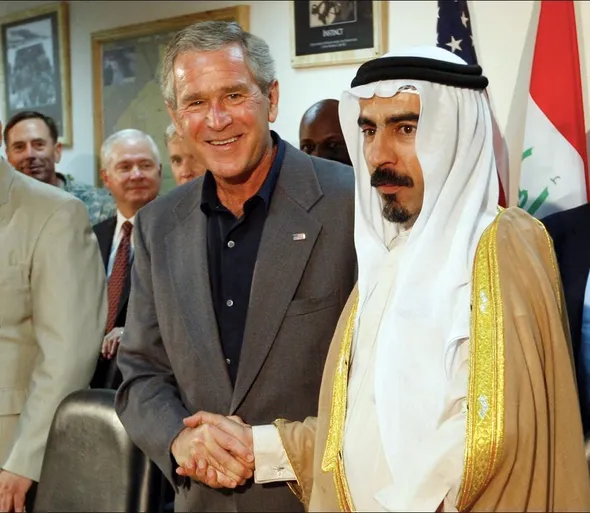
In early September 2006, several key leaders from important Ramadi tribes–the Rishawi, Hardan, Dhiabi, Ubayd, and Iliyawi–convened to form and announce the Anbar Emergency Council, commonly called the Sahwat al-Anbar–or simply the Sahawat.[5] Its goal was to fight the insurgency and replace corrupt or malicious figures in the Anbar provincial government. The Council “consisted of forty-one sheikhs of various ranks from seventeen Anbari tribes, with the tribes of the greater Ramadi area making up a substantial majority. Nine sheikhs hailed from western Anbar, including the powerful Albu Mahal and Albu Nimr. Only two sheikhs from Khalidiyah were represented and there was no representation from the tribes east of the Thar Thar Canal such as the Zobai or the Albu Issa.” (142) The inclusion of the Albu Mahal and Albu Nimr was immediately notable, as these were the first tribes to rise up against AQI. The Albu Mahal in particular paid a high price for their initial rebellion during the summer of 2005.
The idea of a tribal emergency council was not new, as it had been first suggested in November 2005, with its earliest roots being the aforementioned Albu Mahal rebellion (discussed here). There had been previous attempts at forming such a council, like the Anbar Central Council in July 2006, which had tried to unite various Sunni political and non-AQI insurgent forces into one bloc. It failed due to internecine squabbling and competing interests. This ultimately led to the Sahawat’s formation, but the problems afflicting the Central Council were present here as well. An additional concern was the Sahawat’s dubious legality and the implicit political threat it posed to the national government. Although the two Councils had essentially the same goal–uniting Anbari Sunni politics against AQI and in the Iraqi national government–they had different organizational characters. The Sahawat was a tribal outfit, representing Sunni tribal interests as such. The Central Council was a technocratic body, perceived by its rivals as marginalizing tribal authority to secure its own place in Baghdad.
The Emergency Council’s questionable legal status raised alarms as it operated in parallel to the Anbari provincial government, which, by this point, had simply ceased to function while not being an official political entity. The Council, therefore, requested Prime Minister Nuri al-Maliki to legitimize its existence according to a constitutional clause–that is, “to delegate federal authority to the Council so that they could appoint themselves [as provincial government].” (143) The dynamic between the Sahawat and the Anbari government is best seen by two meetings. The first, held on 12 September, convened the Anbari provincial council to appoint a new deputy governor. It had no practical relevance. The second, convened by the Sahawat on 14 September, brought together several major tribes:
At the meeting, the sheikhs planned to establish a new governing body for Anbar with forty-eight members. Sheikh Abdul Sattar was elected the new governor of Anbar, Sheikh Hamid Farhan al-Heis was made the new chairman of the provincial council, and Brigadier General Hamid Hammad Shawka of the Albu Dhiab tribe was made the new provincial police chief. The Anbar Emergency Council then drew up a plan for establishing security in Anbar that was sent on to Prime Minister Maliki and the interior ministry for approval. (143)
The Sahawat formed a parallel government and presented it to the Iraqi national government as a fait accompli.
The Emergency Council’s origins were essentially rooted in the threat AQI posed to tribal authority in Anbari society, whether financially by seizing control of the underworld economy, or politically by killing any and all rivals to its Salafi Jihadist project. The first instance of this was in Al Qaim region in 2005, which AQI had transformed into a jihadist emirate, (literally) decapitating all tribal rivals and seizing smuggling rackets for itself. This current iteration was centered in Ramadi, which had become MSC’s unofficial capital.
The creation of the Anbar Emergency Council was largely motivated by the desperation of the tribal leaders to rid Ramadi of AQI. In their view, AQI’s ruthless attacks and violence had ripped apart the fabric of Anbari society including the authority and influence of the tribal sheikhs. Moreover, the money that had traditionally gone to the sheikhs was now flowing directly to AQI. They feared that if left unchecked AQI would cripple the traditional tribal system throughout Anbar and therefore directed their anger against Governor Mamoun and the Anbar provincial government, whom they regarded as corrupt and incapable of curtailing AQI in Ramadi. These same sheikhs intended to use the Anbar Emergency Council to install themselves as the new provincial government in order to rehabilitate their prestige, ensure their personal security, rehabilitate government institutions, and most importantly eject AQI from Ramadi. (143)
This dynamic was embodied in the person of Shaykh Abdul Sattar Abu Risha, a key member of the Emergency Council. More than anyone else, this man led and represented the Sunni Awakenings.
Abdul Sattar Abu Risha was the son of a prominent Albu Risha family, and his career during the insurgency primarily hinged on how he could most effectively turn a profit. Early during the war, in 2003, he worked as a contractor for the Coalition, creating favorable connections that he used to secure smuggling routes between Iraq and its neighbors. He soon began pilfering weapons from warehouses and stockpiling for his own ends. It was in this criminal capacity that Sattar, through the AQI-affiliated al-Nu’man brigade, became involved in AQI’s oil smuggling operations at the Walid crossing point on the Iraqi-Syrian border. He also soon became involved in weapons smuggling operations as early as August 2004. By all accounts, Sattar’s involvement was purely motivated by money. In this respect, he was typical of many, if not most, tribal figures in Anbar, and there is little indication that he planned to make any changes. The essentially parochial and parasitic social role of the tribes is difficult to miss here–neither is the reason for AQI’s utter disdain for the tribes.
In any case, fate had other plans for Sattar. Through his time as a smuggler, Abu Risha’s father, Bezia Ftaykhan (chief of the Albu Risha tribe), had maintained friendly ties with the Coalition, whose officials he often hosted at his home in Ramadi. It was due to these ties that Sattar never came to view the Coalition as an implacable enemy to be destroyed–he never moved beyond his essentially parochial tribal outlook. AQI soon viewed Bezia as a traitor and killed him in November 2004, during the peak of the Second Battle of Fallujah. With Bezia and his eldest son Abdullah dead, Sattar suddenly became Shaykh Sattar, chief of the Albu Risha tribe. He soon began paying Anbari tribesmen to transport weaponry to his home in Ramadi on the pretext of supposed Coalition orders. This was false, but it did not displease the Coalition, which told Shaykh Sattar to keep stockpiling weaponry. From this point onward, he traveled everywhere with a heavily armed convoy of fifty men for protection. After AQI had been expelled from Al Qaim, it re-based in Ramadi, growing in power in the second half of 2005. In response, Shaykh Sattar joined other Ramadi tribal leaders in forming the Anbar People’s Committee. Most other leaders of the Committee were assassinated, but Sattar survived, leaving him as the Coalition’s most prominent Sunni tribal ally.
The Awakenings Coalesce
The Sahawat soon gained the support of Harith Dhahir Khamis al-Dhari (whose name is censored in the Study, a key leader of the 1920 Revolution Brigades (or what remained of it). He began attending meetings and pushing for his fighters in Harakat al-Islamiyah to join the Iraqi army and police forces. Dhari’s pivot to the Sahawat was motivated by his defeat to AQI early in 2006. More broadly, his pivot represented the capitulation of the non-jihadist Sunni insurgency, which by this point had shrunken significantly in size and influence. MSC was the beneficiary of this process. It was rooted in several factors, primarily political. As I wrote previously:
AQI’s fanatical rejection of imperialism in every respect made it stand out in comparison to other groups, which held halfway positions in attempts to balance the national liberation struggle and their own efforts to secure favorable positions in the new order. Among ordinary (Sunni) Iraqis, the new order had no legitimacy, being as it was the artificial creature of the hated invader. Any possible enticements had little or no appeal. What could an average tribal fighter gain from the Coalition-installed government that he could not get from a free Iraq? The only organization stridently committed to this goal was AQI. Its rhetoric was backed up by impressive battlefield credentials, killing and wounding far more Coalition and Iraqi quisling forces than every other group.
Upon his defeat within the insurgency, Dhari realized that his only remaining choice was to defect to the Iraqi national government. In this way, he could neutralize AQI (with the Coalition’s support) and secure a favorable position in the new order, especially in his native Ramadi. Dhari’s support for the Sahawat highlighted a key difference between it and previous attempts to politically unify Sunni tribes against AQI: namely, that the Sahawat were highly armed and could fight back against AQI. Its armed wing was the Anbar Revolutionaries, which had formed in the Summer of 2006 to fight AQI. It recruited Iraqi police forces, mobilized tribesmen, and anti-AQI insurgent groups like the Islamic Army of Iraq. It was during this time that the Iraqi police in Anbar and other Sunni regions began to meaningfully stand up to AQI after years of brutal repression. For the first time, AQI faced sustained and significant Sunni resistance, drawn from its own social base.
The Anbar Revolutionaries initially began as a loose network of militias, but it soon matured as an organization. The Study is worth quoting at length here:
Despite AQI’s move against the Anbar Revolutionaries, the group continued to grow by absorbing several of the smaller anti-AQI groups. The group was organized into militia, intelligence, propaganda, and assassination units and its propaganda campaign encouraged the use of the names Justice Group, Punisher Brigade, Anger Militia, and Right Truth in place of Anbar Revolutionaries when claiming attacks in order to make AQI believe that it had more enemies than it actually did. A majority of its recruits were drawn from the immediate families of victims of AQI attacks, former Iraqi intelligence or interior ministry officials, and SAR insurgents who had become disenchanted with AQI. Members of the Anbar Revolutionaries who served in the Iraqi police force were allowed to continue their professional careers, while unemployed members of the group were encouraged to join the Iraqi police in their own hometowns. The group also received the support of more than thirty tribes in western Iraq and even some individual cooperation from the Iraqi government. Nevertheless, the Anbar Revolutionaries were wary of government corruption and preferred not to be endorsed by any particular ministry; thus its members always remained anonymous when dealing with Iraqi officials. (147-48).
This last move was particularly prudent, as it distanced the Sahawat from the government’s hideous conduct, making it that much more appealing to other Sunni tribes. Interestingly, its increasing closeness to the Coalition was not as politically toxic as one would expect. Among many Anbaris, the Coalition was perceived as a lesser evil to the Iraqi national government. Unlike the latter, the Coalition was not directly involved in rampant sectarian violence–like the sectarian cleansing of Baghdad–which ingratiated it with many Sunnis who had grown weary of AQI.
This meant that the Sahawat and the Coalition could cooperate militarily. Such efforts bore fruit on the streets of Ramadi, where the Coalition, the Anbar Revolutionaries, and Harakat al-Islamiyah fiercely battled AQI. For the first time in months, it successfully suppressed its activity in the city. Dozens of MSC fighters were killed. As a result, the number of daily attacks dropped from forty-five during the first week of September to twenty-three during the last week of the month. The number of IEDs also dropped from thirty-three to twenty-four, although the number of DF [direct field] attacks increased from forty-nine to eighty-seven.” (148) However, AQI was not deterred. It correctly thought that any tactical withdrawal from Ramadi (as had transpired several times earlier in 2006) would now be viewed as a defeat. This time period was especially critical, as Ramadi was an essential support front for MSC’s campaign in Baghdad. MSC thus intended to hold Ramadi at all costs and would defend it in a grueling months-long battle.
Returning to the Anbar Revolutionaries, its efforts gained a major boost in late September, when it partnered with the Iraqi television station al-Iraqiyya. The partnership entailed that al-Iraqiyya would have exclusive media access to the Revolutionaries, being able to embed among units, cover its military and political efforts, and release its media. The Revolutionaries’ initially provincial efforts now had the national spotlight, constantly broadcasting their message to all of Iraqi society, with special importance to other Sunnis.
The result of the al-Iraqiyya coverage was that the Anbar Revolutionaries’ anti-AQI crusade in Ramadi attracted support from a wide range of Anbari Sunnis, Baghdad residents, tribal leaders in other provinces, and Iraqi politicians. This support was highly unusual in its unanimity, but should have been expected, given the almost universal hatred of AQI. Unlike contentious issues such as sectarian death squads or the status of Kirkuk, the story of the Anbar Revolutionaries was universally attractive to the average Iraqi regardless of race, sect or religion because it involved Sunnis attacking Sunni extremists in a Sunni province. This allowed the Kurds and the Shi’a, who had been the primary victims of AQI, to cheer on the Sunnis while at long last giving the Sunnis a reason to express solidarity with their fellow Iraqis. (149)
The framing of this passage is somewhat misleading. The key points are largely correct, but the slant, particularly in the last line, suggests that Sunnis were the problematic element in Iraqi society. In one sense, this was true–Sunnis were the mass base of the insurgency and the war for Iraqi national liberation. By definition, they were the disruptive element. However, in another sense, Sunnis were not simply withholding solidarity as the Study author implies. Since the fall of the Baathist government, Sunnis had been subject to a highly sectarian government, which persecuted them either politically (through de-Baathification) or militarily (through death squads).
Iraqi Political Crises
This was the root of deep Sunni apathy and disaffection with Iraqi national politics, in this case with the premiership of Nuri al-Maliki, whom they (correctly) perceived to be pushing a viciously sectarian agenda.[6] Throughout 2006, the main paths for Sunni politics were acquiescence to the new order, open war with the government and Shiites, or intransigent opposition in official politics. The first option was dismissed out of hand by virtually all Sunni political forces, which viewed the new order as inherently illegitimate. The second option was led by MSC, whose hideous atrocities and ideology steadily degraded its appeal. The third option was pursued by most non-jihadist Anbari leadership. All three reflected an essentially gloomy political outlook–but this would dramatically change with the Anbar Revolutionaries, which marked a true grassroots Sunni political movement that rejected MSC while advocating for Sunni interests.
Yet the Iraqi political system remained beset by crisis, with the latest being a coup plot from the Iraqi National Dialogue Front (INDF). Although the INDF was originally intended to be a non-sectarian nationalist bloc in the Iraqi parliament, by September, its main leader had formed a shadow government with the aim of overthrowing Maliki. The INDF’s armed wing, the General Command of the Secret Armed Forces, was central to the plot. The Command’s existence was unknown to most INDF leadership, except for two key leaders. They planned to formally request parliament to dissolve the Maliki government and appoint them as the new Iraqi national leaders. If and when parliament rejected their request, the General Command would activate to militarily overthrow the government. By late September, several anti-AQI insurgent groups (e.g., 1920 Revolution Brigades, Jaysh al-Fatihin, Jaysh Muhammad) had pledged to provide fighters and other support to the coup. Yet, at no point did the General Command ever possess the means to actually overthrow the Iraqi government. Its true role was to bolster the INDF’s political power with the threat of force.
More importantly, the plot was patently delusional, as its central planner strangely believed that he could secure the support of the US and UK. When these countries rebuffed him, he unsuccessfully lobbied various Arab states (primarily in the Gulf) and the European Union for support. This INDF leader’s search for foreign backers reflected his precarious political position within Iraq, as leaders in the INDF (let alone in other blocs) had sought to oust him from leadership. They correctly viewed him as hopelessly removed from the INDF’s true problems. Shiite political blocs naturally despised him, while Kurds resented his Arab chauvinism. His grandiose schemes were halted, but he continued to be a source of instability in the already crisis-ridden Iraqi political system.
Sectarian Bloodletting
Another, far more serious crisis came on 21 September, when the Mahdi Army abducted and executed twelve Anbaris attending a wedding in the mixed neighborhood of Mashtal in Baghdad. This was amidst the sectarian cleansing campaign then-ongoing in the city, in which the Mahdi Army, the Badr Brigades, and the Iraqi Interior Ministry were intimately involved. The atrocity naturally enraged Anbari tribal society. The Anbar Emergency Council convened an urgent meeting, where tensions ran high. “Proposals by the attendees focused on reprisals, ranging from killing every Mahdi Army fighter their tribesmen could find, to demanding one hundred dead Mahdi Army fighters for every Sunni victim of the incident.” (151) The central figure was Shaykh Ali Hatim Suleiman of the powerful Dulaym tribal confederation. He had been an essential leader in Anbari political life, whether by managing Fallujah reconstruction funds or the compilation of candidates for provincial elections. He therefore played a key role in handling the reaction to the atrocity. However, Suleiman’s “moderation” revealed the disturbing extent to which murderous sectarianism had been normalized in Iraqi politics:
Sheikh Ali was able to exert a moderating influence on the enraged Anbari tribal leaders, enabling Anbaris to retaliate against the Shi’a under the auspices of AQI. While convincing Anbaris to assist AQI in sectarian attacks in Baghdad may not appear to be much in the way of moderation, it should be understood that there were Sunni tribal leaders who wanted instead to carry out tribal attacks under the banner of the Sheikh Ali and the Dulaymi confederation, which would have significantly escalated the level of sectarian violence. The result, then, was sizable but not uncontrolled reprisals against the Shi’a rather than all-out civil war. (151-52)
This episode also reveals the extent to which AQI had fused with tribal society and authority. Oftentimes, MSC fighters were “just” mobilized tribesmen rather than full-time operatives. Tribal fighters could and did work with AQI to settle sectarian scores. In a bizarre sense, AQI (and later Islamic State) occasionally acted as a militant tribal advocacy group, while at the same time undermining broader tribal authority as such. In this case, AQI served as a valid channel for tribal-sectarian rage, which could not be metabolized by normal tribal procedures. During the original insurgency (2003-08), the Zarqawist movement had not yet struck the right balance of undermining and merging with the tribes. By the second insurgency (2010-14), especially its latter phases, it had perfected this balance to devastating effect. Most notable was the transformation of Shaykh Ali Hatim Suleiman into an IS-collaborator (though he eventually would become a top target), providing tribal fighters during the IS sweep of summer 2014.
Returning to the Mashtal wedding massacre, this was one incident among many in the rising sectarian violence in Anbar and elsewhere, especially Baghdad. The Study assigns blame to AQI and the Mahdi Army. This is correct but incomplete and self-serving, implicitly suggesting that the Mahdi Army had gone rogue. In reality, its actions were part of a concerted sectarian campaign by the Iraqi national government. The Mahdi Army was joined by several Shiite militias (e.g., the Badr Brigades), which were all backed and supervised by the Iraqi Interior Ministry, with the tacit agreement of the Coalition. In Anbar, sectarian violence was concentrated on the town of Hamiyah:
Since early September, the Babylon Sakhr subgroup of the Mahdi Army had attempted to displace the Sunni population of Hamiyah, telling all the Janabi tribesmen in the city to leave or they and their families would be killed. The actions of Babylon Sakhr were designed to allow the Mahdi Army to expand its influence into religiously mixed areas of Iraq in order establish itself as the dominant influence of the Shi’a residents while expelling the Sunnis. (152)
The Janabi tribe was targeted because it was among the most influential tribes in Iraq, and many of its members belonged to AQI and Ansar al-Sunnah. It was therefore perceived to be an AQI-aligned tribe, even though 40% of its 900,000 members were Shiite.
Babylon Sakhr and other Mahdi Army subgroups regarded it as their duty to evict Sunnis from Shi’a areas in order to expand the group’s regional influence and suppress the threat of AQI and its allies from Anbar province. The Mahdi Army’s complete disregard for Sunni collateral damage resulted in Sunni families fleeing west into the Haditha area in an internal displacement pattern similar to that which occurred after the February 22 bombing of the Golden Mosque in Samarra. (152)
A key element of displacement was that uprooted families soon became highly radicalized and prone to recruitment to AQI. Having been personally targeted by Shiite militants, they had every motivation to join AQI to exact sectarian revenge. This directly increased AQI’s power and public appeal, which was sorely needed given rising Sunni resistance against it. In retaliation, AQI targeted Shiite mosques, neighborhoods, marketplaces, and any other popular gathering place to kill as many Shiite civilians as possible. In Baghdad, many of these attacks were orchestrated by AQI's dedicated death squad, the Umar Corps, and the MSC-affiliate group, Jund al-Sahaba, which specialized in mass-casualty strikes and was even more fanatically anti-Shiite than MSC. This same organization was likely responsible for the Golden Mosque bombing. During this period, AQI did not claim attacks with particularly high collateral damage, though it was clear who was responsible. Jund al-Sahaba’s role was partially to launder these strikes in its own name. This made little difference to ordinary Iraqis suffering the depths of sectarianism:
By late October, Shi’a militias were setting up checkpoints in the al-Thuru and al-Talibi districts of Baghdad as well as along Palestine Street to prevent Sunnis from traveling from Ramadi and other Anbari cities to the capital. Because of the poor quality of medical care in Anbar, many Sunnis were compelled to travel into Baghdad for any medical needs. The establishment of Shi’a militia checkpoints led to many Sunnis refusing to undertake the journey for fear of being murdered. (152-53)
A particularly disturbing tactic was the weaponization of the medical system, whereby Shiite death squads used ambulances as cover to abduct Sunni civilians. Similarly, death squads would issue calls for blood donations, then abduct any civilians who turned up. It was during this period that the infamous electric drill execution became especially prominent. The retaliation against Shiite civilians was enormous, oftentimes killing hundreds in individual attacks, typically car bombs.
AQI Shifts West
After AQI successfully destroyed the IIP and city council in Rawah and Anah, in late September 2006, its priority became disrupting Coalition presence in Haditha. AQI leaders from Hit, Haditha, and Anah decided to move operations away from Haditha to the Rawah-Anah corridor. This entailed placing IEDs all along the roads to Haditha, thus attacking Coalition supply lines and forcing them to withdraw entirely. Around this same time, AQI began destroying internet cafes in Rawah to prevent residents from supposedly viewing pornography and sharing intelligence with the Coalition. However, the decision to destroy internet cafes was counter-productive, “as AQI supporters were managing the wireless routers at the time of their destruction and thus able to monitor the server traffic of individuals on the internet using commercial software.” (153-54) This reflected the growing paranoia in the organization and its increasing hostility to its own base, of whom it consistently antagonized.
More broadly, this fit AQI’s effort to control all aspects of communications and establish an effective police state. It had first done so in Al Qaim in 2005, but this effort dramatically expanded in 2006.
For instance, AQI destroyed the land-line telephone switch in Haditha earlier in 2006 in order to deprive residents of the Coalition-sponsored “tip line.” Because of the tip line’s success, after the group had destroyed the telephone switch the local AQI intelligence cell began to plant informants at internet cafes to identify Coalition supporters who might e-mail information on AQI and to target them for assassination. The only alternative for Coalition supporters was to visit the Coalition physically, but Coalition bases were monitored by AQI operatives to identify potential informants and execute them. (154)
One gets a sense of MSC as a whole through the actions of the AQI-associate militia, the Abu Sarah Group, and of pro-AQI defectors from Islamic Army of Iraq (IAI).
Former members of the Islamic Army of Iraq led by [REDACTED] who were now loyal to AQI cooperated with the Abu Sarah Group, both of whom agreed not to attack, kidnap, or steal from any Iraqi Sunni except those who were members of the army or police. Instead, they focused their efforts on targeting Shi’a and [Syrian] truckers who were transporting weapons or commercial goods into Iraq. (154)
That these fighters agreed not to commit such abuses implies that they were the norm across the organization. Unfortunately, their sectarian agenda of “freeing” Iraq from “foreign” (Shiite) influences extended no such grace to Shiite civilians, who continued to be attacked. Although these fighters nominally still belonged to IAI, in reality they had broken ties with the organization, beginning in 2005, when mass defections to AQI began. By early 2006, the IAI in Anbar had been almost entirely subsumed by AQI, leading those still loyal to national IAI to form Jaysh al-Fatihin.
Sahwaji Squabbles
Petty rivalries continued to plague the anti-AQI Sunni political world. For instance, the Sunni Endowment came to challenge the Association of Muslim Scholars (AMS). The Endowment was a quasi-governmental entity responsible for maintaining Sunni mosques and employing Sunni imams throughout Iraq. It was formed during the Baathist period and was friendly with the Coalition. In contrast, the AMS was an organization of Sunni clerics that emerged after Saddam’s collapse, led by Harith al-Dhari. It was hostile to the Coalition and aligned with the insurgency, in some cases having open AQI operatives, like Abdullah al-Janabi, in its ranks. For this reason, the AMS had the support of many powerful Saudi institutions and broader support of the “Arab street” in other Arab countries. The Endowment sought to challenge the AMS on precisely this point, hoping to secure international backing. Its challenge entailed sending a delegation to Saudi Arabia, which bore unremarkable fruit. The meeting in Mecca led to a heartening document categorically denouncing sectarianism, but it had little practical effect.
Similar squabbles transpired during the Anbar Emergency Council’s attempted reconciliation with the Anbar Central Council. Sattar Abu Risha reached out to the Central Council, but was rebuffed on the strange suspicion that he was a double agent for SCIRI. The Central Council believed that the Sahawat’s military activities existed purely as a justification for SCIRI’s own Badr Brigades. Meanwhile, the Central Council woes continued to compound when, by the end of September, it had run out of funding, in no small part due to the stinginess of its own leader, Shaykh Tariq Khalaf al-Halbusi. He was more interested in his commercial interests than in supporting the council, which reflected his increasing detachment from political reality. When asked to comment on the tribal fighting between the Sahawat and AQI, he called it “old news” and added that the Sahawat did not “represent” Sunni tribes, unlike more respectable voices (such as his own).
Within the insurgent world, Jaysh al-Fatihin (the anti-AQI remnants of Islamic Army of Iraq) continued negotiations with the Coalition over potential rapprochement. The Coalition hoped that the negotiations would lead to Jaysh al-Fatihin dropping militancy entirely and joining the official political process. Jaysh had two initial demands: “withdrawal of Coalition from Iraq and recognition of the ‘Iraqi resistance’ as the sole legitimate representatives of the Iraqi people.” (157) After weeks of negotiations, these demands had moderated to “a timetable for Coalition withdrawal from Iraq, the trial of all post-Saddam government officials suspected in complicity with death squads or financial and administrative corruption, and the recognition of all insurgent groups save AQI as legitimate representatives of the Iraqi people.” (157) In the meantime, Jaysh continued attacking Coalition forces to maintain its credibility in the insurgent world and on the street. The whole episode betrayed a fundamental misapprehension about the reality of armed struggle. The Coalition would never accept any such terms, whether hardline or moderate. Negotiations were futile and undermined Jaysh’s already flagging reputation, hence the need for attacks. In trying to split the middle, Jaysh failed on both counts.
In contrast to these myriad squabbles, AQI and Ansar al-Sunnah finally bridged their bitter rivalry and increased their coordination. The rivalry was rooted in Zarqawi’s leadership style, which greatly irritated Ansar al-Sunnah leadership. With him dead, these differences could be solved, especially now that the new AQI leadership prioritized gaining public support. Many AQI and Ansar al-Sunnah cells and branches effectively merged, with membership and leadership structures considerably overlapping, facilitating combat operations. Indeed, more broadly:
AQI and Ansar al-Sunna were now actively working together in Anbar to smuggle money and foreign fighters into Iraq, with their operational cells banding together in order to increase one another’s capabilities. Because of their shared allegiance to AQSL and global jihad outlook, AQI and Ansar al-Sunna were able to compliment one another’s activities and enhance their shared ability to combat counter-insurgent operations. (158)
Anbari Political Crisis
In the over three years since the fall of the Baathist government, Sunni political forces had completely failed to devise a coherent and united strategy to secure, push, or even defend Sunni interests in the new Iraq. Some political parties, like the Iraqi Islamic Party, strongly urged electoral engagement, while others, like the INDF, categorically rejected the national government and threatened it with harebrained coup plots. Still other forces, such as the AMS, openly supported the insurgency and denounced the post-2003 order in its entirety (not without justification). Threatening all of them was the enormously powerful MSC, which had long-monopolized the national liberation struggle against the Coalition–to the severe detriment of ordinary Iraqis. In Anbar in particular, MSC had completely destroyed the official political process and disrupted the provincial government, rendering itself the only true authority in many areas of the province. Furthermore, MSC had cannibalized all other insurgent organizations, except Ansar al-Sunnah, meaning that there was no insurgent rival around which the public could rally to fight off AQI. In the words of the Study:
This created an unprecedented crisis for the Anbari leadership, complicating efforts to build a stable society and played directly into the hands of AQI. All Anbaris, like much of the Sunni Islamic world, was struggling to balance new ideas like representative democracy with their religion and traditions. Although the majority of Anbaris were essentially religious moderates, a few were committed Salafists who supported AQI. Further tension was created among Anbari elites by those who saw tribal leaders as an archaic aristocracy that long ago outlived its usefulness and those who saw sheikhly status as an authentic ancient tradition. Other divisions existed between those who sought a society based around individualism compared with those that favored a “soft authoritarianism” and client-patron relationships. Rivalries also existed between the expatriate elites that fled abroad and those that remained in the country. Because of these factors, Anbar’s traditional leaders found themselves unable to unite despite the brutal AQI insurgency. (159)
Nowhere was this confusion clearer than in Sunni reactions to the trial of Saddam Husayn. Although most Anbaris disliked Saddam, he was far preferred over any other political force operating in Baghdad, in large part because Anbar had benefitted greatly under his regime. The non-AQI insurgent groups expressed no real sympathy for Saddam, but used his trial for recruiting and fundraising. Meanwhile, AQI itself utterly despised Saddam, whom many of its leaders and cadres had fought (in some cases for years) prior to the Coalition invasion.
Autumn City Stories
Sitrep Across Anbar
Despite leadership losses, MSC still retained significant power in Ramadi, particularly in the black market. For instance, in the Tamim and 5 Kilo districts, local contractors could not operate without AQI’s permission and were required to pay 50% of the profit. Extortion of government contracts was routine throughout Anbar, and Ramadi was no different. A new “innovation” in AQI’s extortion methods was to form protection rackets, demanding payment in exchange for guarantees that no insurgent attacks would take place in contract areas. Previously, AQI would not even grant this concession to contractors. Its most important racket, however, remained the illicit oil trade, through which it obtained resources, reaped profits, and controlled the population. To quote at length from the Study:
The Jazira Propane Factory continued to be used as meeting site, arms cache, hostage holding area, and IED factory by AQI fighters loyal to AQI amir [REDACTED]. While multiple Coalition raids on the factory failed to produce any significant findings, this was because the guards at the factory gave AQI fighters advance notice of Coalition movements in the area, just as the guards had done at Ramadi General Hospital during the summer of 2006.
Anbar oil distribution director-general [REDACTED] continued to both support and facilitate AQI’s black market fuel activities in Ramadi by supplying AQI with both money and gasoline that was then sold on the black market. AQI leader [REDACTED] continued to serve as primary contact with AQI and together the two men earned $50,000 and $40,000 a day in black market fuel sales. Because [REDACTED] had held his position as director-general for oil distribution in Anbar under Saddam Hussein, he was able to apply his complex knowledge of the situation to help AQI control gasoline distribution in Ramadi. Working with [REDACTED], AQI fighters were placed in control of Ramadi gas stations and paid $300 a day with money provided by the Iraqi government.
By virtue of his connections with [REDACTED], AQI amir [REDACTED] was able to maintain AQI’s control over Ramadi gas stations and both the price and distribution of gasoline for local generators. Owners of private generators were only able to receive fuel with the verified permission of the local AQI leader in charge of the fuel distribution center. This enabled AQI to finance its operations inside Ramadi while influencing the population through a means that was far less direct but just as effective as the group’s regular murder and intimidation campaign. (160-61)
The educational system remained completely compromised by MSC as well. This process had begun early in 2006 with the insurgency first enforcing sharia in schools and the university, but had now dramatically escalated:
AQI stepped up its campaign against schools in the Tamim and Hay al-Dhubat districts of Ramadi, threatening to kill any student seen attending an education facility and warning that there would be no academic year for anyone in the city unless the Coalition removed its checkpoints. The goal of this intimidation was to force the population into pressuring the Coalition to remove the checkpoints that inhibited AQI’s access to its safe houses, recruiting centers, and weapons caches. It was also a reaction to the Anbar Revolutionaries’ assassination of Ahmad Frayh Ahmad al-Faraji, the AQI amir charged with overseeing Anbar University in order to preserve the institution as an AQI enclave by intimidating the students and faculty. (162)
Faraji’s assassination did not loosen AQI’s grip on Anbar University, which continued to be a stronghold. This was in large part due to three faculty members who recruited and propagandized for the organization. Of the three, one also doubled as a Salafi imam at a local mosque and key ideologue in Salafi organizations in Baghdad. Yet, despite all this, the Coalition and the Sahawat were able to kill multiple key mid-level MSC leaders, leaving insurgent leadership and administration to seven veteran leaders. These seven were, in fact, the original members of Jama’at al-Tawhid wal-Jihad (JTJ) in Ramadi. To restore leadership ranks, AQI began deploying commanders from the rest of Anbar and other regions in Iraq to Ramadi. For instance, leaders from Rutbah were smuggled into Ramadi while disguised as construction workers. Meanwhile, the senior bomb-maker in Mosul leveraged his ties to Bayji fertilizer plant to ship explosives and vehicles to Ramadi.
AQI also doubled operations in Lake Thar Thar region, where it had suffered leadership losses due to Coalition and Sahwa efforts. It set up checkpoints and attacked cargo and tanker trucks, alongside the regular murder and intimidation efforts. Coalition operations discovered firing ranges and hideouts. More disturbingly, they found an “AQI torture house with bloodstained walls that contained Iraqi police uniforms, handwritten notes by torture victims and a log book with interrogation notes. The bodies of Iraqi police officers were also recovered in the Thar Thar Canal near Japanese Bridge, further confirming that AQI used the Saddamiyah-Lake Thar Thar area to interrogate and then murder police.” (163)
This was part of AQI’s renewed campaign to suppress and destroy Iraqi police, which was especially severe in Khalidiyah. The organization assassinated several top security officials, such as the Anbar intelligence director and key supporters of the electoral process. Several others were beheaded. Any and all residents who opposed AQI were tortured and executed, greatly deterring collaboration with the Coalition. The ever-present threats also coerced many young men to join AQI. The campaign effectively disbanded the 1920 Revolution Brigades in the city, forcing its fighters to either join AQI, flee, or retire.
Amidst this brutal offensive, a bizarre and morbidly humorous episode took place north of Khalidiyah. One AQI commander, Khalid Mukhlif Daham of Habbaniyah, disagreed with another, Ali Siyagha of Jazira, on the issue of murdering Iraqi army and police members. Daham opposed it, while Siyagha supported it. This was due to their respective backgrounds. Daham was originally a member of the nationalist-inclined Islamic Army of Iraq, which frowned upon attacking fellow Sunni Iraqis. Although he later joined AQI, Daham never adopted its ideology. In contrast, Siyagha had been an enthusiastic AQI member for several years, gaining prominence shortly after the Second Battle of Fallujah. When Daham publicly denounced killing Sunni army and police members, Siyagha ordered his assassination.This led Daham’s fighters to kill Siyagha in revenge, thus eliminating two key AQI leaders.
MSC’s leadership problems did not impede its operations everywhere, as in the Greater Fallujah area, where it continued to relentlessly target police. In the outer village of Karmah, AQI had infiltrated the police, with two moles working to convince other police officers to formally surrender to AQI in exchange for amnesty. This policy spread throughout the Fallujah area to great success, which soon led to police officers outright defecting to AQI. Within Fallujah proper, AQI still lacked an overall city-level emir but remained combat effective, especially when it came to attacking police forces. The tribal civil war also worsened, with 500 pro-AQI Albu Issa tribal fighters establishing checkpoints in their area to identify pro-Coalition members of the Albu Issa and Albu Alwan tribes. The authorities’ beleaguered efforts in Fallujah were further undermined by severe corruption, as when a local brigade general distorted records, embezzled funds, and stole fuel (among other things) for profit. The situation was especially grim in neighboring Amariyah:
The attacks on the Iraqi police and their supporters in Amariyah and Ferris Town were now far more complex than they had ever been before, with 200 AQI fighters arrayed against them from their base in the Fuhaylat village and more than 500 in the Zobai tribal area. These AQI fighters were armed with heavy weapons, anti-aircraft artillery, and PKCs and had successfully augmented their numbers by recruiting from local criminal elements. (169)
Further to the east, in Zaidon, information simply stopped being leaked to the Coalition, reflecting how deeply it had fallen under AQI’s influence. The Coalition’s successes in Fallujah had been completely undone.
Towards the west of Anbar, MSC’s operations centered on supporting its campaign in the Haditha-Barwanah-Haqlaniyah Triad. For instance, in Hit–which was on the road from Ramadi to Haditha–MSC maintained a tight grip on the fuel trade, though it faced local resistance:
AQI continued to effectively control fuel distribution at Hit gas stations, with fighters keeping customers orderly in line and distributing a portion of the fuel to residents while saving the remainder for sale on the black market. Because fuel was only delivered sporadically to Hit, residents were desperate to obtain fuel, enabling AQI to sell it at up 700% higher than market value. The Kutayshat subtribe opposed AQI and the two fought several battles for control over of fuel distribution in southern Hit in late August 2006 that resulted in the death of a locally-feared Algerian AQI fighter. (171)
In the area between the Haditha Triad and Lake Thar Thar, particularly in Senjick and Albu Hyatt, MSC stockpiled significant amounts of weaponry, with the Coalition later discovering over 200 arms caches. AQI also conducted military training at a milling facility in the AQI-aligned villages of Sakran. Many local villagers were fishermen who moonlighted as smugglers shipping arms, fighters, and supplies up the Euphrates River to Haditha. In this way, AQI could avoid Coalition presence on the highways–where Sakran was known as an insurgent “truck stop”–and resupply its forces undetected.
In the Haditha Triad itself, MSC waged a sustained campaign against the resurgent police forces. In mid-July, the Haditha police forces had reformed, and in early August, arrested sixty-three insurgents. This pushed AQI and Ansar al-Sunnah leadership from Haditha into Sakran, from where the campaign was coordinated:
The local AQI leadership in Haditha was under pressure from its provincial superiors to increase attacks in the area and take any action necessary to prevent the establishment of an Iraqi police force. To emphasize the need for this measure, AQI threatened to cut funding to all its allied groups in the Haditha area if they failed to comply with this directive. This was a particularly effective threat given that the unemployment rate in western Anbar ranged from 70-75% in the first half of 2006, leaving AQI with a large pool of potential recruits that it could use to expand operations or replace lackluster fighters. (172)
By late September, the threat had borne some grisly results, particularly with the mass beheading of ten police members, including a nineteen-year-old cadet. However, a local police chief successfully united several tribes–including the once pro-AQI Jughayfah–against AQI, leading to the graduation of 200 police officers in mid-October. This forced the further evacuation of AQI and Ansar al-Sunnah leadership from the Haditha area, now towards Bayji and areas north of Lake Thar Thar. From Bayji, MSC shipped significant weaponry, usually to be smuggled through the desert into Haditha to avoid local highways. The importance given to the Triad can be seen from the AQI leader responsible for operations:
The coordination of AQI and Ansar al-Sunna activities in Haditha, al-Qaim, and Kirkuk was overseen by [REDACTED] who may have been the head of the Haditha Mujahideen Shura. While [REDACTED] resided in Kirkuk, he also had residences on Huwayji Island near Haditha and in al-Qaim that he traveled to periodically to visit members of his family and local AQI leaders. Through these trips, [REDACTED] was able to issue orders and establish himself as a figure of great prominence within AQI. In addition to having been the mayor of Haditha in 2005, [REDACTED] had also served as Zarqawi’s “war counsel” prior to his death and advised the late AQI leader on virtually all AQI operations in Anbar. He apparently retained this role under [REDACTED], rising to the rank of fourth-in-command for AQI. (173)
It is unclear who exactly this individual was. That he was in charge of Al Qaim and Kirkuk reflected significant authority within MSC as a whole. His position as a top advisor to Zarqawi suggests he was an old guard veteran of the organization, likely during the earlier days of JTJ. Note that this individual had been mayor of Haditha in 2005, reflecting AQI’s penetration of the civilian government.
Insurgent financing in the Haditha Triad was especially revealing of local political dynamics. Opting against criminal or commercial operations, Ansar al-Sunnah leaned into shepherd networks, reflecting affinity with local bedouin families: “The group received some of its finances from donors via the sheep smuggler [REDACTED], allowing the group a regular shipment of $50-60,000 every 4-5 months.” (172) One AQI commander’s finances were more in keeping with the organization’s preferred methods. In addition to extortion and theft, this individual collected payroll for supposed oil protection for the T1 Company and the K3 oil refinery. Naturally, no services were rendered. Earlier that year, in February 2006, AQI had successfully extorted the local mayor, Imad Jawad Hamza, out of a portion of an $8m reconstruction contract. Imad was personally not a Salafi Jihadist, but he supported the insurgency. In November 2005, he mediated an agreement between AQI and other insurgents to evict the Coalition from Haditha. However, this agreement gradually dissolved as AQI became increasingly hegemonic, which threatened Imad’s own position:
Imad continued to walk a fine line during his tenure as mayor, allowing AQI access to power and influence in the Haditha area in return for the group’s protection and support. In October 2006, however, Imad left Haditha and hid in Bani Dahir, essentially dissolving the local government in Iraq’s third largest city. The catalyst for Imad’s flight was that the strengthening of the Iraqi police in Haditha had blunted AQI’s original plan to infiltrate the police from within. This left Imad in something of a quandary, since he was so closely associated with the Haditha police, even though he had no real control over their campaign against AQI. As a result, AQI murdered several of Imad’s assistants and threatened to kill him unless he agreed to rein in the Haditha police. (174)
The situation in the other two towns of the Triad–that is, Haqlaniyah and Barwanah–was even worse than in Haditha, as both towns were deeply infiltrated by MSC. In Haqlaniyah, the Coalition arrested a former city council member who had been an insurgent operative since June 2003, perhaps even earlier. He had become an AQI member by 2005, focusing on propaganda and intelligence work. Meanwhile, in Barwanah, the municipal government had simply ceased to exist, leading criminal activity to skyrocket. As with so many other cities, the fuel trade was under complete insurgent control:
The Barwanah gas station continued to be run by AQI and Ansar al-Sunna members, who determined who was allowed to purchase gasoline in the city. While the two groups had formerly been involved in a dispute with one another over control of the gas station, by September 2006 they had reached an agreement to divide the profits in half in order to fund their respective activities in Barwanah. By mutually supporting one another, AQI and Ansar al-Sunna were able to make both of their operations more effective in Barwanah. AQI used the gasoline in part to pay local fishermen who helped them to transport fighters and supplies along the Euphrates River. (174)
South of the town, AQI maintained an informal medical facility (with capacity of 15-20) at a local home, using medical supplies stolen from local truckers. This reflected a significant degree of organizational sophistication.
However, perhaps the most acutely severe campaign against police forces was in the town of Baghdadi (not to be confused with Baghdad). The police in Baghdadi had proven remarkably resilient to AQI’s brutal attacks. In one extreme incident, the insurgents abducted, tortured, and executed three of the police chief’s cousins. When this did not deter the police, the local AQI emir resorted to a diabolical scheme to break the public: Placing the town under siege. He ordered merchants in Haditha to halt all shipments to Baghdadi on pain of death. This cut the town off from the north. To enforce the blockade from the south, AQI set up several lines of checkpoints between Baghdadi and Hit.
The AQI fighters who ran these checkpoints stopped all vehicles and cross-referenced the occupants’ ID cards with a list of “collaborators” from the ‘Ubaydi and Jubbah tribes. If an occupant was determined to be a “collaborator,” they were taken prisoner, interrogated, tortured, and eventually murdered. (175)
Food and other key supplies were blocked from Baghdadi, placing the population under severe pressure. A state of terror reigned throughout the town.
Local merchants were so intimidated by AQI that they would not do business with the police while they were in uniform. Baghdadi also continued to be plagued by fuel shortages since the only gas station in the town was not operating. Fuel shipments to Baghdadi were intercepted by AQI or stolen from residents by the group. (176)
With the population suffocating under blockade, AQI was now in a position to regain influence. It did so by negotiating with a prominent local tribal leader, Basim Abdullah Hamad Mirhij al-‘Ubaydi, whom it had strongly opposed just months earlier. Basim was a key supporter of the police in Baghdadi–for which AQI had attempted to assassinate him in May 2006–so he possessed considerable leverage.
AQI’s desire to explore alternative ways to address the group’s problem with the largely successful Baghdadi police was due in part to the ability of the group’s checkpoints to affect trade in Baghdadi and Jubbah, allowing [REDACTED] and his followers to exert influence over the population. As a result, [REDACTED] believed that he was in a strong enough position to try and forge a beneficial relationship with Sheikh Basim that would allow him to provide residents with fresh produce (improving both the quality of life and Sheikh Basim’s standing within the Albu ‘Ubayd tribe) in return for Sheikh Basim agreeing to renounce the Baghdadi police. By establishing economic ties with a successful community leader, the Baghdadi AQI leadership sought to regain the ground that the group had lost in the area with the establishment of the police. (176)
AQI exerted pressure on Basim, which, in turn, exerted pressure on the police forces. MSC’s willingness to use such extreme tactics reflected the growing resistance of the Iraqi police–and therefore AQI’s steadily eroding authority among Sunni Anbaris.
The situation in the far west of Anbar was extremely severe, reflecting an alarming resurgence in jihadist activities after a long period of suppression. One such case was Rawah, where it had all begun. Here, AQI’s organizational capabilities had become highly sophisticated. It is worth quoting the Study at great length:
According to documents recovered from a Salafist arms cache near the Euphrates River, AQI displayed an increasing level of sophistication in Rawah, making payments to members of the organization classified as full or part-time fighters, martyrs, and those detained by the Coalition. The primary AQI units in Rawah were 1st through 5th ‘Ubaydi Battalions, with full-time members of the 4th and 5th ‘Ubaydi Battalions being paid regular salaries, with martyrs and those detained by the Coalition being paid more. The salary of individual AQI members was adjusted to compensate for the longevity of service in the organization as well as the number of dependents. All the pay rosters used abbreviated names or aliases to allow members of AQI to conceal their identities.
These ‘Ubaydi Battalions apparently formed part of the AQI command and control center known as the Ajjamiyah network. The network, which had its headquarters in Rawah, directed AQI operations in Anah, Bayji, and Ramadi and existed as far back as July 2006. The network cooperated with AQI leader [REDACTED]’s network to facilitate the smuggling of foreign fighters from the [Iraq-Syria] border to the villages of Samsiyah, Husayniyah, Aumriyah, Ajjamiyah, Mahdyah, and Safrah near Rawah.
AQI leader [REDACTED] who had formerly been based in Ramadi, was the head of the Ajjamiyah network. [REDACTED] was the group’s operational leader and [REDACTED] was its operations chief. Through these individuals, the network was able to coordinate the actions of AQI cells in Ramadi, Anah, and Bayji through lieutenants active in each city. For security purposes, each cell within the network was unaware of the existence of the others. To preserve the network as well as to adhere to [REDACTED]’s new philosophy of building popular support, AQI operatives in the Rawah-Anah corridor were instructed to provide local business owners with advance warning of attacks and ensure that attacks were carried out in open areas to mitigate the risk of civilian casualties. (177)
The situation in Anah was similarly bleak. Under pressure from the insurgency, the provincial government ordered the Anah city council head to disband the municipal government, leaving AQI as the only remaining authority. Earlier in September, fighters from Ramadi had re-based to Anah to avoid Coalition operations. Most fighters resided in the milling areas of Anah, while command centers operated in nearby villages. During this time (as discussed above), AQI systematically eliminated the Iraqi Islamic Party (IIP) in Anah, killing dozens of members and eventually forcing it to disband. IIP members hoped that this would cease the onslaught, but they were bitterly mistaken. AQI fighters openly patrolled the town and continued killing IIP members to prevent any reforming of the party.
AQI even began restoring its influence in Al Qaim, from which it had been evicted in 2005 by the Albu Mahal tribe. The war with the Albu Mahal remained the dominant feature of violence in Al Qaim. Bizarrely, one AQI leader attempted to negotiate with Shaykh Sabah of the Albu Mahal, hoping to gain permission for AQI’s use of Husaybah as an organizational hub. This reflected its weakness with regard to tribal authorities, as previously AQI would have simply exercised force. Unsurprisingly, Shaykh Sabah rebuffed the insurgents, but they were not deterred and leverage key operatives in the area. One AQI leader was the “chief representative for all of western Anbar and responsible for transporting weapons and foreign fighters from al-Qaim to the Haditha area.” (179) This leader’s direct superior had rebased to Kirkuk, so his essential role was to facilitate his activities back in Haditha, Bayji, and Kirkuk itself, reflecting a great deal of operational leeway. In Al Qaim itself, the local council economic advisor was an intelligence asset for AQI, passing on information to a key local AQI operative who ran smuggling for the organization in Husaybah. Several gas station owners in Husaybah financially supported AQI. The police chief of neighboring Karabilah was an AQI operative as well, permitting the group to use his home as a safe-house and urging his officers to listen to AQI propaganda on shift. His son also led an IED unit. To conceal his insurgent sympathies, the police chief periodically arrested low-level AQI fighters.
Liked it? Take a second to support Cosmonaut on Patreon! At Cosmonaut Magazine we strive to create a culture of open debate and discussion. Please write to us at submissions@cosmonautmag.com if you have any criticism or commentary you would like to have published in our letters section.
-
Due to AQI’s predominance in MSC, the two terms are used almost interchangeably.
↩ -
Recently, a veteran Sudanese jihadist, named Adnan Absi, shared his memoirs of the Iraqi insurgency. The memoirs are available in English on my substack, beginning with Part 1: https://robashlar.substack.com/p/the-crusader-invasion-of-iraq-by
↩ -
To be clear, this is simply my own theory of how the Salafist International functioned, based on scant jihadist narratives. I have no confirmation, let alone detailed testimony, about its inner workings.
↩ -
Cf. Joseph Felter & Brian Fishman, Al-Qa’ida’s Foreign Fighters in Iraq: A First Look at the Sinjar Records (West Point: Combating Terrorism Center, 2007); Brian Fishman, ed., Bombers, Bank Accounts, and Bleedout: Al-Qa’ida’s Road In and Out of Iraq (West Point: Combating Terrorism Center, 2008).
↩ -
The terms are here used interchangeably.
↩ -
Cf. Nibras Kazimi, "The Newly Emerging Shiite Chauvinism: Its Origins, Characteristics, and Trends," (originally in Arabic) Imarawatijara.com [archive], 2012. Available in English: https://robashlar.substack.com/p/the-newly-emerging-shiite-chauvinism
↩