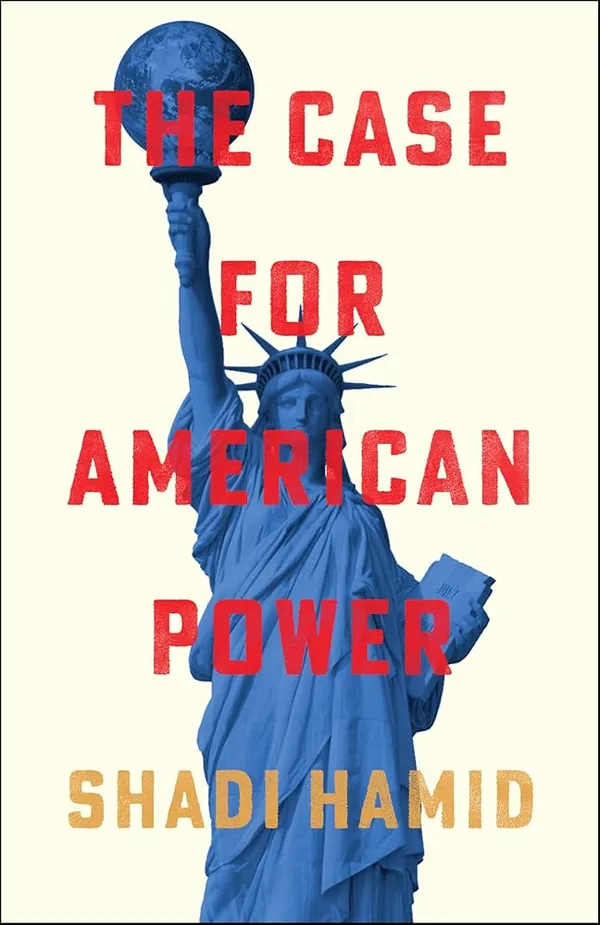
The Case for American Power is, as its author Shadi Hamid claims, a personal reckoning with the idea of American hegemony, the virtues it promises, and the reality of the harms it is frequently responsible for. The “personal” nature of this book is an implicit license to play loose with the facts, fail to engage with counterarguments, and indulge in a level of naivete that goes beyond rational discourse, instead beginning to resemble something like an expression of religious faith. Its assumptions about the inherent goodness of American foreign policy, the tendency to rationalize and sanewash its aspects that contradict the record, and the double standards by which it treats other countries map closely to elements that are common to many forms of religious ideologies: teleology, idealism, and sectarianism. To get a better sense of this, it may help to trace the broad strokes of his argument and see where the disconnect lies in his assertions and the conclusions that he derives from them. The logic chain is roughly as follows: the United States of America is unique in its geography, economic heft, history, and ideals, and these privileges provide its right to operate as the global hegemon.
Might Makes Right?
These advantages are all interrelated for Hamid, but he connects the dots in an idiosyncratic fashion. The United States is indeed a large country, but its size can give way to an illusion that a travail through the historical record quickly dispels: its privileged position in this regard is not a natural fact but one established by persuasion, deception, and most importantly by force. As Huntington famously quipped, “The West won the world not by the superiority of its ideas or values or religion... but rather by its superiority in applying organized violence. Westerners often forget this fact; Non-Westerners never do”.[1] For all the quite similar illusions Brits hold about their own country and its imperial legacy of “freedom” and “democracy” on the specific role of violence, at least in the creation of their empire, they are much more clear-eyed. This is relevant, not because the size factor of the United States as a justification for American Power is one that Hamid dwells on much or digs in his heels about, but because it’s indicative of a mindset that is inordinately panglossian, quickly lapsing into apologia for America’s worst crimes. What, for instance, does he make of America's treatment of the natives, arguably its first foray into foreign policy? Well, we can’t know, because he doesn’t mention it at all, not explicitly at least. At best, we get an oblique justification for all of this in Chapter 1, when he sandwiches a note about how “the United States is not unique in this regard. The founding of any country involves unforgivable acts of violence” in between a longer rant where he whinges about how Americans are insufficiently enamored with their own country’s national mythos. But the point of a discussion about the extirpation of the natives is not just an exercise in land acknowledgements or empty moralism but a recognition that states, their borders, and their policies aren’t actually the stuff of noble idealism. If America is not exempt from these imperatives, then there is no case for American Power that can be derived by gesturing to its ideals.
This is doubly relevant because Hamid attributes the US’s economic might to its ideals as well. This can’t stand. After all, even certain non-leftist accounts of American economic development stress the abundance of land (made available by things like the Dawes Act) vis-à-vis labor as creating an incentive to economize on the latter, inducing technological development and therein economic growth.[2] The role of slavery is a bit more controversial in the literature, but whatever its precise fit in the broader story, it is not ultimately separate from American development. Strictly from the economic perspective, northern banks, industry, and transportation networks were born and cut their teeth via King Cotton.[3] This is additionally relevant because of the role of the planter class in shaping American domestic and foreign policy. Their eventual defeat, with the consequences that followed, positive and negative, was not guaranteed simply by American ideals. It was instead contingent, and had to be struggled for, but one would instead come away reading his rosy telling of the history thinking that it was all inevitable. Now, of course, Hamid in interviews acknowledges capitalist democracy is often bound up with inequality (although he wouldn’t phrase it in this way), and thus endorses populism as a countervailing force. But implicit in this is a separation of the political and economic.
The Democratic Delusion
A major advantage that the United States has, which the author sees as core to his argument, is that the US was born a democracy (major restrictions on the franchise as well as slavery don’t make an appearance in this book). Hamid defends democracy in principle and in practice in this book. He leads with the notion that power is a fact, a claim which sounds suspiciously like realism (as the term is understood in the discourse of international relations), and then pivots to claiming that America should wield such power, a more morally charged claim. He does not substantiate the first; it's more of an axiom. It's not clear why there needs to be a hegemon (or why the world would be worse off without one), and why power couldn’t be more distributed. Additionally, he asserts as a corollary of this axiom that the existence of any given power requires continued maintenance of its power (lest said power is replaced by another). This suggests that whatever protestations to the contrary are peppered throughout the book and implicit in the publishing of it, much of the groundwork has been laid for “business as usual” rather than any kind of substantive break with the status quo of US foreign policy.
Given the above, Hamid then bridges normative and descriptive claims by attempting to establish the moral superiority of democracies over dictatorships. For instance, he suggests democracies are more “honest” on the international stage. Implicitly endorsing the sentiment expressed by Woodrow Wilson (the father of American idealism), he notes,
He (Wilson) was arguing that nondemocracies behaved differently because they were different, premised as they were on a completely different account of human nature and motivation. And the most destructive war up until that point in history provided the unassailable evidence. Put simply, because autocrats were unaccountable to public opinion—or to anything other than their own self-preservation—they couldn’t be trusted. Because they could not be trusted, peace with such nations could be only provisional.
What evidence is adduced in defense of this? Bizarrely, World War I, one of those American wars most detached from any overarching moral principle (for better or worse), was practically synonymous with a flagrant disregard for the truth on all sides (democratic or otherwise). This was recognized even at the time by people like Arthur Posonby, who in his proto-political science book, Falsehood in War Time, documents the various lies told at the time, both in the lead up and with respect to the coverage of conduct like the various tall tales told about the Rape of Belgium and the sinking of the U-Boats.[4]
In general, Hamid’s book is marred by its differing treatment of the motives of democracies and non-democracies vis-à-vis foreign affairs. Keeping to the case of World War I in his scolding of the left, opponents of sending arms to Ukraine, and, charitably, those who take the most favorable interpretation of the motives behind the invasion of Ukraine, he seems to imply that the expansion of NATO, an ultimately anti-Russian alliance, had no role to play in the outbreak of war. But his case of choice parallels contemporary affairs in ways he studiously ignores - for all the grandstanding about keeping the world safe for democracy, Wilson did not intervene until the final hour of the war, and the actual impetus for the formal entry of the United States into World War I, far from being the violation of some democratic norm(s), was the Zimmerman Telegram, where an alliance between Germany and Mexico was proposed. Acts by rival states, on the other hand, are always interpreted as being cynical and amoral (if not generally immoral).
America the Amoral
Hamid feels as though he can justify this tact, especially in the case of American foreign policy, because he believes that the United States is not only uniquely democratic in its conception and practice, but also uniquely ideological. Unsurprisingly, part of the justification for American power is an appeal to American exceptionalism. A sure sign that we are dealing with something more like religious dogmas than rational arguments arrives in the very first chapter, which evinces an unmistakable kind of teleology. The United States of America, unlike other countries we are told, was born of freedom and invokes said legacy in its conduct of foreign policy. In reality, the American Revolution was part of a broader wave of Atlantic Revolutions, all of whom rang the bell of freedom, with the American one in fact being the most limited in its aspirations. It was followed by (and in reality preceded by as well) a long history of revolutionary waves containing a mix of endogenous and exogenous influences, with the precise balance depending on the specific case in question.
Even the notion of “spreading freedom” or exporting revolutionary ideals via foreign policy was hardly unique. Haitian Revolutionaries provided support to Latin American revolutionaries contingent on their outlawing slavery in their newly independent countries. French revolutionaries spread republican ideals throughout the continent from Belgium to Italy, helping to weaken the tyranny of feudal rule in the Old World. Undoubtedly, there was a pragmatic element that accompanied the ideological aspect. Legitimating ideologies are a constellation of ideas, norms, and principles that often draw on specific historical and institutional legacies that are then fitted to contemporary considerations. They often have *some* correspondence to actual policy making, and the influence of one over the other is often reciprocal. Perhaps it is the case that most countries, even seemingly amoral rival great powers like Russia and China, have ideologies that don’t fit neatly on a bumper sticker. What Hamid is asserting is practically close to the opposite of the truth, insofar as practically every country has a legitimating ruling ideology that colors its foreign policy. Russia claims the mantle of defender of traditional values, an inheritor of Christian civilization, the steed of a multipolar order, and various other titles that on their face seem to have some moral dimension. There is nothing wrong with dismissing these out of hand as phony or policies in search of an ideology, but it’s the inconsistency that raises red flags.
The kinds of difficulties that lie in establishing the alleged moral superiority of democracy are no less formidable than establishing the practical superiority of democracy. Much of the political science literature that discusses the benefits of democracy is rather superficial, rarely attempting to separate correlation from causation by trying to get at which direction the arrows flow. Democratic peace theory, for instance, asserts, on the basis of various datasets that cover conflict, that democracies are less inclined to go to war with each other. But could it perhaps be the case that democracy flourishes in areas where war is already less common? Ukraine is now proceeding down a path of democratic backsliding, and it seems difficult to treat that as unconditioned by war and broader geopolitical circumstances. As horrifying and labyrinthine as the “security” architecture developed in Baathist Iraq was, it was said that Hussein had developed a government that was “coup-proof,” undoubtedly shaped by the history of coups in the country and the region (including ones supported by the United States). Latin America, on the other hand, experienced much of the same long peace as Europe, both when it was broadly democratic and when it was undemocratic.
There is, of course, the elephant in the room in any discussion, particularly one by someone with Hamid’s sympathies, which is Gaza. Hamid has stated repeatedly that a condition for US intervention up to and including regime change is “mass slaughter” and has written that he considers Gaza a genocide. Yet as recently as April, he actually argues it would be somehow undemocratic and even immoral to dissolve the existence of Israel as a Jewish state.[5] This is after not only the genocide in Gaza, but repeated invasions of Lebanon (a democracy), and the US-Israeli invasion of Iran (a partial democracy). Here we have two democracies committing the supreme crime of aggression as defined by Nuremberg repeatedly against democracies and non-democracies, and it apparently doesn’t cause Hamid to rethink any of his priors. Additionally, he only ever refers to the US invasion of Iraq as a “blunder” or as a mistake. In fact, under this reductionist rubric, in certain ways, it is more kosher than the invasion of Iraq, since they didn’t have to really lie about why they went in. Certainly, it can’t be compared to the Russian invasion of Ukraine (and can’t be worse) since it is a democracy that invaded an “autocracy.”
Never once does Hamid refer to the Iraq War as a crime (he, of course, regularly describes the Russian invasion of Ukraine in strong, morally condemnatory terms). He is not shy about placing American violence on a pedestal; he goes so far as to say, “I would go one step further: There is no real moral equivalence between what the United States did in Iraq and what Russia did in Ukraine or China might do in Taiwan… The Iraq war was a profound injustice and an unforgivable affront to our own purported values. But it was not the same in degree or kind as what America’s enemies have done and are still willing to do. Iraq wasn’t a democracy; it was a brutal authoritarian regime, led by a man who had committed genocidal acts against Shias and Kurds. In its brutality, it had forfeited both its legitimacy and its sovereignty. Ukraine is a democracy, however flawed. (What democracy isn’t?) And if we turn our attention to the authors of the invasions, America and Russia, again there is no real symmetry. The United States was and still is a democracy; Russia is a brutal dictatorship.”
Measured in terms of the destruction of infrastructure, indirect deaths, and violent deaths, not only are these two not morally comparable, but one is obviously worse. In fact, an act which Hamid identifies as a triumph of American foreign policy, the Gulf War, is, in combination with the sanctions regime which followed it, probably responsible for more civilian deaths than the sum total of all wars waged by Putin’s Russia. It’s worth noticing here the move he makes as well: what we did to Iraq is worse than what China *might* do in Taiwan. Since there is no actual evidence based on their current stance or behavior that a Chinese world order or even the status quo as a regional power would be one where they acted with more impunity on the world stage than the United States, he has to appeal to a hypothetical. So then Hamid's cosmology (democracy vs autocracy) is not about adjudicating right and wrong on the basis of some kind of objective evaluation of conduct but about marking an outgroup subject to exclusion and condemnation; he may as well be speaking of Untouchables or Kaffirs.
Implicit in his argument, expressed in later chapters as well, is a sense that those living in a democracy are almost better people. The argument is a bit more complex than that in reality; it’s more that those in authoritarian systems aren’t actually even moral agents, at least in a political sense, since they aren’t granted the right to express themselves freely and develop and work out their politics in a public setting unencumbered by repression and censorship. In a seeming act of benevolence to Russians who have perhaps tacitly consented to Putinist leadership, looking for absolution for whichever crimes their state could be credibly accused of, Hamid proposes that living in an authoritarian state perverts the conscience of the people who live under it. But what could on the surface be read as graciousness is in fact insidious. To begin with, it’s a way of avoiding uncomfortable realities about public opinion and governance. So it goes, we can’t *really* say if Russians approve of their government (and of course, in his defense, they may not) since we don’t know how United Russia would fare in a democracy. Or take the example of China. Sure, in poll after poll, citizens of the People’s Republic of China consistently register positive feelings about their government, and it in fact ranks high in objective terms with respect to output legitimacy, and that the way the government is set up contributes to this, but somehow things would be even better in a democracy.[6]
Hamid states, quoting political scientists, that China owes its success to the global economic order where “the output legitimacy of any country is a function of access to markets for export and credit, tied disproportionately to the United States, given its role in securing both at the global level… Since the 1990s, and dramatically since 2011”. This is, of course, a perfectly legitimate point, but it undermines many of the purported pragmatic justifications that he defends earlier in the book, especially if we have reason to believe that economic performance and living standards have some relationship with each other.
What makes this argument even more problematic is that Russians, for instance, are almost certainly a stand-in for all those who live in authoritarian countries generally. It’s here where Hamid’s nominal appreciation of democracy is revealed to be hollow because of the implicit dismissal of an important constituency, which is deprived of any democratic choice by unilateral US action: its victims. After all, however despised Saddam may have been, most Iraqis didn’t exactly vote for 20 years of invasion and occupation.
This is all very convenient for Hamid because it means democratic gains are unlikely to be generated internally and have to be imposed by some external power. This reveals a contempt for democracy in the broad sense, as he attributes openings in Asia and Latin America to the United States, even when many dictatorships there only existed because of the US to begin with, and democratization proceeded in spite of US efforts, not because of it.
Again, for someone who is claiming to offer a kinder, gentler American empire, Hamid makes arguments that totally run against the substance of international law in the postwar period, which relies on the notion of sovereign parity or sovereign equality. This makes it generally agnostic as to the ways in which particular states are run internally, and for which there is no special carveout that gives “democratic” states bonus points in adjudicating whether they have committed war crimes. It’s not as if following the SMO, Russia immediately began pilfering Crimea. The current quasi-colonial arrangement imposed on Venezuela, put in place by Trump (which Hamid himself is critical of but tends to lay the blame on the current admin), is actually in keeping with Iraq, where though both countries are nominally sovereign, their oil revenues, which of course are the lifeblood of their economies, are managed by Washington who ultimately has the final say and can use it as leverage to impose various onerous political changes favorable to the US (and which have more to do with checking Iranian and/or Chinese influence and nothing to do with democracy). In general, in the history of colonialism, it is rare for there to be some sort of straightforward hoovering up of resources, and often, before colonies even net profit, they are on paper liabilities strictly from a financial point of view for years and require some investment before they pan out (sometimes they never do).
American Hypocrisy?
There is a long chapter that speaks about a question that troubles him, relating to the idea of hypocrisy, but what exactly is hypocritical about US policy? Even if we take all of US foreign policy as wholly benign in its ends, they remain “ends” in the plural. “Democracy promotion” as a formulation is, in fact, a rather recent notion not really developed until after the Cold War, and was never taken to be the end-all be-all of US foreign policy, apart from perhaps a brief window during the Clinton Administration. Even here, it was a policy agenda developed in the context of a window with the decline of the Soviet Union and the loss of some of its legitimacy in the Eastern Bloc internally. Combined with heavy soft and sometimes hard power, the US determined that the balance of forces in these countries, again alongside US military sabre rattling against Russia, was such that its interests were not necessarily at risk by advocating for democratic elections. The strongest case that could be made for American power, at least applied in favor of democracy promotion, is that these conditions (i.e., favorable geopolitical climate and stable pro-American sympathies among the population) hold generally, but that case isn’t made here and for good reason: they don’t generalize. Latin America, for example, swings pretty regularly, which is why, unlike what Hamid claims, there was in fact no “Middle East Exception” and the US regularly intervened in the 2000s after the Cold War to undermine democracy in Latin America, Venezuela, and Bolivia.
This peculiar mythos common among both liberals (especially Arab liberals, who often romanticize the United States as a kind of coping mechanism) and right wingers argues that there is some kind of “Middle East Exception” wherein, according to Arab liberals at least, because of influence of Israel in shaping foreign policy, the democratization wave which followed the collapse of the Soviet Union somehow passed over the Middle East. Both see US power as fundamentally noble, with the former often drawing essentialist conclusions about the purported Arab capacity for democracy (as a way of excusing the US role) and the latter biting the bullet as an out to marginalize the issue with an immediate fix. But apart from the fact that the wave of democratization occurred *in spite of* American influence and not because of it as mentioned, passed over are Latin America/the Caribbean and Sub-Saharan Africa as well as the fact the US played an important role in christening a new series of dictatorships in Eastern Africa like Rwanda and Ethiopia, who were useful partners in the coming war on terror that would remain in power for years to come. This undercuts a related myth, which crops up here and among liberal pro-empire discourses generally, which is that American support for dictatorships was a temporary blip, a relic of the Cold War, where ordinary, sensible American foreign policy was suspended to enable a more flexible response to Soviet brinksmanship. Hamid indulges in this line of thinking to some extent in this book as he frequently makes excuses for rather aggressive US foreign policy moves in the imperial age. In each period, though adapting to the norms of the period, Hamid simply invents a new excuse for why the US was required to undermine democracy or engage in non-democratic interventionism, which increasingly strains credulity as they pile up.
Hamid also accuses leftists of practicing a variant of American exceptionalism, which purportedly attributes all the evil in the world to the United States. In reality, these kinds of “inconsistencies” are common. The Saudi relationship to various flavors of Muslim Brotherhood-Muslim Brotherhood adjacent Islamist movements is not all that different. Islam or even Political Islam has a great deal of historical significance to the Saudi national story (arguably as much if not more so than “democracy” does the American national mythology), and indeed they often have bankrolled or at least engaged substantially with such movements. However, when these movements become too populist or threaten Saudi interests, they are culled, as was the case in Egypt or even the Sahwa movement in Saudi itself. Conversely, the Soviet Union, which Hamid regards as the overbearing evil empire that Reagan spoke of, did not necessarily enforce its political model and happily accepted non-socialist governments in the Third World, along with a general policy of supporting anti-colonial movements because it didn’t see them as threatening. Quite the opposite, in fact; it actually saw these movements as aligned with its own interests. The US has made it abundantly clear in deed and in words that it supports democracy up until it threatens US interests, at which point it no longer does. When we accept this general principle, US policy is suddenly much more easily interpreted. Hamid speaks of the CCP as a party of cynics because there are markets in China, but no amount of support for dictatorships can ever sway his belief that America supports democracies.
Hamid must be aware of this reality on some level, because when confronted with cases where the American role is so consistently cynical and anti-democratic it cannot be denied, he has to ignore modern scholarship and instead embrace a fairy-tale version of history. He describes the Spanish-American War as follows:
America’s trial run began in the late nineteenth century. Before the United States leveraged its growing power onto the rest of the world, it started with matters closer to home. Closest geographically—as well as in the hearts and minds of the American public—was Cuba, a country embroiled in a war of independence with Spain since 1895. Would America simply stand by and let a fellow revolutionary nation be subjugated by a colonial power?
This astonishing paragraph, said with only the slightest bit of irony, is in total contravention of the historical record. Immediately after the US kicked the Spanish out of Cuba, it was turned into a de facto colony, prevented from entering into relations with other states, and more or less turned into the plaything of American sugar interests. In prior years, it had actually allied with the Spanish to entrench the slavocracy for fear of an independent Black republic which could threaten its influence.[7] The same pattern holds in Haiti, a country that, as mentioned earlier, also aspired to freedom, and though not controlled in quite the same way, the main US legacy (still in play) in Haiti was backing the French position (i.e., punishing Haiti for attempting to free itself) and continuous support for dictatorships friendly to American interests. It is also at variance with what was done to the Philippines, where something close to genocide was committed against the native population who resisted American colonization (Hamid, it should be said, has said a condition for regime change is “mass slaughter”).
What makes this ultimately a religious tract rather than a rational discourse is that it exhibits all of the features of dogma. It’s thoroughgoing in its teleology; America was born with an ostensibly democratic constitution and therefore everything it has done wrong, no matter how evil, can be waived away as bumps on the road to an unfolding of some greater, more enlightened destiny. Its arguments are unfalsifiable and wholly unrecognizable to anyone not already bought into the system. When Hamid reminisces, rather fondly, about the apparent “successes” of the Bush administration in democracy promotion, he invokes those instances where Bush cranked up the notches on the Crusader talk, signaling he was open to outright invading the Gulf monarchies (or at least muscling them into compliance). As many pieces of religious apologetics go, he pleads the reader to ignore the literal words the administration uses with its ramblings about Gog and Magog because he *really* means something else, even claiming Bush was secretly practicing Kissingerian Madman Theory. But we have no reason to believe that Bush was being insincere, or at least insincere in the way Hamid is hoping. The Project for a New American Century, among other think tanks that held sway in the administration, were quite resentful of the Saudis whenever they asked for better terms for oil pricing arrangements or pushed a little too hard on the Palestine question. Their objections rarely had anything to do with democracy.
The Elephant(s) in the Room
Though not pretending to be a unified theory of the American Empire, it is striking how little attention is paid to questions of political economy. One could be led to believe, upon reading this book, that countries have militaries and fight wars to protect their values with things like projection of power (a thing which *he claims* is a fact) or even national defense being auxiliary matters. This is despite the fact that you can find in US policy documents themselves explicit references to defending concentrated economic power, including in the period where Hamid states: “The timing of democracy’s global spread was no accident. It coincided with America’s rise to superpower status. That one country was democratic and claimed that it was better because it was democratic had a crucial demonstration effect. At the dawn of the century, America may have been a rising power, but it was not yet globally dominant. That distinction fell to the British Empire, which, at least in retrospect, was already deep into its twilight. As American power grew, there was the inevitable question of whether and how the United States should use that power to bring about the things it believed in. To think that a large, populous nation with a distinct set of ideals could simply ignore those ideals in its conduct abroad was difficult, if not impossible. The rest of the century would attest to that”. For example, one 1922 US naval intelligence report cheekily titled “The United States Navy as an Industrial Asset,” explicitly zeroes in on their role in protecting “our tremendous fruit, sugar, and hemp trades, as well as oil and mining interests”. Though the US role, in a sense, is certainly less parochial than it once was, its role, like that of the British, shifted away from protection of domestic capital once it had matured and fewer rivals could challenge its particular combination of economic and military strength. This strength was embodied in the control of the international energy system, consecrated in various international economic agreements that established exorbitant privilege and began (very conveniently) to sing the praises of free commerce, taking on the position as a steward of capital accumulation globally.[8] This is why the focus on theft of land or resources, even as the only vector of the cruelty or capriciousness of the American Empire, in the period prior to the consolidation of its borders, and therefore the test of its existence, is misplaced. Indeed, new interventionist logics, which have very little to do with democracy, like the War on Drugs or the War on Terror, still entail an incredible degree of violence, up to and including support for chemical warfare, drone strikes, and even invasions, often aim to deterritorialize but are no less capricious given their horrific costs. Broader frameworks that explore the logic of American empire, as well as specific interventions that challenge the view of it as being based in idealism, are left entirely unexplored.
At most we get rather condescending references to heady dorm room days filled with Noam Chomsky reading sessions. But there is no actual engagement with the arguments of people like William Appleman Williams, Charles Beard, or Seymour Melman about the intimate relationship between US interventionism and domestic concentration of power. Far from being a product of some inherent commitment to democracy, US foreign policy reflects not humanitarian goals by and large, but the interests of the powerful. This is crucially relevant to another issue, which Hamid claims to care much about but mostly ignores in this book: Gaza and the special relationship between the US, Israel, and certain other authoritarian regimes in the Middle East. How can one discuss US involvement in the Persian Gulf and the mutually corrosive relationship it has with the GCC countries without any mention of oil interests? Even if US foreign policy is not reducible to these considerations, surely they can’t just be disregarded without any explanation.
Many of the interesting questions about democracy and foreign policy are left on the table in favor of well-worn cliches. Even ones that seem intuitively plausible, like the idea that democratic states are responsive to the sentiments of their citizenry, seem questionable in the context of the broader argument. There are the standard issues which come up in the literature about the various constraints common to electoral democracies about mobilization of bias,[9] gerrymandering, the role of lobbying,[10] and so on, which receive no attention here.
Additionally, democratic states are not so different from authoritarian states insofar as both often have ways of converting public opinion into a parameter that can be fiddled with to suit pre-existing policy priorities. Much of the graft and fraud that followed the occupations of Iraq and Afghanistan came about because, apart from their own personal greed, US planners were in fact acutely sensitive to political cycles and sought to keep costs low and the war invisible to the public. These tendencies bear on “democracy promotion” as well; the Nixon Doctrine was a structural version of this phenomenon. His administration sought to entrench dictatorships from the Philippines to Korea to Thailand, which could then pick up the slack in enforcing US policies in Asia after a sense of exhaustion set in among average Americans for endless wars. Far from being more humane, the foreign policy decisions of this democratically elected administration set off this whole process with a series of devastating bombings, which would radically shape the future of the region for decades afterward.
It should be said that even this framing operates on the rather heroic assumption that somehow people in the United States are more humane in the kinds of politics which they would support abroad than those in non-democratic countries. For all the attention the anti-war protests in the 60s received, the sentiments that prevailed among activist groups that organized them were not ultimately representative of much of the population. Even unconditional withdrawal from Indochina was considered a pretty exotic proposal until the final hour. There was much more support for the author of the My Lai Massacre, Bill Calley, the Hard Hat Riots, and the Kent State Massacre.
This brings us to another demographic excluded from Hamid’s conception of a democratic world order: namely, the rest of the world. There is something profoundly undemocratic that the entire globe should be subject to the dictates of 4% of its population (even if they are decided on democratically). If we are to accept the legitimacy of a global empire, then there ought to be something like a global vote or structures that enable all the relevant stakeholders to have a say. For as horrific as much of American foreign policy was in its intent and by design, it was not all predetermined or scripted behind the scenes; it was generated in the process of the struggle against local populations and actors, which could sometimes credibly, sometimes not, claim to represent them, and many of whom did not passively accept US dictates but rather resisted. It’s unclear whether even an authentically pro-democracy US foreign policy agenda at present would necessarily result in less violence or even be more democratic.
In the case of Vietnam, there was a referendum which suggested the Vietnamese preferred a united and potentially communist (and by extension undemocratic under his rubric) Vietnam to a partitioned “democratic” Vietnam under US tutelage. What is the policy fix here that is consistent with an interventionist pro-democracy foreign policy? Is accepting the results of the referendum support for democracy, or is it paving the way for a dictatorship? This is a clearer case of a contradiction in a policy which attempts to impose democracy by force, since there is a referendum, but the underlying sentiments (which were also reflected in the high levels of village support and engagement with the NLF) were well understood by regional specialists and even US intelligence. If Hamid rejects the premise of US intervention and, by extension, the various crimes it entailed (and it's not obvious if he does), had the referendum not been held, but as mentioned, the sentiments were known, does that really change the morality of intervention? What about the cases where there is undoubtedly a strong popular element, as there was in say Maoist China (indeed often because of the various constraints which make democracy fickle sometimes even consistently more popular than many nominal democracies), but there aren’t necessarily regular elections?
The reduction of democracy to procedural norms also allows the author to ignore or underrate the ways in which not only supposedly authoritarian states had democratic elements unique to them but lacking in supposedly democratic states, but the ways in which said “authoritarian” states actually made “democratic” states *more* democratic, often transforming them from partial democracies to full democracies. Not only did the general image of the Soviet Union’s creative and forward-thinking nationalities policy and messaging contribute to the moral unwinding of Jim Crow, but the Soviet Union’s backing of the CPUSA, with its involvement in early organizing work in the South, actually sowed the seeds of what would become the Civil Rights Movement. Indeed, in certain Cold Warrior circles, “Civil Rights” became almost a byword or dog whistle for the spread of Soviet influence in the United States. So too with Cuba; it was their backing of the MPLA and the ANC (as acknowledged by Nelson Mandela himself) which hastened the collapse of Apartheid and the democratization of South Africa.
In Conclusion
Ultimately, a cursory examination of the Case for American Power reveals it to be nothing more than a set of propositions about democracy and US foreign policy, which are not simply at odds with the evidence but are unfalsifiable. These allow him to draw arbitrary moral lines that just so happen to privilege the state(s) that are already powerful or supported by the powerful. The only way one could accept the veracity of the ideas here is to take them on faith.
Liked it? Take a second to support Cosmonaut on Patreon! At Cosmonaut Magazine we strive to create a culture of open debate and discussion. Please write to us at submissions@cosmonautmag.com if you have any criticism or commentary you would like to have published in our letters section.
-
Huntington, Samuel P. The Clash of Civilizations and the Remaking of World Order. New York (1996), 51.
↩ -
Habakkuk, H. J. American and British Technology in the Nineteenth Century: The Search for Labor-Saving Inventions. Cambridge (1962).
↩ -
North, Douglass C. The Economic Development of the United States, 1790–1860. New York (1961), 67–74.
↩ -
Ponsonby, Arthur. Falsehood in War-Time: Containing an Assortment of Lies Circulated Throughout the Nations During the Great War. London (1928).
↩ -
Hamid, Shadi. “Does Israel Have a ‘Right’ to Exist? No. But That Doesn’t Mean It Should Be Dissolved Either.” Wisdom of Crowds (Substack).
↩ -
Hamid states, quoting political scientists, that China owes its success to the global economic order where “the output legitimacy of any country is a function of access to markets for export and credit, tied disproportionately to the United States, given its role in securing both at the global level… Since the 1990s, and dramatically since 2011”. This is, of course, a perfectly legitimate point, but it undermines many of the purported pragmatic justifications that he defends earlier in the book, especially if we have reason to believe that economic performance and living standards have some relationship with each other.
↩ -
“Ostend Manifesto.” (1854).
↩ -
Panitch, Leo, and Sam Gindin. The Making of Global Capitalism: The Political Economy of American Empire. London (2012), 353.
↩ -
Schattschneider, E. E. The Semi-Sovereign People: A Realist’s View of Democracy in America. New York (1960), 30–35.
↩ -
Ferguson, Thomas. Golden Rule: The Investment Theory of Party Competition and the Logic of Money-Driven Political Systems. Chicago (1995).
↩