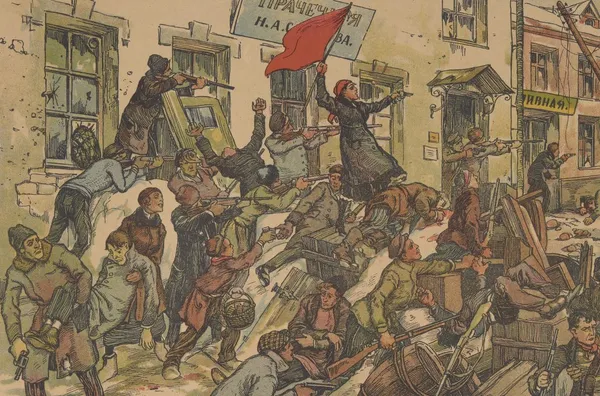
The following collection of theses is put forward with the intent of aiding the Democratic Socialists of America (DSA) in its world-historic mission of dismantling capitalism in the United States through constructive internal critique. As opposed to a traditional essay, this text will instead cover a series of distinct, but interlocking, topics including the necessity of developing a revolutionary political line, reformations of the DSA’s current approaches towards electoral, labor, and community organizing, the development of sustainable chapter growth, and the necessity of armed defense of the socialist movement. Through a critique rooted in historical and contemporary analysis, this text attempts to offer a skeleton framework from which to develop the DSA into the mass socialist party the American proletariat requires.
On Discipline and Programmatic Unity
Before the DSA can transform society, it must first transform itself. In its present form, the organization struggles to articulate a coherent political vision due to its rapid growth and big-tent structure. It is little surprise that the organization faces myriad theoretical and practical contradictions, encompassing all manner of tendencies from social democratic reformism, strains of anarchism, to innumerable Marxisms and their offshoots, with a membership divided among largely autonomous chapters across the country. These internal struggles have manifested as confused public messaging[1][2], conflict between socialist candidates[3], inability to hold electeds[4] accountable to the DSA program[5], and tension between chapter and national leadership[6] over control of finances, optics, and membership criteria. While painful, these struggles are necessary for the organization to evolve from a loose federation of chapters and caucuses to a disciplined organization capable of articulating a clear strategy that guides the actions of its members.
This is not to advocate the complete subordination of chapters and factions beneath a hegemonic central committee; rather, the experiences and ideas of these formations ought to be aggregated, flowing upwards from chapters and caucuses and synthesized by national leadership into a cogent theory of change which may then be practiced, critiqued, and iterated upon by the general membership. The distribution of the party line (in this text and in light of its 2025 Convention, the DSA will be referred to as a party)[7] will be accomplished through coordinated messaging and articles across national and chapter-level media, presenting a unified front towards the public. Experimentation and criticism of this line should be encouraged to prevent the rise of uncritical dogmatism, ruling cliques, and narrow-mindedness within the organization. For these efforts to be constructive, a degree of programmatic unity—defined as the commitment of membership and electeds to, by word and deed, uphold the program of the DSA when engaging with the public—is necessary to drive the organization forward in the development of its theory and praxis.[8]
Respect for programmatic unity is contingent on both the discipline of membership to prioritize the entire organization above parochial concerns and the discipline of national leadership to prioritize the development of a common theory of change towards a cross-tendency definition of socialism. Adherence to said definition and broader party program requires a stronger willingness on the part of national and chapter leadership to apply sanctions—ranging from private warnings, to interventions, to suspension and expulsion—against wayward comrades. At the same time, the party must preserve the right to open criticism so long as the program, once sanctioned by the majority, is not impeded in its execution.
On Social Democracy, Reform, and Revolution
Social democratic reformism has thus far proved incapable of overcoming the core contradictions of capitalism; it succeeds only in temporarily ameliorating the system's worst tendencies at the direct expense of workers abroad.[9] Capitalists, in the instances they tolerate social democratic regulatory policy, compensate by relocating their enterprises to less regulated nations and exploiting the international proletariat for the benefit of the domestic. Unwilling or incapable of advancing to socialism, social democracies have a definite horizon to their political ambition without posing an existential threat to the bourgeoisie. Should they do so, all forms of coercion—capital strikes[10], flight[11], and/or outright counterrevolution[12]—are brought to bear against the movement.
At every historical juncture, social democrats have retreated from this confrontation, unwilling to risk the portion of institutional power they possess in a protracted and likely violent confrontation with Capital. Moreover, history has shown that social democrats may join the counterrevolution themselves to repress socialists through cooperation with reactionaries—up to and including fascists—with predictably bloody results.[13] In submitting to the bourgeois state, social democrats surrender the political initiative with no potential left and shift to a defensive posture. Rudderless, complacent, and without allies to their left, the movement succumbs to a war of attrition with a bourgeoisie that only needs to steadily accumulate further wealth and capital to sustain its counteroffensive.
Perceived dependence on the bourgeois state apparatus strips not only social democratic leadership of their revolutionary ambitions, but their support base as well. Rather than entrust direct control of workplaces, community resources, and the political process to the masses, social democrats—to preserve the structure and property rights of the bourgeois state—limit their reforms to expanding a bureaucratized public sector prone to the inefficiencies of top-down administration and under constant threat by each successive counterattack. The result is a working class materially invested in the continued health and maintenance of the existing state apparatus, tempering rather than radicalizing the masses, which then legitimizes the very bourgeois institutions that will see capitalism's gradual retrenchment.[14]
The social democratic project reveals the limits of reformism and the necessity of a revolutionary rupture with capitalism, defined as[15] the democratization of finance capital allocation through public control of banking and the commanding heights of the economy.[16] No ruling class in history has ever surrendered its power peacefully, rendering such a rupture through electoralism impossible. This is not to advocate immediate insurgency nor to dismiss all electoral work; rather, it is to clarify the purpose of the party and fundamental prerequisites for socialism. A militant confrontation without a far greater degree of public support, a network of worker-controlled dual-power structures, and the capacity to defend these institutions would set socialists back decades at a time when fascism and climate collapse pose existential threats. To fail in any of these respects is to make socialist revolution impossible. Therefore, the preeminent task of the DSA is the cultivation of dual power built from an organized, armed, and class-conscious proletariat, achieved through the following means operating in close conjunction:
- A mass working class party dedicated to advancing “non-reformist reforms” which degrade the power and legitimacy of the bourgeois state while empowering and protecting mass democratic proletarian institutions.
- A militant labor movement of rank-and-file red unions, cooperatives, and credit unions, with each facilitating the development of class consciousness, proletarian democracy, and movement self-sufficiency.
- An array of self-sufficient community assemblies practicing mutual aid, political education, and defense programs dedicated to building solidarity through materially and ideologically aiding the working class independent of the bourgeois state apparatus.
As a unified theory of change, these modes of organizing have the potential to construct the dual power necessary to contest the bourgeoisie when the revolutionary moment comes.
On Electoralism and Non-Reformist Reforms
Electoralism must delegitimize the bourgeois state and its institutions. To accomplish this, principled electoralism has three goals: propaganda through the use of elections as a bully pulpit; the occupation of seats to sabotage the inner workings of bourgeois institutions; and agitation for demands that transfer significant power to non-state proletarian institutions or decrease reliance on bourgeois institutions. This last category of “non-reformist reforms (NRRs)” is defined by theorist Andre Gorz as “trials by strength” for the working class, consisting of policies that seek,
A modification of the relations of power; they assume that the workers will take over powers or assert a force. . . strong enough to establish, maintain, and expand those tendencies within the system which serve to weaken capitalism and to shake its joints.[17]
In Gramscian terms, NRRs are part of the war of position, transferring as much power as possible from the bourgeois state to the proletariat in anticipation of revolution. Policies that reallocate resources and authority to mass proletarian organs (e.g., militant unions, popular assemblies, workers councils, defense patrols), decrease dependency on the private sector (e.g., universal healthcare, mass public transit), and reduce the state's monopoly on violence (e.g., the right to bear arms, decreasing law enforcement capacity) are all examples of NRRs. The development of non-state proletarian organizations is the most crucial objective. Institutions maintain legitimacy through two means: meeting material needs, and the participation of those affected by the institution. As bourgeois state and corporate institutions fail to meet the immediate material needs of the working class, their legitimacy must be supplanted by proletarian institutions—founded on participatory and democratic principles—that strive to accomplish what present systems cannot.
The party must advocate for NRRs that, as a minimum program, develop these proletarian institutions so the working class is prepared for self-governance and confrontation with the bourgeoisie. This confrontation hastens with each successive transfer of power, until the balance of forces poses an existential threat to capitalism. Where precisely that line falls depends on the hubris of the bourgeois state, at which point the demands of the minimum program—policies pursued within the framework of the bourgeois state—become transitional demands, policies only achievable through socialist revolution and the rise of proletarian democracy. Throughout this process, the party must resist all attempts to reduce its platform solely to minimum demands—to “government fiat [...] administered by bureaucratic controls”—which would reinforce proletarian dependence on the state apparatus.[18] Our electeds and propaganda must stress that any and all NRRs be administered directly by proletarian-democratic institutions (e.g., police reform via replacement by grassroots community defense patrols, accountable to popular assemblies).
To agitate for and implement these policies requires principled participation in bourgeois elections. Electoralism in this context is only one of several means for the development of direct-democratic proletarian control over society, not an end unto itself. This invites the risk of opportunist trends within the party, but it is necessary so long as the masses continue to confer legitimacy to bourgeois elections. To quote Lenin, “whilst you lack the strength to do away with bourgeois parliaments and every other type of reactionary institution, you must work within them because it is there that you will still find workers.”[19] Immediate calls for revolution will remain dismissed as unrealistic and extremist propositions by the masses until the contradictions of capitalism force a revolution. Paradoxically, however, socialists will be unable to exploit that scenario without a mass base and apparatus of dual-power institutions to replace the ailing state. To develop such an apparatus requires a movement durable and popular enough to forestall immediate state repression, necessitating engagement with bourgeois institutions.
The Social Democratic Party of Germany (SPD), for all its disgraceful history, came closest to proletarian revolution in an industrialized western country. The revolution failed by succumbing to bureaucratic and opportunist trends[20] that the party must resist at every turn. This does not discredit the reality that a mass party nearly succeeded where strict vanguardism—a wholly clandestine party of professional revolutionaries—has failed. A vanguard without a mass base behind it is the vanguard of nothing. In the absence of a convenient world war to annihilate the professional army and delegitimize all reactionary trends, any successful revolution will require an immense degree of mass popular support and dual-power organization prior to confrontation with Capital. Such a level of hegemony cannot exist without an entrenched presence in mainstream politics to contest the fascist alternative. Any ground we cede is a vacuum that fascism has, and will continue, to fill by weaponizing populist upheaval against the most exploited elements of the working class. We must not retreat from principled engagement in bourgeois elections and institutions; correctly practiced, this effort buys time and improves terrain for organizing revolutionary dual-power.
How, then, do we develop a mass party capable of exploiting bourgeois institutions? US history has consistently shown that third parties are incapable of garnering legitimacy with the public due to the mechanics of single-winner plurality voting.[21] Candidates in winner-takes-all races, where voters of the losing party receive no representation, win by achieving the largest raw percentage of votes representing a plurality but not necessarily a majority. The more candidates contest the race, the smaller a percentage necessary to achieve a plurality, which incentivizes strategic voting that sees the electorate aggregate into two loose coalitions, each arrayed against the other's “greater evil.” Votes outside these blocs are at best derided as protest campaigns, and at worst as saboteurs undermining the coalition of the “lesser evil.” In conjunction with the influence of gerrymandering, private campaign financing, and a lack of direct democratic mechanisms, the US electoral system effectively stymies the development of grassroots political alternatives to the duopoly. Political platforms are diluted to appeal to the broadest denomination of voters and are thus arrayed around cultural-identitarian struggles rather than a coherent, intersectional class-based politics. Third party figures and policies that garner support in spite of these limitations are assimilated into the two-party system, whether through outright subordination or with diluted versions of popular independent policies (e.g., the Black Panther Party’s free breakfasts program).
The DSA has coped by adopting an inside-outside approach to the Democratic Party, tactically exploiting its ballot line to run candidates that would not otherwise succeed in independent or third party campaigns.[22] While successful in expanding the presence of the DSA in public consciousness, the utility of party candidates is curtailed by a tendency among electeds to break with the organization’s program and integrate within the Democratic Party establishment, recently exemplified by Congresswoman Alexandria Ocasio-Cortez’s complicity in funding the Israeli Iron Dome.[23] Alternatively, those few cadres who remain principled in their positions face political isolation across partisan lines due to a lack of support in legislatures, courts, bureaucracies, and the civil service necessary to implement radical policy at even the local level. Without the DSA as a primary means of funding or votes, electeds have few incentives to resist integration with the bourgeois system, rendering programmatic unity unenforceable beyond criticism and expulsion. The successful election of socialists under the Democratic Party label inadvertently serves to confer legitimacy toward the party and the bourgeois democratic process[24], blunting rather than sharpening the radicalism of the electorate while the DSA remains divided on whether to abandon or tail its wayward tribunes.
To overcome these difficulties, the party’s minimum program must include comprehensive electoral reform with proportional representation, ranked choice voting, multi-member districts, public campaign financing, recallable representatives, salary caps for officeholders, and expansion of direct democratic referendums prioritized as essential NRRs.[25] These policies lower the barrier to entry for socialists in electoral politics, empower mass participation in the political process, and create an electoral system closer to those of European bourgeois democracies with stricter party discipline and a more favorable terrain for class politics. Contemporary polling demonstrates record dissatisfaction with both wings of the duopoly[26] while mass pro-democratic movements like “No Kings!” have produced the largest protests in US history, indicating a moment of opportunity for the DSA to take up the mantle of electoral reform and lead, rather than tail, the political zeitgeist.
Efforts to implement electoral reform should prioritize the municipal level, where socialists have the greatest ability to exert leverage on bourgeois institutions and develop a base of popular support through labor and community organizing. State-level reform may be possible depending on regional conditions (e.g., the presence of referendum mechanisms, less repressive union laws), while national reform remains a largely rhetorical prospect. Where possible, citizen ballot initiatives (CBIs) should be utilized to advance electoral reform directly from the masses and circumvent bourgeois legislatures; elsewhere will require the forging of temporary broad coalitions consisting of progressive liberals, social democrats, third-partyists, and independents in conjunction with efforts to embed socialist cadres in as many judicial, labor, bureaucratic, and local seats as possible.[27] Through these means, alongside extensive labor and community organizing, the power to advance electoral reform can be gradually consolidated, and with it the ability to cleanly break with the Democratic Party without succumbing to the pitfalls of present third-parties.
Contrary to the instincts of pure electoralists, these reforms—alongside other minimal demands such as universal healthcare—are not sufficient for constructing socialism, nor would they rehabilitate the fundamental class character of the bourgeois state. Rather, they will allow for the development of an electorally viable third party capable of commanding a stable measure of institutional power to champion further NRRs to a national audience, obstruct the bourgeois state internally wherever possible, and develop the political struggle for democracy into class struggle for socialism. Just as the trade union struggle for economic concessions heightens the proletariat’s understanding of their power and will to exercise it, so too does the struggle for democracy animate the working class for bolder political change. What begins as agitation for electoral reform can escalate to demands restricting and abolishing branches of government, transferring powers from bourgeois institutions to mass democratic ones, passing constitutional amendments, or drafting a new constitution entirely. Minimal demands that appear to only superficially alter the bourgeois state beget yet further demands that ultimately require a revolutionary rupture and reformation of the state, which only socialists and the working class can see through to completion.
Socialists must seize the present discontent by positioning ourselves as leaders in the battle for democracy, or else we risk subordination by bourgeois elements. Lenin understood this, writing in 1902,
It is our bounden duty to explain to the proletariat every liberal and democratic protest, to widen and support it…. Those who refrain from concerning themselves in this way (whatever their intentions) in actuality leave the liberals in command, place in their hands the political education of the workers, and concede hegemony in the political struggle to elements which, in the final analysis, are leaders of bourgeois democracy.
The class character of the Social-Democratic movement must not be expressed in the restriction of our tasks to the direct and immediate needs of the ‘labour movement pure and simple.’… It must lead, not only the economic, but also the political struggle of the proletariat….
It is particularly in regard to the political struggle that the ‘class point of view’ demands that the proletariat give an impetus to every democratic movement. The political demands of working-class democracy do not differ in principle from those of bourgeois democracy, they differ only in degree. In the struggle for economic emancipation, for the socialist revolution, the proletariat stands on a basis different in principle and it stands alone…. In the struggle for political liberation, however, we have many allies, towards whom we must not remain indifferent. But while our allies in the bourgeois-democratic camp, in struggling for liberal reforms, will always look back…, the proletariat will march forward to the end, …will struggle for the democratic republic, [and] will not forget…that if we want to push someone forward, we must continually keep our hands on that someone’s shoulders. The party of the proletariat must learn to catch every liberal just at the moment when he is prepared to move forward an inch, and make him move forward a yard.[28]
As “vanguard fighters for democracy,”[29] the DSA can cement its legitimacy among the proletariat while broadening its consciousness and militancy through the agitation and implementation of NRRs. In contrast to the dirty-break strategy of operating within the hostile framework of bourgeois electoralism, the DSA must instead work to discredit existing institutions and their practices by juxtaposing them against a socialist vision of democracy. It will do so by championing both a radical overhaul of contemporary electoral policy, and the development of non-state proletarian organizations practicing grassroots democracy to meet the needs of the masses. In tandem, these efforts erode the foundations of the bourgeois state while taking full advantage of its machinery, with each successive struggle pushing the boundaries of the system and strengthening the party’s position within it until the working class is prepared for total revolutionary rupture.
Should the state yield no ground whatsoever and, continuing its descent into explicit authoritarianism, clamp down on what few democratic pretenses it retains (e.g., striking down the Voting Rights Act to secure uncontested congressional districts), it will radicalize the masses by destroying its own legitimacy. In doing so, the state sharpens the distinction between the proletarian democracy modeled in dual-power institutions and its own deteriorating fiction of bourgeois “democracy.” The timetable of the revolution, therefore, accelerates: minimal demands (e.g., public services administered by proletarian assemblies) become transitional ones achievable only through the dissolution of the bourgeois state. In either instance, the party and the proletariat’s institutions fill the power vacuum left by the decrepit reactionary state.
On Labor Organizing, Trade Unionism, and Proletarian Democracy
Trade unions are, to paraphrase Lenin, the schools of socialism and muscles of the labor movement.[30] They are the most readily identifiable organs of mass struggle, organically formed by workers to fight for their class interests against the bourgeoisie. Through picketing, boycotts, and strikes, unions extort concessions from capitalists, which in turn reinforce the strength and self-organization of the working class. In this way, class consciousness begins to develop, providing the foundation for militant class politics. Marx describes how,
The attempt to obtain forcibly from individual capitalists a shortening of working hours in some individual factory or some individual trade by means of a strike, etc., is a purely economic movement. On the other hand a movement forcibly to obtain an eight-hour law, etc., is a political movement. And in this way a political movement grows everywhere out of the individual economic movement of the workers.[31]
The party must therefore foster the development of trade unionism, and in doing so secure a receptive ideological, financial, and political base. It is precisely from the absence of an influential workers’ party, however, that the labor movement has failed to develop beyond what Lenin termed “trade-union consciousness,” a permanently defensive and economistic approach to labor organizing.[32] If the primary goal of a union is to win the best possible contract for its workers, this aligns the union with whichever wing of the duopoly appears to offer the least harmful conditions for organized labor; an expansion of the same lesser-evilism which restrains the broader proletariat from politically organizing in their class interests. Marx critiqued such unpoliticized trade unionism as “a guerrilla war against the effects of the existing system, instead of simultaneously trying to change it,” with workers incentivized to abandon class militancy in exchange for limited concessions.[33] The result is a labor movement without class consciousness guided by an entrenched strata of staffers presiding over a largely demobilized membership. Politically neutralized, organized labor has been dismantled piecemeal by the duopoly, with right-to-work laws, bans on solidarity strikes, and increased capital mobility, among other neoliberal policies, causing the percentage of unionized workers to shrink from a peak of 35.7%[34] in 1953 to 9.9%[35] as of 2024.
The task of the DSA is therefore to develop a party capable of strengthening unions externally by advancing pro-labor NRRs (e.g., the repeal of the Taft-Hartley Act) and internally through the ousting of non-militant union leadership. The latter task is the objective of the DSA’s ongoing “rank-and-file strategy (RFS)”: embedding existing unions with socialist cadres who agitate for the restructuring of union administration to place as much direct-democratic control as possible into the hands of everyday laborers, allowing for militant, ideologically principled leadership to rise.[36] Much as party cadres in office must agitate for a more democratic electoral system, cadres in unions must agitate for more democratic rank-and-file leadership. The RFS strategy is not, however, without its limitations. Socialists within union reform caucuses have demonstrated a tendency to downplay their politics, delaying the radicalization of their unions to an uncertain future date, much as social democrats treat the development of socialism in the political arena. What’s more, the RFS focuses solely on existing union infrastructure and does not account for non-unionized sectors of the economy (e.g., gig work, prison labor), nor does it grapple with what to do in the event union bureaucracy resists attempts at democratization and retains power.[37]
The solution to these issues is the same—the DSA must seize the initiative in establishing its own explicitly socialist “red unions” wherever existing infrastructure proves insufficient. Whether accomplished by working in close conjunction with organizations like the Incarcerated Workers Organizing Committee to resist the practice of inmate slavery through the creation of prisoners' unions, or the New Labor Organizing Committee to develop red unions in opposition to establishment outfits, the DSA must not limit itself to mere reformism within the labor movement. Only by committing to a revolutionary labor strategy, as part of a greater revolutionary program, can the DSA develop the working-class power and will necessary, politically and economically, to break with myopic economism and renew mass class struggle. Likewise, in combining the democratic and labor struggles in party agitation material, it can forge an ideologically coherent movement greater than the sum of its parts; a vanguard of political and economic democracy.
Traditional trade unionism—organized along lines of specialized professions and individual departments within larger institutions—will struggle to adapt to a post-industrial economy where workers are more divided and less secure than ever. To compensate, socialist organizers must prioritize what Jane McAlevey termed “wall-to-wall” organizing, overcoming distinctions in occupation, race, gender, education, etc. to pose a united front against their collective employers.[38] While tedious to develop, class solidarity of this scale—such as the 2018 West Virginia school strikes—has proved successful in winning concessions from Capital, demonstrating the power of workplace-wide organizing.[39] If centered on a viable workers' party dedicated to their interests, preexisting professional unions could be brought into greater cooperation, while a tide of new unions with the explicit aim to develop wall-to-wall bargaining units could emerge under the tutelage of experienced party organizers.
Beyond trade unionism, labor organizing must include the formation of workers' cooperatives and credit unions. These institutions serve both as revenue streams for the movement and exercises in proletarian democracy. Workers’ cooperatives, where they are capable of filling a niche, are remarkably stable ventures with minimal individual cost to worker-proprietors, serving as a low-risk, high-reward means of funding the movement.[40] Credit unions expand the movement’s self-sufficiency further by allowing workers to pool limited financial resources, which are managed democratically through elected directors and member-wide votes on critical investments.[41] Through credit unions, the movement minimizes reliance on private finance capital for cooperative start-ups, campaigns, and other expenses while simultaneously offering low-cost banking services to the working class.
Like trade unions, these bodies are not themselves socialist and will succumb to the profit-driven rationale of the market without close interconnection with a revolutionary workers' party. In conjunction with the party, these institutions serve as tools to radicalize the proletariat through class struggle, strengthen its position through concessions and self-sufficiency, and embed economic democracy in day-to-day life.
On Community Organizing and Mutual Aid
Supporting both electoral and labor organizing is the third pillar of class struggle: community organizing and mutual aid. Defined as “a form of political participation, where individuals practice reciprocal exchange in a broadly horizontal framework,” mutual aid seeks to develop self-sufficient community institutions run by and for the people of the community in question.[41] Rooted in the libertarian socialist tradition, mutual aid in the United States was most famously practiced by the Black Panther Party, whose network of free “survival programs”–breakfasts for school children, neighborhood clinics, food and clothes drives, etc.–endeared the Panthers to their unofficial constituents, growing the popularity of the party and its platform of revolutionary socialism.[42] The establishment of the Rainbow Coalition by Chairman Fred Hampton, an alliance of the Panthers, Young Lords, Rising Up Angry, Young Patriots, and other Chicago gangs, expanded the capacity of the Panthers’ revolutionary community organizing across demographic lines, fostering class solidarity through mutual aid.[43] The potential of the Rainbow Coalition as a nationwide model for change posed such a threat to the bourgeois state that FBI Director J. Edgar Hoover feared the rise of Hampton as a black “messiah,” ordering his murder and increased repression against the Panthers, while co-opting their most popular policies through bureaucratic state programs.[44] To quote prolific author and mutual aid advocate Dr. Dean Spade,
The government’s attacks on the Black Panther Party are evidence of mutual aid’s power, as is the government’s co-optation of the program: In the early 1970s, the U.S. Department of Agriculture expanded its federal free breakfast program—built on a charity, not a liberation, model.[44]
It is the task of the DSA to cultivate mutual aid in the model of the Rainbow Coalition by establishing non-state institutions within dispossessed communities that materially serve and politically educate the proletariat, defended from cooptation by a revolutionary party that both sustains and depends on these proletarian institutions as a pillar of its support. While seeking to disseminate socialist ideology and expand the influence of the movement, community organizing must center self-sufficiency over dependency on any one organization, even the party itself, and must be universal in its accessibility regardless of the initial ideological makeup of the community. Sections of the DSA lead by example in this regard, with chapters in Tennessee, Missouri, and Kansas collectively cancelling over $5.1 million in medical debt for workers in their communities through fundraisers and partnerships with Undue Medical Debt.[45] On a micro level, the Atlanta, Athens, and Middle Georgia chapters have provided free meals[46], toys[47], and contraceptives[48] to the unhoused, struggling families, and students, distinguishing themselves from purely agitational, protest-oriented groups. A wave of successful tenant union campaigns has led to the formation of the Emergency Tenant Organizing Committee (ETOC), dedicated to empowering renters against exploitation by parasitic landlords. The DSA must develop and expand campaigns like these into staples of its organizing while distinguishing its actions from charity by consistently reinforcing the self-sufficiency of the community and the political motivation behind its work, with programs acting as forums for political education, agitprop, and informal public dialogue.[49] Through these efforts, we can build the solidarity of the proletariat and the foundation on which other forms of organizing can be developed.
Beginning in urban centers and spreading out into rural communities, mutual-aid campaigns (MACs) will ideally be kickstarted by a diverse array of local volunteers. Organizers should seek to emulate the practices of the Rainbow Coalition by unconditionally working to aid the masses regardless of racial, sexual, religious, and other demographic differences, and in doing so, break down social barriers while spurring the development of class consciousness through solidaristic action and messaging. MACs will build the foundations of a mass base outside of the ballot box and workplace, reinforcing both the party and its affiliated institutions through grassroots support, while receiving funding in the form of dues, donations, and revenues from the aforementioned. The establishment of MACs in rural communities, in particular, has the potential to resist the capacity of the state to violently repress their activities. Distribution across wider geographic areas prevents the concentration of party efforts into a handful of heavily-policed urban centers. Most importantly, the rural proletariat is the most heavily armed section of the populace[50] and thus capable of deterring state violence if properly organized through the development of armed community defense patrols.
The capacity for mutual aid to counteract state repression extends to the professional military as well. Roughly 40% of soldiers come from rural communities[51], with the same percentage of recruits coming from households averaging less than $54,000 per year in 2018.[52] A 2021 study found that 32% of respondents joined the military primarily to access state benefits, with a quarter citing job stability and pay.[53] In conjunction with the development of cooperatives and credit unions, MACs have the potential to reduce dependence on the military as an avenue for escaping poverty by providing material alternatives, reducing the state’s capacity for violence. As a byproduct, the DSA would likewise be aiding the communities of many former and active servicemen who may rightly question the state’s hostility towards the party’s work. Mutual aid thereby develops the support, self-sufficiency, and security of the movement.
On Building Capacity and Self-Sustaining Chapters
While conditions vary considerably across states and localities, there is value in outlining an “order of operations” for the party’s electoral, labor, and community organizing. Burgeoning chapters will likely find community organizing to be most immediately practicable, with membership establishing a positive reputation within the community through minimally expensive mutual aid programs that double as vectors for political education material. In aiding the community, the chapter gains the direct benefits of increased membership, visibility, and organizing experience while also building relationships with local businesses, leaders, and organizations, thus potentially securing future venues, endorsements, and/or coalition partners. Momentum and goodwill from these community programs can then be reinvested towards developing structural power in the form of labor and tenant unions, ideally spearheaded by chapter cadres. The Middle Georgia chapter is a case study for this initial stage, providing free meals and auto repairs in the Macon area, and in turn developing the solidarity, education, and organizing capacity necessary for a local Starbucks unionization campaign.[54]
Local workers are primed for politicization through struggle against their employers and landlords, supported materially and ideologically by the chapter, laying the groundwork for socialist electoralism. Initial campaigns may be small in scale, securing seats on school boards, tax commissions, and local judiciaries. If patiently captured and cultivated, however, these offices have the potential to support more dramatic bids for mayor, city council, and state-level representation, allowing for the exercise of socialist power with minimal resistance on the local level; the platforming of socialist ideals and policies to the public; and the development of chapter capacity through increased membership, dues, donations, and institutional power. This increase in capacity must then be directed towards developing the long-term stability of the chapter: establishing revenue sources such as workers cooperatives and credit unions while wielding office to develop the party’s base and combat class enemies, ousting opponents and devolving power to the workers wherever possible. Once the party’s position is consolidated, it may then expand its community and labor organizing campaigns, thereby building the base for future electoral campaigns, and so on.
Chapters that fail to develop all three modes of organizing, with community and labor work as the foundation on which a political base is built, risk sacrificing long-term capacity for short-term growth. The leadership of the Atlanta chapter appears to be committing the error of overprioritizing electoralism in their attempt to redirect capacity and momentum from the recently successful Kelsea Bond for City Council campaign towards bids[55] for offices[56] in the Georgia State House.[57] Without a broad base of support comprising a network of local offices, militant unions, independent revenue sources, a class conscious proletariat, and direct-democratic community institutions, leadership risks investing limited resources into races with dubious benefit. If successful, the chapter elects candidates lacking the institutional power to resist isolation from or integration with the Democratic Party, in effect receiving a short-term bump in recruitment at the cost of a long-term crisis of faith among both membership and the public in DSA’s elected officials. If unsuccessful, the chapter will have wasted capacity better spent consolidating previous gains, accelerating the aforementioned crisis of faith and burnout among organizers. Lacking the ability to sustain capacity once the limits of unprincipled electoralism become evident in either scenario, the chapter loses the political initiative and may unravel.
In contrast to this electoral-centric model is the People’s Assembly Project (PAP), a coalition of non-profits, NGOs, and social movements cooperating to establish direct-democratic “people’s assemblies (PAs)” in major cities across the country. Drawing inspiration from a myriad of sources ranging from the Black Panthers to Rojava, the PAP—while not explicitly socialist nor revolutionary—in practice seeks to develop dual-power by establishing systems of participatory democracy which work to address shared problems affecting the community, such as resource scarcity, police brutality, and corporate exploitation. The basic method of the assemblies is to collect information and opinions from their members, synthesize the data into a clear set of tasks for organizers, and then establish working groups, committees, and/or campaigns to accomplish the PA’s goals through protests, political education, petitioning local offices, boycotts, or other forms of direct action.[58] These assemblies provide a tangible example for socialists hoping to organize dual-power, and proof that—when firmly rooted in the needs of the community—mass buy-in to non-state institutions can be cultivated.
The greatest vulnerability of the PAP’s model is that—without securing a measure of institutional power through principled engagement in elections, nor basing itself in an explicitly revolutionary politics—assemblies risk the bourgeois parties coopting, suppressing, and dismantling their infrastructure. Without a viable alternative, the working class will resign itself to voting for “lesser evils” explicitly hostile towards the development of socialism and dual-power. In the event the DSA’s participation in elections is curtailed, whether through targeted anti-socialist laws or broader suppression of democratic mechanisms, then the party will have no choice but to rely exclusively on labor and community work in the model of the PAP, albeit on a stronger revolutionary class basis. Indeed, this is preferable to over-prioritizing elections, as the party would at least retain the capacity to develop a degree of grassroots support, rather than foolishly believe it can construct class consciousness from above. So long as the party can contest elections while remaining principled, however, there is little reason not to weaponize and sabotage the machinery of the bourgeois state; failure to do so has, historically, succeeded only in producing generations of dead and disillusioned revolutionaries.[59]
On the Right and Necessity to Bear Arms
No ruling class in history has ceded its power non-violently. The histories of contemporary Iran[60], Guatemala[61], and Chile prove this maxim holds in the present era.[62] In each of the aforementioned instances, reformist left-wing electoral projects had their legal mandates to govern ended at the barrel of a gun. In attempting to construct socialism in the heart of the very nation that facilitated these brazen acts of violence, we will be faced with the same trend from the bourgeoisie and opportunistic elements within the workers’ movement. Returning to the example of the German SPD, the culmination of the party’s march towards socialist revolution was halted at the final hour by an alliance between the old regime and the social democrats who employed the use of proto-fascist paramilitaries to massacre socialists, armed and unarmed, in January 1919.[63] Ever prescient, Marx and Engels predicted this outcome in 1850, writing,
To oppose this party [bourgeois-democrats], whose betrayal of the workers will begin with the very first hour of victory, the workers must be armed and organized. The whole proletariat must be armed at once [...] Under no pretext should arms and ammunition be surrendered; any attempt to disarm the workers must be frustrated.[64]
Even now, fascist paramilitaries are being developed and consolidated: the ICE and police thugs who execute civilian protesters in the street draw from the same recruitment pools as militias like the Proud Boys and Oathkeepers.[65] If socialists are to defeat the fascist threat, then the party must have no illusions that the bourgeois state—already shedding its veneer of constitutionalist legalism—will abandon its capacity and willingness to exercise violence against dissenters. The liberal impulse to call for mass disarmament presupposes the capacity for the bourgeois state to not only successfully self-regulate, but to abandon its historical campaign of violence against the working class and minority demographics. From the genocide of indigenous cultures, to the military bombing of workers at Blair Mountain, to the assassinations of Martin Luther King Jr. and Fred Hampton, to the murders of protesters and detainees by ICE, the ruling class has and continues to exercise violence against dissent, no matter its form. While the party should avoid provoking violence where possible, and would be pleased were the ruling class to respect the principles of non-violence so that firearm regulations were sensible, the arming of the proletariat is a necessary form of insurance in the likely event history continues to repeat itself.
It is the task of the DSA to abide by the lessons of history and resist all calls for the disarmament of the working class, both through formal policy and the exercise of the right to bear arms in the model of the Black Panthers’ trained community defense patrols. Such programs may be facilitated through joint training programs with organizations like the Socialist Rifle Association to teach valuable skills, including firearm discipline, maintenance, and first aid, which may in turn be disseminated through labor and community organizations. The American proletariat holds the unique advantage of being far better armed than many of its siblings abroad—if organized into a network of armed defense forces, it holds the potential to credibly challenge Capital. In pursuing this goal, the party creates a healthy counter to right-wing firearm culture, increases the security of the movement’s members and their communities, and degrades the bourgeois state’s monopoly on violence.
Conclusion
Socialists must be under no illusions regarding the tasks ahead of us: we seek to uproot the heart of the world capitalist system while surrounded at all times by an enemy whose ruthlessness, resources, and capacity for violence are without parallel. If it is to succeed where its predecessors have failed, the DSA must resolve its myriad contradictions by developing the programmatic unity necessary to devise and implement a cohesive national strategy. Without doing so, the party lacks the internal discipline necessary to leverage its scale and resources towards the execution of a clear theory of change, much to the detriment of its organizing. While conditions may vary across individual chapters, the party must commit to a program with a broadly holistic, interlocking view of community, labor, and electoral organizing that collectively works to develop mass non-state proletarian institutions from which dual power against the bourgeois state can be built. To achieve socialism, a revolutionary rupture with capitalism is inevitable, with all the perils and precautions that this entails. We must resist at all turns the impulse to limit ourselves to social democratic reformism, which has and continues to fail in resolving the crises of climate collapse, rising fascism, and imperialist exploitation that ravage the workers of all nations. If the party is to overcome these forces, the premier task of the DSA must be to develop itself into an organization with the discipline, strength, and revolutionary clarity of purpose necessary to guide the American proletariat in its world-historic mission. We can afford no less.
Liked it? Take a second to support Cosmonaut on Patreon! At Cosmonaut Magazine we strive to create a culture of open debate and discussion. Please write to us at submissions@cosmonautmag.com if you have any criticism or commentary you would like to have published in our letters section.
-
Liberation Caucus (@dsaliberation), “Excellent statement that we are proud to add our name to. Free Elias Rodriguez and all political prisoners,” Twitter (now X), May 27, 2025, https://x.com/dsaliberation/status/1927404092088832308
↩ -
DSA (@DemSocialists), “Democratic Socialists of America seek to democratically transform our society and reject vigilante violence. We condemn the murder of Israeli embassy workers. Any statement otherwise is not the stance of DSA,” Twitter (now X), May 28, 2025, https://x.com/DemSocialists/status/1927831096948916461
↩ -
Sterne, Peter. “Former DSA leader Diana Moreno hopes to replace Zohran Mamdani in the Assembly.” City & State New York, October 30, 2025, https://www.cityandstateny.com/politics/2025/10/former-dsa-leader-diana-moreno-hopes-replace-zohran-mamdani-assembly/409178/
↩ -
Fandos, Nicholas. “Mamdani Plans to Keep Tisch as Police Commissioner if Elected.” New York Times, October 22, 2025, https://archive.ph/yZSI9
↩ -
Middle East Eye Staff. “Alexandria Ocasio-Cortez defends decision to support military aid for Israel.” Middle East Eye, July 21, 2025, https://www.middleeasteye.net/news/us-alexandria-ocasio-cortez-defends-decision-support-military-aid-israel#:~:text=Alexandria%20Ocasio%2DCortez%20defends%20decision%20to%20support%20military%20aid%20for%20Israel,-The%20New%20York&text=US%20Congresswoman%20Alexandria%20Ocasio%2DCortez,is%20constructive%20to%20its%20end.
↩ -
“Chapter Memo on Local Memberships.” National Political Committee (DSA), November 2025, https://docs.google.com/document/d/e/2PACX-1vQeahY4ziToDP2eAkdOs6_OpmvScDCVHJiqDucTFhCOy5q_pZ1sKHwl5j9dD9v8kRBmRma2n404mhta/pub
↩ -
“The Party is DSA.” DSA National Convention, August 2025, https://docs.google.com/document/d/1HlDtTSUqAtgvzDqwKoMFpkveOHED9Q2xDsB3UJqm4JI/edit?tab=t.0
↩ -
“Marxist Unity Group: Points of Unity,” Marxist Unity Group, accessed April 6, 2026, https://www.marxistunity.com/
↩ -
Shammas, Victor L. “The Global Hinterland of Social Democracy: On the Limitations of Norwegian Welfare Capitalism.” American Nordic Welfare Research vol. 9, iss. 1 (2024): 66-83, https://www.scup.com/doi/10.18261/nwr.9.1.5#:~:text=What%20this%20traditionally%20economically%20liberalist,not%20destined%20to%20be%20unbound.
↩ -
Schwartz, Joseph M. & Sunkara, Bhaskar. “Social Democracy is Good. But Not Good Enough.” Jacobin, August 29, 2017, https://jacobin.com/2017/08/democratic-socialism-judis-new-republic-social-democracy-capitalism
↩ -
Abidor, Mitchell. “Assessing Léon Blum.” Jacobin, September 26, 2016, https://jacobin.com/2016/09/leon-blum-popular-front-france-socialists-ps-fascism
↩ -
Miliband, Ralph. “The Coup in Chile.” Marxist Internet Archive, October 1973, https://www.marxists.org/archive/miliband/1973/10/chile.htm
↩ -
Hoffrogge, Ralf. “The German Revolution’s Bloody End.” Jacobin, March 16, 2019, https://jacobin.com/2019/03/german-revolution-1919-strikes-uprising-democracy
↩ -
Wahl, Asbjørn. “The Crisis of (Nordic) Social Democracy.” Social Europe, February 9, 2018, https://www.socialeurope.eu/crisis-social-democracy#:~:text=Based%20on%20this%20compromise%2C%20the,administrator%20of%20the%20class%20compromise.
↩ -
Devine, Pat. “Participatory Planning Through Negotiated Coordination.” Science & Society vol. 66, no. 91 (2002): 72-85, https://www.jstor.org/stable/40403953
↩ -
Mason, J.W. “Socialize Finance.” Jacobin, November 28, 2016, https://jacobin.com/2016/11/finance-banks-capitalism-markets-socialism-planning#:~:text=A%20socialist%20program%20must%20respond,to%20their%20access%20to%20finance.
↩ -
Gorz, André. Strategy for Labor: A Radical Proposal. (Beacon Press, 1967), pg. 8, https://archive.org/details/strategyforlabor00gorz/page/8/mode/2up?q=joints
↩ -
Gorz, André. “Reform & Revolution.” Socialist Register vol. 5 (1968), 125, https://www.sscc.wisc.edu/soc/faculty/pages/wright/Sydney%20seminar%202016/Andre%20Gorz%20REFORM%20OR%20REVOLUTION.pdf
↩ -
Lenin, Vladimir. “Should We Participate in Bourgeois Parliaments?” in Left-Wing Communism: an Infantile Disorder. Marxist Internet Archive, 1920, https://www.marxists.org/archive/lenin/works/1920/lwc/ch07.htm
↩ -
Hoffrogge, “The German Revolution.”
↩ -
Greenwood et al. “Proportional Representation.” American Bar Association, May 21, 2024, https://www.americanbar.org/groups/public_interest/election_law/american-democracy/our-work/proportional-representation/
↩ -
Ackerman, Seth. “A Blueprint for a New Party.” Jacobin, November 8, 2016, https://jacobin.com/2016/11/bernie-sanders-democratic-labor-party-ackerman
↩ -
Middle East Eye Staff, “AOC Defends.”
↩ -
Weber, Isabella. “Zohran Mamdani shows how Democrats can defeat authoritarians like Trump.” The Guardian, November 6, 2025, https://www.theguardian.com/commentisfree/2025/nov/06/mamdani-democrats-authoritarians-trump
↩ -
Withers, Samuel. “Going on the Offensive.” Socialist Forum, May 30, 2025, https://sf.dsausa.org/issues/spring-2025/going-on-the-offensive/
↩ -
Jones, Jeffrey M. “Support for Third U.S. Political Party Up to 63%.” Gallup, October 4, 2023, https://news.gallup.com/poll/512135/support-third-political-party.aspx
↩ -
Nicholls, Walter J. “After Mamdani’s Big Win: Is the Time Right for a General Socialist Offensive?” Socialist Forum, December 11, 2025, https://socialistforum.dsausa.org/issues/fall-winter-2025/after-mamdanis-big-win-is-the-time-right-for-a-general-socialist-offensive/
↩ -
Lenin, Vladimir. “Political Agitation & The Class Point of View.” Iskra no. 16 (February 1, 1902), https://www.marxists.org/archive/lenin/works/1902/feb/01.htm
↩ -
Lenin, Vladimir. “Trade-Unionist Politics And Social-Democratic Politics” in What Is To Be Done? Marxist Internet Archive, March 1902, https://www.marxists.org/archive/lenin/works/1901/witbd/iii.htm
↩ -
Lenin, Vladimir. “The Trade Unions, the Present Situation.” Marxist Internet Archive, December 30, 1920, https://www.marxists.org/archive/lenin/works/1920/dec/30.htm
↩ -
Marx, Karl. “Marx to Friedrich Bolte in New York.” Marxist Internet Archive, November 23, 1871, https://www.marxists.org/archive/marx/works/1871/letters/71_11_23.htm
↩ -
Lenin, Vladimir. “The Spontaneity of the Masses and the Consciousness of the Social-Democrats” in What Is To Be Done? Marxist Internet Archive, March 1902, https://www.marxists.org/archive/lenin/works/1901/witbd/ii.htm
↩ -
Marx, Karl. “General Relations of Profits, Wages, and Prices” in Value, Price, & Profit. Marxist Internet Archive, June 1865, https://www.marxists.org/archive/marx/works/1865/value-price-profit/ch03.htm#c14
↩ -
Mishel et al. “Explaining the Erosion of Private-Sector Unions.” Economic Policy Institute, November 18, 2020, https://www.epi.org/unequalpower/publications/private-sector-unions-corporate-legal-erosion/
↩ -
Bureau of Labor Statistics. “Union Members–2025.” U.S. Department of Labor, February 18, 2026, chrome-extension://efaidnbmnnnibpcajpcglclefindmkaj/https://www.bls.gov/news.release/pdf/union2.pdf
↩ -
“Introduction to the Rank-and-File Strategy.” Democratic Socialists of America, accessed April 6, 2026, https://rfs.dsausa.org/introduction/
↩ -
CW, Christian. “Unions Won’t Make Themselves Red.” Zenith, May 9, 2025, https://redstarcaucus.org/zenith4-unions/
↩ -
McAlevey, Jane. “Ask Labor Jane: How Can We Build Industrial Unionism in Education and Health Care?” Jacobin, September 16, 2019, https://jacobin.com/2019/09/ask-labor-jane-mcalevey-trade-craft-unionism
↩ -
Ibid.
↩ -
Voinea, Anca. “Worker Co-op Sector Continues to Grow in the USA.” Co-op News, April 1, 2020, https://www.thenews.coop/worker-co-op-sector-continues-to-grow-in-the-usa/
↩ -
“Why Credit Unions?” World Council, accessed April 6, 2026, https://www.woccu.org/about/credit_unions
↩ -
The Dr. Huey P. Newton Foundation. The Black Panther Party Service to the People Programs. University of New Mexico Press (2008), https://caringlabor.wordpress.com/wp-content/uploads/2010/09/hilliard-ed-the-black-panther-party-service-to-the-people-programs.pdf
↩ -
Serrato, Jacqueline. “Fifty Years of Fred Hampton’s Rainbow Coalition.” South Side Weekly, September 27, 2019, https://southsideweekly.com/fifty-years-fred-hampton-rainbow-coalition-young-lords-black-panthers/
↩ -
Farley, Jonathan David. “Preventing the Rise of a ‘Messiah.’” The Guardian, April 4, 2008, https://www.theguardian.com/commentisfree/2008/apr/04/preventingtheriseofamessi
↩ -
Martin, Tyler. “The “Midwest Socialist Fundinomenon” Campaign Raises Money to Cancel Medical Debt.” Democratic Left, May 7, 2025, https://democraticleft.dsausa.org/2025/05/07/the-midwest-socialist-fundinomenon-campaign-raises-money-to-cancel-medical-debt/
↩ -
Middle Georgia DSA (@middlegeorgiadsa), “We broke our record on New Years Day for most sandwiches made, 540 sandwiches made! We were surprised and glad to see 13wmaz come to cover our mutual aid event!” Facebook, January 3, 2026, https://www.facebook.com/61571977774327/videos/13wmaz-joined-our-sandwich-making-for-community-fridges-on-new-years-day/860127903553577/
↩ -
Atlanta DSA (@atldsa), “Season's greetings! This year has hit working class families across the country hard. We here in Atlanta DSA don't just believe in solely fighting for those working class families, but supporting them as well,” Instagram, December 17, 2025, https://www.instagram.com/p/DSXfPHmkj4R/
↩ -
Dowd, Chris. “UGA students report harassment when handing out Plan B contraception.” Athens Politics Nerd, November 1, 2024, https://athenspoliticsnerd.com/uga-students-report-plan-b-contraception-harassment/#:~:text=%E2%80%9CPlan%20B%E2%80%9D%20emergency%20contraceptive%20pills,who%20preferred%20to%20remain%20anonymous.
↩ -
Khan, Whitney. “Done Right, Mutual Aid Builds Working-Class Power.” Reform & Revolution, April 30, 2021, https://reformandrevolution.org/2021/04/30/done-right-mutual-aid-builds-working-class-power/
↩ -
Schaeffer, Katherine. “Key Facts About Americans and Guns.” Pew Research Center, July 24, 2024, https://www.pewresearch.org/short-reads/2024/07/24/key-facts-about-americans-and-guns/
↩ -
Riis, G. Anthonie. “USDA: Veterans wanted to break ground in agriculture.” U.S. Army, January 29, 2020, https://www.army.mil/article/232095/usda_veterans_wanted_to_break_ground_in_agriculture
↩ -
CFR Editors. “Demographics of the US Military.” Council on Foreign Affairs, July 13, 2020, https://www.cfr.org/backgrounders/demographics-us-military#chapter-how-affluent-are-enlisted-recruits
↩ -
Clark, James. “Why Do People Join the U.S. Military? Here Are the Top 5 Reasons.” The National Interest, March 19, 2021, https://nationalinterest.org/blog/reboot/why-do-people-join-us-military-here-are-top-5-reasons-180727
↩ -
“Home Page,” Middle Georgia DSA, accessed April 6, 2026, https://www.mgdsa.org/
↩ -
“Sanchez for GA State House,” Committee to Elect Gabriel Sanchez, accessed April 6, 2026, https://www.sanchezforgeorgia.com/
↩ -
“Jeremiah Olney for State House,” Friends of Jeremiah Olney, accessed April 6, 2026, https://www.votejeremiah.com/
↩ -
“Samson for Georgia,” Samson for Georgia, accessed April 6, 2026, https://www.samsonforgeorgia.com/
↩ -
Markle et. al. The People’s Movement Assembly Organizing Handbook. Project South (2016), https://meyerfoundation.org/wp-content/uploads/2019/12/Peoples-Movement-Assembly-Organizing-Handbook.pdf
↩ -
Rudd, Mark. “Mark Rudd’s Lessons From SDS and the Weather Underground for Today’s Radicals.” Interview by Micah Uetricht, Jacobin, March 29, 2021, https://jacobin.com/2021/03/mark-rudd-interview-lessons-sds-weather-underground
↩ -
Taylor, Jack. “How the US Destroyed Iranian Democracy to Uphold British Imperialism.” Jacobin, August 20, 2023, https://jacobin.com/2023/08/cia-mi6-churchill-roosevelt-iran-mossadegh-coup-cold-war-imperialism
↩ -
Grosso, Joseph. “Killing Guatemala.” Jacobin, November 18, 2015, https://jacobin.com/2015/11/guatemala-molino-corruption-maras-gangs-cia-united-fruit
↩ -
Miliband, “Coup in Chile.”
↩ -
Hoffrogge, “The German Revolution.”
↩ -
Marx, Karl & Engels, Friedrich. “Address of the Central Committee to the Communist League.” Communist Review vol. 6, no. 10 (1850), https://www.marxists.org/archive/marx/works/1847/communist-league/1850-ad1.htm
↩ -
Tischauser, Jeff. “Head of Trump’s Immigration Plans Met Proud Boys Associate About Deportations.” Southern Poverty Law Center, February 7, 2025, https://www.splcenter.org/resources/hatewatch/head-trump-immigration-plans-met-proud-boys-associate-deportations/
↩