
I) Digital Disembedding and the Emergence of the Fourth Fictitious Commodity
In the 21st century, platform capitalism has ushered humanity into an unprecedented era of the "distributed factory." When we hail a ride on Uber or shop on Amazon, we are not merely consuming; we are continuously generating a strategic resource known as "data." However, these digital footprints—collectively created by all of humanity—are being enclosed, extracted, and transformed into bargaining chips for profit by a handful of platform giants. This phenomenon is, in essence, another deep-seated invasion of the social fabric by the logic of capital.
In The Great Transformation[1], Karl Polanyi profoundly noted that the collapse of 19th-century civilization stemmed from the market's attempt to "fictionalize" labor, land, and money—three entities that are inherently non-commodities—into commodities. This process caused the market to detach itself from society (disembedding), leading to catastrophic consequences.
This article argues that we are currently at the nexus of a "Second Great Transformation": data is becoming the fourth fictitious commodity. Through a theoretical reconstruction of Polanyi’s discourse, we can clearly observe how platform capitalism utilizes algorithms to achieve a new wave of "disembedding." In the face of such digital alienation, simple Keynesian regulation has proven inadequate. We must reaffirm the core tenets of "Neo-Socialism"—re-embedding the market within society and reclaiming control over data as a public resource.
II) A Reconstruction of Polanyi’s Logic on State and Market
The collapse of the 19th-century free-market economy was, in essence, a concentrated manifestation of social crisis during the period dominated by capitalist logic. Why did previous societies not encounter such problems? It was not entirely because the market had not reached a sufficient stage of development. To answer this question, we must turn to the question of the state and what it actually is: the state possesses a duality; it is the supreme social organizer that mediates between various social strata, and it is also fundamentally the embodiment of the will of the ruling class.
Lenin once argued in his original work: "The state is a product and a manifestation of the irreconcilability of class antagonisms. The state arises where, when, and to the extent that class antagonisms objectively cannot be reconciled. And, conversely, the existence of the state proves that the class antagonisms are irreconcilable."[2] The context of The State and Revolution carries the urgency of a revolutionary period; had Lenin dwelled too much on the "mediating" function of the state at that time, it would have dissolved the firm revolutionary convictions of the workers and peasants. However, synthesizing modern state theory, while many focus excessively on the state’s role in public functions, they inadvertently dissolve the function of the state apparatus itself in maintaining the rule of the dominant class. On the right, Michael Oakeshott’s view—"The office of government is not to impose other beliefs and activities upon its subjects, but to prevent them from colliding... thus, the government as the administrator of a ritual, not the manager of an enterprise"[3]—reveals a starkly different layer of interpretation regarding the state.
By synthesizing these Left and Right perspectives, it is evident that it is more objective to say that, since the state is the expression of the ruling class's will, it is inevitably dominated by them. Therefore, the notion of the state as primarily an "impartial mediator" is inherently untenable. Nevertheless, the state cannot entirely ignore the subject class because it bears the responsibility of social reconciliation to keep class contradictions within a controllable range. In a society where a minority rules the majority, the upper limits of economic exploitation and political oppression must be established at a point that does not render the survival of the ruled impossible. This is a task the state apparatus must complete to maintain the ruler's dominion, but it does not mean the state stands on a rational plane as an "impartial mediator." If the state allowed the ruling class to act entirely without restraint, it would only trigger the eruption of class conflict. An essential organizational task of the state is precisely the mediation of social contradictions. Therefore, Polanyi mentioned the so-called "double movement" function of the state in his work, as if the state creates a kind of cyclical contradiction and must periodically reconcile it: "The 'self-regulating market' was a utopia... the state was called upon to play a dual role: it had to create the conditions for the market to function, and then it had to intervene to prevent the destruction of the very society upon which the market depended."[4] He also believed that the free market itself was designed; the state’s design of the free market after the 19th century allowed the bourgeoisie to achieve total exploitation across all economic dimensions, at which point a social crisis emerged that was unprecedented in earlier history. More commonly, this is the classic economic crisis of overproduction inherent in Marxist theory.
In the stage of imperialism, financial monopolies formed, but Polanyi viewed the consequences of these monopoly collapses merely as products of the market itself. However, it is precisely due to the loopholes in free market rules—rather than the market per se—that the laws of natural development inevitably lead toward monopoly to fulfill the law of profit maximization. The appearance of markets has a long history. The Origin of the Family, Private Property and the State describes how, when human society reached the point where the social division of labor was born, individual families could no longer sustain themselves in isolation: "With the division of production into the two great main branches, agriculture and handicrafts, there arose production directly for exchange, i.e., commodity production; with it came trade, not only within the tribe and on its boundaries, but also overseas."[5] As productive forces developed and social forms entered the feudal era, the manorial or small-peasant economies of Europe and Asia were built on the basis of self-sufficiency. At this time, the subjects of market transactions were centered on general means of subsistence or necessities within a small-scale, self-sufficient economic system; cross-regional trade was concentrated more among the upper classes. The role of the merchant underwent a fundamental change with the rise of the burgher class. When urban production—namely, the prosperity of large-scale handicrafts—broke the regional self-sufficiency system, local handicraft production exceeded the needs of the small regional market, prompting them to trade outwardly for direct monetary profit. The merchant, as an intermediary, truly began to flourish. The early forms of the bourgeoisie, spawned by handicraft prosperity, whether guilds or banks, could not achieve capital accumulation and appreciation without the role of the merchant.
This period lasted until the advent of the modern nation-state in the 19th century. During this time, the state was controlled by the feudal nobility and its early modern variants, who seemed to retain a feudal outlook toward merchants. This led to the belief in both Smithian classical economics and subsequent neoclassical economics that the state should not interfere in the market, whether because the upper class deemed commerce unnecessary or because merchants themselves sought profit without intervention. In reality, prior to this, when the market was still embedded within the social body, the state's control over society already functioned as an unintentional regulation of the market. In other words, the market, based on the self-sufficient economic foundation of the feudal era, was itself a part of society, facilitating the necessary exchange of life's essentials following the division of labor. During this time, the state's guarantee of social stability or promotion of production already protected the market in this form. However, when production is geared toward profit acquisition rather than as a derivative of life's necessities, the free market becomes disembedded from society as a gathering of human survival. In other words, the "laissez-faire free market" was itself designed to be detached from society. This is the foundational perspective of Polanyi.
Therefore, market rules themselves do not cause financial crises; rather, it is the logic of the laws of capital—the directional trend of the bourgeois class will—that leads to crisis. When the orientation of production shifts away from the necessities of survival and toward the demands of profit appreciation, the market begins to disembed from society. Polanyi overlooks a crucial fact: the social upheaval and so-called social protection movements triggered by market crises are themselves viewed as the collapse of market laws, whereas the cause of that collapse is the class manifestation behind the capital logic that dominates the market. When the bourgeoisie becomes the master of the state’s will and blindly advances the logic of maximizing its own interests—that is, the transition of capital interests from spontaneous competition to monopoly—it violates the role of the state as the mediator of social class contradictions. When the state fails to intervene, it is the turn of class struggle to intervene; that is to say, spontaneous social protection movements emerge.
As argued above, the market was an integral part of social organization from its inception. When exchange after production is for profit rather than survival itself, the market disembeds from society. Ideally, the market should be a part of society and embedded within it; however, the logic of a market society is to "extract" (disembed) it. In this regard, Polanyi overlooks the essence of society as the sum of all people; in the era of the nation-state, the state itself is the result of class differentiation caused by the social division of labor. Thus, the so-called disembedding of the market from society is the result of the bourgeoisie, as a class, altering social laws. The reason the so-called social counter-movement occurs is that society is the sum of all classes; when the free market is designed such that profit-oriented production replaces production for survival—or transforms the production of life's necessities into a component of profit acquisition through exchange—it violates the principle that society is the sum of humanity. It represents a single class, having detached itself from the requirements of survival, forcibly reconstructing the fundamental role of the market in society (i.e., exchange for survival) according to its own will. This act of one class controlling everything inevitably triggers a backlash. Polanyi simply abstracts society and the market into two independent entities, ignoring that society is the sum of people and the manifestation of classes.
At this point, let us re-examine Polanyi’s deeper discourse, specifically his treatment of the three "fictitious commodities" resulting from disembedding: labor, land, and money. The commodification of these three is itself the manifestation of class logic. These things are not commodities by nature, but under the logic of privatization, they are abstracted as such. In essence, these three represent the collective social body itself. Labor is the concrete social agency of humans for survival; land is the space for human existence, and the source of the means of production; and the essence of money is a medium of exchange. All three are organizational parts of society itself.
Therefore, Polanyi’s view on the end of the market society is essentially that capitalist private ownership is no longer suitable for large-scale socialized production that matches highly developed productive forces; at this point, a new form of organization must emerge to match those more advanced forces. However, mainstream interpretations fail to explain this clearly, instead framing it as a moral concept—namely, having the state regulate the market to maintain social fairness. This has devolved into a Keynesian interpretation, or the reflections seen following the 2008 financial crisis.
In modern society, data is emerging as the fourth "fictitious commodity," following labor, land, and money. Platform capitalism has become the most representative form of contemporary neo-exploitation. The capital that controls data as a medium for profit-making—and the bourgeoisie behind it—constitute a newly spawned class of monopoly capital and rentiers. However, if we shift our perspective from "moral appeals" toward the "friction between productive forces and relations of production," we discover that the logic of capital has completed a clandestine iteration in the digital age. It is no longer satisfied with the exploitation of physical labor and tangible land; instead, it has extended its tentacles into the very traces of social interaction.
III) Analysis of Platform Capital: Data Rent and the Atomization of Labor
The traditional rentier class relied primarily on ground rent or loans as their main source of income, through which land and money were successfully commodified. Today’s platform capital relies on the control of data and algorithms to regulate and extract surplus value from the platform’s hired laborers. Yet, moving a step further, we find that these laborers provide their own means of production—whether it be the vehicles of ride-hailing drivers and delivery riders, or the houses of landlords in real estate brokerage. What, then, does the platform contribute? Indeed, it provides data to reach potential or urgent consumers, establishing a so-called "platform market" for transactions from which it extracts various fees.
The platform itself does not produce value; rather, it extracts profit by regulating production or by mediating the contact between laborers and consumers. According to Uber’s Q4 2025 and full-year financial data, there are 10 million globally active laborers performing productive work on the platform, primarily ride-hailing drivers and delivery couriers. This figure represents an aggressive growth of approximately 19% compared to 2024. Amidst global economic volatility, their expansion has been frenetic; while traditional industries languish, more labor is absorbed into this "distributed factory." Meanwhile, their active consumer base exceeds 202 million. This means that 10 million laborers, through the platform’s data intermediation, serve the survival and lifestyle needs of over 200 million people.
Uber's income model primarily consists of Gross Bookings and Revenue; the difference between the two is the portion allocated to laborers, which also includes insurance and regulatory fees. Let us look specifically at how they achieve such exorbitant profits. In the mobility sector, the average consumer expenditure is approximately $15.00–$22.00 (a global average, though regional differences are vast). However, the platform's Take Rate reached a historic high of 29.9% in Q4 2025. This is undoubtedly staggering, and the specific reasons are discussed below.
Take a $20.00 trip as an example: when a consumer pays $20.00, the platform retains roughly $6.00 (about 30%) for algorithm maintenance, marketing, profit, and partial commercial insurance. The laborer’s gross income is around $14.00. However, once the laborer deducts the actual costs of providing their own means of production—such as fuel or electricity, vehicle depreciation, personal insurance, and maintenance—their actual net profit is typically only $9.00–$11.00. In other words, the platform bears no physical depreciation or physical risk, yet the laborer’s actual take-home pay is only about half of what the consumer spends.
In the delivery sector, the platform's take rate is approximately 20%; this figure is lower only because restaurants have already paid an additional commission. If one includes the 20–30% commission the platform charges the restaurant, the platform’s total "data rent" throughout the entire food circulation process often exceeds 40% of the amount paid by the consumer. When factoring in the laborer’s own depreciation of tools, transportation costs, and risks, the final income received may drop below 40%—or even lower—of the total consumer expenditure.
Apologists might argue that platform capital provides the "market" itself. However, markets arise spontaneously within society. These platform capitalists utilize data to construct new forms of exchange to replace traditional ones, framing these new means of exchange as "great inventions of private property in the information age" and claiming them as their own achievements. Is this not yet another form of the market "disembedding" itself from society?
As we know, the market is a transaction platform born from a public-based society to facilitate the flow of goods; it is a fundamental attribute of human society. Just as land is not man-made, data is not created by capital. It is an objective record of human social interaction, survival trajectories, and collaborative relationships. To commodify it is, in essence, to turn the sociality of humanity itself into a tradable mineral deposit. There is no fundamental difference between this and the 19th-century capitalist commodification of labor, land, and money.
However, it is difficult to discern where the so-called "social counter-movement" of protection lies in this process. This absence is often cited by vulgar scholars as evidence that modern "noble institutions" promote human development and that capitalism has led human society into a "steady state."
First, the economic downturn of recent years, coupled with the transition toward automation, has triggered structural transformations in traditional industries and led to large-scale unemployment. From a statistical perspective, the U.S. unemployment rate peaked at 14.7% during the shock of the pandemic in April 2020 before steadily declining to a yearly average of approximately 3.6% in 2022—a period when the labor market reached a degree of tightness not seen in decades. Since then, the unemployment rate has rebounded, hovering around 4.3% in 2025, failing to return to previous ultra-low levels. On the surface, the overall unemployment rate remains within a relatively normal range; however, the contraction of positions, the reduction in working hours, and the shifting quality of employment within traditional sectors are not always fully captured by a single unemployment metric. Shifting our perspective reveals the rapid expansion of the American platform-based labor system over the past few years.
Take Amazon as an example: around 2020, its direct U.S. employee base was approximately 800,000, growing to about 1.05 million by 2025—an increase of roughly 30% in formal staff. More noteworthy, however, is the peripheral labor system comprised of third-party delivery networks, contract drivers, temporary workers, and flexible labor. While the company does not disclose full outsourcing figures, estimates based on the expansion of delivery stations, the DSP (Delivery Service Partner) network, and the scale of Flex drivers suggest that this workforce has swelled from hundreds of thousands in 2020 to nearly one million by 2025, a growth rate significantly outstripping that of formal employees.
The case of Uber is even more representative. Its platform workforce consists almost entirely of independent contractors who provide their own vehicles and bear their own operating costs. Around 2020, Uber’s global monthly active drivers and delivery partners numbered in the millions; by 2025, this figure had risen significantly above pandemic-era levels, representing a doubling of platform labor supply. Because the nature of this work is not a traditional employment relationship, it signifies that a massive influx of the newly employed population has entered the platform contracting system rather than standard labor contract positions. Set against the backdrop of mass labor displacement during the pandemic, the growth of these two giants was built upon the decline of labor in other industries.
This labor force has flooded into emerging sectors controlled by online platforms—fields that were highly profitable during their "free competition" stage a few years ago. Now, having secured monopoly or semi-monopoly status through competition, these platforms no longer rely on innovation or upgrades to win the market. Instead, they have regressed to the most primitive market logic: aggressively driving down unit prices to destroy potential new competitors. To the public, this appears convenient and beneficial (a "progress" they loudly proclaim), but in reality, it grants the platform total control over the industry. Even if some workers quit due to abysmal pay, countless unemployed workers are waiting to fill the void. The platform does not depend on the profit margin of a single order; it relies on massive volume while maintaining market hegemony and a reputation for "public service."
One might wonder why the state does not intervene in such monopolies. This is because a monopoly in the service sector is not as immediately lethal to the state as a monopoly in industry or finance. Furthermore, the state requires these monopolistic organizations to provide mass employment to maintain social stability. What they fail to realize is that this only traps more workers in a cycle of diminishing returns; a massive population with low purchasing power will eventually cause further atrophy in other service industries.
If we examine their tax contributions to the U.S. government, a highly counter-intuitive situation emerges: despite the explosion in headcount and the surge in per-order profit, one would expect total profits—and thus taxes—to rise accordingly. However, both the total tax volume and the effective tax rate have actually decreased.[6]
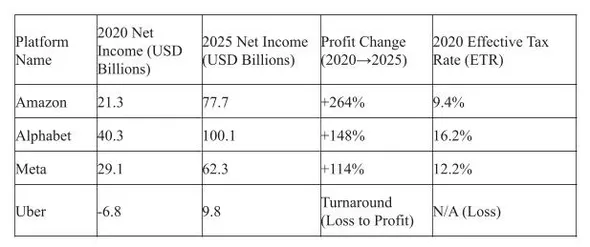
Precisely. The government’s stance toward these platforms is rooted in the belief that imposing high taxes on giants like Amazon or Google would cause these digital titans to lose their competitive edge against overseas tech firms (such as those in China or Europe). Simultaneously, the state tacitly accepts the platforms' high take rates, rationalizing that these platforms absorb the "redundant population" shed by traditional industries and therefore require capital to maintain this function. The state’s acquiescence to these exorbitant profits is driven by the so-called "Great Power" objectives of competing in new industrial sectors, as well as short-term domestic considerations for maintaining social stability by absorbing the unemployed. From the perspective of the ruling class, for the sake of these grand future goals of international competition, the state has abdicated its role as a social mediator. It has employed a more covert method to largely neutralize the "counter-movements" that might otherwise take root in the social soil.
Furthermore, the platform lacks physical substance in the traditional sense. During the Industrial Revolution, workers could pressure the bourgeoisie by sabotaging machinery or blockading factories. Today’s platform laborers have no physical target to attack in the real world. They provide their own means of production; if they stop working, a massive reserve army of labor is ready to fill the gap at any moment. Because the platform does not provide physical means of production, it does not suffer the same losses as an industrial capitalist, for whom a strike means idle machinery and daily financial hemorrhage. Paradoxically, under traditional forms of striking, it is the laborer who suffers the losses of idle means of production and unproductive tools, while the platform can simply hire others from thousands of miles away to replenish the labor force without incurring any loss itself. Even if one attempts a lawsuit, it triggers the union issues discussed below; as an individual litigant, a worker faces a corporate legal apparatus, and ultimately, it is the laborer who collapses first.
At the same time, this new form of production leads to the atomization of the employed. They are unable to build connections and organize unions like the mass-production workers of the past; under the U.S. National Labor Relations Act, only "employees" have the right to form legally protected unions.[7] The platforms insist that drivers are not employees but "partners." Since you are not an employee, you have no right to collective bargaining. If you attempt to coordinate a work stoppage, the platform can even cite Antitrust Laws[8] to accuse these "independent small vendors" of illegal price-fixing. The result is that internal operators (corporate staff) enjoy a full social contract, while external laborers are completely stripped out of the labor protection system. Instead, they view their colleagues with suspicion as competitors, leading to a "race to the bottom." Even if one group attempts a strike, others will not offer solidarity, and the army of the unemployed will continue to fill the void.
Another point is equally thought-provoking: this shift has brought about the "digitalization of the overseer," and these industries are marked by a distinct trend of "de-skilling." Today’s platform workers face an overseer controlled by data. Unlike a human supervisor, you cannot appeal to a machine for sympathy. While a human shouting with a whip is universally recognized as an oppressor, many perceive digital rules as merely "neutral regulations." But where can one find "equal rules" that are unilaterally dictated?
The platform’s pricing is built upon a nominal "partnership" rather than an employment relationship; thus, pricing is based on the platform’s own "freedom." Theoretically, you can choose not to cooperate with the platform. However, under a de facto monopoly, it is virtually impossible to leave these few platforms if you remain in the industry. Consequently, under what is effectively a tacit cartel pricing model, laborers are forced to accept the platform’s "freely set prices."
Furthermore, the trend of de-skilling[9] is self-evident. In the past, industrial workers required training and apprenticeships, but today’s barriers to entry have been drastically lowered. Marx argued in Capital: "The expenses of the production of labor-power are the expenses of making the laborer a skilled laborer. These expenses vary according to the quality of the labor-power... Since the period of apprenticeship is long, the value of skilled labor-power is also high."[10] Among traditional industrial workers, based on international labor standards and the historical experience of industrialized nations like Germany and the U.S., the cultivation cycle for a qualified worker typically falls into three levels.
First, the junior skilled worker takes about 3 months to 1 year. They primarily engage in specific operations on an assembly line (such as in a Fordist factory), requiring only the mastery of a single tool and basic safety protocols. Second, intermediate technical workers require 2 to 3 years—the standard duration of Germany's "dual system" of vocational education.[11] These workers must understand mechanical principles, blueprint reading, and complex production processes (such as advanced fitting, welding, or CNC machining). Finally, senior master technicians require 5 to 10 years or more; they must not only master production but also possess the ability to maintain documentation, improve processes, and mentor newcomers.
Contrast this with ride-hailing drivers or delivery couriers: one can start working as soon as the driver's license probationary period ends, following just 20 minutes of app-based tutorials. This means that labor is highly interchangeable, which further erodes the bargaining power of the worker. To establish a foothold in an already saturated market, laborers can only resort to cutthroat competition, while the platform remains the ultimate beneficiary.
Thus, we see the consequences of data being sold as a fourth fictitious commodity. Data is an objective record of human society and production, yet in this era of "traffic explosion," it is held by a few and sold as a commodity to laborers who provide their own means of production. This transforms the platform into a private machine with extremely low production costs and minimal risk, profiting solely by selling data. In this highly disembedded relation of production, traditional boundaries of "employment" become blurred, replaced by a false subjectivity packaged by algorithms. This subjectivity obscures capital’s deep subsumption of labor, causing workers to lose even the language required to identify their exploiters during the very process of being exploited.
IV. The Paradox of Revolution and the Prospects for Neo-Socialism
This form of hired labor creates an illusion for the employed, which can be called the "partner illusion." They are not the proletariat in the traditional sense. When these industries first emerged, most practitioners were part-timers. At that time, labor was scarce while market demand was skyrocketing, leading to high profit margins for both platforms and workers. However, now that monopolies have formed and more practitioners have become full-time rather than part-time, the market has been carved up. The labor force is growing, consisting of small-scale producers who bring their own means of production. The platform claims it merely provides a "stage" for them to get rich and that the relationship is a "partnership." But once they truly leave the platform, they cannot produce using their own means and tools; even if they could, they would be hopelessly inefficient. Moreover, they have no pricing power; the power to extract profit from every order remains with the platform. Can this still be called a "partnership with dignity"? Even if they leave one platform due to low prices, they find that small platforms lack resources, and the "cartelization" of the remaining large monopolies ensures similarly low prices. Consumers rarely choose higher-priced small platforms, meaning the "freedom of choice" is effectively non-existent. As long as you remain in the industry, it is impossible to produce outside of a few monopolies. Furthermore, the wear and tear of the means of production and all personal risks are borne by the laborer. The platform assumes almost no physical risk, extracting profit and crushing rivals through an infinite influx of labor and a saturated market to maintain its monopoly status.
Therefore, we can understand why the traditional Marxist theory—which posits that the more developed the productive forces, the richer the soil for mass revolution—appears to have failed today by looking at how the collective power of workers has been systematically dismantled.
In classical theory, an individual’s productive capacity is shaped by their tools and skills, and the total productive power of society is the sum of these individual strengths. Crucially, the Revolutionary Potential of the working class relies on a powerful combination of three things: the capacity to produce, a clear class consciousness, and a high degree of organization. If any of these elements is missing, the entire movement loses its momentum.
Today, however, the rise of algorithmic platforms has crushed this collective potential. First, because platforms monopolize the most advanced digital tools, workers are completely "de-skilled"—their personal expertise no longer matters, and they are reduced to replaceable, low-value cogs in the corporate machine. Second, their "class consciousness" is constantly fragmented and diluted by algorithms that feed them customized, distracting information. Finally, instead of bringing workers together under one factory roof, the gig economy isolates them. In the past, organization meant that workers united to multiply their collective strength; today, platform capital ensures they remain scattered individuals, interacting with the system only as isolated numbers.
During the Industrial Revolution, the Revolutionary Potential of workers grew as Marxist dissemination raised ideological consciousness and large-scale production increased the degree of organization; thus, Europe was the ideal birthplace of revolution in Marx’s view. However, the economic base determines the superstructure: advanced productive forces also lead to increasingly powerful superstructural forces, meaning the two sides rarely achieve total unilateral suppression of the other. Why, then, did revolutions occur in the relatively backward Russian Empire and China? Because backward productive forces resulted in a weaker superstructural power, while revolutionary parties—by raising consciousness and organization—caused the Revolutionary Potential of the worker-peasant alliance (transformed from vast populations) to grow exponentially, ultimately completing the revolution.
Today, it appears that the soil for spontaneous mass revolution or organized Leftist mobilization has been severely restricted, an issue we can examine from multiple perspectives. It is evident that decades of Neoliberal cultural hegemony have caused the Left itself to become confined within the "ivory tower." Starting from the forefather Gramsci, the movement has drifted toward a path of overcorrection. Gramsci noted: "Every 'position' in the social structure is not merely an extension of the state apparatus, but a site for cultural and ideological infiltration. Any political victory is fragile and unsustainable without establishing hegemony in these areas through a 'war of position'."[12] One could argue that the Black Panther Party represented the last large-scale awakening of mass organization and ideology in the United States. Since then, both in thought and organization, the movement has regressed into the self-isolation of small circles rather than the true seizure of cultural positions. One must ask: is the rise of so-called "identity politics" truly reclaiming territory, or is it driving more "conservative" masses into the arms of the Far Right?
As for the organizational dimension, Lenin’s descriptions remain remarkably clear, and I believe I need not quote them excessively. In fact, Gramsci also maintained that the seizure of cultural positions was for the sake of the rise of the organization—that is, for political leadership: "The leadership of a social group manifests itself in two forms: 'leadership' (hegemony) and 'domination.' A social group must already be a 'leader' (i.e., possessing moral and cultural superiority) before seizing state power; after seizing power, it becomes the 'ruler'."[13]
Therefore, the scarcity of Revolutionary Potential today does not mean the proposition regarding developed productive forces is incorrect; rather, it is the scarcity caused by ideological algorithms and atomization. To achieve a true awakening of the masses, the method is intuitive: achieve class consciousness and re-organization.
How, then, should Polanyi’s so-called "de-commodification" be re-interpreted under today’s fourth fictitious commodity? Platform capital has "disembedded" data, and while society should theoretically trigger a counter-movement, no large-scale movement has actually occurred.
Contemporary class struggle under these new forms is fragmented and quickly "suppressed" by new methods.
A true curative measure is impossible to implement thoroughly under existing conditions; it requires a fundamental social soil that can only be realized under the conditions of "Neo-Socialism." There are almost no precedents or theories for the construction of Neo-Socialism today. Therefore, until Neo-Socialism is constructed, this article has neither the capacity nor the necessity to finalize the specific details of de-commodifying data. However, we can explore some general directions:
First, the Socialization of Data.
Second, the Democratization of Platforms.
Liked it? Take a second to support Cosmonaut on Patreon! At Cosmonaut Magazine we strive to create a culture of open debate and discussion. Please write to us at submissions@cosmonautmag.com if you have any criticism or commentary you would like to have published in our letters section.
-
Karl Polanyi, The Great Transformation: The Political and Economic Origins of Our Time (Boston: Beacon Press, 2001).
↩ -
Vladimir Lenin, The State and Revolution (Chicago: Haymarket Books, 2014), 9.
↩ -
Michael Oakeshott, "On Being Conservative," in Rationalism in Politics and Other Essays, new and expanded ed. (Indianapolis: Liberty Fund, 1991), 427.
↩ -
Karl Polanyi, The Great Transformation, 74-76.
↩ -
Friedrich Engels, The Origin of the Family, Private Property and the State, trans. Alec West (New York: International Publishers, 1972), 221.
↩ -
Data for 2020 sourced from the Annual Reports (Form 10-K) of Amazon.com, Inc., Alphabet Inc., Meta Platforms, Inc., and Uber Technologies, Inc. Figures for 2025 are projections based on 2020–2024 fiscal trajectories and algorithmic extraction trends observed in Q4 2024 reports.
↩ -
National Labor Relations Act of 1935, 29 U.S.C. §§ 151–169.
↩ -
Sherman Antitrust Act of 1890, 15 U.S.C. §§ 1–7. The specific conflict between 'independent contractor' status and price-fixing is discussed in [Source on Gig Economy Law].
↩ -
Cf. Harry Braverman, Labor and Monopoly Capital: The Degradation of Work in the Twentieth Century (New York: Monthly Review Press, 1974).
↩ -
Karl Marx, Capital: A Critique of Political Economy, Volume I, trans. Ben Fowkes (London: Penguin Books, 1976), 276.
↩ -
For a detailed breakdown of the Vocational Training Act (Berufsbildungsgesetz - BBiG) and training durations, see Federal Institute for Vocational Education and Training (BIBB) reports.
↩ -
Antonio Gramsci, Selections from the Prison Notebooks, ed. and trans. Quintin Hoare and Geoffrey Nowell-Smith (London: Lawrence & Wishart, 1971), 238-239.
↩ -
Antonio Gramsci, Selections from the Prison Notebooks, 57-58.
↩