
A Helping Hand
The year was 1989, and China lacked everything. Following the violent crackdown on the Tiananmen Square protests, Western states rallied to condemn and issue arms embargos against what they saw as a relic of 20th-century Communist totalitarianism. Economic growth had also slowed since Deng halted market reforms during the inflationary panic that contributed to that year’s demonstrations. Militarily, the People’s Liberation Army was demoralized and discredited, a result of the humiliating stalemate in its 1979 invasion of Vietnam as well as the spectacular destruction of Chinese equipment that followed in the 1991 Gulf War.

At the People’s Republic of China’s lowest point, the State of Israel offered a hand. Though arms shipments from Israeli private dealers had gone on since the mid-1970s, official transfers of advanced military technology from the State of Israel promised brute power and the more elusive legitimacy in the Tiananmen Square Protests’ aftermath.[1] From 1979 to 1993, Israel sold more than $3.5 billion worth of weapons to China. Major technology transfers included the sale of Harpy UAVs in 1994, an invitation to join the Lavi Fighter Jet project which formed the basis of the J-10 Fighter, the PRC’s first break from Soviet military derivatives in 1995, and a contract for aircraft radar systems in 1996.[2] These are only the deals we know of; Article 3 of the 1993 Sino-Israeli Treaty on Technological Cooperation swears both parties to secrecy.[3]
Following close behind these arms transfers were diplomatic breakthroughs. Yang Shangkun, the PRC’s then-President, acknowledged contact with Israel shortly after the protests in 1989.[4] Chinese recognition of Israeli sovereignty then opened formal relations in 1992, and high-level state visits followed in the mid-1990s, beginning with military officials and culminating in Ezer Weizman visiting China in 1999 and Jiang Zemin visiting Israel in 2000.
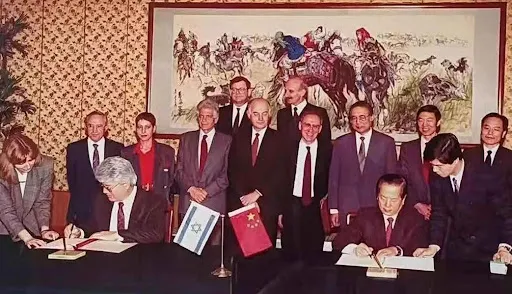
Of course, Israel was not motivated by altruism. If we think about a ‘balance-of-benefits’ in early Sino-Israeli diplomacy, Israel supplied military technology and diplomatic support in international organizations while the PRC granted increasing degrees of political recognition. As the former guiding light of Third World revolutionaries worldwide committed to the Palestinian revolution, Chinese recognition of Israel was cheap to its new nationally-minded military and economic elites but dear to Israel.
Therefore, aside from that pivotal moment in the early 1990s, historically the Zionist state had a one-sided infatuation with the People’s Republic. It desperately courted Chinese recognition when it unilaterally recognized the PRC in 1950 and cut ties with the Republic of China. In 1971, it voted against the United States in favor of the PRC’s accession to the UN. As David Hacohen, Israel’s man in Asia from the 1950s to the 1970s, said, “If Jews want to be known in Asia, China is the key.”[5]
There were domestic considerations after the Oslo Accords too. Israeli military spending more than halved from 15.6% of GDP in 1991 to 7.5% in the relative peace of 1995.[6] A market in China helped keep the Israeli military-industrial complex on stand-by while subsidizing the development of weapons of counter-insurgency.
Finally, while the USA was never happy with Israeli technology transfers to China, it was unwilling to put a stop to them when it needed international support in the Gulf War, Yugoslavia, Afghanistan, and Iraq. But with its mission accomplished in Iraq, the USA pressured Israel to cancel contracts with the Chinese for Phalcon radar systems and for upgrading the Chinese Harpy UAVs in 2004, a controversial decision in both Israel and China.[7] Israel, which had built its relationship with China through exchanges of military technology, was now conscripted into the American arms control regime that had shut out China.
Academics’ Diplomacy
To make up for American limitations on military technology transfers, Israel redoubled on other methods, encouraging a pro-Israeli lobby in Chinese academia’s Jewish Studies centers. Though Jewish Studies in China mainly focused on politically safe topics like Judaic exegesis, philosophy, and pre-modern history, its origins were anything but apolitical.
In the 1980 and early 90s, both sides sought connections that were durable but deniable. The first Chinese tourist office in Israel effectively acted as an embassy from 1989 to 1992, but academic exchange was the preferred method of informal contact.[8] In the 1990s, the Israel Academy of Sciences and Humanities and the technocratic think tank of Chinese Reform, the Chinese Academy of Sciences, began collaborating with their governments’ approval. Israel’s first unofficial diplomat to China, Reuven Merhav, outlined how this exchange would affect policy-making:
. . .the PRC system was far from being monolithic. Its many existing cracks and fissures could first be exploited to create a partial and unofficial presence, and then carefully, gradually, patiently, and quietly expanded to uncover the right channels to the political leadership.[9]
Over time, academic diplomacy was diffused in smaller research centers and individual scholars. On the Chinese side, the first Jewish Studies Center was established in the Shanghai Academy of Social Sciences in 1989, and other universities set up their own centers soon after.[10]
New institutional connections allowed for the most influential names in Chinese Jewish Studies to study and engage with their Israeli counterparts. In 1993, Xu Xin, the founder and director of the highly-prestigious Nanjing University’s Institute for Jewish Studies, was invited to Israel to meet with Prime Minister Yitzhak Rabin, President Ezer Weizman, and future President Shimon Peres, to whom Xu dedicated his new translation of Encyclopaedia Judaica for Chinese audiences meant to “lay an intellectual foundation for a normalization of relations on all levels between the two peoples” because “what the Chinese did know never went beyond the abstract and superficial and (by and large) negative.”[11] And, with financial and institutional support from Zionist backers, these Jewish Studies centers like Nanjing University’s were rebranded by their directors as institutes for Jewish and Israeli Studies in the 2010s, conflating Judaism and popular Chinese philosemitism with the State of Israel.[12]
These connections didn't stay in academia: Zhang Qianhong, another scholar with ties to academics and politicians in Israel, participated in government consultative bodies since 2003 and served as a delegate to the Twelfth Session of China’s National People’s Congress from 2013 to 2018. Not coincidentally, this period was the recent high-point in Sino-Israeli relations. Annually from 2015, Zhang was the head editor of the official foreign policy reports, called Blue Books, on Israel for consideration by the highest levels of the Chinese government.[13]
In the Blue Books, Zhang Qianhong included essays from Israeli think tanks including the Sino-Israeli Global Network and Academic Leadership (SIGNAL) group, whose aim was to “deter China from damaging Israel’s interests while at the same time advancing Israel’s diplomatic and economic successes.” Naturally, these agenda-setting Blue Books pushed for closer relations with Israel.[14]
Islamophobia was a key thread connecting the two. According to the Israeli Institute for National Security Studies, the Chinese and Israeli security establishments are united against a perceived threat in transnational Islamic extremism, though the extent of their cooperation is unclear.[15] However, this common enemy faded as the US pivoted towards a Pacific confrontation. No clash had emerged between Israel’s interests and China’s in combatting Islamic extremism, but it had to rhetorically realign itself to continue drawing on American support. Israel signed onto a Canadian-led HRC Resolution calling for investigations into the mass incarceration of Uyghurs in Xinjiang in June 2021.
Sino-Israeli academic networks have also begun to crack as the Chinese state grows more skeptical of the Israeli-American connection and Chinese society grows more horrified at the Gaza genocide. If a single person can be named the father of Israel Studies in China, it would be Pan Guang, but even he has criticized Israeli actions in Gaza; though he frames it in liberal Zionist terms as the betrayal of Israel’s democratic foundation by far-right ethnonationalists around Likud.[16] Likewise, Zhang Qianhong, while sympathetic to post-Zionist reformism, terminated her connections with SIGNAL’s researchers who abruptly stopped contributing to the Blue Books after 2021.[17] Talking about the discipline, Xu Xin advised Chinese scholars of Jewish and Israel Studies to “prepare for the long-term, remain resolute, and dig in” in 2025—a grim forecast but one that contains a subdued hope for revitalizing the Sino-Israeli relationship.[18]
Theatre at the Bay
The last card Israel had to play was leveraging its geo-logistical advantages. Post-CHIPS Act Israel is no longer an important source of microprocessors for China. It can be, however, a major transshipment hub into Mediterranean and European markets. In 2021, the Chinese state-owned Shanghai International Port Group (SIPG) finished construction of and began to operate the Haifa Bay Port, one of the Belt and Road Initiative’s largest Mediterranean investments.
Even in the Bay Port, Israel’s triangulating foreign policy between the US and China reveals itself to be potentially fatal. The beginning of the Israeli invasion of Gaza shut down the ports at Ashdod and brought a flood of traffic to the Bay Port. However, the overconcentration of Israeli logistical capacity at Haifa meant that the American Sixth Fleet docked across the bay and other Israeli port operators felt that the Chinese-run facility posed a surveillance risk and have called for suffocating scrutiny on the SIPG-run port, which had already seen its traffic plummet as shipping routes readjusted to avoid Israel entirely.[19] In response, SIPG has chosen to sell a 25% minority stake in the Bay Port to an Israeli infrastructure investment fund as of 2025, and the Chinese state is discouraging private investments in Israel according to unconfirmed reports in 2026.[20]
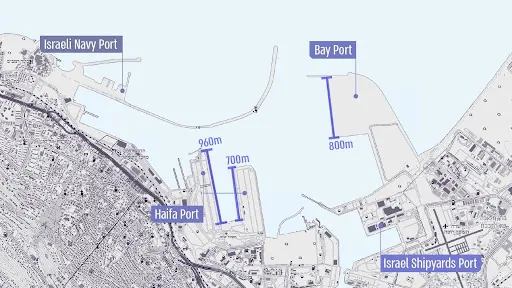
Therefore, Israel is also losing its geo-logistical advantages as a bargaining chip to China, especially when nearby regional ports like Piraeus in Greece—or even Bandar Abbas in Iran until recently—are domestically stabler, safer from American interference, and operate more efficiently.[21]
At the same time as Israel’s field of action in the Middle East narrows, regional developments initiated by China, including the 2023 Saudi-Iranian Reapproachment, have only expanded its list of mutually compatible partners, drawing concern from the INSS.[22] While far from divesting from Israel, China’s turn away from Haifa reflects the fraying of yet another bond tying the Sino-Israeli relation together.
This carries the implication that Israel’s actions as the regional arsonist—most spectacularly demonstrated in the Twelve-Day War and the 2026 War on Iran—were intended to neutralize Chinese partners and incentivize China to re-engage with Israel. That Israel wishes to diplomatically distance Iran from China was never in doubt, but it is possible that a major factor pushing Israel to throw the region into chaos was to present itself as the only stable state capable of securing Chinese exports and investment through a devastated region and to the European market.[23]
Paradiplomatic Praxis
It is the central contention of this paper that the Genocide in Gaza and the War on Iran are too important to be left to the diplomats, something that Maoist China tried to articulate with People’s Diplomacy where “non-state actors [played] diplomatic roles” with an internationalist outlook, challenging the technocratic foreign relations that we now see perfected in all its horror and banality.[24]
People in China are restive and opinionated. And, unless you actually believe that the CCP has been spreading antisemitism abroad and at home, organic outrage at Israel is just as visible there as anywhere else. In China, I’ve seen that energy with no place to go: international students waved a large Palestinian flag and chanted slogans during a public event against the wishes of the staff at a university I attended, anti-Israel posters are plastered on shop walls, and stickers demonstrating solidarity with Palestine are worn even by precarious delivery drivers. The first Red Guard, a Muslim writer named Zhang Chengzhi, has also retained a cult following among China’s leftist radicals for his writings on Palestine. The question now is of directing that energy.

Considering the PRC’s repression of its own Muslim populations, building ties with Chinese communities based on opposition to Islamophobia and settler-colonialism could result in a paranoid backlash and another domestic crackdown, but it is a risky balance we have to strike. With the pro-Israeli lobby in China temporarily unable to exert as much influence as before, opponents to apartheid, settler-colonialism, and genocide have to grab all that we can.
Moreover, past clashes between Israel and the US over their differing appetites for engagement with China in 1989, 2004, and over the Haifa Bay Port also demonstrate that the Sino-Israeli relationship shouldn’t be written off as entirely determined by the New Cold War rivalry.
To elaborate on Razan Shawamreh, a scholar of Sino-Palestinian relations, the main imperative now should be to “bring critical Palestinian perspectives into Chinese policy circles” precisely because Beijing’s complicity with genocide was not the mandate from a monolithic Chinese state, but rather the payoff from decades of pro-Israeli efforts which we must now exceed.[25]
Liked it? Take a second to support Cosmonaut on Patreon! At Cosmonaut Magazine we strive to create a culture of open debate and discussion. Please write to us at submissions@cosmonautmag.com if you have any criticism or commentary you would like to have published in our letters section.
-
Bruce W. Nelan and Lisa Beyer, “Israel’s Secret Weapon,” TIME Magazine 142, no. 17 (1993).
↩ -
Nelan and Beyer, “Israel’s Secret Weapon.”; Jonathan Goldstein, China and Israel, 1948-1998: A Fifty Year Retrospective (Praeger, 1999), 145.
↩ -
“中华人民共和国政府和以色列国政府科学技术合作协定” [Science and Technology Cooperation Treaty Between the People's Republic of China and the State of Israel], (February 14, 1993) People's Republic of China Treaty Archive, https://treaty.mfa.gov.cn/Treaty/web/detail1.jsp?objid=1531876681525.
↩ -
Goldstein, 112.; Elliot Jager, “How China Shifted Toward the PLO – Israel My Glory,” Israel My Glory, September/October 2006, https://israelmyglory.org/article/how-china-shifted-toward-the-plo/.
↩ -
Goldstein, 51.
↩ -
The World Bank, “Military Expenditure (% of GDP) – Israel,” World Development Indicators, accessed June 19, 2026, https://data.worldbank.org/indicator/MS.MIL.XPND.GD.ZS?locations=IL
↩ -
Sameer Suryakant Patil, “Understanding the Phalcon Controversy,” Israel Journal of Foreign Affairs 2, no. 2 (2008): 95-96.; Ze’ev Schiff, “Don’t Return Drones to China, U.S. Tells Israel,” Haaretz, December 22, 2004, https://archive.is/20231030222716/https://www.haaretz.com/2004-12-22/ty-article/dont-return-drones-to-china-u-s-tells-israel/0000017f-e254-d9aa-afff-fb5c710d0000.
↩ -
Goldstein, 99.
↩ -
Goldstein, 102.
↩ -
Zhang Qianhong 张倩红, “我国犹太-以色列研究的新进展” [New Developments in Jewish-Israeli Studies in China], China Social Science Network, January 8, 2020, https://www.cssn.cn/lsx/lsx_sjs/202210/t20221024_5552123.shtml.
↩ -
Xu Xin 徐新, “哀悼佩雷斯先生” [In Memory of Mr. Peres], The Diane and Guilford Glazer Institute for Jewish and Israel Studies, Nanjing University, September 29, 2016, https://judaic.nju.edu.cn/2f/c9/c10846a208841/page.htm.; Xu Xin, Ling Jiyao, eds., The Encyclopedia Judaica: Chinese Edition, (Shanghai People’s Publishing House, 1993), i-iii.
↩ -
Xu Xin, “Chinese Open New Chapter With the People of the Book,” Forward, April 20, 2007, https://forward.com/culture/10542/chinese-open-new-chapter-with-the-people-of-the-bo/.; Carice Witte, “A Quiet Transformation in China’s Approach to Israel,” SIGNAL Group, April 1, 2012, https://signal-group.org/articles/a-quiet-transformation-in-chinas-approach-to-israel/.
↩ -
“文以载道,以德化人 ——记张倩红教授教育家精神” [To Express Ethics with Words, To Change People with Ethics: A Record of Zhang Qianhong’s Spirit of Teaching], Henan Sheng Shi De Zhuti Jiaoyu Huodong, May 20, 2025, https://www.htu.edu.cn/sdzthd/2025/0520/c5806a346365/page.htm.
↩ -
“Gloal Israel Initiative,” SIGNAL Group, https://signal-group.org/global-israel-initiative-gii/.; Zhang Qianhong 张倩红 et al., eds., 以色列发展报告 (2015) [Annual Report on Israel’s National Development (2015)] (Social Sciences Academic Press, 2015), 2-3.
↩ -
Zhang, “New Developments in Jewish-Israeli Studies in China.” David Goldman, “Israel Is Not an Outpost of the West,” SIGNAL Group, October 9, 2024, https://signal-group.org/articles/israel-is-not-an-outpost-of-the-west/.
↩ -
“潘光:中东地区秩序正在悄然重组” [Pan Guang: The Middle-Eastern Order’s Quiet Reconstruction], Shangguan News, November 26, 2025, https://news.qq.com/rain/a/20251126A018KG00.
↩ -
Zhang Qianhong 张倩红 and Han Boya 韩博雅, “‘后犹太复国主义修正派’与以色列民族国家叙事的新趋向” [Post-Zionism Reformism’ and Trends in Israel’s National Narratives], Theory of Historiography 4, no. 1 (2024): 120–21.
↩ -
“中东区域国别研究论坛暨第五届中国犹太学研究年会在郑州成功举行” [Forum on Middle Eastern Nationality Studies and the Fifth Chinese Jewish Studies Annual Meeting Was Successfully Held in Zhengzhou], Zhengzhou University School of History, November 24, 2025, https://www5.zzu.edu.cn/lsxy/info/1268/3772.htm.
↩ -
Galia Lavi, “Three Years of the Bay Port: A Status Report,” The Institute for National Security Studies, September 10, 2024, https://www.inss.org.il/publication/port-haifa-3-years/.; Israel Ministry of Transport and Road Safety, Shipping and Ports Authority, Service Indicators 2024: Cargo Quantities (Jerusalem: Government of Israel, 2024), https://www.gov.il/BlobFolder/reports/service-indicators-24/he/%D7%9E%D7%93%D7%93%D7%99%20%D7%A9%D7%99%D7%A8%D7%95%D7%AA%20-%20%D7%9B%D7%9E%D7%95%D7%99%D7%95%D7%AA%20%D7%9E%D7%98%D7%A2%D7%A0%D7%99%D7%9D.pdf
↩ -
“Noy Fund to Acquire 25% of Bayport Terminal Shares,” Port2Port, June 29, 2025, https://en.port2port.co.il/article/Sea-Transport/Ports/SIPG-Bayport/Noy-Fund-to-Acquire-25-of-Bayport-Terminal-Shares/.; Tomer Ganon, “Chinese Fund: ‘The Chinese Government Has Imposed a Ban on Any New Investment in Israel,’” CTECH News, February 2, 2026, https://www.calcalistech.com/ctechnews/article/rlw9l86qt.
↩ -
The Container Port Performance Index 2020 to 2024: Trends and Lessons Learned (World Bank, 2025), 56–75, http://hdl.handle.net/10986/43744.
↩ -
Shira Gross, “China’s Global Initiatives: Implications and Recommendations for Israel,” The Institute for National Security Studies, May 11, 2025, https://www.inss.org.il/publication/china-world/.
↩ -
Tommy Steiner, “China Is Recalculating Its Middle East Policy,” SIGNAL Group, November 14, 2024, https://signal-group.org/articles/china-is-recalculating-its-middle-east-policy/.
↩ -
Huang Ying and Yang Yanling, “The Role of Sino-Arab Film Collaboration on Cultural Diplomacy during the ‘Seventeen Years,’” Transnational Screens 15, no. 2 (2024): 140, https://doi.org/10.1080/25785273.2024.2375123.
↩ -
Razan Shawamreh, “China and the Gaza Genocide: A Strategic Distance,” Al-Shabaka, September 16, 2025, https://al-shabaka.org/policy-memos/china-and-the-gaza-genocide-a-strategic-distance/.
↩