
I was happy to see some serious engagement with my political economy research by The Inner Moon in a recent article for Cosmonaut. However, I did want to clarify one thing regarding my methods and conclusions, and the limits of extrapolation to certain examples. In the article, Moon raises the example of Argentina as what the social democratic model would look like past its prime. Previously, I’ve spoken about how in the US, the New Deal, pre-neoliberal era was based on a class compromise of rising investment rates and falling rates of exploitation, and Moon seems to want to apply this same compromise model to the Argentinian economy, due to the similarities in Peronist politics to social democratic and new deal politics in terms of class compromise. However, there is a problem with this extrapolation. The Argentinian model of post-Peron politics which survived into neoliberalism was not one based on rising investment but the opposite.
See the graph below, which tracks capital intensity vs labor productivity, Argentina’s capital intensity essentially stopped rising in the 70s, taking it off the track of economic development that the rest of the world was pursuing.[1]
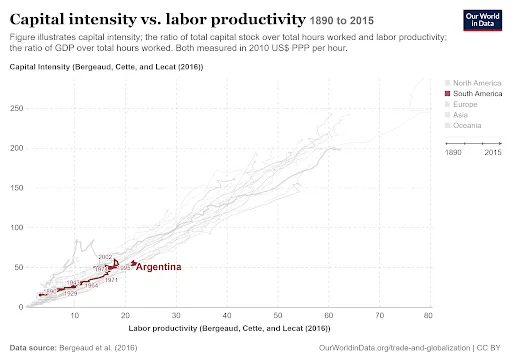
In other words, we cannot understand Argentina’s continuance of class compromise in the neoliberal period as simply being the extension of the previous social democratic politics.
To get a grip on exactly how Argentina differs from the US example it’s useful to decompose the surplus for both countries.[2]
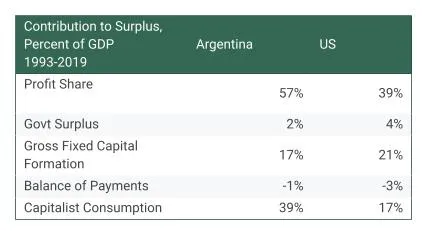
Perhaps as expected for a developing country, Argentina actually has a higher profit share of income, and therefore a higher exploitation rate than the US, and it also has a correspondingly lower capitalist consumption rate. Crucially, however, it also has lower average gross fixed capital formation than the US, meaning less overall investment.
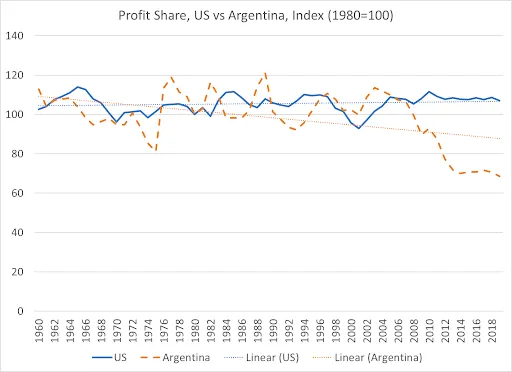
If we look at changes in the output-to-capital ratio, and the profit share, over time, we can begin to see how each country responded to neoliberalism.
With regard to profit share, both countries kept this pretty stable, the US seeing modest rises and Argentina seeing a modest fall and then more precipitous one after 2003.
Similarly, Argentina, just like the US, saw a stagnation in the output-to-capital ratio[3], which is ultimately determined by the investment rate. A rising investment rate would lead to a falling output-to-capital ratio.
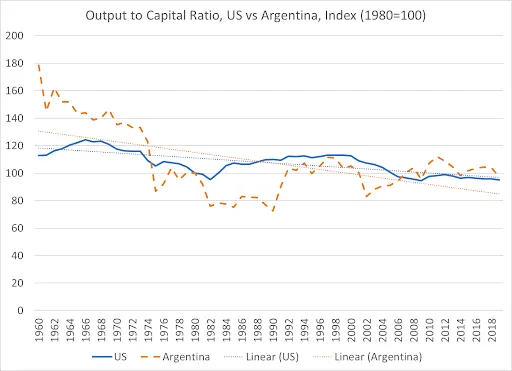
In other words, Argentina responded to neoliberalism in much the same way the United States did! It undertook policies to withhold investment and protected capitalist consumption. The main difference is that Argentina, as a developing country, had a much higher profit share and rate of capitalist consumption to start with, and also less ability to stabilize its situation via financial rent-seeking and international financial markets, although its periodic debt and currency crises are based on heroic efforts to try.
If we compare the curve of capital intensity to labor productivity for both Argentina and the US, we can see that the US has continued to see rising capital intensity and labor productivity, albeit it went from an extreme outlier in high capital intensity in the 20s and 30s to an outlier in low capital intensity under neoliberalism.
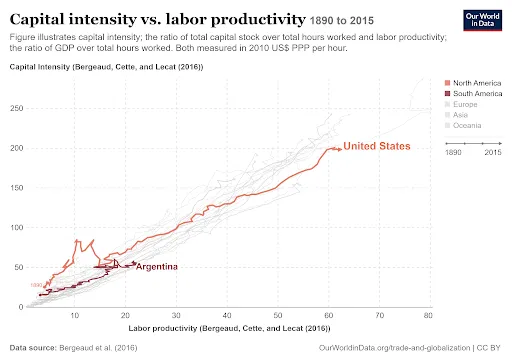
It should be noted that while the output to capital ratio is a ratio of purely monetary units, the capital intensity in the graph above is a ratio of a the capital stock and total hours worked, hence why the US and Argentina can have drastically different levels of capital intensity while having similar levels of output to capital (32% for the US and 36% for Argentina on average between 1980 and 2019). To the extent to which Argentina is an aberration in any way is the decline in profit share and capitalist consumption rates since 2003, probably credited to the economic populist policies of the Kirchners. While there was ostensible commitment to industrial investment during this period, this didn’t really materialize, and instead state-led intervention and programs to help the poor only helped decrease the exploitation rate.
We must not say that Argentina avoided neoliberalism. Rather, Argentina experienced quite typical neoliberalism beginning in the 70s and 80s, which crippled investment and therefore long-term economic growth in the country. In the 2000s, left populist governments gained power, which reduced the rate of exploitation, but did not actually solve this problem of underinvestment. Unlike the United States, which could rely on extensive domination of financial markets and a few cutting-edge sectors with intellectual property rents, Argentina floundered and totally stalled out in terms of growth and labor productivity (here measured crudely in terms of GDP to hours worked). The current political climate in Argentina can be understood as a backlash to the consequences of left populism in neoliberal conditions. I’ve remarked before that Milei is likely to restore normalcy, albeit at great cost to the working class of Argentina. Redistribution in an economy not experiencing real growth will necessarily lead to inflation since the capitalists do not consume as much of their income as workers, and that’s before even getting into the currency shenanigans which benefit the consumption of domestic capitalists and workers alike. The restoration of proper neoliberalism, with low investment and high rates of exploitation, seems certain. Contrary to expectations of free market fundamentalists, we’ve already seen a collapse in foreign direct investment in Argentina this year as many foreign companies sell their operations to locals due to unfavorable macro economic conditions, even as inflation and Argentinian bonds have begun to stabilize.[4]
It is important to be precise in these things, and to back up our claims with data. Neoliberalism is characterized by a set of economic stylized facts which can be easily seen in many data series, and divergences in the data can be illuminating when included in analysis. I have a Latin maxim I like to repeat and which I have on my phone lock screen to remind myself, veritas ex materia, truth from matter, which I favor a bit more than the “truth from facts” Dengist doctrine I’ve previously cited in the letter section, mainly due to its empiricist connotations, and my own personal pretension. The material facts, the scientific theory which explains the material world, and experimental practice which informs both - these things are essential to Marxist research, and we must make it a habit to pester each other on these sorts of details.
Liked it? Take a second to support Cosmonaut on Patreon! At Cosmonaut Magazine we strive to create a culture of open debate and discussion. Please write to us at submissions@cosmonautmag.com if you have any criticism or commentary you would like to have published in our letters section.
-
Bergeaud et al. (2016)HYDE (2023)Gapminder, Population v7 (2022)UN, World Population Prospects (2024)Gapminder - Systema Globalis (2022)Our World in Data – with major processing by Our World in Data https://ourworldindata.org/grapher/capital-intensity-vs-labor-productivity?time=2003..latest&country=~ARG
↩ -
Data from: Feenstra, Robert C., Robert Inklaar and Marcel P. Timmer (2015), "The Next Generation of the Penn World Table" American Economic Review, 105(10), 3150-3182, available for download at www.ggdc.net/pwt ; Calculations by author.
↩ -
Basu, Deepankar, Julio Huato, Jesus Lara Jauregui, and Evan Wasner. 2022. “World Profit Rates, 1960–2019.” Review of Political Economy, November, 1–16. https://doi.org/10.1080/09538259.2022.2140007. ; https://dbasu.shinyapps.io/World-Profitability/ ; Author's calculations.
↩ -
2019. Tradingeconomics.Com. TRADING ECONOMICS. December 5, 2019. https://tradingeconomics.com/argentina/foreign-direct-investment. ; Iglesia, Facundo. 2025. “Argentina Records Negative Foreign Investment for the First Time in over Two Decades.” Buenos Aires Herald. December 16, 2025. https://buenosairesherald.com/business/argentina-records-negative-foreign-investment-for-the-first-time-in-over-two-decades.
↩