Unless one is a socialist organizing on the ground, it is easy for one to read the terrain of class struggle and conclude that capital has the upper hand. While capital in the imperial core intensifies border regimes and escalates racialized policing, comparable working-class organization on the national or international level has yet to emerge. During the era of the mass worker, one may point to the mass parties and revolutionary organizations that claimed to represent them. Yet during the neoliberal period, capital went on a global offensive that hollowed out the working class’s mass organizations, leaving practically no organizations that could appropriately scale to counter the hegemony of capital. For the Marxist, one has to squint to locate the working class.
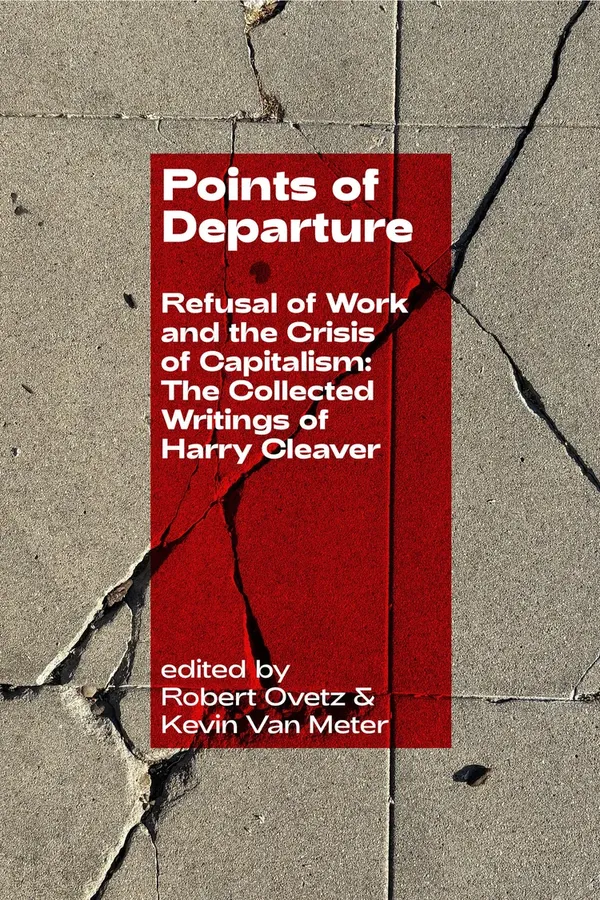
A newly published collection of writings by Marxist Harry Cleaver seeks to re-center the working class as the subject of class struggle. Cleaver emerged from the 1960s American New Left and is a chief proponent of the Italian autonomist tradition of Marxism. By inverting the relationship between capital and labor to one where labor initiates struggle and capital reacts and restructures, socialists discover a very different narrative of the past half-century. Per editors Robert Ovetz and Kevin Van Meter, “[Cleaver] doesn’t see us getting our collective class-ass handed to us. He sees the working class doing the ass-kicking…There has been a danse macabre between a powerful global working class and weak capitalist class in the decades following World War II.”[1] Capital is always already running to catch up with and reassert command over labor-power, with labor in turn always changing shape and forcing capital back on the defensive. Cleaver’s perspective transforms capitalist offense into defense, restoring the protagonistic agency of the working class at a historical juncture where it appears most invisible.
Yet given how indispensable Cleaver’s “class composition” approach proves, Cleaver’s own conclusions about what this approach says about working-class organization betray a fundamental ambiguity. This has less to do with the class composition approach itself than with Cleaver’s opposition to organizational forms like the Leninist party model, which he struggles to ground in the very class composition approach he professes. Even bracketing Cleaver’s conclusions pertaining to organization, his writings at times fail to fully follow through the mandate to not only center working-class agency, but show how capital’s counteroffensive itself must proceed on the basis of working-class composition. Consequently, Cleaver’s analyses frequently risk a voluntarist reading of class struggle that ironically decenters the very working-class agency he otherwise works very hard to center. When pursued with the rigor that Cleaver himself demands, the class composition approach turns back upon the very conclusions Cleaver seeks to draw from it.
UPSIDE DOWN, ROUND AND ROUND
“The history of all hitherto existing society is the history of class struggles.” Therein is the point of departure for Marxist analysis of the centuries-long struggle between labor and capital. Yet a sociological danger lurks: labor and capital as two equal and opposite classes externally related to one another, like two boxers in a ring. Among the features that distinguish Marxism from sociology is the former’s point of departure: that of a working class which seeks not only to abolish capital but also itself. For Marx, the proletariat is the class “which cannot emancipate itself without emancipating itself from all the other spheres of society.”[2] The asymmetry that justifies the protagonistic character of labor is what structures Marx’s critique of political economy’s labor theory of value throughout Capital, where the distinction between the laborer and the capital, i.e. tools or machinery with which they produce commodities, is the difference between living and dead labor. For Marx, Capital is “dead labour” which exists only “by sucking living labour, and lives the more, the more labour it sucks.”[3] When the socialist forgets this, they pay a great price—struggle slips back into the background and capital retains its eternal-like position, with labor once again reduced to its lackey and follower.
Cleaver’s essays on class composition are invaluable for any contemporary socialist within the Marxist tradition working to identify the autonomous character of the working-class. In saying so, it’s important to understand what about our historical conjuncture leaves class composition so necessary for analysis. In Marx’s day, one did not have to work hard to identify working-class political subjectivity. During the late-19th century, socialist mass parties such as the German Social Democratic Party and trade union movements were emerging at such a rapid pace that the question of how the working class may be politically constituted at scale was easily answerable. Even as late as the mid-20th century, the international emergence of postcolonial and revolutionary socialist movements made clear how the international proletariat could contest and overthrow capital.
But from the seventies onward, the working-class movements of the sixties increasingly demobilized at the same time as what Mike Davis calls the “insurgent middle strata” of the imperial core came to dominate the organizational terrain of American political life.[4] In a matter of decades, the classical organizational forms of the imperial working-class ossified and withered while more individualist middle-class special interest groups, lobbying firms, and PR committees blossomed. The Marxist tradition, which took for granted the working-class’s traditional forms of political organization, was suddenly bereft of the organizational forms that rendered the working-class legible as a political subject.
In this sense, Cleaver’s concept of class composition—derived from the late-20th century Italian autonomist tradition—works as a historically compensatory mechanism to retrieve a form of political legibility that the Marxist tradition once took for granted. The contemporary Marxist who fails to center class composition and the autonomy of the working class risks losing themselves in the dark, relying only on liberal sociology’s traditional categories that abstract reality by freezing struggle into place. Or, on the other end, the socialist organizer becomes trapped within the immediacy of local organizing work, incapable of circulating their struggles beyond their local position and connecting them to the global struggle of the working class. Class composition enables socialists to discover and show others that the working class did not disappear, but shifted into a form that both we and capital are still working to catch up with.
Especially valuable in Cleaver’s class composition is the centrality of unwaged and reproductive labor that was a lacuna for the Marxist tradition until the 1960s and 70s. Because the center of gravity for class struggle has shifted beyond the factory, Cleaver can analyze how the real subsumption of life within the imperial core has led to the generalization of class struggle beyond the factory. “Precisely because capital seeks to intervene and shape all of life, all of life rebels, each nook and cranny of life becomes a site of insurgency against this subordination.”[5] Housewives strike in the home or organize in the streets for reproductive rights, college students set up encampments in protest of university endowments supporting genocide abroad, and peasants barricade roads to disrupt trucking routes. These centuries-long reproductive struggles attain an undeniable visibility because of transformations wrought within the terrain of class struggle that lead to their increasing centrality to capital accumulation. After the 1960s, traditional forms of unwaged feminine labor became increasingly waged as the healthcare industry and service sector grew central to the formal reproduction of American capitalist society.[6] Forms of “private life” outside of the factory have been integrated into the overall social reproduction of capitalist society, i.e., the social factory.[7] The struggle appears to have disappeared because our categories have yet to catch up with the degree to which the struggle has generalized beyond the doors of the factory.
By centering class composition, socialist organizers can broaden and historicize how the form of class struggle has unfolded since the 1960s, thereby equipping them with the conceptual tools to more adequately connect local struggles among distinct constituencies with the global class struggle as such. Cleaver’s framework enables organizers to re-evaluate traditional categories of Marxist political economy, thereby enabling organizers to identify opportunities for organizing that may have remained otherwise invisible.
Ironically, the moments where class composition shows the greatest explanatory potential are the ones where Cleaver chooses not to further extend his analysis. For example, Cleaver frames the rise of neoliberalism as a defensive measure against the progressive uncontrollability of labor and breakdown in the Fordist regime of accumulation:
This [shift from fixed to floating interest rates] also constituted a shift of terrain on the part of capital: from the concrete worlds of production and reproduction to the abstract and fetishized world of money; from the city streets, factories, college campuses, and rice paddies in which the struggles of the 1960s were being fought to the obscure back rooms of central banks and distant markets for foreign exchange.[8]
Cleaver seeks to correct the narrative held among some Marxists and left-liberals that the seventies through the 2000s constituted the triumph of capital over labor, shifting perspective to one where capital careens from “one crisis strategy to another, ever seeking a formula which will restore its control [over global labor-power].”[9]
Yet Cleaver does not go far enough in showing how capital’s response was grounded on terrain dictated by the working class itself. Consequently, his approach risks objection by unsympathetic critics. A critic may well concede that financialization was a defensive strategy deployed by capital placed off-balance by resurgent labor. But they may then reject that class composition itself explains why precisely financialization was the necessary mechanism capital congregated around. Cleaver writes that “We should instead [interpret capital’s counteroffensive as a] response to the failure of both recent and past attempts to decompose the working class into a profitably malleable labor force.”[10] Political Marxists like Dylan Riley and Robert Brenner, who read financialization as symptomatic of the terminal crisis of late capitalism, would not find anything objectionable here. But what Cleaver leaves ambiguous and therefore open to attack is his claim that the working class did not just influence capital’s response, but dictated the terms on which capital generated its counteroffensive; this latter claim remains underdeveloped in his account of the neoliberal counteroffensive.
Cleaver’s class composition approach risks the objection of being a mere “just so” story: it does not extend his analysis into the realm of Fordist production, showing how the neoliberal counteroffensive was not only a response to the Fordist working class, but how it was made possible by it. The “massification” of the working class happened by way of the factory, whose large-scale machinery attempted to break the power of the craftsman over the labor process, rendering workers more specialized, interchangeable, and individually weaker.[11] But the interchangeability of labor wrought by the Fordist labor regime, reaching its political apex in the postwar period, enabled an unprecedented degree of mobility among workers, turning it around and threatening the Fordist regime of labor command. Jefferson Cowie observed how the RCA factory managers who benefited from the surplus of Indiana farm labor by the 1960s were fretting over the mobility of workers who could now quit in response to work speed-ups and go back into town where ten other factories were hiring for identical wages.[12]
Outside of the factory, Fordist planning integrated household consumption and production into macroeconomic planning.[13] Millions of working-class and middle-class women leveraged this to gain entrance into and win protections within the sphere of formalized wage-labor and escape localized forms of patriarchal domination within the home. The consequent abstraction and standardization of labor at once facilitated the tightened integration of the national economy, while leaving older regimes of racial domination exposed to challenge. Middle- and working-class Black Americans exploited this, pitting Old South elites attached to the old regime of Jim Crow against New South business and political elites anxious to facilitate a “business-friendly climate” that would not scare off Northern capital eager to escape the tyranny of the trade unions.[14] Grounding the political form of these struggles was the growing and uneven recognition on the part of the American working-class that capital’s recomposition of the terrain of struggle could be exploited to the advantage of the working-class.
Yet capital would eventually turn the increasingly mobile and abstract character of labor back against the working class, even as the counterrevolutionary offensive could only be conducted on the terms set by the working class. I do not have to venture far from Cleaver’s argument to find the theoretical resources for this turn, finding it in the very autonomist tradition Cleaver himself represents. Analyzing the crisis driving the death of the Keynesian state and the rise of neoliberalism, Antonio Negri writes that “capital is forced to accept the situation brought about by the split between labour and the general law of value. The capitalist attempt to re-establish hegemony over the class relation follows from this perception.”[15] While Negri aligns with Cleaver’s conclusions, Negri goes further than Cleaver in showing that not only is the neoliberal offensive a defensive maneuver against the working class, but, more radically, how the struggle of the working class determines the field of possibility through which capital organizes its counteroffensive.
Thus, Cleaver’s notion of financialization is made possible by the abstractive and interchangeable form that labor-power takes in the post-Fordist period. Capital takes on a more mobile, financialized character because social labor has itself become more mobile. Capital’s shift from the factory complex to small- and medium-sized contractor firms that break the industrial union model, its “flight” to the Global South—these processes are made possible by the achievement of a standardization, formalization, and abstraction of labor-power, whose mobility forced capital to mobilize, catch up, and transform working-class mobility into working-class precarity.[16] Late-20th century labor-power and its forms of struggle at once foreclosed old forms of capitalist discipline while also opening up new possibilities of exploitation. Abstract standardized labor, made possible by the factory, amplifies the power of financial capital to take the lead in organizing production at an unprecedented scope. Capital is driven to financialization in order to outmaneuver the global working class; yet the very possibility of financialization is only enabled by and constituted through the productive terms set by an increasingly globalized and mobile working-class composition. That capital can financialize and contractorize to assert indirect command over global labor-power is only possible because of the terrain of class struggle set by the working class.[17]
I point this out because the selected Cleaver essays within the collection risk passing over what makes his class composition perspective so invaluable. At times Cleaver’s framing of the approach risks falling into the same sociological reading of class struggle his methodology criticizes, but reversed: instead of capital acting and labor reacting, now it’s just labor acting and capital reacting. This inverted perspective, even as it appears to be “worker first,” in fact decenters the working class by leaving underdeveloped exactly how and why the working class historically took the forms of struggle that it did.
This danger expresses not a failure of method, but its incomplete application. To develop this framework to its fullest would require showing why capital’s tendency towards financialization during the late-20th century was an avenue at once rendered possible through and demanded by the same class composition over which capital sought to reimpose command through global financialization. Left as it is, Cleaver’s reading marginalizes the agentic capacity of the working class by only showing how the working class pushed capital to financialize, stopping short of showing how it also materially built the very ground on which capital maneuvered. Cleaver’s occasional neglect to follow through on his thesis that Marxist analysis must center class composition consequently warps the terrain of the class struggle, failing to move beyond the immediate and empirical appearance of working-class activity.
THE SHEEN OF DIFFERENCE
One strength of Cleaver’s class composition approach is the manner in which it drives socialists to reckon with how the shape of class struggle has changed since the 1960s. Cleaver forcefully argues for the inclusion of non-waged, reproductive labor as a central site of working-class antagonism that exceeds older Marxist approaches centered on the industrial factory. “The narrowness of [both Marxists and non-Marxists’] vision of dwindling jobs derives from the way they largely ignore unwaged work and the way its growth must be taken into account in any contemplation of the evolution of work…In this way, what a one-sided representation of high unemployment portrays as a reduction in jobs available, a more comprehensive view must understand as a redistribution of work between waged and unwaged sites.”[18] Through the process of “self-valorization,” there has come a rise in the number of struggles against capital: mutual aid networks, peasant communes, student occupations, women’s movements.[19] Here again, though, Cleaver’s arguments throughout these essays risk taking these forms for granted and passing over the class composition that renders these struggles possible to begin with.
As society becomes more structured by the “social factory,” the diversity of struggles through the household, university, and indigenous community attain a unitive character in their shared opposition to capital. “The ‘working-class,’” writes Cleaver, “ is monolithic only as a class in-itself, i.e., as formed by capital through the universal imposition of work.” The class only becomes for itself “through its negativity which is rooted in the commonality of its opposition to the domination of capital, i.e., in its struggles to cease being defined as either a working class or as any kind of one-dimensional class.”[20] The universality is only discovered negatively, through the distinct ways in which capital realizes its domination: what unites the Ecuadorian peasant commune, the North American women’s rights group, and the French graduate student union is the “refusal to work” within their particular spheres within the globalized social factory.
Cleaver’s emphasis on the diversity of struggles grounds his opposition to traditional political forms of working-class subjectivity like the mass party and trade union. For Cleaver, the present form of working-class self-valorization exceeds the trade union and mass party, opting instead for a united front of confederated projects that preserves both the diversity of struggle and also the unity of the objective. “In the place of attempts to organize the homogenization of workers’ struggles through institutions such as trade unions or political parties which push a unified vision of the future (socialism) against capitalist domination, we should substitute the politics of alliance for the replacement of capitalism by a diversity of social projects.”[21]
While Cleaver’s argument is a necessary rejoinder to those socialists who insist on the politically inadequate mass party and trade union, his essays do insufficient work to support his wholesale affirmation of the “diversity of socialist projects.” My chief concern is the extent to which Cleaver successfully argues that the political composition of struggle is adequate to contemporary class composition. Cleaver is right to insist that socialists should begin from the “coordination of complex networks of social cooperation” that have emerged in past decades.[22] However, Cleaver neglects to show the very thing that allows these spontaneous forms of working-class organization to resist capitalist domination also disables and slows the circulation of struggle. The locality and opacity of the mutual aid network are also the structural features that limit its scalability and circulation of struggle beyond it. There is no doubt that these diverse forms of proletarian struggle that have emerged in the wake of the mass party and trade unions’ collapse indicate very important features of the changing terrain of class struggle. But Cleaver, at least in these essays, does not do enough work to show why these particular organizations are immediately sufficient for overthrowing the global rule of capital.
An analogous example to the shortcoming of Cleaver’s position on “self-valorization” comes through Negri’s analysis of the immediate reaction to the emergence of the soviets during the 1910s from Central European and Russian communists. Where Luxemburg saw within the soviet the “expansive nature of the Soviets” to civil society, and Trotsky the potential “centralizing phase of their revolutionary functions” for the party, Lenin rejected both positions.[23] By Negri’s interpretation, the root of their error for Lenin lay in “considering the revolutionary process as a continuity that does not find any solutions, and in particular, solutions between economic demands and political demands.”[24] In other words, both assumed that the immediate form of the soviet would automatically translate to insurrectionary purposes. Both are caught up in the organic character of the soviet that they momentarily lose sight of its structural danger—either of reformism, settling at whatever concessions capital can give within the soviet’s narrow terrain of activity, or its democratic character where its class-based character may be dissolved in a populist, democratic orientation. For Negri, writing on Lenin, the insurrectional character of the soviet must be affirmed and directed “exterior” to the narrow terrain the soviet operates. Left on its own, nothing can stop it from leaning either into reformism or populism.
Cleaver’s interpretation of self-valorization is a useful corrective to socialists who nostalgically dwell on old forms of political struggle no longer adequate to the contemporary working-class’s composition. Self-valorization also presents the danger of resting on the immediate appearance of spontaneous organizational forms if unmoored from material analysis. However, Cleaver himself may be charged with not following through with the demands made by self-valorization. Self-valorization must go beyond acknowledging the plurality of ways working-class subjects valorize through the refusal to work; it must also assess whether those particular refusals are adequate to the revolutionary organization their conditions demand. Cleaver is empirically correct about the many diverse forms of struggle emergent within the current historical conjuncture. But the more pressing problem than their existence is whether diversity itself is sufficient for adequately challenging capital. It is on this question where Cleaver falls shortest from his method—the question of the vanguard Party.
PARTY AT THE END OF THE WORLD
Throughout several essays in this collection, Cleaver expresses complete dismissal of the classical Leninist vanguard party as a vehicle for revolution, laying at its feet twentieth-century socialism’s negative association with top-down central planning and autocracy. “The origins of top-down, centrally planned concepts of socialism lay within the biases of Marxist-Leninists…to see workers as essentially reactive to mechanisms of oppression and, therefore, to think that they depended on some kind of outside leadership (of the party or of intellectuals) to mobilize them for revolution.”[25] In his dismissal, Cleaver falls significantly short of his method of class composition, projecting backward into time the conditions that limit the party today. This not only blunts his own critique, but disqualifies a form of working-class organization that may be increasingly adequate to working-class composition. When rigorously followed, Cleaver’s class composition approach generates a critique of how he treats the political composition of Leninist party organization.
Cleaver discloses next to nothing concerning the conditions that drove the “top-down, centrally planned” structure of the Leninist party. This neglect obscures the conditions that made the party politically effective in organizing workers within the context of turn-of-the-century Tsarist Russia. Unlike in Western Europe, working-class resistance struggled to attain legal organizations like trade unions and mass parties under the harsh autocratic regime of Tsarist Russia. The only form of cooperation allowed to workers was the factory. Even when workers organized and won wages within the factory, organization struggled to extend beyond its walls. The classical vanguard party of professional revolutionaries emerges to provide a totalizing vision of the landscape denied to the spontaneous strikers and unionists. “Spontaneous revolts and riots develop without managing to group up: here, in a preliminary way, the idea of an absolute need for a central nucleus of leadership is formed precisely as an appreciation of the specific character of the struggle against autocracy and against the ferocious centrality of repression.”[26]
Negri’s analysis of how the party form was structured by the top-down factory provides more clarity behind the logic of its political composition. The insufficiency of Cleaver’s characterization of “top-down” derives from his omission of how that “top-down” organization was structured and whether or not it was adequate to the composition of labor. By contrast, Negri is far more thoughtful in his analysis, arguing that the project of Leninist organization reproduces the “technical and political composition of the proletariat” adequate to the “ideology of organized labor typical of the large factory and of the class vanguard in Russia.”[27] The specialization of party members and its cells presupposed the centralization of the party as the central nucleus, a form adequate to the occupational specialization and consequent organizational isolation of the factory worker under the conditions of harsh repression.
The particular composition of Russian labor allowed the Leninist party to strike at the state’s “weak points.” The large-scale factories of Petersburg and Moscow enabled a partial massification of the industrial worker that forced the Tsarist state to deal with labor as a general, political subject it could integrate, plan, manage, and administer. However, the uneven and semi-colonial conditions of industrializing Russia—the domination of foreign-owned capital, the relative weakness of the homegrown bourgeoisie, the concentration of massified industrial workers in the city—opened up tremendous organizational opportunities that allowed the Leninist vanguard party to recompose the decomposition of Russian labor into an insurrectional force that could eventually strike at the heart of imperial Russia.
Even as the massification of the worker dissolved the strength of individual labor-power, it enabled a centralized organizing body to coordinate strikes and slowdowns to horizontally cascade throughout the small working-class. “The autocratic state…was presented as exercising control in forms that were based on the generality of the power relations between classes: these could become, and did become under the pressure of workers’ offensives, points of rupture.”[28] Historian Marcel Liebman describes how the absence of a centralized revolutionary body in the conditions of pre-1905 Russia left workers and revolutionaries quite vulnerable to state repression, citing a contemporary observer claiming that “the average period that a Social democratic group survived in Moscow was, as a result of police intervention, no longer than three months.”[29] The political disconnect between overlapping, uneven, and partial struggles of the trade unionists and intellectuals promoted a political environment where “autonomy…amounted to atomization.”[30] The adequacy of the Leninist party’s vanguard political composition to factory struggle—at that point the center of gravity for worker organizing—allowed the otherwise small Russian working class to become the tip of the revolutionary spear, connecting struggles that would have otherwise failed to politically coalesce under the harsh political environment and narrow terrain of factory struggle.
More unhelpful, though, is Cleaver’s characterization of the Bolsheviks’ relationship with state policy and the soviets. Cleaver attributes the “top-down, centrally planned” concept of socialism to “the biases of Marxists-Leninists” who “[saw] workers as essentially reactive to mechanisms of oppression and, therefore, to think that they depended on some kind of outside leadership (of the party or of intellectuals) to mobilize them for revolution.”[31] This obfuscates the degree to which Bolshevik policies like nationalization emerged “bottom-up” from class conflict on the factory floor, with workers themselves pushing the Bolsheviks towards nationalization against Russian capitalists engaging in lockouts, plant closures, and mass firings. David Mandel, historian of the Petrograd Soviet, writes that “economic regulation” emerged from the “conditions of the revolution itself.” The demand for state regulation was grounded in the workers’ struggle with the capitalist class, who the workers increasingly suspected were attempting “to overturn the [February] revolution” by “sabotag[ing] the economy.”[32] The Russian working class adopted nationalization as a demand partially as a means of defending the power of the soviets against the gathering counterrevolution throughout the spring and summer of 1917. Cleaver can only press the charge of centralization against the Bolsheviks by abstracting away the dynamics of class struggle that informed Russian state formation, leading him to present the same one-sided picture of the Russian working class that he charged the Bolsheviks with.
Cleaver’s struggle to follow the class composition approach with regard to the Bolsheviks’ relationship with the soviets stands out for its high level of abstraction from the actual conditions of struggle following the October Revolution. Cleaver, in another essay, claims that the Russian Civil War provided “Lenin and the other Bolshevik leaders…the excuses [needed to] rationalize the need for centralized control.”[33] His omission of the fact that the soviets were quickly degenerating not just because of “central authority,” but more crucially because of the terror inflicted by the White Army and the “consequences of the civil war” is quite glaring in its one-sidedness.[34] The loss of “three-quarters of the country's production of coal, two-thirds of its iron ore, four-fifths of its sugar, three-quarters of its manganese and nine-tenths of Russia's exportable wheat, not to mention two-thirds of all the salt extracted” entailed the “gravest consequences” because of the Treaty of Brest-Litovsk for the Revolution.[35] The numerical collapse of the Russian working-class by 50 percent was fatal for the vitality of the Russian soviets.[36]
Neglecting to note this forces Cleaver to attribute an autonomous logic to the centralizing Russian state—the Bolsheviks in power go from revolutionaries attempting to manage a cascading crisis through the expansion of state employment to simply power-hungry counterrevolutionaries. This is despite Lenin’s own efforts to curb the exponential growth of bureaucracy, following through with a torrent of “suggestions, plans and recommendations” from workers and revolutionaries alike to slow it down.[37] This bears saying not because the Bolshevik government is above critique, but because Cleaver’s approach is not critical enough. His underdevelopment of the compositional terrain of struggle that structured the unfolding of the Russian Revolution severely limits Cleaver’s critique from providing the bite his approach demands. Cleaver’s choice to withhold his class composition approach to get the solution he wants leads to a warped understanding of the dynamics of class struggle that, in turn, bears significant consequences for organizational strategy.
The result of Cleaver’s analysis is that he attributes an all-powerful character to the very Party-form he seeks to undermine. By departing not only from the actual struggles from which the Leninist party emerged, but also from Lenin's own self-understanding pertaining to the Party, Cleaver limits his own capacity to answer why the organizational structures of the Party so significantly ossified even as its stated goal nevertheless remained working-class autonomy. As Lenin writes, insurrection as an art “must rely not upon conspiracy and not upon a party, but upon the advanced class.”[38] From the Party’s beginning, the revolutionary subject remained the working-class. The aim of the Party was to surround the state with a “vast constellation of extraparliamentary self-activity” of “soviets, red guards, committees, and factory councils” constituted by the working-class with the aim of substituting worker power for state power.[39] In other words, the establishment of the “revolutionary dictatorship of the proletariat.”[40] The Party is therefore a political formation always moving to transcend itself organizationally, strategically, and tactically with the purpose of catching up with a revolutionary working-class that it in turn educates and organizes. Cleaver’s unwillingness to take Lenin seriously in his understanding of the Party limits the depth of his critique of how and why the Party proceeded as it did through the early to mid-20th century.
Cleaver’s abstract treatment of the Party and its resulting analytical consequences are best illustrated by way of one of the more infamous historical examples within the American revolutionary tradition—the CPUSA’s Popular Front strategy and its marginalization of revolutionary Black sharecroppers during the Great Depression. During the twenties and early thirties, the CPUSA successfully organized Black Alabama sharecroppers in self-defense against the Ku Klux Klan and local police.[41] Yet Stalin’s promulgation of the “Popular Front” strategy led leaders within the CPUSA chapter to de-emphasize Black worker and sharecropper self-defense as well as the dissolution of Communist shop units.
Under Cleaver’s analysis, it would be easy to attribute the CPUSA’s moderation to top-down directives by far-off Party bureaucrats. However, such abstraction one-sidedly ignores how the “success” of the Popular Front policy in decentering Black sharecroppers was not merely top-down proclamation, but bottom-up implementation. As Richard Hunsinger observes, the CPUSA leadership and rank-and-file membership were already predisposed to a Popular Front strategy due to being constituted by “second-generation European immigrants in a settler-colonial context” as well as “the white, urban intelligentsia leadership.” At the same time, Cleaver’s adherence to the flat “top-down” notion of the Party ignores how these “top-down” organizational structures were also the very same ones that freed the CPUSA to organize Black sharecroppers. “Black and anti-racist communists” could successfully push “the Black Belt thesis” that launched rural Southern organizing precisely because they could directly appeal to Moscow leadership. The “ComIntern’s distance from the U.S. and objective study of conditions of the Black proletariat” enabled anti-racist communists to bypass and suppress the numerical strength of its settler worker and predominantly urban intellectual membership less amenable to organizing Black sharecroppers.
The resulting analysis does not deliver a straightforward condemnation of the Party-form as such; instead it drives us to a closer investigation of how the revolutionary strata of the American working class alongside Communist partisans adopted, critiqued, and grounded the Party-form in a manner that, in turn, influenced Comintern policy. Attending to these struggles more firmly grounds critique of the CPUSA by clarifying the terrain on which the Party maneuvered and through which it was constituted. Centering the working class requires acknowledging that the Party itself was internally differentiated by working-class struggles both from within and without, producing contradictory strategies and tactics that only make sense when grounded in the Party’s class composition. By contrast, Cleaver’s mode of analysis flatly asserts a top-down Party structure that stifles the voices of the Black sharecroppers, antiracist communist organizers, and industrial trade unionists struggling to determine the form of the Party against other proletarian and intellectual strata during the interwar years. Cleaver’s framework—an omnipotent Central Committee in Moscow stifling the voices of a pluralistic working class—ironically makes the Party far stronger than it actually was and leaves the working class much weaker and homogeneous than it really was.
This analysis by itself does not mean that Cleaver is wrong that the vanguard party may be inadequate to today’s contemporary working class. However, the presence of Marxists within his own tradition who more closely attend to the adequacy of political and class composition in the Russian conjuncture indicates that Cleaver’s analysis precludes questions of organization before they can be raised. Omitting the question of the degree to which the Leninist model was adequate to Russian class composition obscures the resemblances we may find within our own conjuncture and that of Lenin’s. Negri is certainly right to claim that “we are a planet away from Lenin’s issues,” and that the present class composition is sufficiently different from that of 1917 that importing the “classical” Leninist model within the imperial core would be inadequate.[42] Yet this alone does not vindicate Cleaver’s conclusion that the party is completely outdated and politically unusable. A more scientifically rigorous assessment—one more faithful to Cleaver’s call to center class composition—would need to ask two questions that Cleaver’s analysis does not: what are not only the discontinuities, but also the continuities of the terrain of class struggle between our present conjuncture and 1917; and is the Leninist model of organization capable of transformation adequate to the problems facing the working class of the imperial core, whose racialized recomposition—as the Jim Crow-era struggles above suggest—remains inseparable from the terrain of struggle itself?
Why Cleaver hesitates to leave these questions open may only be answered when properly historicized within his own political formation and experience of the changed terrain of class struggle under neoliberalism. Cleaver’s keenness on preserving the diversity of perspectives in a more open organizational model was shaped by his experience within the Euro-American New Left, in which “we believed in ‘participatory democracy’ and tried to give everyone, regardless of gender or experience, a chance to speak and be heard.”[43] The New Left was a political formation both driven to find forms of organization more adequate to the changing composition of the working class than the classical vanguard model, and sensitive to the dangers posed by the ossified and bureaucratized party form: the gulags, the purges, the crushing of the soviets. For Cleaver, the centralized party model proved increasingly inadequate to a landscape of struggle where the center of balance was shifting away from the factory and to the streets; and where the working class’s organizational forms were increasingly legalized and integrated within capitalist state planning. Cleaver’s position that centers diversity of tactics, organizational multilateralism, and democratic openness cannot be appreciated without his first-hand experience contributing to and participating in the changing shape of class struggle from the revolutionary sixties onward.
Here Cleaver’s move to foreclose these questions may have been adequate in a different period and composition of struggle. Yet it leaves, by process of elimination, the diversity of socialist projects and organizations that have emerged in the past half century as the only route to revolutionary organization, failing to ask if the changing terrain of struggle has driven organizers to re-open questions of organization that were foreclosed in Cleaver’s day. The irony central to Cleaver’s analysis is that his abstract valorization of the diversity of spontaneous organizations forces him to a priori eliminate certain forms of organization from the running. This requires him to decenter the question of class composition, placing him in danger of becoming disconnected from the most pressing concerns of organizers on the ground. The kaleidoscopic diversity of struggles emergent from the 2010s is indisputable within the post-2020 conjuncture. However, at issue for present-day organizers is no longer diversity, but unity—how to transcend the limits of structurally localized organizations, by themselves vulnerable both to reformism and populism, and attain organizational unity sufficient for challenging international capital.
CONCLUSION
This collection of Harry Cleaver’s published essays is invaluable for socialist organizers and theoreticians to re-center the working-class as the protagonist of struggle within late capitalist society. Many self-avowed Marxists approach the working-class in a way that is formally not very different from the academic sociologist. For good analysis, it is non-negotiable that the working class be the point of departure, the beginning and the end, of theoretical practice. The shortcomings in Cleaver’s own analysis and the at times uneven application of his own approach only heighten the theoretical value of the class composition approach.
The chief danger of concluding where Cleaver does—refusing to push the logic of the framework he inherited from autonomists like Mario Tronti and Antonio Negri—is settling for the spontaneous organizations that have arisen from working-class struggle, taking their immediate appearance to automatically lend themselves to revolutionary struggle. This is the same incomplete application of Cleaver’s approach—the first in his analysis of financialization as class strategy, the second in his critique of the Leninist party form, and the third in his reading of the relationship between the Bolsheviks and the working class—where the logic of the method should press beyond the formal conclusions that Cleaver settles for. The scientific analysis of class composition then risks collapse into a form of theodicy and consolation for an otherwise impotent left. A Cleaverite may say, “it may look like the working-class is disoriented, but in reality it is capital that’s cornered and wounded like an animal.” Class composition loses its vitality and becomes, in the negative sense, compensatory for the Western middle-class leftist disconnected from the struggle: the reframing of defeat into victory remains at the formal level and unjustified without material analysis of the relations of struggle therein.
The question of the party then re-emerges not in spite of the diversity of struggle but because of it. The originary value of the Leninist party was its capacity to coordinate distinct, uneven, and overlapping struggles, none of which could structurally attain a total view of the political terrain beyond their particular terrain. The party was thus able to coalesce the diversity of factory struggles into a spear that struck at the heart of Russian capitalism. Cleaver may well be right that the classical model is inadequate for the composition of the working class within the imperial core today. But whatever clarity he offers here is insufficient for completely foreclosing the Party as a viable organizational form today. His class composition framework challenges organizers to ask what forms of organization could confirm and preserve rather than impede the spontaneous character of the struggles today. However, Cleaver’s best efforts to lead us away from the Party-form only further center crucial questions about the Leninist party—we are led to ask not only whether a Leninist organization could maneuver through the 2020 uprisings, but what a successful Leninist party in the wake of the uprisings would look like.
Liked it? Take a second to support Cosmonaut on Patreon! At Cosmonaut Magazine we strive to create a culture of open debate and discussion. Please write to us at submissions@cosmonautmag.com if you have any criticism or commentary you would like to have published in our letters section.
-
Harry Cleaver. Points of Departure: Refusal of Work and the Crisis of Capitalism: Collected Writings of Harry Cleaver. Edited by Robert Ovetz and Kevin Van Meter. 5.
↩ -
Karl Marx. The Marx-Engels Reader: Contribution to the Critique of Hegel’s Philosophy of Right. W.W. Norton. 64.
↩ -
Karl Marx. Capital: Volume I. Penguin Classics. 342.
↩ -
Mike Davis. Prisoners of the American Dream: Politics and Economy in the History of the US Working Class. Verso Press. 219-221.
↩ -
Cleaver. 61
↩ -
For an excellent case study of this post-Fordist phenomenon, see Gabriel Winant. The Next Shift: The Fall of Industry and the Rise of Health Care in Rust Belt America. Harvard University Press. 218-259.
↩ -
Cleaver. 166.
↩ -
Cleaver. 101
↩ -
Cleaver. 101.
↩ -
Cleaver. 114.
↩ -
David Noble. Forces of Production: A Social History of Industrial Automation. Routledge. 35-36.
↩ -
Jefferson Cowie. Capital Moves: RCA's Seventy-year Quest for Cheap Labor. Cornell University Press. 65.
↩ -
Lizabeth Cohen. A Consumers Republic: The Politics of Mass Consumption in Postwar America. Vintage Books. 125-126
↩ -
Jack Bloom. Class, Race, and the Civil Rights Movement: The Changing Political Economy of Southern Racism. Indiana University Press. 116.
↩ -
Antonio Negri. Revolution Retrieved: Writings on Marx, Keynes, Capitalist Crisis and New Social Subjects. Red Notes. 124.
↩ -
Marx. Capital Vol. I. 464.-465.
↩ -
For more on how financialization intensified competition and command over labor-power at unprecedented scope, see Stephen Maher and Scott Aquanno. The Rise and Fall of American Finance: From JP Morgan to Blackrock. Verso Books. 93-94; 118-119.
↩ -
Cleaver. 37.
↩ -
Cleaver. 191-194.
↩ -
Cleaver. 88.
↩ -
Cleaver. 94-95.
↩ -
Cleaver. 168.
↩ -
Antonio Negri. Factory of Strategy: 33 Lessons on Lenin. Columbia University Press. 119.
↩ -
Negri. Factory of Strategy. 120.
↩ -
Cleaver. 54.
↩ -
Negri. 35.
↩ -
Negri. 37-38.
↩ -
Negri. 140-141.
↩ -
Marcel Leibman. Leninism Under Lenin. Haymarket Books. 26.
↩ -
Liebman. 27.
↩ -
Cleaver. 54.
↩ -
David Mandel. The Petrograd Workers in the Russian Revolution: February 1917 - June 1918. Brill Publishers. 165.
↩ -
Cleaver. 212.
↩ -
Marcel Leibman. Leninism Under Lenin. 228-231.
↩ -
Liebman. 346.
↩ -
Liebman. 347.
↩ -
Liebman. 322.
↩ -
Lenin. Marxism and Insurrection. https://www.marxists.org/archive/lenin/works/1917/sep/13.htm
↩ -
Salar Mohandesi. Red Internationalism: Anti-Imperialism and Human Rights in the Global Sixties and Seventies. Cambridge University Press. 36.
↩ -
Marx. The Marx-Engels Reader: The Critique of the Gotha Programme. 538.
↩ -
Robin D.G. Kelley. Hammer and Hoe: Alabama Communists during the Great Depression. University of North Carolina. 32-33
↩ -
Negri. 11.
↩ -
Cleaver. 12.
↩