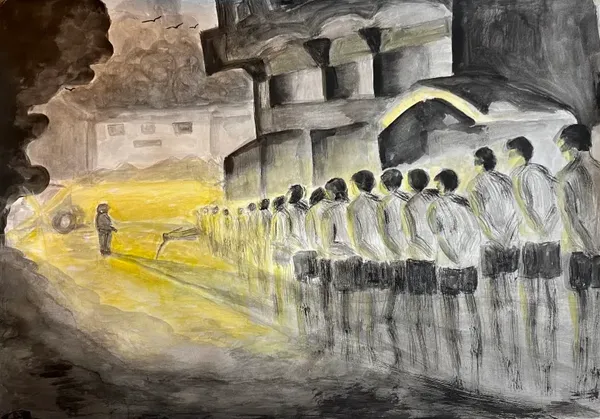
The Zionist movement emerged in the late nineteenth century, spurring increased Jewish migration from Central and Eastern Europe to Palestine. While most newcomers fled conditions of immiseration and oppression, many also embraced Theodor Herzl’s vision of a Jewish state, which promised liberation and a homeland of their own.
Setting aside differences within the pre-1948 Yishuv, it was Zionism’s dominant strains – despite their internal variations and occasional conflicts – that ultimately shaped the movement’s trajectory and sealed Palestine’s fate. These dominant strains initially converged on a common objective: the construction of a society of Jewish primacy in Palestine, one that necessarily entailed the political and social marginalization of the indigenous Palestinian population. The more extreme forms that this project would later assume – the large-scale dispossession and expulsion of Palestinians, inaugurated in the 1948 Nakba, and later still the far more radical destruction of Palestinian life now unfolding before our eyes – were not articulated in identical form from the outset. They emerged gradually from that foundational logic of exclusion.
What began as Jewish primacy hardened over time into outright Jewish supremacy, intolerant of any Palestinian parity. Along this trajectory, Zionism moved from the gradual ethnic cleansing of Palestine to the destruction of Gaza, and ultimately to Israel’s emergence as a perennial agent of chaos and destruction across the wider region. It is this trajectory that I try to trace and explain in what follows.
I. Empires in Transition
Let me begin with a historical overview. It may at first sound far removed from the present, but its relevance will soon become clear.
The Ottoman Empire endured for more than six centuries, reaching its height in the mid-sixteenth century after consolidating control over the lands of the Levant, and attaining its maximum territorial extent in the late seventeenth century. Its later decline in the eighteenth century culminated in its nineteenth-century reputation as the Sick Man of Europe. This decline coincided with what historians call the Great Divergence[1], as Western Europe – led by Britain and followed by France and Germany – was transformed into a cluster of industrial capitalist powers and pulled ahead of Asia and the rest of the world in wealth, power, and living standards, producing vast global inequalities. In these societies of Western Europe, bourgeois liberalism, as distinct from declining monarchical autocracy, emerged as the dominant form of state rule, providing the legal and economic framework necessary for rapid industrial growth, capital accumulation, and plundering colonial expansions into Asia and Africa.[2]
By the late nineteenth century, Ottoman retreat had created a geopolitical vacuum: the so-called Eastern Question. Capitalist powers such as Britain and France intervened to prop up the Sick Man, not out of altruism, but in order to check Russian expansion while simultaneously profiteering through debt and colonial extraction.[3] The interwar period between the First and Second World Wars marked the decline of this traditional Anglo-French model of direct colonial rule.[4] In its place, the United States gradually emerged as the foremost capitalist power, consolidating that status in the second half of the twentieth century.
This transition introduced a new, and often more violent, form of imperialism. Whereas the older European powers relied on territorial possession, US hegemony pivoted toward what might be called “violent stabilization.” This meant enforcing a global capitalist order through covert interventions[5], inconclusive yet violent and destructive wars[6], and equally violent and destructive proxy or client-state warfare.[7] Military force was used not necessarily to settle the land directly – though it strategically enabled proxies to do so – but to maintain American dominance and the political conditions congenial to international capital.
Why review this history, which seems unrelated to Zionism? For three reasons.
First, I want to challenge the persistent myth of inevitable Western superiority. It was not some inherent greatness that allowed Europe, and later the United States, to pull ahead and outpace the East, but access to coal, colonial resources, and specific structural shifts and advantages.[8]
Second, the very troubled present of Palestine and the wider Middle East is deeply rooted in this earlier history of imperial decline, intervention, and restructuring, which will continue to shape for years to come the region’s conflicts and political landscape – and it is precisely this history within which the Zionist project remains inescapably embedded.
Third, this history is vital for understanding our current century and even beyond. We are witnessing a global shift that could see the East overtake the US-led West in just a few decades. This raises a critical question: how will established movements in the Middle East – including Zionism, now more than ever tethered to a US-led West – respond to the rise of China, perhaps followed by India and other parts of the East? These are not just rising markets, but multi-millennium civilizations, including Iran, that have maintained their cultural cores despite centuries of predatory Western interference. We must consider how they will reshape the world as they reclaim their roles as near-equal centers of power and cultural influence.[9]
II. Surfing the Tides of History
To understand the success of the Zionist movement on its own terms, we must look beyond its internal ideological debates and examine its external strategy as a form of high-level geopolitical synchronization. Zionism’s survival and eventual triumph rested on a single realization, systematically pursued by its leaders: a settler-colonial project in the twentieth century could not survive without the active sponsorship of the reigning imperial power.
Zionism functioned, in effect, as a geopolitical chameleon, navigating three successive imperial waves by identifying and attaching itself to each era’s relevant hegemon. In its infancy, the movement first turned to the Ottoman state. Herzl, the founding figure of modern political Zionism, spent years trying to bargain with Sultan Abdul Hamid II, offering a deal that was quintessentially capitalist: debt relief in exchange for land. Herzl proposed using European Jewish financial networks to “cure” the Ottoman debt crisis in return for a charter over Palestine. But the Sick Man was not yet dead, and the Sultan understood that granting such a charter would trigger the very internal fragmentation the empire was desperately trying to avert; he famously refused to sell even a foot of land because, he declared, “it belonged not to him personally, but to his people.”[10]
As the Ottoman decline accelerated into final collapse, Zionist leadership – most notably Chaim Weizmann – pivoted decisively toward London, recognizing that the United Kingdom had become the central power of the Great Divergence. This realignment was driven primarily by Britain’s pre-First World War strategic priorities, which centered on securing imperial lines of communication, especially those linking Britain to India and the rest of its empire in the East.
The convergence of interests culminated in the Balfour Declaration of 1917. For Britain, a Zionist presence in Palestine amounted to a strategic masterstroke: what Sir Ronald Storrs described as a “loyal little Jewish Ulster” amid an “ocean of potentially hostile Arabism.” Such an outpost was ideally positioned to safeguard the Suez Canal – the vital artery of imperial trade – and to anchor British influence in a region rapidly becoming indispensable to industrial and military power.[11]
At this stage, oil had not yet assumed the central role it would later acquire. Its full strategic importance emerged gradually during the interwar period and became decisive only after the Second World War, when control over oil production and its global circulation rose to the top of imperial priorities. Palestine’s significance must therefore be understood in light of this shifting hierarchy of concerns, as British and later American interests in the region evolved from imperial connectivity to energy dominance.
Yet this alignment was not static. As the interwar period unfolded and the Anglo-French colonial order began to erode under mounting debt and rising nationalist movements, Zionist leadership registered the shifting contours of global power. The decisive reorientation came after the Second World War, when the movement turned toward the United States in the aftermath of the Palestinian Nakba and the establishment of the State of Israel in 1948. By then, oil had become the lifeblood of the global economy, and the United States – the ascendant hegemon – was determined to shape who controlled it. Israel’s value to Washington was therefore not merely military or ideological, but structural: a reliable, heavily armed ally embedded in the most oil-rich region on earth.
The relationship with Washington developed gradually. It was solidified during and after the 1967 war, when the United States recognized that Israel could perform a function colonial troops could no longer provide: violent stabilization without the political cost of American boots on the ground. Under US hegemony, Israel’s role shifted from an outpost colony of the West to a regional “unsinkable aircraft carrier.”[12] Its mission was no longer to protect a canal, but to check the rise of Arab nationalism, contain Soviet influence, and forcibly maintain the political conditions congenial to international capital and the global energy trade. The history is instructive: the Zionist movement’s greatest strength was its opportunistic agility. It did not fight the tides of history; it rode them. It offered itself as banker to the Ottomans, as allied garrison to the British, and as regional enforcer to the Americans.
III. From Oslo to October 7
October 7, 2023, opened a new phase in Zionism’s trajectory – more brutal, more explicit in its ultimate goal, and proceeding with unrestrained impunity. This brutality was enabled, in part, by earlier Israeli successes in defeating or marginalizing progressive and secular currents within Palestinian resistance. The gradual evisceration of the movements that had led the First Intifada (1987–1993) shifted the balance of Palestinian resistance toward more socially conservative and Islamic-based forces.
Hamas, which began in 1987 as a marginal organization ostracized by the PLO, had by the early 2000s become the most organized Palestinian resistance force, as the promises of the Oslo Accords (1993–1995) – in which Hamas played no part – dissolved into illusion and marked a turning point in the character of Palestinian resistance. While the First Intifada was characterized by centralized coordination among secular-left groups and a focus on grassroots nonviolent protest – earning it the moniker ‘Stone Intifada’ – the Second Intifada (2000–2005) lacked any such monopoly over narrative or strategy. This fractured environment allowed Hamas to transition from an ostracized movement into an alternative political and military force, fundamentally altering the form of Palestinian resistance.[13]
Indeed, not every Zionist victory required the violent suppression of Palestinian resistance. The Oslo Accords themselves constituted what even liberal Israeli commentators recognized as a major triumph for Zionism, not a compromise respectful of Palestinian rights.[14] Structured around Israel’s narrowly conceived priorities, the accords indefinitely deferred the questions which any genuinely equitable settlement would have had to resolve – refugees, Jerusalem, borders, sovereignty – and left Palestinian fundamental needs systematically unaddressed. Israeli novelist Amos Oz, often described as a dove, reportedly characterized the accords in a BBC interview as “the second biggest victory in the history of Zionism,” surpassed only by the establishment of the State of Israel in 1948.[15] What appeared to some as diplomatic progress proved, in time, to be a profoundly asymmetric bargain dressed in the language of peace. This transformation – which seemingly elevated Hamas into Israel and Zionism’s most serious threat – also served Israeli interests: it allowed the Zionist propaganda apparatus to recast the conflict as a religious war or “clash of civilizations,” rather than as a political struggle over occupation, settlements, and Palestinian rights.
The collapse of the Oslo framework had lasting consequences for Gaza specifically. When Hamas won the Palestinian legislative elections in January 2006 and subsequently consolidated its control over the Gaza Strip in June 2007, Israel and Egypt imposed a comprehensive blockade – sealing Gaza’s borders, severing its trade links, and subjecting its roughly two million inhabitants to severe restrictions on movement, goods, and basic supplies. That siege, which international human rights organizations consistently described as a form of collective punishment, turned Gaza into what many observers called the world's largest open-air prison.
It was in this context that the Great March of Return unfolded in 2018–2019: a mass mobilization along the Gaza fence and one of the last sustained efforts by unarmed, progressive forces within Palestinian society to break the siege through collective, nonviolent action. The protests were initiated by civil-society activists, not by Hamas; Hamas permitted and later supported them, but did not originate their nonviolent strategy or define their initial political character. Week after week, tens of thousands of Gazans marched, only to be met with Israeli sniper fire that killed hundreds and left thousands more maimed. The world watched – and did nothing.[16]
After nearly twenty months of weekly demonstrations, the Great March of Return fizzled and collapsed – crushed not through negotiation but under live ammunition – dealing a devastating blow to the very currents that had sustained it. It hardened a growing conviction, in Gaza and beyond, that nonviolent mass protest could neither loosen the siege nor compel meaningful international intervention. In its aftermath, Hamas was strengthened in its claim that armed resistance was the only remaining path. It is against this sequence of exhausted alternatives that the events of October 7 must be understood.[17]
They were the eruption of accumulated grievances, public humiliations, and suppressed rage built up over decades. Less an act of vengeance than an act of desperation, Gazans burst out of their slow strangulation. Chaotic beyond what even many Palestinians themselves expected, and intensified by the collapse into disarray of Israeli army units around Gaza, the events of that single day were abhorrent and horrific, spearheaded by Hamas and followed by an assortment of other groups and individuals.[18]
And then came the events of every single day since October 7, 2023: far more abhorrent and horrific, now carried out methodically and deliberately by the Israeli military under explicit instructions from Netanyahu and his ministers. It has now been more than two and a half years of unchecked orgy of manic violence and destruction. As of early 2025, barely a year and a half into the campaign, Israel had already dropped, by some estimates, well over 85,000 tons of bombs on Gaza, surpassing the combined tonnage dropped on Dresden, Hamburg, and London during the entire Second World War.[19]
This is the current phase in Palestine – more violent and more devastating than all the preceding ones – in the century-long trajectory of ethnically transforming it. For much of the Israeli public, Palestinians have been dehumanized so thoroughly over decades of indoctrination that the destruction of Gaza is seen as justified, and Palestinian suffering as either deserved or politically irrelevant.[20]
IV. Becoming Perennial Agent of Regional Chaos
The aftermath of October 7 did not remain confined to Gaza; it soon spilled into the West Bank and beyond. As Israel’s destructive rampage expanded in scope and intensity, it revealed how Israeli ambitions and US policy have combined to batter the whole Middle East – entrenching a variant of Zionism whose logic increasingly relies on domination by sheer military force, veiled only by the occasional fig leaf of diplomacy.
To understand how this escalation unfolded, it helps to recall the strategic doctrine that preceded it. After Oslo and before 2023, Israel had carefully balanced military force with diplomacy, operating under a policy it called “mowing the lawn” – which called for permanent stand-by mobilization to periodically strike non-state resistance groups without expecting to destroy them entirely. As one formulation put it, Israel was “not aiming for victory or for ending the conflict,” but rather focused on weakening and indefinitely deterring its foes.[21] At the same time, it incrementally expanded what it could get away with: military incursions into Palestinian cities and refugee camps in the West Bank grew more frequent and more brutal, eroding the jurisdiction of the Palestinian Authority; in the summer of 2023, Israel carried out airstrikes in the West Bank for the first time since the Second Intifada; and its tolerance for civilian casualties in Gaza steadily rose — from 1,383 killed in Operation Cast Lead (2008–9) to 2,251 in Operation Protective Edge (2014), and more than 200 killed and 34,000 wounded during the Great March of Return (2018–19).[22]
Hamas’s attack on October 7 shattered this incremental logic. Proponents of “mowing the lawn” declared the doctrine had failed; it was now, in their words, “an urgent necessity – indeed, a survival imperative” to uproot the enemy completely.[23] Netanyahu himself made the shift explicit in a 2024 Wall Street Journal interview: “From the air you can mow the lawn ... You can't pull out the weeds. We're here to uproot Hamas – not to deliver deterrent blows, but to destroy it.”[24]
The scope of Israeli strikes, proxy actions, and covert operations subsequently reached targets across the Levant and beyond – from Lebanon and Syria to Yemen and, since June 2025, direct strikes on Iranian territory. In that single year, Israel had been engaged in armed confrontations with five countries – Iran, Lebanon, Syria, Qatar, and Yemen – in addition to its continuing rampage across the occupied Palestinian territories, striking more countries than any other state on earth. This diffusion of violence was not random. It followed a strategic logic of degrading neighboring capacities and pre-empting rival influence, while signaling to regional and global audiences that Israel would assert its will far beyond the narrow pretense of self-defense.
Netanyahu provided the ideological framing for this campaign when he described Israel as a potential “super-Sparta” – a militarized society in which the capacity for organized violence is not a regrettable necessity but a civilizational virtue.[25] Sparta, it is worth recalling, was not a society that made peace with its neighbors; it was one organized entirely around the permanent preparation for war. That Netanyahu reached for this image approvingly reveals how thoroughly the original Zionist promise – a haven for Jewish renewal and flourishing – has been abandoned in favor of its precise negation.
Equally consequential has been the deepening operational intimacy between Israel and the US. Public statements and reporting in early 2026 made clear that US policymakers were not mere bystanders. Senior US officials framed preemptive or parallel operations as necessary measures to reduce American casualties, even when those measures amounted to joining or enabling offensive actions against third states.[26] That posture – a willingness to back, support, or co-conduct strikes beyond Israel’s borders – recast Israel not only as a regional actor but as an instrument through which US power projection was mediated and amplified. Where earlier decades saw Israel positioned as a local proxy for containment, the recent period shows a far more integrated, mutually reinforcing militarism.[27]
Perhaps the most chilling development is the normalization, in elite discourse, of rhetoric once reserved for the most extreme fringes. Statements by leading Israeli officials celebrating or yearning for the destruction of rival countries, and the invocation of existential metaphors likening Israel to a perpetual warrior-state, have filtered into public conversation.[28] Such rhetoric serves two functions: it hardens domestic support for maximalist responses, and it signals to allies and adversaries alike a willingness to pursue the most extreme outcomes. When allied officials rationalize preemptive strikes as casualty-avoiding necessities, the moral constraints that once moderated state practice are further eroded.[29]
V. End of the Road for Zionism?
The preceding trajectory traces Zionism’s impact on Palestine and its surrounding region, in particular on Palestine’s original inhabitants, who were predominantly non-Jewish when Zionism emerged in the late nineteenth century. Yet this same trajectory has proven ruinous for Jews themselves, whether they were among Palestine's original inhabitants or arrived as newcomers over the past century. Far from fulfilling its founding promise of a safe, protective, and culturally enriching haven in Palestine, Zionism now offers Jews the opposite: a militaristic, dehumanizing, violently anti-Arab society, trapped in a cycle of perpetual conflict with its neighbors. Indeed, Zionism’s capacity to oppress, attack, and kill has grown in direct proportion to its betrayal of a humane Jewish renewal.[30] This is a movement rotting from within – an internal failure that abandons the very people that Zionism claims to represent and protect.[31][32]
Beyond this internal decay, an irretrievable external failure is now looming. The Zionist movement had once offered itself as a service provider to successive imperial powers – banker to the Ottomans, garrison to the British, regional enforcer to the Americans. In each arrangement, strategic utility was exchanged for material and diplomatic support. But this relationship has gradually shifted and has now been significantly recast. As the United States has become the foremost engine of global disorder under the presidency of a reckless narcissist, Israel – whose prime minister relishes flattering and goading the American president in equal measure – has assumed a role that no longer fits the traditional client model.
The United States is no longer merely sponsoring and enabling the Zionist project; it increasingly appears to be drawn into conflicts whose timing and initial trajectory are shaped in part by Israel's priorities, even as Washington retains ultimate control over their scope and termination, at costs – in blood, treasure, and international standing – that fall more heavily on the United States than on Israel.[33] The “unsinkable aircraft carrier” – a description of Israel favored by several American politicians in the past – has in effect begun to steer the fleet into endlessly destructive and ultimately unwinnable battles.[34]
But this in turn – and in dark irony – may be accelerating Zionism’s own demise. By completely tethering its destiny to a US-led West in visible retreat, Zionism has made a wager it is unlikely to survive unscathed. Future US presidencies – ones forced to reckon with the true costs of unconditional sponsorship – may prove unwilling to sustain this arrangement indefinitely. Zionism’s survival has always required an imperial sponsor willing to shield it from accountability. In an emerging multipolar world order – in which China, India, and other rising powers of the East and elsewhere are striving to preserve a stable and economically integrated world – an imperial shield of impunity may no longer be available.
So, where is Zionism heading?
It is difficult to make predictions, as we are still weathering the Trump era, clinging to the hope that the unprecedented excesses he has unleashed will not outlast his tenure. Yet while the current period has unleashed Zionism’s most extreme annihilationist impulses, and its proclivity for fomenting chaos and destruction beyond its borders, a larger question remains: Can Zionism recalibrate yet again as a multipolar world order – one no longer dominated by the US-led West – takes shape? The answer may well be no. For one thing, Zionism as Israel’s foundational doctrine now stands irrevocably tarnished and stripped of any remaining legitimacy for growing numbers of ordinary people outside Israel[35], having supported and justified the first live-streamed destruction of a community of more than two million human beings in Gaza. Its eventual abandonment may not occur within a single decade, or even within several decades. But it is undeniable that the forces and social currents that once sustained it are gradually receding or falling away – and, to end on a hopeful note, perhaps also prodding a majority of Jewish Israeli society eventually to turn away from it as a losing bet.[36][37]
Liked it? Take a second to support Cosmonaut on Patreon! At Cosmonaut Magazine we strive to create a culture of open debate and discussion. Please write to us at submissions@cosmonautmag.com if you have any criticism or commentary you would like to have published in our letters section.
-
My main reference is the Wikipage Great Divergence which cites several books by prominent social and economic historians.
↩ -
Beyond the classics, e.g. Rosa Luxembourg, The Accumulation of Capital: A Contribution to the Economic Theory of Imperialism (1913), and the many informative reviews of it such as Peter Hudis, “Rosa Luxemburg Anticipated the Destructive Impact of Capitalist Globalization” (Jacobin, July 29, 2023), as well as more recent books tracing capitalism’s unsustainable drive to ever expand on a finite planet, e.g. Trevor Jackson, The Insatiable Machine – How Capitalism Conquered the World (2026), there are also illuminating accounts of the ideological shift that both predated and justified the great wave of colonial expansion and consolidation in the second half of the nineteenth century, particularly in the cases of Britain and France. See, for example, Jennifer Pitts, A Turn to Empire: The Rise of Imperial Liberalism in Britain and France (2005). Pitts documents the dramatic shift in British and French thought about empire over the sixty years straddling the turn of the nineteenth century, culminating by the mid-nineteenth century in open support by leading British and French liberal thinkers, including John Stuart Mill and Alexis de Tocqueville, for the conquest of non-European peoples – thus revealing, however disconcertingly, the racial hierarchies and sense of civilizational superiority embedded within liberal imperial thought.
↩ -
On the decline of the Ottoman empire, see Roger Owen, The Middle East in the World Economy, 1800–1914 (1993), pp. 121–165. Eugene Rogan, The Fall of the Ottomans: The Great War in the Middle East (2016), and David Fromkin, A Peace to End All Peace: The Fall of the Ottoman Empire and the Creation of the Modern Middle East (2009).
↩ -
A classic account of British imperial decline in the Middle East is Elizabeth Monroe, Britain’s Moment in the Middle East, 1914-1971 (1981). A broader context on the shift from European to American dominance is Zachary Lockman, Contending Visions of the Middle East (2009). An informative account for bridging the decline of Anglo-French colonialism and the rise of US hegemony is A. G. Hopkins, American Empire: A Global History (2018).
↩ -
Ervand Abrahamian, The Coup: 1953, the CIA, and the Roots of Modern U.S.-Iranian Relations (NY: The New Press, 2013). Abrahamian situates the CIA-backed overthrow of Mohammad Mosaddegh in the struggle over Iranian oil and shows how the coup restored and consolidated the Shah’s autocratic rule. See also Mark J. Gasiorowski, “The 1953 Coup d’État in Iran,” International Journal of Middle East Studies 19, no. 3 (1987): 261–286.
↩ -
There is of course a multitude of books on wars pursued by the US after the Second World War. Among books that are particularly thorough in documenting some of these wars, the following are noteworthy: George C. Herring, America’s Longest War: The United States and Vietnam, 1950–1975, 5th ed. (McGraw-Hill, 2013); Fredrik Logevall, Embers of War: The Fall of an Empire and the Making of America’s Vietnam (Random House, 2012); Carter Malkasian, The American War in Afghanistan: A History (Oxford University Press, 2021); Steve Coll, Directorate S: The C.I.A. and America’s Secret Wars in Afghanistan and Pakistan (Penguin Press, 2018). These books document long US wars marked by enormous violence, unclear or shifting objectives, and ultimate strategic failure.
↩ -
A prime example of a client-state repeatedly engaged in warfare is the state of Israel. Among other references, see Ze’ev Maoz, Defending the Holy Land: A Critical Analysis of Israel’s Security and Foreign Policy (University of Michigan Press, 2006); Rashid Khalidi, Under Siege: P.L.O. Decisionmaking During the 1982 War (Columbia University Press, 1986; reissued 2014); Avi Shlaim, The Iron Wall: Israel and the Arab World, updated ed. (W. W. Norton, 2014). Khalidi gives a detailed account of Israel’s 1982 invasion and siege of Beirut, including its military and civilian consequences, while Maoz and Shlaim place Israel’s repeated regional interventions within the broader history of Israeli security policy and US-backed regional strategy.
↩ -
I clarify how I use the terms “East” and “West,” which admit of different interpretations – and controversies too – as illustrated, for example, by the recent book The West and its many reviews. I use “West” to refer to the United States and the dominant countries of Western Europe, primarily Britain and France, whose colonial policies have left deep and lasting scars on the Middle East over the past two centuries. The US-led Western alliance is a broader category, encompassing additional countries such as Japan, Australia, and others which, while aligned with the West, were not principal actors in the colonial and imperial penetration of the Middle East. I use the term “East” to refer to emerging powers outside the West so defined, primarily China and India, whose historical trajectories include prolonged engagement with and resistance to Western dominance; this latter sense applies to other emerging, though smaller, powers not located in the geographic East, such as Brazil and South Africa. A more precise designation for this broader category would therefore be “non-West” instead of “East,” but I avoid the term because it is overly broad and plays no role in my presentation below. I do not use the common distinction between “Global North” and “Global South,” as it is imprecise and admits numerous exceptions, including small but highly affluent states such as the Gulf countries (Kuwait, Bahrain, Qatar, the United Arab Emirates, and Oman).
↩ -
While Iran may not currently rival China or India in raw economic power, Western discourse routinely overlooks Iran’s extraordinary role in the broader Asian cultural world. Jawaharlal Nehru, India’s prime minister in the 1950s and 1960s, once noted, “among the many people and races who have come in contact with Indians and influenced India’s life and culture, the oldest and most persistent have been the Iranians.” The contemporary Indian writer Pankaj Mishra similarly observed that “for nearly a millennium, Persian was the lingua franca of Asia: the language widely used by political and intellectual mandarins and necessary, too, for travelers such as Marco Polo and Ibn Battuta, who both deployed the language in China.” If Persian identity has maintained a profound sense of historical continuity, now in the throes of a decaying theocracy, it is because of its roots in an expansive and enduring civilization. It is in this light that we must keep in mind the calamitous nature of threats from the current US president; on April 6, 2026, Mr. Trump threatened with characteristic casual callousness that Iran’s “whole civilization will die tonight, never to be brought back again.” (Quotes and thoughts in this footnote are suggested by Pankaj Mishra’s essay, “A Bitter Education,” The NY Review of Books, April 9, 2026.)
↩ -
Theodor Herzl, The Complete Diaries of Theodor Herzl, ed. Raphael Patai, trans. Harry Zohn, vol. 1 (New York: Herzl Press and Thomas Yoseloff, 1960), p. 378, entry for June 19, 1896. See also Mim Kemal Öke, “The Ottoman Empire, Zionism, and the Question of Palestine, 1880–1908,” International Journal of Middle East Studies 14, no. 3 (1982): 329–341.
↩ -
Ronald Storrs, Orientations (London: Ivor Nicholson & Watson, 1937), p. 364; Bernard Regan, The Balfour Declaration: Empire, the Mandate and Resistance in Palestine (London: Verso, 2017), ch. 1; W. M. Mathew, “The Balfour Declaration and the Palestine Mandate, 1917–1923: British Imperialist Imperatives,” British Journal of Middle Eastern Studies 40, no. 3 (2013): 231–250.
↩ -
Alexander Haig, who was US Secretary of State under Reagan in 1981–82, is quoted in Michael Oren, “The Ultimate Ally,” Foreign Policy, April 25, 2011. Oren gives Haig’s formulation as: “Israel is the largest American aircraft carrier in the world that cannot be sunk, does not carry even one American soldier, and is located in a critical region for American national security.” A closely related view was expressed by Senator Joe Biden in 1986, when he called US aid to Israel “the best $3 billion investment” and added that, “Were there not an Israel, the United States of America would have to invent an Israel to protect her interests in the region.” See Chris McGreal, “‘Israel in his heart’: why Biden ignores growing anger over the Gaza offensive,” The Guardian, March 8, 2024.
↩ -
For a fuller account of Hamas’s history, see Assaf Kfoury, “Hamas: From Candidate Enforcer to Implacable Foe,” International Union of Scientists, Aug 7, 2024. Of particular relevance here is the article’s discussion of how, until the early 1990s, Israel tolerated, enabled, and at times encouraged Hamas’s growth, whether overtly or indirectly, as a way of undermining and countering the PLO, which had represented the main currents of Palestinian resistance in the 1970s and 1980s.
↩ -
Edward W. Said, “The Morning After,” London Review of Books, Oct. 21, 1993; Rashid Khalidi, The Hundred Years’ War on Palestine: A History of Settler Colonialism and Resistance, 1917–2017 (New York: Metropolitan Books, 2020), pp. 171–185. Said’s contemporary critique characterized Oslo as a Palestinian surrender rather than an equitable compromise, while Khalidi situates the accords within the larger history of Israeli control, deferred final-status issues, and Palestinian political subordination.
↩ -
Edward W. Said, “The Morning After,” London Review of Books, Oct. 21, 1993. Said reports that, in a BBC interview, Amos Oz described Oslo as “the second biggest victory in the history of Zionism.” See also Mehran Kamrava, The Impossibility of Palestine: History, Geography, and the Road Ahead (New Haven: Yale University Press, 2016), where Oz’s remark is cited in the same discussion of Oslo’s asymmetrical terms.
↩ -
On the Great March of Return, see UN Human Rights Council, Report of the Independent International Commission of Inquiry on the Protests in the Occupied Palestinian Territory, A/HRC/40/74, Feb. 25, 2019, which reports that Israeli forces, including snipers, killed 183 Palestinians and injured thousands during the 2018 demonstrations, including 6,106 shot with live ammunition. See also Jehad Abusalim, “The Great March of Return: An Organizer’s Perspective,” Journal of Palestine Studies 47, no. 4 (Summer 2018): 90–100, which presents the march as a civil-society mass mobilization rooted in nonviolent protest and the right of return. For a later scholarly discussion, see Bram Wispelwey et al., “The Great March of Return: Lessons from Gaza on Mass Resistance and Mental Health,” Health and Human Rights Journal 22, no. 1 (2020): 179–185.
↩ -
Tareq Baconi, Hamas Contained: The Rise and Pacification of Palestinian Resistance (Stanford University Press, 2018). See also UN OCHA, “Approaching the First Anniversary of the ‘Great March of Return’ Protests in Gaza,” March 27, 2019, and B’Tselem, Unwilling and Unable: Israel’s Whitewashed Investigations of the Great March of Return Protests (2021).
↩ -
Tareq Baconi, “An Inevitable Rupture: Al-Aqsa Flood and the End of Partition,” Al-Shabaka, Nov. 2023; Sara Roy, Unsilencing Gaza: Reflections on Resistance (Pluto Press, 2021); Rashid Khalidi, The Hundred Years’ War on Palestine (Metropolitan Books, 2020), esp. the chapters on Gaza, Oslo, and the siege. For the attack itself and the Israeli intelligence/military failure, see Michael Wyss, “The October 7 Attack: An Assessment of the Intelligence Failings,” CTC Sentinel 17, no. 1 (2024).
↩ -
For the scale of destruction in Gaza, see UN Environment Programme, Environmental Impact of the Conflict in Gaza: Preliminary Assessment of Environmental Impacts, June 2024. For estimates of bomb tonnage, see Palestinian Environmental Quality Authority, “The Occupation Dropped More Than 85 Thousand Tons of Bombs on the Gaza Strip,” Nov. 10, 2024; Muhammed Enes Çallı, “Amount of Israeli bombs dropped on Gaza surpasses that of World War II,” Anadolu Agency, June 4, 2024. For the WWII bombing comparison, see Richard Overy, The Bombing War: Europe 1939–1945 (Penguin, 2013), pp. 304–340.
↩ -
Nurit Peled-Elhanan, Palestine in Israeli School Books: Ideology and Propaganda in Education (I.B. Tauris, 2012); Amnesty International, “You Feel Like You Are Subhuman”: Israel’s Genocide Against Palestinians in Gaza (2024), esp. its discussion of dehumanizing statements by Israeli officials; Pew Research Center, “Israeli Views of the Israel-Hamas War,” May 30, 2024; The Palestinian-Israeli Pulse, joint survey by PCPSR and Tel Aviv Univ, Sept. 2024.
↩ -
The core idea of “mowing the lawn” – periodic punitive operations to manage but not eliminate an adversary – long predates the modern phrase. Variants appear in Israel’s responses to fedayeen incursions in the 1950s–60s, reprisal raids, and the 1982 Lebanon War, where limited punitive actions were preferred over comprehensive political solutions to avoid broader international condemnation. The explicit framing of “mowing the lawn” as a doctrine became prominent in public and policy discourse in the 1990s–2000s and entered wider reporting and scholarly discussion during repeated Israeli operations in Gaza after 2006, e.g., Operation Cast Lead (2008–09), Pillar of Defense (2012), Protective Edge (2014). While some Israeli security figures used similar metaphors earlier, the English idiom “mowing the lawn” as shorthand for this recurring limited-strike model appears in journalism and policy commentary from the 2000s onward and became widespread in the 2010s. Further elaboration of this doctrine, with appropriate references, can be found at the Wikipedia page Mowing the Grass.
↩ -
A more detailed review of this history is in Amjad Iraqi, “From Gaza to Iran,” London Review of Books, 2 April 2026. Amjad Iraqi is a senior Israel/Palestine analyst at the International Crisis Group.
↩ -
Eitan Shamir, “The End of Mowing the Grass: If Israel Wants to Continue to Exist, It Must Uproot Hamas from Gaza,” BESA Center Perspectives Paper no. 2,223, Begin-Sadat Center for Strategic Studies, Oct. 22, 2023.
↩ -
Elliot Kaufman, “Benjamin Netanyahu: The Inside Story of Israel’s Victory,” Wall Street Journal, Dec. 20, 2024. Netanyahu is quoted there as saying: “From the air, you can mow the lawn. You can’t pull out the weeds. We’re here to uproot Hamas – not to deliver deterrent blows, but to destroy it.”
↩ -
Julian Borger, “Netanyahu’s ‘super-Sparta’ vision braces Israel for isolated economic future,” The Guardian, 16 Sep 2025.
↩ -
See, for example, how American officials explained the US-Israel relationship: Secretary of State Rubio, State Department transcript, March 2, 2026. Rubio framed US action as preemptive, saying that Washington knew an Israeli action was coming, knew it would likely trigger attacks on American forces, and acted first to reduce US casualties.
↩ -
See Jonathan Swan and Maggie Haberman, “How Trump Took the U.S. to War With Iran,” NY Times, Apr. 7, 2026, which reports that Netanyahu had pressed for months for US agreement to a major assault on Iran, made a classified Situation Room presentation, and helped set the United States and Israel on the path toward war. For the continuing asymmetry in the relationship, see David M. Halbfinger, “Lebanon Cease-Fire Leaves Netanyahu in an Uncomfortable Spot,” NY Times, Apr. 17, 2026, which emphasizes both Netanyahu’s role in persuading Trump to join the Iran attack and his later inability to resist Trump’s pressure for cease-fires.
↩ -
On the rhetoric of escalation among Israeli officials and legislators after October 7, see Law for Palestine, Database of Israeli Incitement to Genocide, updated Feb. 27, 2024, which compiles statements by Israeli ministers, Knesset members, military figures, and media personalities calling for destruction, forced displacement, starvation, and collective punishment in Gaza. See also Nimer Sultany, “A Threshold Crossed: On Genocidal Intent and the Duty to Prevent Genocide in Palestine,” Journal of Genocide Research 26, no. 4 (2024): 606–628.
↩ -
On the mainstreaming of extreme and dehumanizing discourse in Israeli society and official rhetoric, see Tamir Sorek, “Mainstreaming a Genocidal Imagination in Israeli Society: Settler-Colonialism, Settler Anxiety, and Biblical Cues,” Journal of Genocide Research 27, no. 3 (2025): 469–490. For the parallel problem of dehumanization and silencing in Western institutional discourse, see Mishal S. Khan and Alu Tacon Tinua, “Israel–Palestine: Dehumanisation and Silencing,” The Lancet 403, no. 10426 (2024): 515–516.
↩ -
I leave aside the question of whether Zionism could have taken different turns in its century-long trajectory that might have fulfilled its founding promise while respecting Palestinian rights. There were certainly many humanist and cultural (or ‘soft’) Zionist thinkers (e.g., Ahad Ha’am, Martin Buber, Judah Magnes, members of Brit Shalom, and several others from earlier and later periods) who believed such an outcome was possible and advocated for it, primarily in the form of a binational state. Had such an outcome been realized, however, it would have been a remarkable exception to the broader historical record of settler colonialism elsewhere in the world. All settler-colonial projects – including the United States – have always entailed land theft and large-scale displacements of indigenous people, even in sparsely populated lands, typically leading to ethnic cleansing and, in many cases, culminating in outright extermination. Several historians have examined the US and Israel comparatively as settler-colonial projects, pointing to this affinity as another dimension of their close relationship. Among such scholars, this theme emerges especially starkly in the writings of Eric Cheyfitz, a distinguished scholar of Native American and Indigenous Studies. By comparing the North American context since the 17th-century and the Palestinian context in the 20th-century, Cheyfitz draws a scathing analogy between the American and Israeli settler-colonial projects – one that ends up being in many ways a more devastating indictment of Zionism than anything I have written in this article. See Cheyfitz’s essays, “Understanding the shared ideology behind settler colonialism in Native America and Palestine,” Mondoweiss, May 2, 2026, and “Zionism and the Iran War,” Counterpunch, March 31, 2026.
↩ -
Totally left out from my account in this article is how Zionism negatively affected non-European Jewish communities, especially those that were spread throughout the Arab world and the wider Middle East for many centuries up until the creation of the state of Israel in 1948. Among many other documents covering this topic, consider the following: Ella Shohat, “Sephardim in Israel: Zionism from the Standpoint of Its Jewish Victims,” Social Text, nos. 19/20 (Autumn 1988), pp. 1–35, which is a foundational article on how Zionism betrayed Mizrahi and Sephardic Jews, stripping them of their Arab cultural identities and incorporating them into a racial hierarchy that served European-Zionist ends. Elaborating further some of the themes in Ella Shohat’s article are two books: Yehouda Shenhav, The Arab Jews: A Postcolonial Reading of Nationalism, Religion, and Ethnicity (2006) and Sami Shalom Chetrit, Intra-Jewish Conflict in Israel: White Jews, Black Jews (2013).
↩ -
Also, totally left out from my account is another critique of Zionism’s trajectory, this one from an East-European perspective – that of the Bund. A remarkable and deeply engaging overview is a recent book by Molly Crabapple, Here Where We Live Is Our Country: The Story of the Jewish Bund (2026). Summaries of the book in sympathetic reviews are by Max Strasser, “What Does Judaism Look Like Without Zionism?” and Adam Hochschild, “A Dream of a Socialist Commonwealth.”
↩ -
Put more bluntly: is the tail now wagging the dog? A close reading of reports on internal deliberations since the US and Israel launched their joint assault on Iran, suggests that the answer may well be yes. See, for example, Mark Mazzetti et al. “How Trump Decided to Go to War With Iran,” NY Times, March , 2026, and Jonathan Swan and Maggie Haberman, “How Trump Took the U.S. to War With Iran,” NY Times, April 7, 2026.
↩ -
That situation is best exemplified by the cascading fallout from the US-Israel war on Iran, which has irrevocably redrawn the region’s strategic alignments. Iran’s successful strikes on at least sixteen American military installations – crippling the radar and communications systems on which both US and Israeli forces depend – have exposed a vulnerability Washington had worked hard to conceal, while its decision to dedicate far more defensive resources to protecting Israel than to shielding the Gulf states that host its bases has answered an uncomfortable question once left unasked: does an American military presence make US-allied Arab states more secure, or does it simply make them targets? Saudi Arabia has already moved to build an independent regional security network anchored by Turkey, Pakistan, and Egypt; Kuwait, Qatar, and Oman are charting a middle course driven by deep disillusionment with Washington; and even the UAE’s conspicuous doubling-down on its US-Israeli alignment signals awareness of the fracture. The US will remain the world’s most powerful military for many years to come – but as a strategic guarantor it has forfeited much of the credibility it once commanded, and Gulf states know they can do better and will act accordingly. A process of distancing that was already quietly underway has now been accelerated: rather than slowing down the decline of the US-led West against a rising East, the war on Iran has in effect accelerated it. For further elaboration of the repercussions from the war on Iran for which the US under Trump was caught unprepared, see Mitchell Plitnick, “Iran is a Bigger Failure Than You've Been Told,” Cutting Through, May 3, 2026.
↩ -
In 20 of 24 countries surveyed, around half of adults or more hold an unfavorable view of Israel, with a median of 62% unfavorable across all countries and only 29% favorable. In several countries – Australia, Greece, Indonesia, Japan, the Netherlands, Spain, Sweden, and Turkey – three-quarters or more hold unfavorable views. In the United States, the share with a negative view of Israel rose 11 percentage points between March 2022 and March 2025. These figures are taken from Laura Silver et al., “Most people across 24 surveyed countries have negative views of Israel and Netanyahu,” Pew Research Center, June 3, 2025. Beyond public opinion, a similar tilt is visible in academic scholarship, as documented in E. Ennouri, M. Boussarsar, et al., “Scholarly Publications and Opinions Through 366-Day War on Gaza (2023–2024): A Scoping Review and Bibliometric Analysis,” International Journal of Health Policy and Management, April 14, 2025.
↩ -
One particular manifestation of this trend is the growing intergenerational and political tensions among Jewish communities in the United States, which will, in all likelihood, remain the last bastion outside Israel in defense of Zionism anywhere in the world. Older and unconditionally pro-Zionist Jewish generations are being gradually displaced by younger and non- or anti-Zionist Jewish generations. This shift is perhaps best exemplified by the rise of Jewish Voice for Peace (JVP) in the US. JVP was founded in 1996 by three undergraduate students at UC Berkeley; it grew to over 32,000 active dues-paying members by 2024, with more than 80 chapters across the US, including over 30 on college campuses. Initially open to differing views on Zionism, JVP adopted an explicitly anti-Zionist position by 2019; its rapid expansion since October 2023 – with revenue growing from $3.32 million in 2023 to $11 million in 2024 – reflects a broader current within American Jewish life that rejects unconditional support for Israel. This current is generationally structured: among Jewish Americans under 40, 38% agreed that Israel is an apartheid state and 33% agreed that it is committing genocide against the Palestinians, compared to 13% and 15% respectively among those over 64. The fracture extends beyond the Jewish community: a New York Times/Siena poll from late September 2025 found slightly more American voters siding with Palestinians than with Israelis for the first time since the Times began asking that question in 1998, and while 79% of Republicans over 65 sympathized more with Israelis than Palestinians, only 40% of Republicans under 44 agreed. On generational polling among Jewish Americans, see J. Muchnick and E. Kamarck, “The Generation Gap in Opinions Toward Israel,” Brookings Institution, Nov 9, 2023. On the broader generational fracture in US public opinion, see Johannes Späth, “Declining US Support for Israel: From Bipartisan Consensus to Generational Fracture,” Austrian Inst for International Politics, January 2026
↩ -
Most of the text in the first three sections is a polished-up version of notes for a talk I first gave at the end of 2019. The last two sections were added to account for developments since then. I owe special thanks to my close friend Oded Goldreich, who carefully read earlier drafts and engaged deeply with their substance. He offered substantive suggestions about what to add, what to remove, and how to reorganize the text. The final version reflects his contribution at many crucial points – indeed, to the extent that I, at one stage, thought he should be a co-author.
↩