
DSA is thriving. Membership is hitting record highs. DSA candidates are winning elections. The organization is gearing up for a presidential campaign. Even if the presidency or the Democratic nomination isn't won, the organization will grow in popularity and membership. With that growth, DSA will be able to try again and again to get closer and closer to the goal: socialism.
Within DSA's discourse, this narrative carries weight for good reason. If DSA is an organization on a trajectory towards socialism, then its growth by any means, even class-neutral means, must surely bring us closer to socialism. Yet this narrative makes a critical error, and it's an error that misses not only the present state of DSA, but DSA's entire history and founding. Class-neutral mass politics, meaning a politics that positions itself around the mood of a moment and not a class-rooted political program, is not what built DSA's success. Campaigning for Bernie expanded DSA not by pulling from an abstract mass captured by charisma, but by pulling from a specific section of the working class with a politics of trust, principle, and consistency. That section is the highly educated subset of the working class who, as a general trend, are motivated by a sectional experience: the broken promise that higher education would deliver socioeconomic security. DSA must therefore take what has been successful already and work to expand it, not abandon it for a class-neutral mass politics that risks folding the movement into capitalist institutions and failing to win the trust of the working class.
By class-neutral mass politics, I mean a politics that eschews class for an amorphous subject: “the people”. This means taking positions from whatever will widen the coalition in a given moment. Its opposite is a class-explicit politics, one that names the specific subject it fights for: working people. They hold a shared position within the productive process, and from that position have a shared set of interests. A class-explicit politics derives a program from those interests and consistently defends that program. Note that this contrast is about where political positions come from, rather than tone or breadth of appeal. The broadest political appeal the American left has seen in living memory was the Bernie Sanders campaign, and he consistently spoke about the billionaire class in contrast with working people. The coalition behind his campaign was built around a shared set of class interests and political positions derived from those interests. As DSA moves forward, we must be diligent in ensuring that our politics are class-explicit, and that they remain so, especially in the high-pressure political moments we are sure to face, which is where many movements before us abandoned the cause of socialism.
A Systemic Betrayal
DSA's expansion into the organization we now know was largely rooted in the failure of capitalism to realize a narrow set of its own promises. "Stay in school, get a college education, and you'll be secure." Some Americans have correctly realized that this is a myth, and that realization has drawn them towards anti-capitalist critique. That's not to say that DSA members are monolithically motivated, but that the conditions and composition that constructed today's membership point to a general trend along those lines. The composition of today’s DSA has a precedent within the organization’s founding. DSA was not cohered out of necessity by a materially desperate working class, but by a close-knit group of academics and college-educated professionals. Barbara and John Ehrenreich, writing from the milieu DSA came out of, made this observation and warned about its implications;[1] Barbara herself would go on to co-chair DSA. To the extent DSA has even heeded their warning, it has not been successful in altering its course. Today’s DSA was expanded by a broader group of this very same section of the working class: the college-educated who, unlike DSA’s founders, were on the receiving end of a broken promise.
It is no secret that DSA is disproportionately college-educated. Around 80% of members are college degree holders[2], compared with around 40% nationally.[3] Why does DSA continue to overwhelmingly draw the college-educated? It's relatively straightforward. Capitalist ideological apparatuses in the US have promised that college education leads to relative security. Yet there are those who received said education but have not seen the promised outcomes. They have been plainly shown by their lived experience that this ideological claim is a myth. Insofar as it's revealed as a myth, it is experienced as a failure by the system to keep its promises. The same DSA internal survey that shows DSA's overrepresentation of college-educated workers also shows their betrayal: despite DSA being overwhelmingly college-educated, its income distribution reflects the country as a whole.[2] Without this key data point, one could point to the over-representation of the educated in the foundation of socialist movements more broadly. But one would expect a group as well educated as DSA to have an income distribution akin to college-educated workers nationally. It doesn't. On the other hand, the majority of the working class lacks a college education, and they have been made a different systemic promise: "Get a job, work hard, and you'll be okay." That promise has also been broken.
Why then does this not move them to political action in the same way? Whereas the promises to the college-educated working class have been broken since the Great Recession, the promises to the broader working class have been broken since Reaganism and deindustrialization. The Democrats signed NAFTA, unions gave up concessions and were hollowed out, and the Obama-era response to the Great Recession rescued banks instead of workers. So while the college-educated working class still expects the promise to be made good, as it was in recent memory, the working class at large has no reason to hold such high expectations. It's for this reason that the college-educated section of the working class remains dramatically over-represented in DSA: promises have been broken to them, and the recency of that break leaves them with faith that it can be reversed by political action. The same cannot be said of the working class at large. This isn’t to say that we don’t want college-educated people in DSA or to assign blame. It’s to understand the grievances of DSA’s existing membership, and how the recency and reversibility of those grievances shape how DSA approaches existing capitalist structures.
Wide is the Road that Leads to Destruction
The roots of DSA's frustrations with capitalism matter because they shape the trajectory of the organization relative to existing capitalist political structures. Those structures are constantly exerting a pull on DSA to fold it in, as it becomes a more serious political force that existing systems have to contend with. A DSA motivated by a recently broken promise can be satisfied by a reversal of that break within existing systems (e.g., student debt relief, job opportunities). Combine these two factors, and you have a DSA on a trajectory aimed towards being folded into existing capitalist structures. Historically, it has been the norm in Western countries for those structural pulls to be successful in time. The project of European "social democracy", of so-called progressive capitalism, has been a project of socialist movements being folded into capitalist institutions. They may have won real gains, but they abandoned the cause of socialism. This has been the case even for movements with far broader and deeper roots in the working class, particularly its non-college-educated sections (e.g., the SPD in Germany formally dropping Marxism and the goal of socializing the means of production in 1959).[4]
Aiming for socialism then would mean making our number one priority resisting this pull towards a merger with capitalist structures. Unfortunately, this is not DSA's current stance. Far from it, it seems like an afterthought for much of the organization. This is not terribly surprising; a movement whose frustrations can be resolved within existing systems has little reason to experience structural pulls as a threat. For many, being folded in could even feel like success. By making resistance to structural pulls an afterthought, DSA points itself firmly away from socialism as a destination. In practice, this looks like loose endorsement criteria, flexible electoral discipline, and weakness when defending our program. An organization that takes the threat of being folded into capitalist institutions seriously would be doing the opposite. Winning socialism remains a possible destination for DSA, but its current trajectory is aimed far away from it.
Trustworthy Bernie
Some of the socialists advocating for class-neutral mass politics are perfectly cognizant of the structural pulls on DSA. Likely out of discontent with the failure of the Left in the West, they have abandoned politics of class interest in favor of what seems, on the surface, to have been responsible for DSA's success. From the perspective of those who have spent significant time in small left-wing parties in the US, it's understandable why they would want to try something new to avoid a return to irrelevance. However, it misreads DSA's success. DSA did not grow and win by setting aside principles for class-neutral mass politics. Bernie Sanders, whose electoral campaign DSA owes much of its growth to, didn't reach people with broad class-neutral appeal and charisma. Instead, a section of the working class primed by broken systemic promises found Bernie to be a political actor they could trust as a political vehicle. His principles and consistency in maintaining his positions for four decades earned him that trust. His campaign followed and built upon a series of events that included Occupy Wall Street, a protest event that, like DSA, was overwhelmingly (roughly 75%[5]) made up of college-educated workers experiencing a broken systemic promise. By attaching itself to and embodying Bernie’s campaign, DSA was able to capture much of the energy around it and pull that section of the working class in.
The section of the working class that Bernie brought in is a minority section, and the immediate task of DSA is to expand itself to include the majority. For the broader working class, their defining political experience is empty promises and charisma without a record to back them up. This is what class-neutral mass politics offers, and it's exactly what they have learned to ignore. Therefore, to make progress towards socialism, DSA must build trust to expand further. The trust in Bernie that pulled in a section of the working class was personal; DSA has to earn its own trust. What does winning the trust of the working class look like? It looks like standing in stark contrast to the ambiguous politics of liberalism. It looks like principled defense of class interests. It looks like refusing to blow with the wind. It looks like a rigorous defense of DSA's platform. This is not to say that we win the working class’s trust through ideological purity testing; far from it. The working class is diverse, and there are differing views between individuals and sections within it. Many DSA members, myself included, had our differences with Bernie during his campaign, but trusted him nonetheless. His principled, steadfast track record in politics as an independent voice earned him that trust. That's the kind of trust that lets people who disagree with one another look past those disagreements in service of a shared mission. Trusting that the other person means what they say and says what they mean. Or, in other words, evaluating whether the person sticks by their word and principles even when there are forces pulling them away. The way to expand DSA into the broader working class is to firmly oppose a class-neutral mass politics that blows with the wind.
What Is To Be Done?
DSA has strategic options that go well beyond the populist-sectarian binary as it's so often framed. The binary assumes that populism is the form politics takes in our current historical period, such that refusing populism means refusing to engage in politics of our period. Even if we grant this assumption, it says nothing about class neutrality. Class neutrality describes how a candidate and DSA relate to a program, which is a choice that can be made in any period in any political form. Instead of this binary, it's helpful to view our options as a two-axis grid. On one axis, the degree to which a strategy wins trust with the broader working class. That trust increases to the degree DSA acts in a principled way consistent with its program. On the other axis, the degree to which a strategy risks DSA being folded into capitalist institutions. That risk increases to the degree DSA gives up its independence and to the degree electoral victory takes priority over winning the trust of the working class. See the table below which evaluates strategies around a presidential campaign:
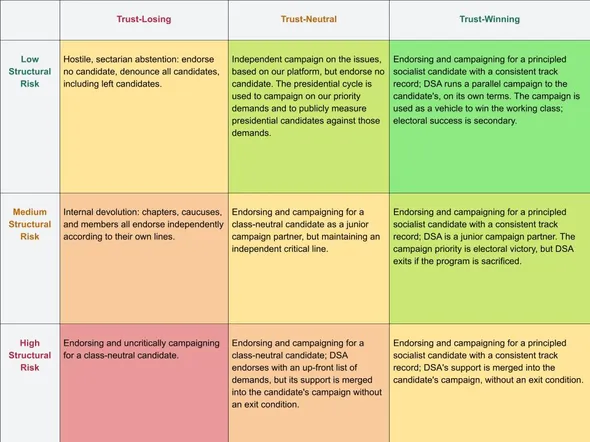
With this table, our best option becomes clear: endorse and campaign for a principled socialist candidate with a consistent track record, and run a parallel campaign to the candidate's on our own terms. We can also use this table to evaluate the various proposals from other DSA members, caucuses, etc. as a more precise instrument than the narrow binary of "populist vs sectarian". It also serves another useful function. It provides a map of where to move as conditions change in ways that make a particular option less viable. For example, if no principled socialist candidate ends up running, and DSA doesn't develop a candidate of its own, we move from the option in the top right cell to the top center cell. Or, for example, if we're running a principled socialist candidate, an argument could be made at Convention to pre-authorize a calculated risk under certain conditions (like winning the Democratic nomination) and make DSA a junior campaign partner with an exit condition, shifting from the top right cell to the center right cell. Strategically approaching the presidential campaign, and by extension any campaign, means evaluating our options with these two axes in mind. If we ignore the risks posed by structural pulls, we let DSA get folded into capitalist institutions. If we ignore the necessity of winning the trust of the working class, we fail to expand our movement from a narrow section of the working class to the working class as a whole. Avoiding both of these errors means rejecting a pursuit of growth by class-neutral means and focusing our efforts on winning the trust of the not-yet-engaged sections of the working class.
Narrow is the Road that Leads to Socialism
DSA’s expansion into the organization we now know came largely from a specific section of the working class: the college-educated who were promised security and had that promise broken. This source of growth accounts for both DSA’s current organizational strength and its vulnerability to abandoning socialism. Because that promise was broken in recent memory, this section of the working class still has faith that it can be honored by political action, and that faith is what made DSA's expansion possible. But because the promise can be honored within existing capitalist structures, DSA can be easily folded into them. Class-neutral mass politics is how that folding happens in practice. It is also exactly what the broader working class, whose political experience is promises without a record, has learned to ignore. The section of the working class that DSA has already won was won through trust in a consistent political vehicle. Winning the working class as a whole means DSA earning that trust for itself. The two-axis grid above is a tool for keeping a DSA presidential campaign, and every other DSA campaign, aimed at winning that trust rather than at growth by any means.
Liked it? Take a second to support Cosmonaut on Patreon! At Cosmonaut Magazine we strive to create a culture of open debate and discussion. Please write to us at submissions@cosmonautmag.com if you have any criticism or commentary you would like to have published in our letters section.