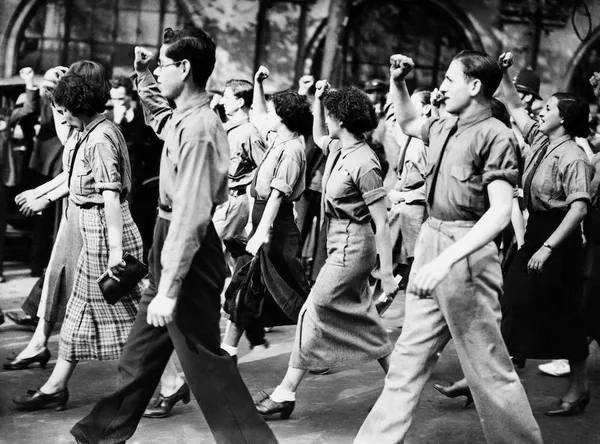
The Battle of Cable Street took place in East London on Sunday, 4 October 1936. It was a conflict largely between people mobilized by the Communist Party of Great Britain (CPGB) – with help from groups such as the Independent Labour Party (ILP) and other working-class activists – and the police. The police were trying to clear a path for a provocative march through the East End by Oswald Mosley’s British Union of Fascists (BUF). Although there were clashes with BUF activists on the day, the main confrontation was with the forces of the capitalist state.
It can only be called a community action, or Jewish community action, with a deal of difficulty. Communist Jews (with an accent firmly upon the first part of this identity) played a leading role. The Jewish People’s Council Against Fascism and Anti-Semitism apparently gained 100,000 signatures imploring the Home Secretary to ban Mosley’s march. The Labour Party instructed its members to ignore the counter-demonstration. As Nigel Copsey recounts: “The Jewish communal leadership, through the Co-ordinating Committee of the Board of Deputies, also issued advice which subsequently appeared in the form of a prominent notice in the Jewish Chronicle on 2 October directing Jews to keep away from the demonstration: ‘Don’t go. Shut your doors. Don’t be involved.’”[1] On the eve of the battle, Labour mayors and some rabbis appealed again for people to stay away. The London district committee of the CPGB had originally attempted to yank its comrades away from facing down Mosley’s Blackshirts in favor of attending a youth rally for the Spanish Republic in Trafalgar Square. The district leadership backed down after receiving a deputation of its Stepney comrades[2] and what I guess would have been a growing realization that large sections of the CPGB’s support were determined to turn out in the East End come what may.
This fractured event did not stop the BUF as imagined by modern-day “They did not pass” mythologists. Copsey cites Metropolitan Police reports that the BUF gained in prestige following Oct 4, bolstered by working-class recruits in the East End. BUF-inspired anti-Semitism did not disappear from the East End or other areas where Mosley’s forces had influence.[3]
What we have with the Battle of Cable Street is a display of political disunity and division, a fight against the police on behalf of more determined working-class activists and their followers, and a questionable outcome. The recent 90th anniversary celebrations were presaged by an alternative mythology: broad cross-class unity between workers and their leaders; “community” resistance to the BUF; the idea that “Mosley did not pass”; and the downgrading of the CPGB’s role. This false narrative says everything about the deplorable state of left politics in 2026 Britain and almost nothing about the Battle of Cable Street in 1936.
In fact, these anniversary celebrations were informed more by another event in 1936: the Public Order Act, which came into force in 1937 to ban political uniforms worn by the right and the left, and to give the police more power to control marches and clashes between communists and fascists. This was supported by the Labour Party of the time with its patriotic injunction of “democracy versus dictatorship” pitched against the “continental”, “foreign” incursions of communist and fascist violence on British streets. Speaking in the House of Commons, Herbert Morrison of the Labour Party made it clear that the Public Order Act was aimed not just at Mosley’s BUF: “If this house does nothing, the trouble will break out again. After this private army of the fascists, the private army of the communists must come.”[4] Anniversary celebrations thus intent on highlighting nebulous “community” and trade union resistance at the expense of the CPGB and other political forces of the time thus pay obeisance to the British state’s response to Cable Street and not the historical event itself.
The lack of a real successor to the CPGB, willing to contest this modern narrative, only magnifies the problem. The Morning Star’s Communist Party of Britain (CPB), a splinter from the official CPGB in 1988, was involved in the 90th anniversary celebrations, but in the context of banning its own Young Communist League supporters from wearing communist uniforms and expelling those who won’t comply. While CPB leaders such as Mary Davis do emphasize CPGB involvement in 1936, this is subtly downgraded by over-emphasizing the Jewish identity of communists in line with modern ideology. The Jewish People’s Council Against Fascism and Anti-Semitism, the body that called for the Home Secretary and the forces of the state to ban Mosley’s march and save working-class residents the bother, is hailed as “a model of a broad-front anti-fascist organization”.[5] This seems a strange way to celebrate Cable Street given that the events were a response to the lack of a broad front and the opposition of the Labour Party, locally and nationally. To play its marginal role from the wings, the CPB, in line with its state-loyal reformist politics, also has to re-enact the outcome of the 1936 Public Order Act.
While the official celebrations are hamstrung by false history, those who now espouse one particular tactic from the 1930s, the old German Communist Party’s “beat down the fascists wherever you meet them”, “no platform for fascists” in modern parlance, are also blighted by history; in this instance, one particular physical-force tactic that the CPGB saw as strategically limited as early as 1934. By over-focusing on fringe far-right groups, anti-fascists have forgotten the CPGB’s correct recognition from the 1930s that the capitalist state sets the boundaries for the impregnation of society with far-right and semi-fascist ideas, flowing from commonplace bourgeois ideas of militarism and state integrity.
To cap it all, modern-day anti-fascists fall back on the quack remedies that the CPGB proposed to fix a drift to the right in 1930s Britain: economism and programmatic shortcuts through a Labour government. All of the modern left’s response to the contemporary shift to the far right can be found in the CPGB’s 1930s playbook. However, the CPGB and its main thinker, Rajani Palme Dutt, had the political gumption to understand that the British left was stuck at an impasse, and that some of the theory of those years, too often dismissed with pejorative and overused epithets such as “Stalinism”, still stands up.
This article will consider four themes, which will touch on the events of the Battle of Cable Street but necessarily point beyond it to a broader context of the CPGB’s politics in the 1930s: a) the subsequent literary processing of Cable Street by communist writers; b) the failure of physical-force anti-fascism as early as 1934; c) CPGB responses to the 1936 Public Order Act; and d) how some of these themes became manifest in the party’s 1939 Draft Programme. The methodology of this article is loosely based on Theodor Adorno’s idea of constellations: a method of intellectual inquiry that clusters multiple concepts, historical contexts, and contradictions around a specific object to reveal its truth. There has been a small-scale historical industry around narrowly unpacking the events of the Battle of Cable Street. Indeed, that thin empirical focus and a tendency to focus on mere celebration fuels the far-left’s contemporary delusions.
Processing Cable Street
In 1939, Frank Griffin’s[6] novel October Day recorded the events of the Battle of Cable Street in 1936. One of the characters in the book is an unemployed laborer called Slesser, unwilling to take a job with the local council because of his refusal to join a trade union. After an argument with his wife, he gets sucked into the vortex of the anti-Mosley demonstration, marching and fighting alongside CPGB members before becoming involved in confrontations with fascists after the demonstration when he is mistaken for a Jew. Griffin’s book is fast-paced, knockabout stuff. But we are left with a strange denouement. By the end of the book, Slesser has reversed his previous outlook on life: “‘I’ve been a bloody fool! I ought to have joined the union years ago. Everybody ought to join a union. Don’t you see?’ he asked passionately. ‘We must all stand together. All us working folks must be organised. That’s the only way we’ll ever fight the bosses, that’s the only way we’ll ever get the rich off our backs.’”[7]
So, after one day, the anti-union Slesser seems on his way to becoming a communist sympathizer. He has simply been processed by the experience of the demonstration and militant action, buoyed along by events that he initially had very little understanding of; enough that he fairly immediately sloughs off his previous worldview. This is mechanistic in the extreme and a mystical, not rational, view of the formation of working-class consciousness. One has to ask whether a character with views such as Slesser would have even gone to Cable Street or, if he had, whether he would have been marching on the fascist side. But Griffin ultimately allows no mediatory role to his character’s consciousness, and his views are simply a matter of chance as to where he ended up on the day. This stems from the montage-like production of novels such as October Day (shared with John Sommerfield’ May Day [1935] and John Dos Passos’s USA [1937]) where a kaleidoscopic cast of fragmented characters only allows for an incremental and semi-fantastic unfolding of proletarian consciousness.
Slesser (and Griffin) have taken one step beyond the day’s events in the sense that something needs to be done beyond a mere celebration of the day’s events or a repeat of them. But that step is an incremental one of joining a trade union, not of joining the CPGB, which, in the context of the novel’s events, would have been just as abstract. That incremental view of proletarian consciousness is more than familiar to modern-day leftists, but Griffin estranges Cable Street for us. No longer a semi-mythical event of the “they did not pass” variety, the latter part of the novel shows Slesser arrested for fighting with fascists in central London: the message being that the BUF hasn’t gone anywhere and the future crowds in, beyond Cable Street. Of course, that is partly the historical period talking: with the onset of the Second World War, the Battle of Cable Street was an inconsequential pip-squeak of an event. October Day thus ends up posing uncomfortable questions for our various anti-fascist re-enactment societies.
A later recreation of the Battle of Cable Street, Arnold Wesker’s 1956 play Chicken Soup with Barley, is, on the surface, a more critical production.[8] The events of Cable Street, filtered through the experience of the Kahns, an East End communist family, are shown as part of a 20-year cycle that ends with the Soviet intervention in Hungary in 1956, the Cold War, and the persecution of Soviet Jews. The Battle of Cable Street is shown as the heroic start of the cycle, and this was a trope of the CPGB’s internal opposition of 1956 (led by figures such as EP Thompson), carried through into the so-called New Left and across all wings of the party in its final decades. The CPGB of the 1930s was always counterposed to its post-1945 existence and failings on various fronts; because the unpopular popular front had precious few successes to recommend it, Cable Street, as an apparent success, began to shine out.
It’s not that every member of the Kahn family is heroic on the day of Cable Street (Harry Kahn evades his party duty), but compared to later scenes, when the family’s communist network disintegrates geographically and politically under the pressure of the Cold War, this is the most dynamic part of the play. The consciousness of the characters is more plausible in Chicken Soup with Barley compared to the restrictive montage of October Day, coming to reside, through activism and heroism in a mixture of resignation and the stoicism of family matriarch Sarah Kahn, who stays loyal to the CPGB because she’s always been a communist and sees any alternative as bleak. But Wesker’s open and non-didactic conclusion has become subverted in the flow of history by the pressing need for what CPGB general secretary Harry Pollitt saw as a series of regimental myths to inspire the lads and lasses on the byways of British socialism.
Beating the Fascists, Losing the War
There is a simplistic theory that has grown up around the CPGB’s short-sighted approach to the Public Order Act, its initial hesitations around Cable Street, and a developing desire for its members to wind down constant street confrontations with BUF members that runs along the following lines. The onset of the Popular Front in 1935 meant that the Comintern was pushing the CPGB to adopt more respectable politics so that the Soviet Union could better pursue alliances with the bourgeois states in Western Europe. Hence, moves away from street warfare with fascists and abiding by the law were all part of this move towards respectability.
While it is true that the CPGB’s politics became broader in the late 1930s in the sense of a willingness to throw in its lot with almost any establishment figure that was at least able to countenance an alliance with the Soviet Union, the CPGB was never respectable in British society. Labour Party propagandists constantly traduced the CPGB for its disloyalty to the British nation-state and its fealty to the Soviet Union. Stalin’s well-founded distrust of British imperialism put a hard stop on the CPGB’s organic incorporation into polite society. The CPGB was quite prepared to enter its members into Labour in secret and to break its rules; it made preparations for illegality at the start of the Second World War; and many of its members were prepared to break the law and spy for the Soviet Union, even when it was an ally of Britain against the Nazis. If you wanted to pursue respectability, then it wasn’t advisable to be in the CPGB, except perhaps in Britain’s first flush of enthusiasm for their new Soviet ally in 1941; even then, communist cadre would be more suspect due to events such as CPGB organizer Dave Springhall’s conviction for espionage on behalf of the Soviet Union in 1943.
CPGB members certainly did use organized violence against the BUF in the 1930s, often premeditated violence, as documented in the work of Stephen Cullen.[9] In a smaller-scale imitation of tactics used by the German communists against the Nazis before 1933, the CPGB physically contested the BUF on the streets of Britain. However, just as the German communists began to realize that such tactics were severely limited[10] in terms of winning people to the party’s broader political strategy and, before the emergence of the Comintern-inspired popular front, the CPGB also started to push its comrades towards more variegated tactics.
In December 1934, the CPGB’s George Allison gave a useful insight into the party’s anti-fascist activity that is worth quoting at length:
In almost every big centre the announcement that Mosley is coming is sufficient to ensure the setting up of an anti-fascist committee on a united front basis. In Nottingham, Leicester, Manchester, Liverpool… such committees have been established and have almost invariably succeeded in carrying through effective counter-demonstrations. But nearly all of them find themselves stumped when this has been accomplished. A Nottingham comrade expresses the position very plainly in saying ‘now that Mosley has gone there seems to be nothing left for us to do’, and other committees in the provinces and in the London areas find themselves in a similar position. Such an attitude has much in common with the purely reformist view that sees only the fascism of Sir Oswald Mosley. Moreover, it relegates the anti-fascist front to a purely defensive position and does not countenance the urgent necessity of developing the counter-offensive against fascism on the widest possible front. In addition there is a noticeable slowness to penetrate into the working-class organisations… in order to win them for continual activity against fascism….[11]
To a reader in Britain in 2026, this is familiar ground given that it illustrates the imbecility of the left’s still favored tactics of running around after fringe fascist outfits while downplaying the militarism and authoritarianism embedded in mainstream bourgeois politics. Despite being couched in the language of broad fronts, Allison is drawing attention to the fact that the battle on the streets is hindering the development of the party inside working-class organizations. In other words, the anti-Mosley circus restricts the CPGB to the fringes and only underlines its status as a marginal organization in British politics. This is a thoroughly modern disease that the CPGB, to its credit, had begun to diagnose 90 years ago. The party’s leaders knew that the politics of street violence and demonstrations were severely limited tactics. This was an entirely rational response.
It is this type of understanding that also forms the boundary of the famous account of Phil Piratin, the CPGB’s MP for Stepney, London, in 1945-50 in Our Flag Stays Red (first published in 1948). He discusses the party’s change of tactic towards BUF members when it had to think about winning them politically rather than just clouting them in the street.[12] Piratin recounts how he and the CPGB set about defending fascists suffering the blight of slum housing, evictions and bailiffs. Our Flag Stays Red was published when the CPGB had begun to lose ground in local politics in its “Little Moscows” in London, South Wales and Scotland; Piratin and Gallacher had lost their seats as MPs. Piratin was trying to convince his comrades that determined activity around local issues could rally its support when the CPGB was becoming unpopular due to the Cold War and its association with the Soviet Union. He was banking on winning an army of Slessers on the model of October Day and would not countenance the slow political strangulation envisaged by Chicken Soup with Barley.
As with the tactic of beating down the Blackshirts, this was an entirely defensive posture that could only delay the CPGB’s decline. Local issues and what Allison called the “widest possible front”[13] scarcely allowed the CPGB to win support for the non-reformist politics of combatting the bourgeois state – the very incubus of British fascism.
Public Order Act: the CPGB response
The important thing to understand about the 1936 Public Order Act and its attack on the wearing of political uniforms is that it was not only aimed at Oswald Mosley and the BUF Blackshirts; it was also aimed at the uniforms of the left. This was made clear by then Home Secretary Sir John Simon in Parliament when the bill was debated in the House of Commons in November 1936. He said: “… information is coming in of efforts being made by people largely of the anti-fascist persuasion by way of reprisals, who are attempting and are actually adopting the wearing of uniforms of their own. We do not want this situation to develop.”[14] Police reports of the time identified a few strands of uniform that the ban was aimed at:
- Black, blue and grey shirts worn by the BUF and fascist splinters.
- Red shirts worn by the Independent Labour Party’s Guild of Youth.
- Green shirts worn by the Social Credit Party of Great Britain and Northern Ireland.[15]
- Brown/khaki-grey shirts worn by the YCL and the communist Young Pioneers children’s group, often with red ties or armbands.
Indeed, the press and some MPs mocked the act’s profligacy in banning coloured shirts. One wry comment piece joked: “We may have to amend the act by making it illegal to wear shirts in any of the primary colours in the interest of hygiene and public peace.”[16] It goes without saying that bourgeois militarist groups such as the Boy Scouts were not targeted by the acts, and Sir John showed caution in not precisely defining terms such as “uniform” so as to preserve the intention to only target certain forces, namely the BUF, the YCL and others.
Joe Jacobs, a more conservative-minded communist, remembered that many YCL members in the East End in the 1930s “were fond of dressing in an outlandish way. Khaki or red shirts were common. They also liked to wear sandals”. He said that “there were frequent arguments in the YCL and the CP because some of us felt that these outlandish dressers were behaving in a ‘sectarian’ manner”.[17] The YCL, of course, would have been imitating European communists, particularly in Germany, where the party had presented itself in a military fashion (Red Front Fighters’ League and so on) before the Nazis assumed power in 1933.
It seems like this was also the view of the YCL and CPGB leadership. When the YCL was sent a police circular informing it of the uniform ban, secretary John Gollan wrote to the Metropolitan Police commissioner: “We wish to inform you quite definitely that we are not a uniformed organisation, but as we are in complete agreement with the forbidding of militarised politics and uniformed organisations, we have taken the step of circularising your letter to all our branches.”[18] This opportunist position may have been a means of self-defence, given that the CPGB’s then operative 1935 programme, For Soviet Britain, called for the arming of the working class. But it was more likely to have spread from the ambiguous position of the CPGB’s MP Willie Gallacher when the Public Order Bill was debated in the House of Commons. While he argued the bill would “seriously threaten the working-class movement and the trade union movement”, Gallacher also said: “I am in agreement with the banning of uniforms and the prohibition of military formations, which are obviously directed to attacking the working class.”[19] He seemed blind to the obvious truth that the ban would also be used as a weapon against the YCL and the CPGB.
The party was fortunately composed of more determined types than Gallacher and Gollan, and Sheffield CPGB moved to test the terms of the uniform ban. The act had left a loophole for the potential wearing of political uniforms: “Provided that, if the chief officer of police is satisfied that the wearing of any such uniform as aforesaid on any ceremonial, anniversary, or other special occasion will not be likely to involve risk of public disorder, he may, with the consent of a secretary of state, by order permit the wearing of such uniform on that occasion either absolutely or subject to such conditions as may be specified in the order.”[20] In January 1937, Sheffield CPGB wished to commemorate the life of Arthur Newsum, a communist killed while fighting for the Spanish republic. Given the ceremonial nature of this gathering, the local party asked for permission for the YCL to wear uniforms. “The uniforms of the Young Communist League, which would be worn on Sunday if permission is granted, will consist of khaki shirts and red ties. About 40 men and girls wish to wear them in the city hall… It is also proposed to wear a red badge with a mourning centre.”[21] However, Sheffield police and the Home Secretary refused to give the communists permission to wear uniforms.
Even when CPGB writers mentioned attacks on civil liberties in the late 1930s, they still seemed to be partly blind to the import of the Public Order Act. A Labour Monthly article in May 1937, recorded the case of one Mrs Urquhart, “who was accustomed to sell the Daily Worker outside Golders Green tube station [in North London]. One day she was arrested by two detectives and charged under the Highways Act, a 100-year-old measure intended by Parliament to prevent horses and carts being left in the streets, and now used largely for prosecuting persons holding political meetings on the highway”.[22] Despite this realisation, there still seemed to be a level of naivety shown towards the recently passed Public Order Act; “Whether or not, of course, the Public Order Act is used solely for the purpose for which it was alleged to be intended by Parliament, the suppression of fascist hooliganism, or whether it is used in industrial disputes, must depend not upon Parliament but upon the police.” This ostrich-like remark ignores that, as we have seen, politicians had been open in Parliament that their intent was to persecute left-wing opponents of fascism and if the police were capable of using the Highways Act against communists then they were surely capable of using the Public Order Act. Indeed, arrests and persecution of CPGB members had been a constant factor in the street clashes with BUF forces and was the main drama of the Battle of Cable Street itself.
The CPGB/YCL thus learned the hard way that it was firmly in the crosshairs of the Public Order Act. Its response to state repression was insufficient and somewhat at odds with its theory of fascism being incubated by the bourgeois state. Although the performative aspect of the CPGB’s politics remained throughout the 1930s, with the hammer and sickle being flown without shame, the specific political uniforms of the YCL seemed to have disappeared[23]] and, in any case, many young communists did hidden entry work inside the Labour Party’s League of Youth for the rest of the decade, which required a more incognito identity.
Programme and Fascism
Dutt’s theoretical work, starting with Fascism and Social Revolution (1934), had the distinct advantage of looking at fascism through the lens of the crisis of capitalism and its incubus inside the bourgeois state, always allowing for the interplay between a hegemonic state and Mosley’s more peripheral BUF. This was a consistent reminder to CPGB activists that their horizon could not be limited to street brawls with Blackshirts, or the symbolic theatre of “they shall not pass”.
Dutt expressed this with admirable clarity in July 1934:
It is essential for the workers to see clearly the character and strategy of the enemy they have to fight. For the enemy is not merely the Blackshirts; the workers could easily deal with these, despite all their weapons, if it were only a question of these. The problem only arises because the Blackshirts are assisted and protected by the forces of the state, both police and judicial. This is the heart of the problem. The Blackshirt army is in effect a kind of auxiliary irregular force of the state… which can on the one hand be used, under the protection of the regular forces, for rough work not suitable for the regular forces, and can on the other hand be disavowed as often as necessary. Open fascism is in reality an unofficial department of the capitalist state machine, which is itself preparing the conditions of fascism in every field. The central enemy is still the [British] National Government, which simultaneously assists and protects the fascists to organise their forces of violence, at the same time as in public it disavows them.[24]
Despite the CPGB being told at the Comintern’s August 1935 Seventh Congress that “at the present stage, fighting the fascist danger in Great Britain means primarily fighting the ‘National Government’ and its reactionary measures”[25] it is easy to see how the CPGB had in fact disregarded Dutt’s warning of constitutional illusions in its response to the Public Order Act in 1936-37. Dutt’s theory was not perfect. The idea that it was the “leaders of finance-capital” working in tandem with the National Government to foster an incipient British fascism was flawed, as it left intellectual space for the conception of a kinder native capitalism that could potentially offset the machinations of the financiers. Fascism and Social Revolution was conceived by Dutt as a kind of sequel to Lenin’s also problematic Imperialism, the Highest Stage of Capitalism (1916).[26]
That the CPGB had succumbed to the twin-headed hydra of economism and illusions in the bourgeois state was clear from the organization’s 1939 Draft Programme. I have written elsewhere how this draft was essentially bifurcated: by a more healthy “Erfurtian” section with the idea of a “workers’ democratic republic” to plug a democratic deficit that was a breeding ground for militarism and fascism; and a heavily truncated immediate section that merely looked towards the establishment of a left Labour government.[27] The Draft Programme’s treatment of fascism tended to encapsulate these issues.
In line with Dutt’s basic theory, the CPGB said: “In some countries the capitalist class has abolished the democratic forms and established open terrorist dictatorship or fascism. Strong tendencies in this direction exist also in Britain, and the process of preparation for fascism has begun with the anti-democratic legislation of recent governments.”[28] But then, rather astoundingly in light of the CPGB’s experience around the Public Order Act, the immediate section posits “the establishment of a government led by Labour, which will hold back the advance of fascism at home and abroad”[29] with such a government being entrusted with the “suppression of all fascist organisations”.[30] The CPGB here seemed intent on ignoring the Labour bureaucracy’s entwinement with the British imperialist nation-state.
This underlines how politically hopeless it is for modern critics to merely chastise the CPGB leadership for winding down violent attacks on Blackshirts or for not wanting to get overly excited about episodes such as the Battle of Cable Street. This wasn’t the problem. The CPGB’s real problem was how it responded to its correct analysis of the limitations of street politics and demonstrations. Nebulous broad-front work (of the united or popular type); immediate issues of housing and wages; and constitutional illusions, despite Dutt’s warnings, turned rational insights into irrationalism.
None of the contemporary narratives around Cable Street – which either celebrate more-or-less mythical conventions, or scold the CPGB for being too respectable – come anywhere close to diagnosing the party’s real tragedy in the 1930s.
Liked it? Take a second to support Cosmonaut on Patreon! At Cosmonaut Magazine we strive to create a culture of open debate and discussion. Please write to us at submissions@cosmonautmag.com if you have any criticism or commentary you would like to have published in our letters section.
-
Copsey, N. (2000). Anti-fascism in Britain. New York: Palgrave Macmillan pp.57-58.
↩ -
Marsh, K. and Griffiths, R. (2012) Granite and Honey: the Story of Phil Piratin, Communist MP. London: Manifesto Press, pp.16-17.
↩ -
Copsey, 2000, p.62.
↩ -
Great Britain. Parliament. House of Commons (1936) Public Order Bill, Parliamentary Debates: Hansard, 5th series, vol. 317, cols. 1349-1473. Available at: https://api.parliament.uk/historic-hansard/commons/1936/nov/16/public-order-bill (Accessed: 12 October 2026).
↩ -
Davis, M. (2026) ‘Cable Street at 90: The Communist Party, the Jewish community and the fight against antisemitism’, Morning Star, [online]. Available at: https://morningstaronline.co.uk/article/cable-street-90-communist-party-jewish-community-and-fight-against-antisemitism (Accessed: 12 October 2026).
↩ -
Frank Griffin (1911-84) had previously written ‘I Joined the Army’ (1937) as ‘Private XYZ’, an exposé of the brutal nature of British army life. He joined the CPGB in the late 1930s and later wrote thrillers.
↩ -
Griffin, F. (2011) October Day. Nottingham: Five Leaves Publications p. 225.
↩ -
Wesker, A. (1964) The Wesker Trilogy: Chicken Soup with Barley, Roots, I'm Talking About Jerusalem. Harmondsworth: Penguin Books. Wesker was born into a communist family in Stepney, East London.
↩ -
Cullen, S.M. (1993). Political violence: The case of the British union of fascists. Journal of Contemporary History, [online] 28(2), pp.245-267. Available at: https://www.jstor.org/stable/260710 [Accessed 12 Oct. 2026].
↩ -
Rosenhaft, E. (1983) Beating the Fascists? The German Communists and Political Violence 1929-1933. Cambridge: Cambridge University Press.
↩ -
Allison, G. (1934) ‘The Next Steps in the Fight against Fascism’, Labour Monthly, 16(12), pp.728-734.
↩ -
Piratin, P. (1978) Our Flag Stays Red. London: Lawrence & Wishart.
↩ -
Allison (1934).
↩ -
Great Britain. Parliament. House of Commons (1936) Parliamentary Debates: Hansard, 5th series, vol. 317, London: HMSO. Available at: https://hansard.parliament.uk/Commons/1936-11-16/debates/5c357821-1aad-4d2f-a856-a7d541618825/PublicOrderBill (Accessed: 12 October 2026).
↩ -
Political party that grew out of the Boy Scouts in 1920, which later turned into a paramilitary group. Some MPs questioned why this group was being targeted by the state.
↩ -
‘What is a Uniform?’ (1937) Dundee Courier and Advertiser, 1 January.
↩ -
Jacobs, J. (1978) Out of the Ghetto: My Youth in the East End: Communism and Fascism, 1913-1939. London: Janet Simon pp.79-80.
↩ -
The National Archives (no date) Young Communist League. Available at: https://www.nationalarchives.gov.uk/education/resources/thirties-britain/young-communist-league/ (Accessed: 12 October 2026).
↩ -
Great Britain. Parliament. House of Commons (1936) Public Order Bill, Parliamentary Debates: Hansard, 5th series, vol. 317, cols. 1349-1473. Available at: https://hansard.parliament.uk/Commons/1936-11-16/debates/5c357821-1aad-4d2f-a856-a7d541618825/PublicOrderBill (Accessed: 12 October 2026).
↩ -
Great Britain. Public Order Act 1936 (c. 6). London: HMSO. Available at: https://www.legislation.gov.uk/ukpga/Edw8and1Geo6/1/6/section/1/enacted (Accessed: 12 October 2026).
↩ -
‘Sheffield police ban on uniforms challenged’ (1937) The Daily Independent, 20 January, p.5.
↩ -
Bing, G.H.C. (1937) ‘Civil Liberty’, Labour Monthly, 19(5), pp.296-301.
↩ -
I’m making this judgment based on Ernie Trory’s fascinating films of Sussex CPGB in the late 1930s, CPGB marches are colourful and performative but do not feature uniforms.
↩ -
Dutt, R.P. (1934) ‘Notes of the Month: The Anti-Fascist Front’, Labour Monthly, 16(7), pp.387-402.
↩ -
Dimitrov, G. (1935) The Fascist Offensive and the Tasks of the Communist International in the Struggle of the Working Class against Fascism (Main Report delivered at the Seventh World Congress of the Communist International, 2 August 1935). Available at: https://www.marxists.org/reference/archive/dimitrov/works/1935/08_02.htm (Accessed: 12 October 2026).
↩ -
Morgan, K. (1989) Against Fascism and War: Ruptures and Continuities in British Communist Politics, 1935–41. Manchester: Manchester University Press p.22.
↩ -
Parker, L. (2023) ‘More or Less Erfurt? The CPGB’s 1939 Draft Programme’, Cosmonaut Magazine, 20 October. Available at: https://cosmonautmag.com/2023/10/more-or-less-erfurt-the-cpgbs-1939-draft-programme/ (Accessed: 12 October 2026).
↩ -
Communist Party of Great Britain (1939) Draft Programme to be Submitted to the 16th Party Congress, Town Hall, Stoke Newington, London, October 7, 8, 9th, 1939. London: Communist Party of Great Britain. Available at: https://archive.org/details/draftprogrammeto00comm_0 (Accessed: 12 October 2026) pp.21-22.
↩ -
Ibid p.37.
↩ -
Ibid p.38.
↩