On October 7th, 1985, four members of the Palestine Liberation Front (PLF) – a splinter group of a splinter group of the PFLP – seized the Achille Lauro ocean liner, which had taken off from Genoa, bound for the Port of Ashdod. According to then-leader of the PLF, Abu Abbas, the plan had been for the fedayeen to use the cruise as a means of transport; their real goal being a military base at port. However, after a stewardess discovered them cleaning their guns, they pivoted to commandeering the ship. By the next day, the hijackers – who were by all accounts visibly erratic and nervous – had relayed to the Americans their demand for Israel to release 50 Palestinian prisoners. When this did not happen by the time they had specified, the hijackers executed Leon Klinghoffer, a Jewish American tourist. The exchange ended on October 10th, with the PLF members surrendering thanks to PLO mediation, but the attack left a huge footprint. It represented a pivotal moment in the concretization of the US’s counterterrorism policy, as well as a major blow to the PLO’s international reputation.
Also on the 10th, far from the Mediterranean, in Los Angeles, California, KABC-TV ran a segment on the hijacking, including portions of an interview they had conducted with local Palestinian activist Alex Odeh. Despite having recorded over forty-five minutes of the interview, KABC-TV decided to air only a few heavily edited clips. The final product deceptively took Odeh’s statements out of context, making it appear that he responded to a question about the fedayeen’s motivations with “They can do desperate acts, and I can understand this. Because they are very frustrated with the whole situation.” They then spliced in a clip of Odeh praising Arafat, whom American media had largely taken to blaming for the entire incident. Not included were Odeh’s many profuse condemnations of the attack, and insistence that Arafat had nothing to do with it.
Odeh was born four years prior to the Nakba, in Jifna, a mostly Christian West Bank village north of Ramallah. In 1967, he finished his degree in Cairo, but was barred from returning to Palestine due to the Naksa, the Israeli annexation of the West Bank and Gaza following the Six-Day War. Suddenly a refugee, Odeh made his way to the United States, where he settled in Santa Ana and raised a family. He would become regional director of the American-Arab Anti-Discrimination Committee (ADC), the first Arab civil rights organization in the United States. A charismatic speaker, Odeh was something of a local celebrity, frequently conducting interviews on behalf of the Arab community. He consistently promoted peace and condemned violence, advocating instead for interfaith dialogue.
On October 11th, Odeh was supposed to meet a friend for coffee at his office. Later, he would be going to the local Jewish Community Center for a panel. Arriving at work just after 9 a.m., Alex opened his office door and took a single step inside before a bomb exploded, killing him instantly.
______
The reason I begin by explaining the Achille Lauro hijacking is that, without the proper context, Alex Odeh’s death would appear to be an isolated hate crime; his four-decade-old cold case just another racist miscarriage of American justice. But beneath the bare facts of the case lies a far more consequential story. It is the story of the long-suffering Palestinian diaspora, and of the ostracized Arab-American community. It is also the story of a great evil, its sudden manifestation, and its rapid rise to the heights of global power.
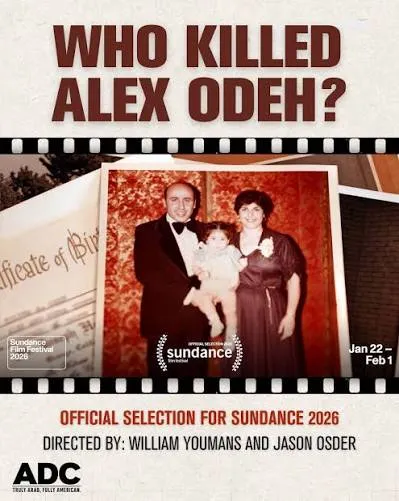
In Who Killed Alex Odeh?, co-directors Jason Osder and William Lafi Youmans take the Odeh case and look beyond its immediate circumstances, widening their focus from a single death to a vast, powerful fascist political movement that now threatens the entire world. That is not to say that the film does not deliver on its title. Employing the investigative techniques pioneered by great documentary exposes like The Thin Blue Line, the film aims to conclusively solve its titular crime, something it accomplishes by the time the credits roll. This is thanks, in no small part, to Israeli-Canadian investigative journalist David Sheen, who has made a career of reporting on the far-right reality of Israeli society, and had already been investigating Odeh’s death when the filmmakers first made contact with him. Sheen is the de facto protagonist of the film, propelling the narrative of the surprisingly on-the-ground investigation. Yet, throughout the entire experience, the contemporary story is interspersed seamlessly with a robust selection of archival footage, similar to Osder’s 2013 Let the Fire Burn. The footage is meant to connect the investigation to the vast, often convoluted historical context that surrounds Odeh’s death. It balances this perfectly, tying together every loose thread into a comprehensive tapestry.
The film opens by recounting the story of Odeh’s violent death, before quickly transitioning to a rapid-fire montage of frenetic shots, purposely confusing pieces of the greater conspiracy that will later be repeated in context. Immediately, the viewer is aware that they are entering a world that stretches far beyond the sleepy cul-de-sacs of Santa Ana. We are bombarded with television clips of press conferences and US presidents, shots of al-Aqsa Mosque, and footage of young men in mock military fatigues running through the woods and shooting rifles. Then, unceremoniously, the film jerks us away from the sequence and throws us back into the present. We are released into the cozy dining room of Norma Odeh, Alex’s widow, who sits and sorts through old photographs with her daughter Helena.
Together, Norma and Helena give the film its humanity. Throughout the film, head-spinning political revelations are gently interrupted with scenes of heartbreaking, often difficult, moments of cinema vérité. The mother and daughter are there to remind the viewer that, despite every earth-shattering implication, this is still the story of a family robbed of their husband and father, never granted the closure they deserve. Old clips are shown of a young Norma in the months and years after the murder. In every one, she appears despondent and almost dazed, as if she is still reeling from her husband’s death, unable to fully ground herself in a world without him. In one clip, asked by a reporter why she thought her husband was killed, she replies in a dreamy sort of monotone, “Because we are Arabs…And they have always discriminated against Arabs.”
Over three and a half decades later, she still possesses that quality, wistfully gazing at old photos with careless tears winding down her face. In one particularly agonizing scene, Norma begins to tell a story but chokes up, asking her daughter to complete it instead. Helena recalls that every day after picking her daughters up from school, Norma would park the car far from the house, making Helena and her sisters duck down in the backseat on the floor. Then, she would walk up to the front lawn, grab the newspaper, and fling it at the front door, in a desperate attempt to test for the same type of explosive that had killed her husband.
________
From the moment Odeh was killed, everyone knew it was the JDL. This is a point that Who Killed Alex Odeh? wastes no time litigating. At no point does the film even hint that any other suspect could be involved. This is done to make the JDL’s responsibility as incontrovertible to the viewer as it was to those involved at the time.
In March of that year, the ADC’s New York City offices were broken into and ransacked, with JDL graffiti left on the walls. In August, a JDL bomb detonated in the Boston branch, destroying the office and injuring police. And for months before his death, Odeh would regularly receive calls from JDL members across the country, threatening to kill him.
Despite their insistence, Odeh’s family and community were left in the dark in the days after his death. It would take an entire month before the FBI finally released a statement explicitly naming the JDL as responsible. From there on, no further progress was made. By the next summer, the FBI declined to repeat their statement that it was the JDL which had committed the bombing, instead attributing it merely to a “Jewish extremist element.”
The Jewish Defense League was a kind of grotesque parody of the militant identity-based groups that dominated the New Left era. The Black Panther Party was founded in response to the failures of the Civil Rights Movement, redlining, and police brutality, and was prompted by events like the Watts riots and the Hunters Point social uprising. Their inspirations were Malcolm X, Mao Zedong, and the FLN. For the Young Lords, it was the Division Street riots and the Battle of Lincoln Park, with the group taking inspiration from the Panthers, militant Third Worldist formations, and the PNPR. The JDL, on the other hand, was brought into being thanks to issues like the movement of non-white and immigrant populations into historically Jewish neighborhoods.
Put simply, the JDL began as a group of angry Jewish thugs. In 1968, in a huge civil rights victory, New York City was pressured into handing over control of the school board to the Black and Puerto Rican community activists who had been lobbying for increased representation in a neighborhood that was less than 5% white. The board terminated all the white teachers, replacing them with teachers from the community. However, most of the fired teachers were incidentally Jewish. The overwhelmingly Jewish United Federation of Teachers smeared the move as antisemitic, and launched a crusade against the community board. The episode was the result of decades of built-up resentment between the upwardly mobile Jewish community and the still-oppressed Black community, becoming the first of many big flare-ups between the groups. In an attempt to capitalize on the incident, a young Jewish man named Meir Kahane recruited some friends and placed an ad in The Jewish Press: “Anti-semitic Black racists are battling for control of cities,” it said, and urged readers to join the “Jewish Defense League.”
Meir Kahane was born into a prestigious rabbinical family in Brooklyn in 1932. For Kahane, the great distances between the US, Europe, and Palestine were insignificant. His mother was Latvian, and had come to New York fleeing the Russian Civil War. His father was a third-generation son of Safed, the family being part of the much romanticized pre-Zionist Old Yishuv. The young Kahane was brought up to believe that everywhere, the Jewish people were a single, maligned group who had two choices: be killed or fight back.
Kahane was raised to be an ardent Zionist. Ze’ev Jabotinsky was a friend of his father’s and would stay with the family when he came to New York. In one prescient anecdote, his mother recalled her son following Jabotinsky everywhere around the house, walking directly in his footsteps. When he was a teenager, Kahane would do just that, becoming heavily involved in Betar, Jabotinsky’s right-wing Zionist youth organization. He and the group stage guerilla demonstrations and protests, and provided direct material and financial support to the Irgun in Palestine. His experiences in Betar would heavily inform his political philosophy as he grew older and became a respected rabbi in the community.
Kahane was an ardent proponent of what founding Zionist Max Nordau termed “Muscular Judaism,” meaning a Judaism that prioritized strength and self-sufficiency, rejecting the weakness of concepts like martyrdom. In Kahane’s words, “The time has come for the Jew to understand that his roots are in his people, and that for him, the priorities start with Jewishness. Jews always wait until the holocaust is upon them to suddenly realize that they must fight back. And that is what JDL is trying to get across to the Jews.”
The JDL was meant to be an amalgamation of each of the supposed articulations of this idea that Kahane had grown up valorizing. The organization took as its slogan “Never Again,” which was purportedly the rallying cry of the Jewish resistance in the Warsaw Ghetto, and frequently invoked mythical Jewish heroes like Bar Kokhba and the Maccabees, who became proof to them that deep within the weak Jews of their parents’ and grandparents’ generations, there was a Muscular Jew lying dormant.
Of course, their greatest inspiration was Israel. The JDL believed foremost that the founding of the State of Israel was the most important moment in Jewish history, the greatest act of Jewish self-determination. Rather than the more mainstream Haganah, Kahane’s JDL had an affinity for the Jabotinsky-inspired Irgun, as well as its even more outwardly fascistic splinter group, the Lehi. This is precisely why the group was so obsessed with bombings and assassinations, tactics that had defined the terror campaigns of both those factions. The JDL sought to replicate the formation of a rogue militia, unfettered by laws and willing to violate all the rules of war. These actions would always be justified by what Jabotinsky termed “The Iron Wall,” a strategy of overwhelming, unforgiving military might, meant to be a form of preemptive self-defense. While the JDL was many things, it was perhaps above all an attempt to import the model of the Israeli Jew to the United States.
In the film, archival footage shows a JDL training camp in the middle of the woods. There are young Jewish men, most chubby or lanky, some with thick-rimmed glasses, all dressed in ill-fitting green fatigues. They run through the forest with real rifles, shooting targets and practicing drills. At one point, we watch them stand at attention. The drill sergeant salutes and screams, in a thick New York accent, “Who are we?” The young men, in unison, reply “Jews!” Another clip shows the trainees doing a marching drill, their feet out of sync as they are led through a field. In this one, there is no call-and-response. The men just scream “KILL” over and over, at three-second intervals.
The JDL committed hundreds of attacks over its lifetime. From its inception in 1968 through the end of the 1980s, the group would break into homes and assault targets, attack gatherings and protests, occupy buildings, and start massive fires. They conducted dozens of bombings over the years, and seven people, including Odeh, were killed in these. They attacked diplomats, NGO workers, activists, and often even uninvolved civilians.
Of course, they were not just a militia. They were also a political organization, and would frequently stage protests and demonstrations. In the film, footage shows a small pro-Palestine gathering in the 1980s. Across the street are the JDL counterprotestors, chanting “Hell no, PLO,” or otherwise just yelling racial slurs. A local news interview with Irv Rubin, the leader of the West Coast JDL, has him smirking, saying, “I have great empathy for these people. I think they should convince their Arab brethren in Israel to leave, so that they won’t be shot.”
________
Kahane first went to Palestine in 1962, absconding wordlessly one night without telling his wife or four young children. He had a loose notion that his ideas, then too radical for the US, would be recognized for their brilliance among the Israelis. He first tried going to yeshiva in the northern city of Hadera, where he struggled to learn Hebrew and supposedly offended locals with his arrogance. Then, he left for a Kibbutz far in the south, taking on the role of an assistant rabbi. Little is known of his time there, but after only four months, he returned to the US, penniless and reluctant to speak about his time in the Holy Land.
Fast forward nine years and the JDL, barely two years old, was already a major hit. A survey from 1971 puts American Jewish support for the group at roughly 25%, overwhelmingly from young people. Virtually every major Jewish institution had outright condemned the group, but this only lent it more appeal to a generation of young, frustrated Jews. They were the first generation born after the Nazi holocaust, and despite their near-instantaneous assimilation into whiteness, there was a prevailing notion that their immense privilege could be taken away from them at any moment. The JDL was the only American group that offered them a concrete means to counter that. This was also after the 1967 Six-Day War. American Jewish opinion on Israel – previously split – had swiftly coalesced around the state. Young Jews now idolized Israel, and wished they could be more like the brave soldiers in their imaginations. The JDL billed itself as a part of that same radical, voluntarist Jewish tradition.
Kahane was at the top of the world, commanding a national organization of over 10,000 members, which acted outside of the law, yet suffered none of the same governmental scrutiny as groups like the Black Panther Party. But rather than being content just building out the JDL, Kahane wanted more. In September of 1971, he officially made aliyah, this time with his family in tow. Unlike his last attempt, this time he had an actual plan: he wanted to get into politics.
Despite Kahane’s family being Old Yishuv, the man was a born-and-bred New York Jew. He didn’t have an innate hatred for Palestinians in the same way Israelis did. To him, the Arab had always been just one of the Jewish people’s many enemies. The JDL didn’t bill itself as a particularly anti-Arab group, in fact, it began with the intent to combat popular neo-Nazi formations, Black New Yorkers, and other perceived enemies of the American Jewish community. The JDL’s international focus was primarily on the Soviet Union, as the plight of the so-called refusenik Jews in the USSR was much closer to home in New York than anything going on in the Middle East. However, as the post-1967 Jewish imagination shifted to centering Israel, the bigoted antisemitic European was gradually superseded by the backwards Arab warlord. Still, while Arabs gained prominence, they were still only one of many windmills the JDL was tilting at. This all changed after Kahane arrived in Palestine. He immediately started JDL-Israel, which concocted a modality similar to its US progenitor. It mainly targeted non-Jewish immigrants, in particular the Black Hebrew Israelite community of Dimona, who had arrived from the United States only a few years earlier. This was fitting, seeing as how the JDL in the US very often went out and assaulted Black people. However, very quickly, Kahane realized that Israelis didn’t care about immigrants nearly as much as they despised Palestinians.
He arrived in Hebron/al-Khalil within a year, inserting himself into the local settler scene by invoking an uncle – one he had never met – who had been killed in the city during the 1929 riots. Hebron was one of a handful of Palestinian cities where pre-Zionist Jews had a centuries-old presence, and the city was also home to the Ibrahimi Mosque, known to Jews as the Cave of the Patriarchs, the resting place of the founding Abrahamic prophets. In response to Zionist settler colonialism under British rule, the 1929 Palestinian riots forced out all of the city’s Jews, new and old. The "reclamation" of Hebron thus became a major aim of Zionism. Next to East Jerusalem, annexing Hebron was the biggest victory of 1967. The year after the city came under Israeli occupation, Rabbi Moshe Levinger – an adherent of Rav Avraham Kook’s Religious Zionism movement – and his followers came and occupied a hotel in the city, refusing to leave. Eventually, the government dropped the pretense of keeping the peace, and paved the way for the zealots to establish Hebron’s first illegal settlement, Kiryat Arba.
Kahane milked his pedigree, as well as the fact that the Religious Zionists were some of the only Israelis as outwardly far-right as the JDL, to establish himself in the city. He began a highly publicized campaign against Hebron’s mayor, who had allegedly participated in the 1929 riots. This put him on the radar among the fringe, but growing, Israeli right-wing. He soon became an influential voice, as his anti-Arab agitation evolved into a political project seeking the expulsion of all Arabs from Israel. Initially, this plan took the form of voluntary emigration; he wanted to provide any Palestinian who agreed to leave and renounce their claim to the land with a monetary settlement. While this may seem almost quaint now, at the time, this was the most radical position an Israeli had ever pushed.
Back home, young American Jews were thrilled by Kahane’s project. The American Jewish perception of Arabs had solidified into a brand new ancient blood feud. In addition, the Palestinian fedayeen had emerged onto the world stage, their instant vilification by the West reinforcing many of the anti-Arab prejudices that American Jews were already forming. In particular, the Operation Iqrit and Biram attack on the Munich Olympics became a moment that resulted in many Jews becoming more sympathetic to the JDL. Kahane still ran the organization, and managed to balance the two poles of Jewry that he was seeking to ideologically unite.
By 1973, the JDL-Israel had become the League List, which eventually became Kach (taken from the Irgun’s slogan, “rak kach”), and competed in the Israeli legislative elections. The party received less than one percent of the vote, and couldn’t qualify for the elections. Yet, Kahane gained an even more public profile, as well as many more followers and sympathizers, especially after the 1973 war. Paradoxically, as Kahane’s influence grew, he did progressively worse in each subsequent election. This contradiction can be explained by the fact that Israelis were rapidly moving rightward, but it was Menachem Begin’s right-wing movement, Herut, that was catching them.
Begin, born Mieczyslaw Biegun, was a Belarussian-Polish immigrant to Mandatory Palestine, who was also a dedicated follower of Jabotinsky. He became the Irgun’s commander, personally ordering notorious crimes against humanity, including the Deir Yassin massacre. Afterwards, he became an Israeli statesman, leading the unpopular right-wing in an Israel that still maintained its veneer of Labor Zionism. Begin was the face of the Israeli opposition, a loud but fringe Revisionist Zionist voice in the Knesset, decrying the weakness of Ben-Gurion and advocating “impossible” ideas like the annexation of the West Bank and Gaza. After 1967, Begin became a more legitimate figure. And after 1973, he became a major threat to the undefeated center-left. In the 1977 elections, Begin and Herut defeated Labor and took control of the government, in what Israelis now know as the Mahapach (revolution).
When Kahane first burst onto the Israeli political scene, Begin approached him and offered him a cushy seat in Herut, no strings attached. Many Herut figures were already admirers of the JDL, including Geulah Cohen, a former Lehi militant who became a major Israeli political figure. They saw Kahane as the perfect way to attract the many American Jews who were now making aliyah. But Kahane declined. Even after Herut ascended to power and formed the powerful political coalition Likud, Kahane consistently refused to join. This was a decision motivated as much by ego as it was by strategy; Kahane didn’t want a high-up position in someone else’s party, he wanted to lead his own movement.
Whether it was out of pure coincidence or not, this strategy worked out for Kahane. The JDL had actually gone down in membership significantly by the time the 80s were rolling around. But it didn’t matter; the group had succeeded in its goal. The vast majority of popular and institutional American Judaism was made up of rabid Zionists and anti-Arab racists. The JDL, while still seen as extreme, was a largely accepted staple of American Jewish life. In Palestine, Kahane had also succeeded in ratcheting Israelis to the right. His voice was widely listened to, and while he wasn’t a part of the governing coalition, his ideas certainly were. He was cultivating a strong base of followers, many of whom were becoming quite influential themselves, to the horror of the Israeli political mainstream. In a desperate bid to stop him, Israel’s Central Elections Committee initially tried to bar him from running. Kahane took this to the Bagatz (the Supreme Court of Israel), and in a shocking upset, the court sided with him. By 1984, Kach qualified for the elections, and Kahane finally mounted his throne in the Knesset.
Kahanism had become the talk of Israel. While Israel was a racist, settler colonial state from its inception, this vulgar Jewish supremacism was alien to the political mainstream. As Sheen says in the documentary, “He preaches ethnic cleansing, openly, straightforward, without trying to hide it in euphemisms, and says that there’s only one choice: Kick them all out, or kill them… Up until that point, people couldn’t speak those words out loud. It had been behind closed doors. So he speaks openly about this, and that breaks the taboo in Israeli society.” After his first year in the Knesset, a Ha’aretz poll found that 40% of Israelis aged fifteen to eighteen agreed with Kahane. A Ma’ariv poll from the same year found that Kach, polling at about 9% of the electorate, was on track to become Israel’s third-largest party, with almost unanimous institutional disapproval.
Kahane embraced his pariah status, presenting himself as a new type of Israeli politician. He agitated constantly, publishing Kach advertisements that warned of Jewish women being seduced by Arab men, and proposing the criminalization of Jewish-Palestinian sexual activity. A big part of this new Israeli politics was the performance. In one infamous stunt, Kahane staged a visit to the northern 48 city of Umm al-Fahm, “appealing” to its Palestinian inhabitants to emigrate. Young men from the town came and urged Kahane to leave, which eventually turned into a confrontation. Six Palestinians were injured by the police’s crowd control, as the cops escorted Kahane away. He continued to try to visit Palestinian villages, which became so controversial that the Knesset actually voted 58-36 to strip him of his parliamentary immunity, so that the police could arrest him if he kept trying to go. Even after this, he refused to yield and continued the stunts.
His theatrics inspired his followers to become more hands-on. One shocking anecdote took place in the wake of the Camp David Accords and Israel phasing out its occupation of the Sinai. A group of Kahanist settlers in the Sinai settlement of Yamit refused to leave, even threatening to kill themselves if the military tried to intervene. It took Kahane himself mediating, at the personal request of Prime Minister Begin, for the settlers to finally relent, though he was largely thought to be behind the whole event. His supporters became emboldened across Palestine, frequently assaulting Palestinians and destroying their property. In March of 1984, five American JDL members who had been trained in the aforementioned boot camp went to the outskirts of Jerusalem and fired machine guns at a bus filled with Palestinian workers, severely injuring eight of them. In October of the same year, a young Israeli inspired by Kahane fired an anti-tank rocket at a Palestinian bus, killing one person and wounding many. In response, Kahane made the attacker an honorary member of Kach and paid for all his legal fees.
During all of this, Kahane was making frequent trips back to the US, where he was embraced in much the same way as in Israel. He would also conduct the same dramatic displays, performatively storming college Hillel houses unannounced to preach about Arabs. Many mainstream Jewish figures called for his arrest and expulsion from the country. Yet he remained a popular figure among many Jews. He was a bridge between the newest incarnations of the Israeli Jew and the American Jew, united in their shared hatred of the Arab.
In the film, we see a video of Kahane’s second speech in front of the National Press Club in Washington. A protester runs up and dumps a bucket of fake blood on him. Kahane barely reacts, watching calmly as the protester rushes out of the room, trailed by security. Then, without so much as shrugging, Kahane turns back to the microphone, dripping head to toe in dark red paint, and says “I would rather be a winner than a loser, and I would rather have the entire world hate a State of Israel, which is a winner, than love a State of Israel, which is dead.”
_____
David Sheen, the Israeli journalist, made aliyah in 1999 from Canada, inspired by the propagandized image of Israel he had been fed all his life. Over the years, he became disillusioned, watching an already extremely radical, apartheid country descend even further into fascism. His focus eventually became the Israeli far-right, which introduced him to the murder of Alex Odeh. The works of Robert Friedman, an American investigative journalist who extensively covered Kahane, led Sheen to investigate the primary suspects in Odeh’s death: Robert Manning, Keith Fuchs, and Andy Green. The three had been top lieutenants in a JDL cell that was close to Kahane. Friedman had credibly proven that all three were behind a series of bombing attacks, with the last being Odeh’s assassination. Afterwards, they escaped to Palestine, each deciding to settle in the West Bank.
While researching the murder, Osder and Youmans got in touch with Friedman’s widow, asking if they could have access to his archives. She put them in touch with Sheen, and the directors ended up deciding to merge their investigation with his. From there, the three went over their respective theories, concluding from Friedman’s work that there was no way the FBI couldn’t have known about the suspects. The story had gone from a miscarriage of justice to something resembling a conspiracy.
The first suspect, Robert Manning, was eventually extradited back to the US in 1993 for an entirely different bombing. In 1980, Manning, on behalf of wealthy JDL financier William Ross, sent a mail bomb to the offices of Brenda Adams, who he was in a real-estate dispute with. Adams’s secretary, Patricia Wilkerson, opened the package instead, setting off the bomb and killing her. The US initially sought Manning’s extradition in 1990, but it took years for the Israeli courts to finally relent. When they did, the terms of the extradition specifically stipulated that Manning could not be tried for the crime of Odeh’s murder. Manning went to prison and never admitted his role in any of the bombings. The other two suspects, Fuchs and Green, were still presumably in the West Bank.
From this point on, the film begins focusing heavily on the investigation in occupied Palestine, with Osder flying out to film Sheen’s investigation. Their research revealed that Keith had changed his name to Israel, and had actually been involved in the 1984 bus attack. Sheen is able to track him down to a settlement near Bethlehem. Dressing up in a yarmulke and tzitzit, Sheen drives into the West Bank and goes to Fuchs’ settlement, finding his address. He knocks on the door and pretends to be a tourist interested in moving there. To Sheen’s fluent Hebrew, Fuchs answers jovially in English. He immediately invites Sheen and his partner inside. Sheen gets out about three cautious, seemingly innocuous lines before Fuchs, out of nowhere, gleefully says, “My background is JDL!” Fuchs starts telling them all about his time in the group, apparently neither ashamed nor apprehensive. At the end of the scene, he simply says, “I don’t hate Arabs. I don’t hate anybody. I hate people who hate me. If God created the Arabs poorly then it’s God’s fault.”
The last suspect in the case, Andy Green, is the most infuriating. Green changed his name to Baruch Ben Yosef after leaving LA in 1985, but he had already been going back and forth between the two countries with Kahane for years. In 1980, Kahane and Ben Yosef drew up plans to shoot an M72 LAW anti-tank rocket at the Dome of the Rock. They believed that this would trigger a redemptive sequence: the act would bring on the war of Gog and Magog between what religious fundamentalists like Kahane called “the children of Israel and the children of Ishmael.” The defeat of the Arabs by the Jews, in combination with the destruction of al-Aqsa, would then prompt the messiah’s return and the construction of the Third Temple. Not long after planning the attack, Kahane’s offices – which he called “the Museum of the Potential Holocaust” – were raided, and Kahane and Ben Yosef were detained for six months.
After Odeh’s assassination, Ben Yosef stopped going to the US and became a prominent Kach activist and lawyer. By the 1990s, he was a leading figure in the Third Temple movement, frequently conducting illegal incursions onto the al-Aqsa mosque compound. He was investigated many times for his connections to extremists and terrorists. He has brought numerous cases to the Bagatz, and in 2015 sued the Palestinian Authority and the government of Jordan for one million shekels for “discriminating against Jews” who wanted to pray at al-Aqsa.
For this part of the investigation, Osder pretends to be a professor making a sympathetic documentary about Israeli settlers. They convince Ben-Yosef to come and do an interview, ambushing him with questions about whether he is Andy Green and if he was involved in the death of Alex Odeh. Unlike Fuchs, Ben-Yosef is standoffish even before the deception is revealed. After they begin to interrogate him, he rips off his mic and storms out of the room.
This portion of the film is one of the most engaging, but it leaves the viewer feeling uneasy. While major discoveries have been made, at no point is there any indication that anything can be done about them. Fuchs and Ben-Yosef are free to do whatever they want in a country that gives them total impunity. Over the course of the film, we have become invested in the story of Odeh’s life, the injustice of his death, and the mystery surrounding the investigation. We have gotten to know his family, and become passive sleuths alongside Sheen and the filmmakers. It is in this on-the-ground segment, once the magnitude of the revelations washes away, that we realize the emptiness of it all. These men are Jewish Israelis in the 21st century, who killed an Arab forty years ago. There is no justice to be found here.
Adding to our unease is that the film’s character, by necessity, has changed. Sheen, despite his politics, is still a Jew who made aliyah, and still lives in occupied Palestine. In one scene where he meets Helena, she is tense and visibly uncomfortable, not sure of what to say to the Israeli journalist flying back and forth between her hometown and the homeland that she is denied. In a later scene, Helena and David are on a video call, discussing the investigation. The scene is mostly innocent, but David is positioned in front of his apartment window, and behind him lies a nighttime view of Jerusalem. Meanwhile, a Palestinian woman looks at it through a screen, as she discusses her father who died for the land. Youmans, also a Palestinian, remains silent the entire film, and is absent from any shots in Palestine. But Osder, a Jewish American, emerges from behind the camera for one of the documentary’s most memorable moments.
None of this is an indictment of the filmmakers or of the film. The movie is still riveting, and the portions that are uncomfortable are among its best parts. They highlight the complexity of navigating the subject of Palestine in a way that does justice to the Palestinian people and their continued oppression. The film challenges the viewer throughout to consider the precarious positionality of the Palestinian, though it is never polemical. It accomplishes this instead by presenting the bare facts of an injustice so obvious in its specific anti-Palestinian racism. Yet, in exploring a continued, worsening oppression, whether intentionally or not, the film also portrays, through its own production, that the same structural forces that led to Odeh’s death are still prevalent today.
When the film leaves Palestine and returns to California, it feels almost emancipatory. However, we soon learn that Israel’s reach extends far beyond its borders. Sheen, back in California, calls Detective Hugh Mooney, who led the Santa Ana Police Department at the time. Sheen explains the situation, and Mooney eventually says something staggering. “You’re aware that the Mossad shut us down along with the US State Department, right? The FBI was told not to arrest them, and they just watched them get on a plane and fly out to Israel.”
Mooney recounts to Sheen that the day of the murder, the FBI told the SAPD that they knew who was behind the killing. Not just the organization, but the three suspects. The FBI in New York had been tracking the three JDL lieutenants for months, and followed them all the way to the airport, then they lost track of them before finding out they were in Los Angeles because of the bombing. According to Mooney, the FBI agents he had spoken to said that they were ready to arrest the killers, but received last-minute orders from the State Department to stand down, apparently because the Mossad had requested that the murderers be allowed to leave. The FBI later tried to get the State Department to extradite them, but were stonewalled.
Despite the efforts of the filmmakers and Sheen, who gather witnesses, testimonies, and assemble an airtight case, the investigation goes nowhere. The FBI reopens the case due to the overwhelming evidence, but years go by, and nothing happens. We get a shot of Helena and Norma in the car, driving back from an interview with the feds, who give them nothing but pleasantries. Norma, her characteristic sadness punctuated by what seems like a white-hot rage, says, “I need to hear more. I need to understand more. I need more, more, more… and I was given nothing. It’s like the same answer I had in 1986, they give me today.” The documentary closes on Norma, cleaning Alex’s grave, holding back tears.
____
The day Kahane was sworn in, a new Palestinian representative also joined the Knesset. Mohammed Miari of the Progressive List for Peace was requesting to be added to a committee, when Kahane, minutes after being reprimanded during his swearing in, started mockingly chanting at him that he was a “PLO-nik.” Other members started shouting him down, and the chamber erupted into chaos.
Four years later, at a Knesset session, Miari took the podium. Before he could start, Kahane whipped out a hangman’s noose and started waving it at Miari. Once more, the chamber erupted. The incident became infamous, and the Knesset voted to suspend Kahane for five sessions. Despite his power, forces behind the scenes had been conspiring against him. Yitzhak Shamir, Begin’s successor in Herut, had grown annoyed with Kahane. A few months after his suspension, the Central Elections Committee voted to disqualify Kach and Kahane from the upcoming elections.
Kahane only became more defiant after this. He continued to agitate in Palestine, and took longer, more frequent speaking tours to the US. On one tour, he was speaking at the Marriott Marquis in Manhattan on November 5, 1990. At the end of the speech, he took questions from the audience. A young man walked up, as if to ask a question. Then, standing five feet from Kahane, the man produced a handgun and shot him point blank in the neck. Kahane was pronounced dead on the scene, and the young man, El Sayyid Nosair, received a life sentence.
Though Kahane was dead, Kahanism was more alive than ever. In an act of revenge, settlers killed an elderly Palestinian couple outside of Nablus shortly after Kahane’s death. The day after, Kahane’s funeral turned into a massive pogrom. Attendees conducted a twisted funeral procession, marching down the streets of Jerusalem, breaking the windows of Palestinian-owned shops and screaming “Death to the Arabs!” Groups of “mourners” trolled the streets, finding Palestinians to beat within an inch of their lives.
Kahanism permeated mainstream Israeli society, burning even brighter during the Oslo years. In defiance of the idea of normalization with the PLO, in 1994, an American JDL member and a good personal friend of Kahane’s, Baruch Goldstein, walked into the Ibrahimi Mosque during Ramadan prayers and killed 29 Palestinian worshippers, injuring an additional 125. The event energized the far-right. In 1995, at a rally for the Oslo Accords, Prime Minister Yitzhak Rabin was shot dead by Yigal Amir, an associate of Kach and a friend of Ben-Yosef’s. Various groups tried to revive Kach, becoming terror cells that would carry out attacks against Palestinians. Most of these would later be absorbed into the settler movement.
In the years after Rabin’s death, the Israeli left withered away. The center became the perennial opposition, while Herut, now called Likud, remained Israel’s dominant political force. Playing on the powerful right-wing energy that had seized the country after Oslo, a young wunderkind Likudnik named Benjamin Netanyahu seized control of the party by appealing to the increasingly Kahanist sentiments of his base. Over time, Likud, the successor to the Irgun and Revisionist Zionism, became more overt in its explicitly anti-Arab platform.
The 2000s were when the symbiotic relationship between Kahanism and the settler movement became a formal union. Revisionist Zionism, as developed by Kahane, and Religious Zionism, as developed by Rav Kook’s son, Zvi Yehuda Kook, merged into the more familiar neo-Kahanist, National Religious ideology of today’s settler movement. Kahane’s grandson, Meir Ettinger, would become leader of the Hilltop Youth, the paramilitary formation of lawless settlers now annexing the West Bank for Israel.
In the early 2010s, one of Kahane’s closest followers, Michael Ben-Ari, formed Oztma Yehudit (Jewish Power), a Kahanist party, alongside other key Kach figures like Baruch Marzel and Bentzi Gopstein. The party, initially derided as fringe, amassed considerable power over the years. In 2019, Itamar Ben-Gvir took over the party. Ben-Gvir had joined Kach when he was a young teenager, eventually joining Kahane Chai – one of the successor groups – after Kahane’s death. He became a prominent activist in the anti-Oslo Accords protest movement, and was most famous during that time for ripping the hood ornament off of Rabin’s Cadillac, which he proudly displayed on the news while casually predicting Rabin’s death that followed a few weeks later.
Ben-Gvir became a well-known activist lawyer after getting his start by articling at Ben-Yosef’s firm. In his practice, he represented many Kahanist and settler figures, including the Duma arsonists, who intentionally snuck into a Palestinian village and burned a young couple and their baby to death. In 2022, Ben-Gvir joined Otzma Yehudit with Tkuma, aka the Religious Zionism Party. Tkuma is led by Bezalel Smotrich, a Religious Zionist settler leader also heavily inspired by neo-Kahanism. The two parties became key members of Netanyahu’s government, which now openly parrots Kahanist doctrine. Likud is populated by many actual Kahanists, including ambassador to the US Yechiel Leiter, a former member of both the JDL and Kach, as well as a number of MKs.
Anyone familiar with Kahane will recognize his political style in figures like Ben-Gvir and Smotrich. The latter both provocatively tour Palestinian villages, tearing down monuments and gleefully recording themselves watching houses get demolished. Yet, it has transcended beyond just these two. The model of the populist, vulgar, openly racist Israeli politician that Kahane pioneered is every Israeli political figure. They all campaign by recording videos being as inflammatory as possible, hoping to catch some of the latent racial rage that fuels all of Israeli society.
The Israeli left no longer exists, and the center has become a couple minority parties. All that really matters is the right-wing. In the current elections, Netanyahu’s Likud is neck-and-neck with Gadi Eisenkot’s Yashar, another right-wing party. All the other viable options are also on the right, signalling just how much Israeli society has degenerated. Kahane would be a moderate by today’s standards. A majority of Israelis support the sweeping ethnic cleansing project that he first articulated. Where once bringing a noose into the Knesset was enough to be censured, today Ben-Gvir can proudly wear his noose lapel pin and post AI videos of him killing Palestinians. In short, Kahane won.
Kahane’s legacy extends to the US, as well. The scenes of the JDL counterprotestors are identical to groups that now exist in the US, like Betar USA, whose members frequently crash pro-Palestine events and threaten to kill protesters. Supposedly a revival of the original Betar that is unaffiliated with Kahanism, the group barely tries to conceal their true inspiration, often bringing Kach flags to protests, sharing clips of Kahane on social media, and taking a video with actor Michael Rappaport proudly saying “Kahane was always right,” along with the caption “#kahane.”
Betar USA is an obvious attempt to bring back the JDL, and became known to many because of a stunt in which they handed out beepers (meant to reference the 2024 Israeli beeper terror attack in Lebanon) to their stated enemies. In March 2026, a Betar associate named Alexander Heifler, officially part of a group called JDL 613 Brotherhood, attempted to assassinate Palestinian-American activist Nerdeen Kiswani.
Who Killed Alex Odeh? presents us with a past that feels remarkably familiar: American Jews, immensely privileged but driven insane by an imaginary threat, take out their anger on the legitimately oppressed. Palestinians and Arabs are denied both the ability to preempt this when it is obviously telegraphed, as well as the ability to respond even after there are devastating consequences. The United States government, beholden to the whims of Israel and the Jewish lobby, denies the victims the ability to seek justice. Yet, the world we glimpse in the documentary’s past is contrasted with a present that is distinct in how entrenched this cycle has become. In 1985, the United States’ deferential relationship with Israel was a newer, inchoate phenomenon. At the time, nobody could have predicted that the Americans would only become more obsequious as the decades went on, to their own detriment. Few could have predicted that Israel would be allowed to devolve into an outwardly fascist state, committing multiple genocides and wars of aggression totally unfettered. People like Alex Odeh had a real reason to hope for change. Today, none of that hope remains. We live in a world bereft of justice, one whose racist, devastating contradictions are clearer than ever.
Yet, it is Palestine that has illuminated those contradictions to the world. The caricature of the Arab terrorist is losing its place in popular consciousness, and every day more people learn of Israel’s crimes. The US has proven, in its degenerative state, that it can no longer control the narrative, and the truth of the Zionist occupation of Palestine has come to light. That truth has turned Israelis into global pariahs, shamed wherever they go for not disavowing their Kahanist society. And while Israel still has massive institutional capture, support for Palestine is no longer confined to tiny gatherings of diaspora Palestinians. People across the world have taken up the Palestinian cause. Though our world may be rife with a certain hopelessness, perhaps Alex would have taken pride in seeing a world that has woken up to the oppression of Palestine.
Liked it? Take a second to support Cosmonaut on Patreon! At Cosmonaut Magazine we strive to create a culture of open debate and discussion. Please write to us at submissions@cosmonautmag.com if you have any criticism or commentary you would like to have published in our letters section.