In Part One of this series, we saw that while Bukharin is commonly invoked to describe China's modern development as a product of a NEP-like transition to socialism, this misreads both modern China and Bukharin's thought. Bukharin was not a ‘market socialist’, but instead was largely committed to the mainstream of Bolshevik thinking. He presented the NEP as a socialist project on the basis of its commitment to rapid expansion of state control and planning over the economy, workers’ control over the state and production, rapid co-operativisation of agriculture, and the support of socialism internationally. However, as was illustrated, contemporary China exhibits none of these key features.
If China is not a market socialist state undergoing an NEP-style transition, then what is it? State capitalism is often used as the alternative conceptual framework to characterize the structures of China's political economy.[1] However, despite his crucial role in developing the concept, Bukharin's work is rarely engaged with in this context, and the term remains underdefined.[2] In this section, we will look into Bukharin's theories of state capitalism to help clarify and restore the concept and assess how well it fits China’s reality and that of the broader global capitalist economy. It will show how a synthesis with the work of Giovanni Arrighi can help complement both their theories of capitalist development.
State Capitalism - Problems of Definition
The state increasingly becomes a direct exploiter, organising and directing production as a collective, joint capitalist.[3]
As is often remarked, State capitalism is an awkward, complicated and compromised analytical category within Marxism and the wider social sciences. It is applied by different writers in wildly diverging and contradictory ways. It has been used to refer to countries which have significant numbers of state-controlled firms, those with large-scale ‘Keynesian’ state investment, any act of state regulation of private capital, any public-private partnership, a state-controlled economy which nonetheless possesses a market, or simply as a moniker for countries with ‘non democratic’ state structures by contrast to the West. Typically it is held up in contrast to and in conflict with supposedly ‘market capitalist’ or ‘liberal capitalist’ economies.[4]
But economies typically designated ‘socialist’ or ‘market capitalist’ also always possess large state control, regulation and direction of the economy. The state is everywhere involved in some way in the normal operations of capitalist economies and always has been. Almost every revolutionary socialist project has in some sense possessed a market, and the ‘authoritarian vs democracy’ distinction obscures the significant ways in which Western states have always operated in an authoritarian manner. States categorized as both have utilized and continue to utilize the state for capitalist ends. Indeed, countries as diverse as the US and USSR have been referred to as ‘state capitalist’. State capitalism as a category is thus undefined, and its analytical use undermined.[5]
This confused situation has not been helped by the emphasis within Marxist studies of state capitalism on Lenin’s theorization of the concept. This is despite the fact that Lenin's major work on the topic, Imperialism, the Highest Stage of Capitalism, is very underdeveloped.[6] Lenin intended it primarily as a pamphlet to introduce the more detailed works of contemporaries, not as a developed elaboration. Crucially, Lenin’s conception of it was also relatively contradictory. At various points, he characterized the nascent Soviet state as “state capitalist” or containing significant elements of state capitalism alongside socialist and even feudal elements.[7] He thereby muddied the concept and erased clear distinctions between capitalism and socialism. Modern uses of the concept often inherit this conceptual confusion.
The result is that there is no clear definition of state capitalism as a distinct form of capitalism, a lack of a theory of why and in what contexts it emerges and how it impacts class struggle, and no clear distinction between it and socialist projects that utilize the state. In this context, for lack of a clear alternative, presenting China as socialist becomes as defensible as any other conception. The question ends up being whether one trusts the stated intention of the Chinese state to ‘build socialism’, not any analysis of the structure of China's economy, which all agree is state-dominated.
Another group of writers has attempted to resolve this conceptual impasse by synthesizing these two concepts: presenting China as either a new form of economy or a hybrid in flux - where capitalist and socialist elements compete over and within the state.[8] However, this presents even more problems than it solves and has huge ramifications for leftist theory and political practice. If we can't draw a clear line between a socialist economy and a capitalist state, how do we clarify what capitalism and socialism even are? If socialism can be fought for by undefined groups of officials within the state, then what remains of class struggle or any wider revolutionary politics? Confusion about the nature of China becomes a broader confusion for the left over our goals and tactics.
Returning to Bukharin’s work can help address this conceptual confusion. This is because, unlike Lenin, he developed a very specific and distinct model of state capitalism as a political-economic form held up in contradistinction to the NEP.[9] This concept can offer some clear insight into China's political economy.
Bukharin's State Capitalism: The Theory
Drawing on Marx, Engels and Rudolf Hilferding, Bukharin acknowledged the state had always played a key role in the development of capitalism.[10] However, for him, state capitalism was a novel and heightened form of this existing state involvement that had emerged in the specific context of a multipolar world of conflicting capitalist states of the late 19th and early 20th centuries.[11] Bukharin argued that as capitalism developed within the major imperialist countries in the West, and as productivity increased and capital accumulated, there was a resulting glut of capital and goods seeking profitable employment and purchase in domestic markets and a rapid increase in demand for raw materials beyond domestic capacity. This meant inter-capitalist competition for domestic markets and resources became increasingly intense, encouraging European capitalists to seek out more profitable markets and cheaper resources and labor abroad, leading to the spreading of capitalism across the globe.[12] To help facilitate this process, finance capital and the banking sector became increasingly significant to enable capitalists to move capital across borders and seek out more profitable investments.[13] As all countries across the world were absorbed into one world market and capitalist expansion reached its limit, competition in turn became increasingly intense and zero-sum for these global resources and markets in a mirror of the domestic situation. The financialization of the global economy increased the regularity and intensity of market crises on a world scale.[14]
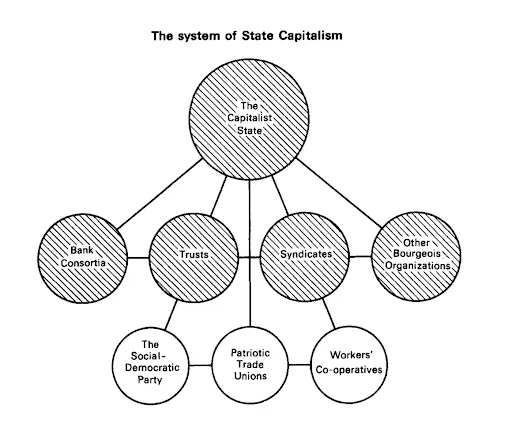
In this context, Bukharin argued that Western capitalist elites were increasingly turning to the “mailed fist of state power” - using the state as a tool to coordinate their activities, ameliorate competition and crises domestically, and strengthen their competitiveness relative to other capitalist powers on the world market.[15] This was a necessity if capitalists wished to survive this competition and maintain profits. This included, in particular, utilizing tariffs to lock rival powers out of their domestic markets and thereby guarantee high profits domestically, and more generally, expanding militarism: the utilization of the state military to increase capitalists’ colonial holdings, defeat rival powers, and conquer new markets and resources across the globe, which Bukharin and others in the socialist movement marked as the key driver of the First World War.[16] In this sense, Bukharin tied the Marxist concept of imperialism to state capitalism.
This process also included the growth of direct state involvement in the economy itself. This included an increase in both state investment and regulation to prevent financial crises, including by managing demand and propping up failing industries, and to promote technological development. It saw increasing direct state ownership of industries, the growth of the “mixed enterprise” - partnerships between state and private capitalists and the use of the state to pull together large combines of private capitalists into big monopoly companies: “state capitalist trusts.” These thereby acted to organize the “anarchy” of the domestic market, monopolize industries, extract super profits for their capitalist owners and in turn increase competitiveness on the world market.[17] This involved an increasingly significant role for central banks to fund and manage this process, leading to finance capital becoming fused with the state.[18]
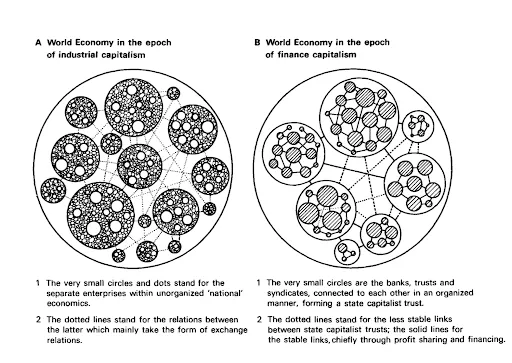
Increased militarism and war further intensified this trend towards state organization of the capitalist economy.[19] State direction and involvement were necessary to organize military conflict and stabilize and protect supply lines from rival capitalist powers in wartime. State finance was necessary to fund it and guarantee continued investment in firms where private capital might balk at the risks of war. State regulation of competition and consumption through enforced monopolies, norm setting, and rationing was necessary to prevent market crises that would destabilize the domestic economy and social fabric and undermine the war effort. The rise of conflicting Imperial economic zones excluding non-domestic capitalists via tariffs and military would further shrink the market available to rival capitalists and thereby intensify the trend to monopoly and conflict.[20]
To help pursue this conflict and competition, state capitalism became increasingly authoritarian, intervening to discipline labor by utilizing the power of the military and police to crush workers’ movements, strikes and protest.[21] It restricted workers’ rights and forced unions into a position of dependence on the state and fused them into the apparatus of business.[22] State capitalism turned socialist parties and trade unions into “a simple appendage of the state apparatus” - corporatist bodies and shop unions increasingly subservient to capital, infected with jingoism and "yellow social democracy” and actively participating in suppression of wages for the benefit of the national ‘war effort’.[23] All this operated in order to lower labour costs and maximise the competitiveness of domestic industry on the world market and thereby industry profits. The resulting suppression of wages generated problems of underconsumption within the domestic state capitalist economy.[24]
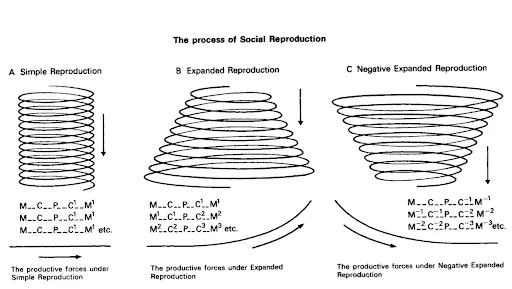
Long term, however, the rise of state-capitalist competition threatened the whole system. Bukharin argued that whilst in the short term, military violence can be profitable for certain sections of capital, in the long term rampant military conflict between state-capitalist powers would destroy capitalist industry and production networks and absorb larger and larger quantities of capital, commodities and workers in the unproductive pursuit of war. This he termed ‘Negative Expanded Reproduction.’ The increasing costs of conflict would squeeze the working class and intensify class conflict, and as a result capitalism would be weakened, and workers increasingly encouraged to challenge it; the mass conscription and militarisation would give them the weapons and training to do so.[25] Ultimately socialism would emerge from the destruction of state capitalism.[26]
Why didn’t capitalists just form international agreements and avoid this destructive conflict? Bukharin theorized that whilst intensified competition and conflict might give an incentive to state capitalist powers to fuse into one central organizing body to ameliorate conflict, this could never last long term because of the dynamics of uneven capitalist development.[27] Against contemporary Marxist Karl Kautsky’s ‘ultra-imperialism’ theory that capitalism had a tendency towards just such a peaceful universal capitalist state, Bukharin instead declared that the fundamentally uneven nature of capitalist development would make such a world state (whilst possible in theory) impossible in practice.[28] Because capitalism necessarily developed at different rates in different countries, the most developed countries would always organize the global economy in their favor to the detriment of their rivals, and developing capitalist states would always come up against this and have a strong incentive to fight it. There could never be a long-term situation in capitalist development in which a number of powers were equally powerful and balanced enough economically and militarily to facilitate such a fusion:
Comparative equality of positions in the world market is the first condition for the formation of a more or less stable compact. Where there is no such equality, the group occupying a more favourable position in the world market has no reason for joining a compact: on the contrary, it sees an advantage in continuing the struggle, for it has grown to hope that the competitor will be defeated.[29]
In other words, stronger capitalist states will always have a strong incentive to maintain their dominance if they have any edge over their rivals because of the profits of and their preexisting structural dependence on such a policy. Moreover, the less developed nations, as they develop, will necessarily come into conflict with the global market economy organised by the stronger states because
The stronger state secures for its industries the most advantageous trade treaties, and establishes high tariffs that are disadvantageous for the competitors.[30]
Weaker developing states in turn would also always be inclined to project forward to a possible future world in which they may be able to claim hegemonic status and therefore would be inclined to compete and conflict with stronger rivals on this basis.
The "national" groups of the bourgeoisie build their plans not only on what "is" but also on what "will probably be." They take into strict account every possibility of development which may allow a certain group to become superior to all the others in due time.[31]
Even if two powers were to become entirely equal economically, the older power would likely possess an accumulated, preexisting military edge that would encourage them to continue the competitive struggle.
Even where there are relatively equal economic structures, but the military powers of the state capitalist trusts differ considerably, it is better for the stronger to continue the struggle rather than to enter into a compact or to merge with the others.[32]
Even if somehow such a fusion were to occur, long term it would be unlikely to last because any minor redistribution of capital across the global economy or shift in market conditions or uneven development of any region of the global capitalist economy (or even the prediction or possibility of such a development) would likely cause such an alliance and fusion of capitals to collapse into conflict.
Everyone acquainted with the history of the struggle among cartels even within the boundaries of one country knows how often, when the situation changed, when the market conditions changed, agreements dissolved like soap bubbles.[33]
For Bukharin, the idea of global capitalist unity is premised on a fundamental impossibility - an eternally even capitalist development. In truth, conflict was bound to intensify to such an extent that capitalism would destroy itself and be replaced by socialism.
Crucially, Bukharin clearly distinguished state capitalism and its state ownership and involvement from socialism and socialist state control under the NEP. Where the NEP’s workers state was defined by workers’ control and direction, state capitalism entailed the dominance of capitalists and capital over positions of power in the state and state industry. Where under socialism there was a steady expansion of workers-state control over the economy, state capitalism saw rather a shift in the organisational form of capitalist dominance.
By no means do we see here a new structure of production, i.e., a change in the interrelation of classes; on the contrary, we have here an increase in the potency of the power of a class that owns the means of production in quantities hitherto unheard of. To apply to such a state of affairs a terminology fit for post-capitalist relations, is not only very risky, but also highly absurd.[34]
Whereas the NEP would see an increasing move towards equality and an orientation towards production for social benefit, state capitalism was defined by the maintenance of stark inequality and pursuit of profit for the state-capitalist elite.[35] Under state capitalism the state itself became a giant corporation, run by a new type of capitalist, the state ‘verbandkapitalist’ or ‘syndicate capitalist’, who subsisted on and extracted the profits of state industry for their own benefit.[36]
On this basis, Bukharin criticised Lenin’s conception of the USSR under the NEP as in some sense containing both a socialist and a ‘state capitalist’ element.
State capitalism under the dictatorship of the proletariat-this is an absurdity, soft-boiled boots.[37]..."Noncapitalist capitalism"- this is the height of confusion[38]
For Bukharin, NEP and state capitalism had two utterly distinct logics and structures and were two distinct phases of historical development. An economy could not be both capitalist and socialist simultaneously. It was one or the other. It was either controlled by the working class and oriented to its needs or not.[39]
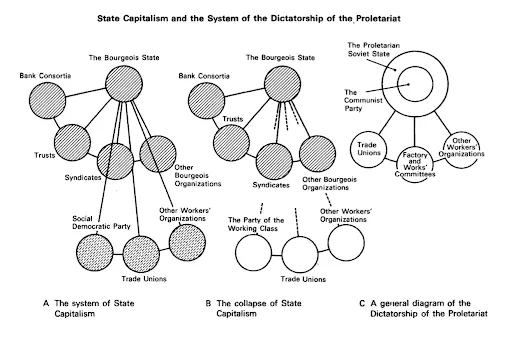
Bukharin’s model of state capitalism illustrates the logic of China’s economy far more clearly than the NEP. In China we have a large and powerful state bureaucracy and industry, both of which are structured like capitalist enterprises oriented overwhelmingly towards growth and profit on the world market and minimizing cost.[40] The party state is controlled at the top by a combination of the owners and managers of private capitalist industry and the directors and leading officials of the marketized state and its industry. State officials work in tandem with private capitalists to extract as much wealth as possible for themselves via salaries, bonuses, kickbacks and state asset sell-offs.
China’s state capitalism has emerged in a context of increasing multipolarity, competition and conflict over the world market with rival capitalist powers - including most notably the US. This globalization process has brought about an attendant financialization that has provoked financial crises of increasing intensity. China’s state financial system has proven more adept than Western states at managing the resulting market anarchy.[41] Notably, as Illias Alami, Adam Dixon and Thea Reafrancos emphasize, the US and European states have responded by expanding their own state capitalist capacity and locking China out of their markets to compete with its state capitalism in much the manner predicted by Bukharin.[42] China has in turn responded by placing its own reciprocal tariffs on the US and allied powers and expanding its military apparatus. It has placed limits on imports of products and the purchase of services from the US, Canada, and Australia in the last few years. Most recently, it initiated a series of export controls to lock the US and European powers out of its key supply chains and easy access to its AI, solar panels, and key minerals.
To help maximize Chinese corporate profits and competitiveness on the world market, the Chinese state works to limit welfare support to the bare minimum, and Chinese corporatist unions limit workers' power on the shop floor. This limits working-class wealth, which results in a widely acknowledged underconsumption and overcapacity problem.[43]
Challenges
Nonetheless, there have been significant challenges to both Bukharin’s theorization of state capitalism and its use as a designation for the PRC.
Bukharin has been critiqued for suggesting that capitalist states invest in and develop the markets of the countries they dominate. Dependency and World Systems Theorists like Immanuel Wallerstein and Samir Amin have suggested that the history of Imperialism has instead been purely one of raw material extraction for Western industry, which has tended to ‘underdevelop’ non-core nations and thus reinforce the subordinate position of non-Western states in the global economy. In this sense, the only way for the colonized nations to become developed is for them to overthrow these colonial regimes and become socialist.[44] Many of these theorists have thus viewed China as continuing down a socialist path by virtue of its developmental success and its investments in and development of the industry of other non-Western states.[45]
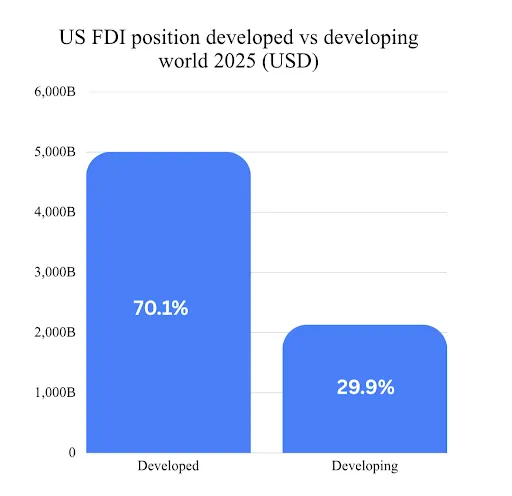
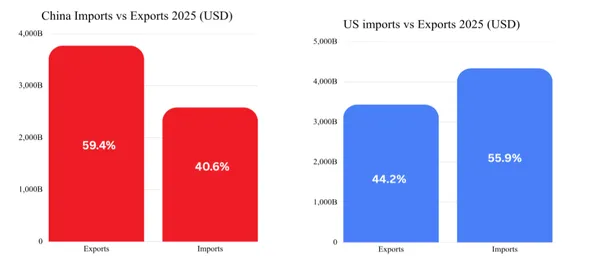
In a similar vein, theorists of ‘New Imperialism’ have critiqued Bukharin for suggesting that the motor of the expansion of global capitalism and ultimately state capitalism is the oversaturation of domestic markets with capital and goods that thereby have to be invested or sold to undeveloped countries. David McNally, Leo Panitch, and Sam Gindin have pointed out that capital and goods are largely exported to other developed economies, not to the undeveloped, and that many of the leading developed imperialist nations are net importers.[46] The US, for example, is a net importer, importing $4.33 trillion by comparison to $3.43 trillion exports in 2025, and holds $5 trillion of Foreign Direct Investment (FDI) in the developed world by comparison to only $2.1 trillion in the rest.[47] Historically, they also argue that state capitalist development has typically occurred in contexts where domestic markets are not oversaturated and are continuing to expand and develop.[48]Indeed, some, like Bill Warren, suggest the complete opposite dynamic predominates, with Western capital driven to seek out global markets to secure raw materials precisely to meet the needs of its rapidly expanding domestic market.[49]
They have also criticized Bukharin for suggesting that state capitalism and imperialism lead to the formation of national blocs of capital engaging in armed conflict with one another and forming formal colonies to lock each other out of their markets. David Harvey, Ellen Meiksins Wood, and Panitch and Gindin point out that instead the post-war economic order has seen a period of internationalization of capital through multinational corporations, the hegemony of one capitalist state, the United States, over the capitalist world via its financial system, and a period of peace between it and other Western capitalist states under its banner.[50] It has also seen the end of formal colonialism and war between developed nations, with military conflict instead largely between the US and less developed peripheral nations that in any way attempt to challenge its hegemony. These theorists see the modern economy as much more in line with the ‘ultra-imperialism’ thesis Bukharin and Lenin so aggressively critiqued, one in which the great capitalist nations would unite into one bloc to dominate the global proletariat.
Open Marxists have critiqued Bukharin for his theory of the state. Alex Sutton has suggested Bukharin adopts a fractional theory of the state that suggests state capitalism sees a section of capital seize control and direct the nation towards imperial expansion and inter-imperialist conflict against the interests of other capitalist fractions.[51] They instead argue that the state operates as a more autonomous unit that, rather than being directed by one fraction of capital, is instead driven structurally to support the development of capitalism because it relies on it for its own survival and revenue.
Finally, Bukharin’s periodization and stadial history of state capitalist development have been significantly challenged.
Mike Macnair questions Lenin and Bukharin's framework's depiction of the early development of capitalism in relation to the supposed high point of ‘state capitalism’ in the early 20th Century they were describing. He points out that both adopt an image of early capitalism as a location of open competition, domestically oriented production, and less state involvement in the economy. However, capitalists and the developing capitalist state have always been highly engaged in international trade, and the state and monopoly corporations have, in many instances, from the beginning of capitalism to the present, been significant factors in its organization.[52]
David McNally questions to what degree Bukharin’s theories can apply to the more recent history of capitalism. Bukharin’s deterministic assertion of State capitalism’s inevitable, unstoppable intensification on the global level and its eventual replacement by socialism is impossible to defend given both the defeat of socialism globally and the rise of neoliberalism and privatized capitalism within the West since the 1970s.[53] Open Marxist theorists like Sutton have gone one step further, however, and rejected even Bukharin’s notion of ‘stages’ of capitalism. Instead, he argues capitalism is one global historical system and that what Bukharin describes is merely the regular activities of the state.[54] Moves towards state direction of capital or away from it are merely autonomous strategies adopted by capitalist states at their own discretion in different economic contexts to maintain themselves and capitalist production within and beyond their borders.
In turn, many argue Bukharin's theories of state capitalism and imperialism also cannot be applied to China specifically.
Critics have highlighted that State Capitalism in socialist theory is typically associated with a stagnant and uncompetitive domestic economy, which China does not exhibit. Bukharin and other classical Marxist theorists of State Capitalism tend to suggest that as the state takes over and monopolizes larger and larger portions of the economy, the domestic economy ceases to be competitive and dynamic. However, China has a marketized state industry with state officials overwhelmingly focused on growth and profit. It also possesses a productive and dynamic private capitalist industry that includes being a world leader in several modern industries like the EV market and solar panel production, and has developed major rivals to US AI in DeepSeek.[55] Indeed, Brewer has questioned whether uncompetitiveness domestically in the way Bukharin describes has ever been a dominant feature of any capitalist economy.
Carlos Martinez, Deborah Brautigam, Jason Hickel and others question how China can be categorized as imperialist, militarist or extractivist in the form Bukharin defines a state capitalist economy. They point out that China has dominated international markets without military conflict and lacks formal colonies in the manner of 20th-century capitalist states, and stress the non-coercive nature of its capital export, emphasizing the lower interest rates and minimal conditions attached to Chinese loans relative to the financial institutions of US capitalism. They also highlight how these loans fund the development of the industry and transportation systems of less developed countries in Africa, Latin America, and Asia, supposedly in clear contrast to Western imperialism. In turn, Martinez, Hickel and co. emphasize that in per capita terms, Chinese economic and military power is not on a par with Western States, with GDP at an upper-middle-income level and military spending below the world average. Similarly, they emphasize how Chinese FDI outflows, in per capita terms, are only on a par with states like Italy. They suggest that China does not engage in the extraction of resources or exploitation of labor in these countries, merely trading in a fair and mutual way. Finally, Martinez and Hickel also emphasize that China’s military buildup is still far off that of the US and that it possesses only a few military bases by comparison to the US’s 750.[56]
Finally, Bukharin's theorization of the transition to state capitalism has also been criticized for failing to match China's trajectory. China has of course moved from greater to lesser state ownership, not from market to state ownership.
In Defense of State Capitalism
Whilst some of these criticisms are useful, many misread Bukharin's writing, and none fundamentally undermine the model or its applicability to China and the wider contemporary capitalist system.
Theorists who criticize Bukharin for his emphasis on capital and goods export over raw material extraction miss the mark. Bukharin is clear to emphasize that one of the main, if not the main, drivers of imperial expansion of the capitalist economies was to secure raw materials in strategic industries. He marks it as one of three central drives for capitalist expansion, saying
We have laid bare three fundamental motives for the conquest policies of modern capitalist states: increased competition in the sales markets, in the markets of raw materials, and for the spheres of capital investment.[57]
Indeed, he explicitly frames this drive for raw materials as being necessitated by the faster development of industrial production relative to agriculture and other raw material sectors, necessitating the securing of these resources from abroad.
We have in mind the disproportion between the development of industry and the development of agriculture as a source of raw material for the manufacturing industry. The latter requires greater and greater volumes of raw materials…which plays a colossal part in all phases of industrial life.[58]
In this sense, he is in no way in fundamental disagreement with either World Systems or New Imperialism theorists here. Where Bukharin departs is that, like Marx and most other classical Marxist theorists of imperialism, he did not believe it impossible that the export of capital to undeveloped countries would lead to the development of non-Western capitalist powers. The history of Japan, South Korea and China (amongst others) should bear him out on this. Indeed, as we have seen, this dynamic was part of what Bukharin identified as the necessary driving force of inter-state conflict. Capitalist development could never be balanced enough to ensure eternal stability or an end to competition.
Similarly, those who raise the fact that domestic markets are not saturated and more capital is exported within them than to undeveloped ones as disproving the theory also misunderstand Bukharin’s framework and his periodization of the development of state capitalism.
Bukharin theorizes the steady development of the state capitalist economy out of the intensification of competition over the world market. It is only in the latter stages of state capitalist competition that Bukharin suggests developed markets will be more isolated from one another. In the initial stage of that process, Bukharin's theories in no way correspond to the critiques leveled at him.
Bukharin does not suggest that markets have to be fully saturated for capitalist economies to export abroad. He explicitly says that it is
not the impossibility of doing business at home, but the race for higher rates of profit is the motive power of world capitalism.[59]
He merely suggests that in certain contexts - either due to lower labor costs in such areas, the relative unproductivity of local manufacturing, or cheaper access to key raw materials - capital flows to undeveloped regions to secure a higher rate of profit through trade with or production in these economies. Securing this higher rate of profit is a necessity for capital lest domestic capitalists fall behind domestic and international rivals. It seems clearly correct that these are some of the main drivers of developed capital export to undeveloped markets.
Moreover, Bukharin also does not suggest that capitalist economies necessarily must be net capital exporters at first either. His main contention is solely that capital accumulation and growing industrial productivity will tend to encourage the seeking out of new markets and more profitable investments abroad; relatively uncontroversial assertions.
Bukharin is somewhat ambiguous on the question of whether the primary site of export is likely to be undeveloped economies initially. He does remark that
the more developed the country, the lower is the rate of profit, the greater is the "over-production" of capital, and consequently the lower is the demand for capital and the stronger the expulsion process. Conversely, the higher the rate of profit, the lower the organic composition of capital, the greater is the demand for it and the stronger is the attraction[60]
This could certainly be said to imply that he believed it likely more capital would always be exported to the underdeveloped world than the developed. However, elsewhere he analyses in some detail the greater volume of capital in his own time flowing from the British Empire to America and its developed colonies and in turn the high volume of US and German capital flowing into Europe and the US as a central element of the developing state capitalism of the early 20th century.
Regardless, it does not seem that the fundamentals of Bukharin's theory depend on this being the case. All that matters for the core of his argument is that the most productive capitalist states are the most significant exporters of capital abroad and that foreign markets - either within the developed or developing world - are significant enough to these states to promote competition and conflict between them. Both of these seem hard to dispute. China and the US are the two largest economies on earth in GDP terms and the largest and second largest exporters, exporting $3.78 trillion and $3.43 trillion respectively in 2025. They are also among the largest holders of FDI, with the US holding the most at $7.14 trillion and China the third most at $3.5 trillion.[61][62] Moreover, in the last 5 years, as heightened competition has led to both countries placing restrictions on foreign states holding assets in their countries, net flows have shifted in both states from net inflow to outflow, making FDI export increasingly significant. China and the US compete intensely over the supply chains of raw materials and key minerals like Lithium, Copper and Cobalt.[63] Export markets are clearly hugely important and profitable to both states.
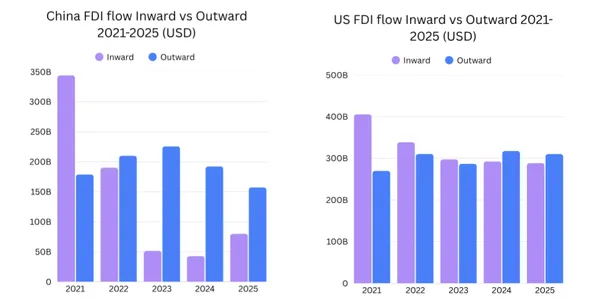
As Bukharin argued, it is the most productive capitalist states that are the largest exporters of capital, precisely because their greater productivity means they possess more of it to seek out profitable investment and more industrial demand for raw materials, and significant competition has been prompted between them as a result. Even with a minor adjustment here, we can retain the key elements of Bukharin's theory.
In any case, the image of developed capitalist nations exporting primarily to the developed world and cutting one another out of their markets is Bukharin’s prediction for the end result of state capitalist development, not the start.
Bukharin argues that as capitalist powers' competition over natural resources and markets intensifies, both within domestic markets and externally, the state and capitalists will tend to fuse together in order to organize this intensified competition and dominate one another. This only requires initially that international markets (of all types) are significant for leading capitalist economies. It does not necessitate that these powers must be net exporters or that this competition must solely or largely be over undeveloped markets.
As this process intensifies, however, Bukharin predicts these state-capitalist trusts will increasingly turn to tariffs and war to defeat one another, resulting increasingly in attempts to lock each other out of domestic markets and in turn intensifying competition over undeveloped markets. It is in this context of conflict that we should expect to see evidence of a decline in investment between developed capitalist states.[64]
These criticisms of Bukharin's theory take the endpoint of his theory as proof of its inadequacy to describe the present. However, we are only just starting to see the development of the dynamics described by Bukharin as the starting point of state capitalist development: intensifying market competition, expanding state capitalism and a resultant rise of tariffs and military tension. In short, we are at the start of Bukharin's theory, not its end point.
Similarly, whilst critics have raised the lack of formal colonies and conflict between developed capitalist states in the modern capitalist economy, Bukharin also does not argue that these are necessarily a characteristic of the initial stages of state capitalist development. Whilst Bukharin was writing in a context in which capitalist powers were engaging in formal colonialism, he marked this only as one potential method for capitalist domination over crucial international markets. Bukharin saw it as the archetypal method by which Western capitalist states expanded the global market in his time largely because of the resistance of undeveloped regions to incorporation into the world market (or their lack of markets or states to speak of) and the intense competition between developed capitalist powers over these markets and resources. In the modern day, capital has fully encompassed and marketized the globe, and there are few states that resist subordination to developed capitalist states. Those that do (like Venezuela, Cuba, Iraq, Iran) are brutally attacked by the United States.
As competition intensified, however, Bukharin expected both formal colonialism and war to intensify. Rival developed capitalist powers, in the context of competition, were expected to form more isolated economic zones that locked each other out of their respective markets and tightened their grip over their colonial markets in an attempt to dominate one another. In this sense, we should only expect to see the development of more formal colonialism in the modern day either in the contexts in which undeveloped states intensely resist exploitation or extraction of resources by developed states or when developed states are engaged in intense competition, tariff conflict, and war over said markets.
Bukharin’s theorization of the state is also not as fractional as Sutton suggests. He does not argue that finance capitalists have ‘captured’ the state and tooled it for their own interests. Instead, Bukharin’s argument is that finance capital is a stage in capitalist development brought about by intensified global market competition - the logic of which has transformed capitalist relations and the nature of the state. In his words,
the interests of the state and the interests of finance capital coincide more and more. On the other hand, a maximum of centralisation and a maximum of state power are required by the fierce competitive struggle on the world market. The latter two causes on the one hand, and fiscal consideration on the other, form the main factors making for state organisation of production within capitalist society.[65]
This is not a process of ‘seizure’ by a specific fraction of capitalists. Rather, the state and private capital are conceptualized as separable factors brought together due to an alignment of interests prompted by the intensified competition of the market. Indeed, there is as much of a sense of the state as organizing this process and the fusion with domestic capital as there is of an internal ‘occupation’ or ‘hijacking’ of it by bourgeoisie.
Economic revolution, fortified at this point by the war, must and does lead to a situation where the bourgeoisie as a whole is more tolerant regarding monopolistic interference of the state power.[66]
If anything, the state is the active element here. Capitalists are presented as sacrificing or relinquishing their right to autonomy to the state within the state capitalist system in return for gaining profits through it. The state bank itself is presented as the leading director of the state capitalist production system
The central banking institute of the government thus becomes the "golden head" of the entire state capitalist trust.[67]
Bukharin certainly highlights the influence of the ‘big bourgeoisie’ of industrialists and finance capitalists over and within the state bodies themselves, both in terms of interpersonal connections and institutionally via state banks, monopolies and other state bodies. However, this seems self-evidently true. The interpersonal and institutional influence of capital over the state, throughout the history of capitalism, the revolving door between private corporations and state bodies, historically and in the present, is clearly in evidence in both the US and China.[68] In so far as they minimize this, Open Marxist and structuralist readings of the state miss a crucial part of the picture.
Where Bukharin really departs from Open Marxism is in his theorization of how the development of state capitalism transforms the nature of the capitalist state and its relation to capital. He argues that the transition to state capitalism will tend to reduce the separability of the state from capitalist production. Rather than the state simply enabling or facilitating the flow of private capital as in other capitalist forms, Bukharin argues that state capitalism will increasingly see it directly organize capitalist production itself. The state becomes the capitalist-trust. In such a world, Bukharin's state capitalist state resembles less the structuralist or Open Marxist readings. But this is to its strength. In China, for example, what autonomy exists for the state from capital accumulation given the fact that state industry and state bodies themselves are thoroughly marketized, and the party itself is dominated by state and private capitalists?
The most useful critique of Bukharin's theory is that of its stadiality and periodization. Bukharin certainly does suggest that state capitalism is a distinct ‘latter’ stage in the development of capitalism and is, largely, wedded to a deterministic account of socialism's inevitable triumph after the state-capitalist epoch. Such a framework minimizes the significance of capitalist monopoly and state involvement at different points in its development and seems somewhat ridiculous 100 years on from when it was written, in a world in which the socialist projects Bukharin was involved in have failed, and capitalism is dominant everywhere.[69]
However, rejecting this deterministic teleology does not necessarily mean rejecting stadiality - at least in the sense of a distinct organizing logic. Capitalism has throughout its history seen periods of more intensive involvement of the state in the organization of production, and those have tended to have both been seen, in some form, across all leading capitalist states and simultaneously to have facilitated and been reinforced by more intensified competition and conflict.
Rejecting stadiality or periodization entirely prevents us from distinguishing state-organized capitalism from more private forms. It prevents us from identifying the distinct scale and intensity of state involvement in the economy it precipitates, its reorganization of capitalist life, or its competitiveness and militarism by comparison with other periods of capitalist development. It also prevents us from understanding or even investigating why certain periods in the history of global capitalism have seen the development of it and the adoption of its structures, and what the impacts of this reorganization are on capitalisms organising logics, structures and class relations. Retaining the concept of state capitalism as a form of capitalism brought about by specific contexts in global market development and entailing a specific organizational logic should be possible without necessarily implying socialism as the inevitable endpoint. Equally, it should be feasible without rejecting the possibility of state-capitalist transition or dissolution into less state-organized forms.
Ultimately, by abandoning the linear teleology of Bukharin’s original account, we can retain its key insights. Rather than viewing state capitalism as a definitive, last stage of capitalism on the road to socialism, we can instead understand it, in Alami and Dixon’s frame, as an “immanent potentiality” or tendency in modern global capitalism that emerges with increasing strength in specific contexts of challenge, multipolarity or crisis, but which tends to relax or be reversed in times of hegemonic stability.[70] State capitalism is the form capitalism takes in a multipolar context in which capitalist states are threatened by rival capitalist or socialist polities. The key drivers that Bukharin identifies are still present, even if the guarantee of a socialist future is not.
Here we can strengthen Bukharin’s theory through a synthesis with the work of Giovanni Arrighi. The intensification of state capitalism can be marked as a key feature of global capitalism at the point of hegemonic breakdown or challenge in the financialization stage of the cycle of accumulation Arrighi analyzed.
In his work The Long Twentieth Century, Arrighi suggests that the history of capitalist development has seen 4 distinct hegemons (Genoa-Spain, the Netherlands, Britain and the US) which have each managed an initial commodity-based expansion of capitalist production followed by a financialization and contraction as capital accumulates and profit rates decline.[71] As each cycle of accumulation reaches its “autumn” phase, he argues there typically follows a period of intensified competition and military conflict between rival capitalist states and the existing hegemon over the tightening markets of capitalism as it reaches its geographic limits, after which the new hegemon - the most powerful capitalist state - reorganizes capitalism and unleashes a new round of global capitalist accumulation. This autumn phase describes many of the same dynamics analyzed by Bukharin in the early 20th century.
Arrighi does not note an expansion of the state in the period of hegemonic decline as an element of his theory.[72] However, we can see state power and involvement in the capitalist economy expanding in tune with the cycles of hegemony he identifies. I will attempt a short sketch of this here. Historians like Marjolein ’t Hart, J. Glete and Arrighi himself have noted the significant expansion of state involvement in the context of intensifying competition and conflict of the late 16th to early 17th centuries - the period Arrighi marks as the twilight of the Genoese-Spanish cycle of accumulation and rise of the Dutch. Indeed, in this period the Dutch pioneered new expansive state forms in their revolt against Spanish rule and wars over trading routes, including new state-managed systems of taxation, debt management, and military organisation (including the rise of standing armies) alongside the spread of state-backed and administered monopoly trading companies: the Dutch VOC and WIC and British EIC.[73] After a brief period of relative peace and reduction or stabilisation of the involvement of the state during the expansion of the Dutch Golden Age in the mid-17th century, the late 17th to 18th century waning of Dutch hegemony saw an intensification of competition and conflict. The rising hegemon of Britain pioneered a return to more intensive state involvement in the economy in its competition and war with first the Dutch and then the French in what Sven Beckert calls the era of “war capitalism.” This included the development of an intensified mercantilist trade policy and what John Brewer terms the “fiscal-military state”, which spread across Europe in this era.[74] There is broad historical consensus that competition and conflict between these leading capitalist states were the prime motor of state expansion in this period.[75] As Britain assumed hegemony and initiated a new round of huge industrial and commercial growth, there followed another period of relative relaxation of state involvement over the 19th century, including reductions in taxes, duties and monopolies in the classical era of “laissez-faire.”[76] This was finally followed by the rise of the first true “state capitalism” that Bukharin analyzed in the early to mid-20th century, which emerged as British hegemony declined and as the US claimed hegemonic status and overcame all its European rivals.[77] The relative relaxation of state involvement in the leading capitalist states in the context of neoliberalism since the 1970s and the triumphant hegemony of the US over global capitalism is of course fairly well established. In other words, we see an expanded role for the state in this crucial phase of hegemonic decline, competition and reordering of capitalism. By combining Bukharin and Arrighi’s insights, we can get closer to a theory of the cyclical development of state capitalism over the global history of capitalist expansion.
Moreover, whilst we should dismiss the straight line Bukharin draws from non-state organized capitalism to state capitalism to socialism. His teleology is partially correct in three key ways. Firstly, it asserts the tendential intensification of state power and involvement in the economy over time under capitalism as and when it does emerge. Bukharin argued this was a tendency in capitalist development brought about by its drive to increase productivity, and this seems hard to dispute. The intensity and breadth of Chinese state power and control over the economy is far superior to that of the Imperial powers of the First World War, which in turn was on a far greater scale than that of the fiscal-military, mercantilist states of the long 18th century. When the state capitalist impulse does emerge, it is each time more powerful and reaches more deeply into the economy. Moreover, Bukharin is right to say that true ‘state capitalism’ as he theorizes it, as a force that intensively organizes and monopolizes domestic economic life, is first produced, made possible, and necessitated by the modern industrial and commercial expansion of 20th-century capitalism that he analyzed at the twilight of the British and rise of US cycle of accumulation.
Secondly, Bukharin's theories on the relation between uneven development, capitalist conflict, and state capitalist development also have something to recommend them. If they do not make state capitalism a permanent inevitability, the last 40 years do suggest that long-term conflict and the development of state capitalist relations are periodically encouraged by uneven development. The unprecedented global unification of capitalism under US hegemony and the global spread of its capital have directly led to the development of a capitalist China which has come up against and challenged a world economy and trading system organized in its favor, facilitating conflict. The US retention of a minor advantage, particularly militarily (as Bukharin predicts), has made it all the more determined to maintain its hegemonic position and drive to conflict all the more intense.
Thirdly, whilst there is no guarantee of socialist victory, Bukharin was right to suggest that if socialism was to successfully challenge capitalism again, it would likely be a state capitalist form that it would face. The crisis in the capitalist system that a socialist challenge would both be borne out of and represent would no doubt encourage increased state direction and control within remaining capitalist territories to counter it.
State Capitalism in China
Having established the legitimacy of Bukharin’s theory of state capitalism, we will now defend its application in an understanding of modern China.
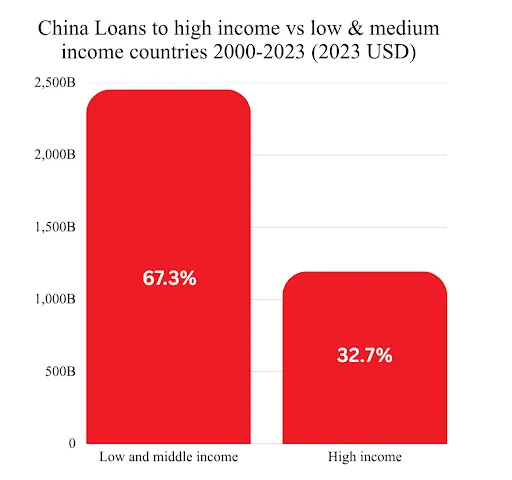
To begin, China’s foreign investments and loans are not as conditionless or non-exploitative as Martinez suggests. Whilst in certain contexts they are certainly lower interest than Western capitalist loans, they are still notably charged at interest, operating on a fundamentally capitalist logic. Where in the Mao era China’s capital export primarily operated through grants, Chinese foreign investment since the 1980s, as Martinez readily admits, has operated on a commercial basis. China exported $3.6 trillion in capital in loans from 2000-2023, $2.4 trillion to lower-income nations, all of which do yield interest.[78] This has resulted in large numbers of countries being in China's debt, giving it significant leverage over these states. Cuba, for example, is $3.17 billion in debt to China. Whilst Martinez emphasizes that China regularly restructures this debt rather than calling it in, it is not true to say it exacts no conditions from it. China has leveraged the debt it holds from Cuba to push for the opening of its market and the sale of industry to Chinese capitalists. Whilst there is little evidence that Chinese state officials have deliberately indebted countries in order to extract assets, as is sometimes alleged, it certainly has opportunistically utilized its debts to countries like Laos, Malaysia and Sri Lanka to leverage favorable treatment, access to contracts and sometimes state assets.[79]
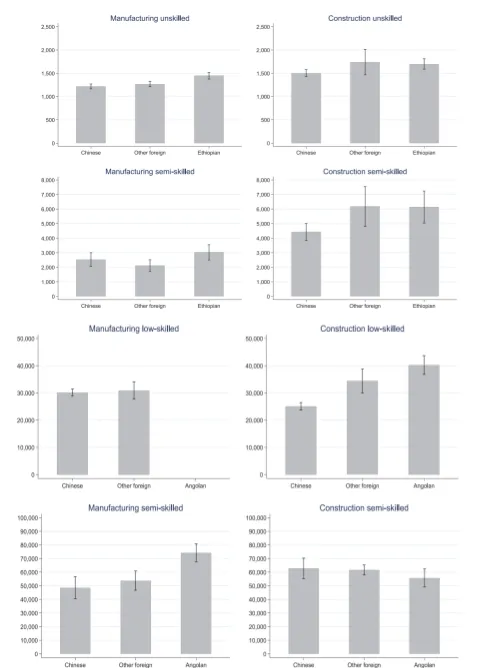
China also manifestly does export capital to exploit underdeveloped countries for cheap labor and resources. We have seen above China’s extractive practices in parts of Africa. In Mutoko and Hwange in Zimbabwe, Chinese firms have regularly bought up land at cheap prices for their coal mining operations, dispossessing local communities and damaging the local environment while providing minimal or no compensation to the inhabitants. The profits of such ventures flow primarily to Chinese capitalists and the local elites who support the process.[80] In Latin America and Africa, China is similarly focused on securing dominance over the extraction of key rare earth minerals like Cobalt, Copper, Lithium and Iron ore for its crucial electronics, green tech, and manufacturing sectors.[81] Chinese firms control 70% of the Congo's copper mines and almost all its Cobalt. These minerals are either impossible to secure elsewhere or are secured here more cheaply. Chinese firms in these industries have been consistently found to have focused on securing low-skilled, low-cost labor on insecure contracts in dormitory systems to minimize the risk of unionization.[82] Chinese companies routinely pay wages either at the same level or below that of other capitalist countries, well below those it would have to pay in China. Similar employment practices have been found in Chinese mines in Latin America. In the Chinese-owned Shougang Hierro iron ore mine in Peru, for example, workers are paid very low wages, at or below those of local and other international capitalist employers.[83] Huge environmental damage has been caused by these projects, including most recently, in 2025, the collapse of containment dams at Chinese cobalt and copper mines in Lubumbashi in the Congo and Chambishi in Zambia, which flooded local rivers and communities with industrial waste.[84]
China’s militarism is also ramping up in the context of tension with the US over markets. It is certainly correct to say that Chinese military power is not on the same scale as the US, nor is its conflict with other states. However, its increasing market conflict with the US has led to rising militarism - including raising military spending to $293 billion in 2021, expanding its fleet to 420 ships (the largest on earth), increasing construction of hypersonic missiles, and the establishment of military bases in Djibouti and Equatorial Guinea, with more expected in Pakistan and Sri Lanka. This has been followed by increasing assertiveness around Taiwan, with regular flights over the island and a greater deployment of ships in the area.[85] China has also flexed its muscles in territorial disputes with US allies such as the Philippines, Japan and South Korea.[86] China’s competition with the US is still primarily carried out through the market, including state attempts to carve out market zones through tariff wars rather than strictly military conflict. Nonetheless, as its economic power expands, direct or proxy wars with the US and other rivals are increasingly likely, as Bukharin predicts.
Tariff wars, however, are only partial sorties, they are only a sort of testing of the ground. In the long run the conflict is solved by the interrelation of real forces.[87]
China’s lack of formal colonies also does not mean it is not state capitalist or imperialist for the same reasons as the US above. Formal colonialism is not necessary for a state capitalist or imperial policy and, in any case, is most likely, according to Bukharin, in the context of inter-imperial conflict. This is a dynamic we may see in the future but shouldn't necessarily expect until such conflict intensifies.
Finally, the fact that in per capita terms China's economic and military power and exports aren’t at the same level as many developed Western states does not fundamentally affect the characterization of China as state capitalist. Global power is measured primarily in raw terms. It is in the real economic resources that China’s capitalist class and its state control, and the real military technology and manpower it can mobilize, that we should measure its power.[88]In these raw terms, China’s state capitalism is increasingly a match for the US and European states. It is the largest exporter on earth at $3.7 trillion (closely followed by the US at $3.4 trillion) and the third largest exporter of FDI. It is second only to the US in state income and expenditure and military power. This is far more significant for the structure and power of the Chinese state and for the nature of the global capitalist economy. Similarly, the fact that China clearly has developed a more market-oriented and dynamic state industry than Bukharin thought possible merely reveals what is already obvious: that state capitalism - certainly in China's context - can be more durable and strong than 20th-century socialists originally imagined.
Indeed, there is some evidence that Bukharin himself came to accept much of this towards the latter stages of his life and revise his theories. As the original socialist revolutionary wave abated in the 1920s and Bukharin observed the increasing stability and productivity of the state capitalist nations, he began to revise his dismissive attitude towards their dynamism and his certainty of stadial progression to socialism. Increasingly, he expressed a horrified fascination with the massive economic and technological growth of US and German state capitalism and its relative effectiveness at handling market crises.[89] This came with an increasing fear that it was more durable than he originally anticipated and a socialist future less certain.[90] This new form of state capitalism Bukharin termed the “second round”, a far more advanced and dangerous form than that seen in the First World War.[91] It is perhaps this form that best describes the current development of capitalism, in China and globally.
Of course, China's trajectory to state capitalism has not followed the same path that Bukharin described for the European imperial powers of the early 20th century. It has arrived at it through state ownership and a socialist project. Nonetheless, this doesn’t affect the core of Bukharin's theory either. China’s state capitalist structures have been born out of, influenced by, and proven effective in navigating competition on the global capitalist marketplace. Similarly, its competitive success has prompted its Western rivals to imitate these structures in all the ways Bukharin theorized. Just as rejecting rigid determinism can allow us to conceive of more privatized forms of capitalism emerging from state forms, we can also allow for the possibility of state capitalism emerging from socialist forms.
The application of this theory to the contemporary economy begs the question of what underlying process in capitalist development has led to the tightening of international markets and expansion of competition that is bringing it about. Traditional Marxist crisis theorists like Bukharin ultimately saw the prime motor as a tendency of overproduction within the capitalist core, rising organic composition of capital, and its uneven global development.[92] Likewise, Meiksins Wood has argued that as capitalism has reached the limit of its possible expansion, having encompassed the whole globe, it is leading to increasingly zero-sum competition over the existing markets, a concept readily synthesizable with Bukharinite theories.[93]Alami, borrowing from Robert Brenner, sees the root development of state capitalism as a product of a stagnating global economy brought about by manufacturing sector overcapacity.[94] James Meadway instead centers the early stages of the global climate crisis.[95]
Investigation into these explanations is not possible here, but it is also not necessary to fully adopt them in order to utilize Bukharin's theories. Regardless of its ultimate origins, his model of state capitalism and the dynamics of its development in the context of intensification of capitalist competition apply to and explain our contemporary moment.
State capitalism, as Bukharin described it, is on the rise. It is an undeniable fact of the modern global economy. State involvement and control over the economy is everywhere on the march, and China is at the vanguard of this process.[96] Since 2000, State-owned enterprises (SOEs) have massively expanded in scope, with assets increasing from $11 trillion to $43 trillion. Of the world's 2000 largest firms, SOEs represent 20% (doubling in the last 2 decades) and 50% of the top 10 non-financial firms. The number of State Sovereign Wealth Funds has grown six-fold in the same period, going from controlling $1 trillion worth of assets to $11 trillion today. Likewise, national development banks have increased in number and assets, with 900 globally controlling $49 trillion in assets.[97] We have here a definitive, global expansion of state monopoly and the ‘nationalising’ of capital led by, but not reducible to, China.
This has also clearly been associated with a rising militarism across the global capitalist economy. Military spending by the US, EU states, and China has all massively increased in the last 2 decades. The US state under Trump has proposed a massive 50% increase in an already bloated military budget from its current $901 billion to $1.5 trillion by 2027.[98] It has also formed new military alliances including AUKUS and the ‘Quad’ alliance, explicitly premised on ‘containing’ China. In turn, China has, in the last 3 years, increased its spending by 7% annually, to $277 billion in 2026 (with some estimates putting the true figure at $335 billion), with further significant increases planned until 2035, and strengthened its military alliance with Russia.[99] EU military spending has increased by 75% in the last 5 years, at about $454 billion, with the ReArm Europe plan aiming to leverage almost $900 billion by 2030 and a target of roughly 5% of GDP by 2030 amongst all NATO states.[100]
Contra Harvey, Panitch and Gindin, the idea that the US remains the undisputed hegemon is becoming harder and harder to maintain. China’s state capitalist economy is better suited to global market capitalist competition and financial anarchy for the reasons Bukharin identified, and as such it is in many areas outcompeting Western states and driving them to imitate China's structures. We are conclusively entering a world economy which mirrors the early 20th-century one Bukharin described, with China and the US in particular challenging one another for global dominance of the capitalist system. Tension is even growing between the US and its erstwhile ally/vassals in the European States over its economic and military policies. Tariff wars are accelerating as China and the US attempt to cut each other out of their markets and carve out economic zones. Military build-up is increasing, and open conflict is occurring with growing intensity. Whilst neither China nor other Western countries possess formal colonies in the 19th-century form, this does not affect the fundamental dynamics of global capitalism, with major capitalist centers competing to dominate global markets and extract resources from peripheral nations.
Crucially, these tendencies will likely continue to accelerate in the future. With the intensification of the climate crisis, the next 50 years are likely to be defined by increasingly muscular and authoritarian states attempting to manage natural disasters and refugee crises, secure key resources and markets, maintain capitalist production and suppress political challenges to their rule.[101]
Bukharin emerges as the theorist not just of China, but of our age. He provides us with a very clear and useful definition of state capitalism and the designation of capitalist relations to the state in the context of multipolarity and intensifying capitalist conflict. This model both describes China’s structure and the broader dynamics of contemporary global capitalism and distinguishes them from socialism.
It is certainly far more convincing as a description of the Chinese political economy than the NEP.
Conclusion
Bukharin’s writings clearly illustrate why China isn't socialist, or undergoing a NEP-style transition to communism. Contrary to how he is commonly invoked on the left, Bukharin’s conception of the NEP is very distinct from the economic structure of China, with its market, private industry and inequality far more limited and its state, worker and cooperative control far more significant. Most crucially, where Bukharin clearly marked out the imminent transition to a planned economy, China has no such emphasis or direction. Whilst Bukharin is often presented as representing an alternative, market form of socialism to the hegemonic Stalinist planning system of the 20th century, his actual thought illustrates an overwhelming continuity with the mainstream of Bolshevism.[102] This is not to dismiss the possibility of a form of “market socialism” in general, but simply to illustrate that neither China nor Bukharin’s thought should be characterized in this way.[103]
Instead, with some minor developments, Bukharin's theory of state capitalism provides a far more useful lens through which to analyze the nature of the Chinese state and the contemporary direction of global capitalism. His model is far clearer than many modern theorists, distinguishing state capitalism from either state involvement in the construction of socialism or the state's role in the development and maintenance of capitalism in general. It illustrates the key contours of China's economic structure - with its powerful set of state industry monopolies and large private capitalist sector oriented towards profit and the world market, its low domestic consumption and state suppression of worker movements, its increasing bellicosity, and its dominant coordinating state based on an alliance of private capitalists, managers of state and private industry, and military officials. Moreover, he shows why state capitalism has re-emerged as a form, both East and West, through the return of global competition and conflict between rival capitalist centers in our multipolar world.
Bukharin’s theories can also help clarify bigger conceptual and strategic questions for the left. In a context in which the NEP, socialism and state capitalism are used in contradictory and confused ways, his analysis can help distinguish them.
Bukharin provides a useful conception of socialism as a political-economic structure in which the state and industry are run by and democratically accountable to the working class, not a separate wealthy class of private or state capitalists, where the state directly supports socialism across the globe rather than suppressing it, and where it is oriented towards rapidly reducing inequality, replacing production for the market and profit with production for social benefit. Such an emphasis can help us to clarify what we are trying to build and what we are trying to overcome. As state involvement in capitalist production expands everywhere, it is crucial that we are able to distinguish this phenomenon from socialism.
In turn, Bukharin’s predictions about the developments of state capitalism can provide us a guide for the future direction of class politics in ways contemporary state capitalist theorists are yet to fully grapple with.[104] As his theories suggest, we should expect to see the continued rise of state involvement in and organization of capitalist production, both in China and across the globe, in response to intensifying conflict over markets between Western states and China and other imminent threats to capitalism like the climate crisis. Crucially, this rise of state involvement will not make these states ‘socialist’. Instead, this will likely entail a maintenance of capitalist relations of production and inequality, an increasing suppression of democracy and working-class movements, and rising militarism as states gear up for conflict.
Whilst we should dispense with his determinism, as Bukharin highlighted, the intensification of military conflict will in turn likely weaken capitalism in the East and West and open up challenges to its rule. The destruction of war and the process of expanded negative reproduction will likely cause severe strain to the capitalist profit system and leave it vulnerable to challenge. Alongside this, the attendant rise in the cost of living and the state’s militarised taxes on the working class - in the form of both money and military conscription - are likely to intensify class conflict and hand workers the weapons and training to challenge it. As Bukharin expresses it
Capitalism has increased the power of militarism enormously. It has brought to the historic arena millions of armed men. The arms, however, begin to turn against capitalism itself. The masses of the people, aroused to political life and originally tame and docile, raise their voices ever higher.[105]
The rise of the naked power of the state over production is likely to point to the feasibility of production organized by workers and in their interest.
a highly developed capitalist organism…makes the introduction of a planned course of social production possible[106]
In sum, globally the left should both anticipate and look to organize a class politics oriented towards and against militarism, imperialism and the state.
Finally, Bukharin should give pause to those on the left who suggest that China's model is something for us to draw on in particular. That the leading supporter of the use of the market in the Bolshevik project was nonetheless hugely concerned about its potential impacts and preoccupied with limiting it and any inequality it generated challenges the increasing numbers of the left who view it as a neutral institution easily mobilized for socialist goals or easily mastered by a large party-state. If it can be used, Bukharin provides a guide for both how it can and why it must be constrained. His emphasis on the vital importance of workers' control at the point of production and direct involvement in state governance as the key determinant of whether state control is socialist or capitalist should encourage us to prioritize this element as we attempt to build socialism.
Whilst China and the socialist project undertaken there is hugely valuable and must be learned from, it is chiefly in the negative. The increasing left fascination with it and attempt to use it as a ‘socialist success story’ speaks more to the lack of successful alternative leftist projects in the last few decades, which few have come to terms with. The failure of the Latin American Pink tide and social democratic projects across Europe has left many slightly desperately reaching around for something to give us comfort, mobilize us and provide direction. Pointing to Chinese capitalist development is easier than coming to terms with our political weakness and lack of clear strategy. However, abandoning this naive vision of China has positives. It helps us clarify what socialism is, abandon false illusions, and expand the horizons of socialism beyond the market. China is not coming to save us. We will have to do that ourselves.
Liked it? Take a second to support Cosmonaut on Patreon! At Cosmonaut Magazine we strive to create a culture of open debate and discussion. Please write to us at submissions@cosmonautmag.com if you have any criticism or commentary you would like to have published in our letters section.
-
See Bremmer, Ian. 2010. The End of the Free Market: Who Wins the War Between States and Corporations? N.p.: Portfolio; Kurlantzick, Joshua. 2016. State Capitalism: How the Return of Statism is Transforming the World. N.p.: Oxford University Press.
↩ -
Sperber, Nathan. 2019. “The many lives of state capitalism: From classical Marxism to free-market advocacy.” History of the Human Sciences 32 (3): 100-124. 10.1177/0952695118815553, 101.
↩ -
Bukharin, Nikolai I. 1982. “Toward a Theory of the Imperialist State (1915)” In Selected Writings on the State and the Transition to Socialism, edited by Richard B. Day. Armonk, New York: M. E. Sharpe Inc, 22.
↩ -
Alami, Ilias, and Adam D. Dixon. 2024. The Spectre of State Capitalism. N.p.: Oxford University Press, 31-3, 37-38, vi.
↩ -
Isteni, Vilen. 2026. “The Poverty of Terminology.” Cosmonaut. https://cosmonautmag.com/2026/06/the-poverty-of-terminology/; Alami and Dixon, Spectre of State Capitalism, 28, 31-3, 40-49. For a state capitalist account of the USSR see Cliff, Tony. 1974. State Capitalism in Russia. N.p.: Pluto Press.
↩ -
“Lenin: Imperialism, the Highest Stage of Capitalism.” 1916. Marxists Internet Archive. https://www.marxists.org/archive/lenin/works/1916/imp-hsc/#f1r.
↩ -
Sperber, “state capitalism”, 106; Cohen, Bukharin, 76.
↩ -
Arnold, Theryn. 2026. “Toward a Marxist State Theory of the Socialist Market Economy.” Cosmonaut. https://cosmonautmag.com/2026/04/toward-a-marxist-state-theory-of-the-socialist-market-economy/, Jabbour, Dantas, and Espindola, “New Projectment Economy”, Arrighi, Adam Smith in Beijing.
↩ -
These include, most significantly, ‘Towards a Theory of the Imperialist State’ in 1915, Imperialism and World Economy, 1917, The Economics of the Transition Period, 1921, New Forms of the World Crisis in 1928, and ‘The Theory of “Organized Economic Disorder”’ in 1929. Despite some revisions, the major contours of his theories throughout this period remained the same.
↩ -
Day, Richard B. 1982. “The New Leviathan: Bukharin’s Contribution to the Theory of the State and the Transition to Socialism.” In N. I. Bukharin, Selected Writing on the State and the Transition to Socialism. Armonk, New York: M. E. Sharpe, Inc., xxxiii-iv. Marx’s comments on the crucial phase of primitive accumulation within the development of capitalism and the role of the state in this can be found throughout Capital Volumes 1-3 and particularly in Marx, Karl. 1990. Capital: A Critique of Political Economy. Translated by Ben Fowkes. London: Penguin Books, 873-931. Engels provided a significant base for Bukharin from his work Anti-Dühring, which provides one of the early touchpoints for Bukharin’s generation of Marxists' conceptualization of state capitalism. Rudolf Hilferding's Finance Capital and its discussion of monopoly was the most recent major work Bukharin built on.
↩ -
Bukharin, Nikolai. 1966. Imperialism and World Economy. London: Martin Lawrence Ltd, 124. “The state apparatus has always served as a tool in the hands of the ruling classes of its country, and it has always acted as their 'defender and protector' in the world market; at no time, however, did it have the colossal importance that it has in the epoch of finance capital and imperialist politics.”
↩ -
Bukharin, Imperialism and World Economy, 83-4, 96-103.
↩ -
Arnold, Theryn. 2026. “Toward a Marxist State Theory of the Socialist Market Economy.” Cosmonaut. https://cosmonautmag.com/2026/04/toward-a-marxist-state-theory-of-the-socialist-market-economy/, Jabbour, Dantas and Espindola, “New Projectment Economy”, Arrighi, Adam Smith in Beijing.
↩ -
Bukharin, Economics of the Transition Period, 179.
↩ -
Bukharin, The Imperialist State (1915), 10; Bukharin, Platform of the Opposition, 115. Bukharin, Imperialism and World Economy, 124. “The more strained the situation in the world sphere of struggle—and our epoch is characterised by the greatest intensity of competition between "national" groups of finance capital — the oftener an appeal is made to the mailed fist of state power.”
↩ -
Bukharin, The Imperialist State, 16-19, 32, 158.
↩ -
Bukharin, The Imperialist State, 17, 20; Bukharin, The Politics and Economics of the Transition Period, 59-61; Bukharin, Organized Economic Disorder, 346-7. Bukharin, Imperialism and the World Economy, 170. “Capitalism has attempted to overcome its own anarchy by pressing it into the iron ring of state organisation. But having eliminated competition within the state, it let loose all the devils of a world scuffle.”
↩ -
Bukharin, Imperialism and World Economy, 41-2.
↩ -
Bukharin, Economics of the Transition Period, 178.
↩ -
Bukharin, Economics of the Transition Period, 74.
↩ -
Bukharin, Imperialism and World Economy, 128, “This is one of the main causes of the so-called crises of parliamentarism. Finance capital has consolidated almost all of its varieties into one "solid reactionary mass" united in many centralised organizations. "Democratic" and "liberal" sentiments are replaced by open monarchist tendencies in modern imperialism, which is always in need of a state dictatorship. Parliament at present serves more as a decorative institution; it passes upon decisions prepared beforehand in the businessmen's organisations and gives only formal sanction to the collective will of the consolidated bourgeoisie as a whole. 'Strong power' has become the ideal of the modern bourgeois.”
↩ -
Bukharin, Imperialism and World Economy, 160, “The workers are deprived of the freedom to move, the right to strike, the right to belong to the so-called "subversive" parties, the right to choose an enterprise, etc. They are transformed into bondsmen attached, not to the land, but to the plant”
↩ -
Bukharin, The Imperialist State, 31. Yellow social democracy was a contemporary form of French corporatist socialism that advocated accommodation with the bourgeoisie and opposed Marxian ‘red social democracy’ and its revolutionary emphasis. Yellow socialism subsequently became a pejorative term used by Bukharin and other Bolsheviks to describe all non ‘communist’ reformist socialists, including the Second International socialist parties.
↩ -
Bukharin, Platform of the Opposition, 112; Bukharin, A New Revelation, 174. For Bukharin, socialism did the opposite - generating mass consumption through wealth redistribution. See Bukharin, Organized Economic Disorder, 346.
↩ -
Bukharin, The Imperialist State, 170.
↩ -
Bukharin, Economics of the Transition Period, 180.
↩ -
Bukharin, Imperialism and World Economy, 133-43. This theory is most commonly associated with Trotsky in the form of “Uneven and Combined Development” and is sometimes even framed as an explicit foil to Bukharin and Stalin’s “socialism in one country”. However, the concept of uneven development (in some form) was fairly central to all the classical theories of imperialism, including Hilferding, Bukharin and Lenin. Nonetheless, Trotsky was certainly its most sophisticated and developed theorist. See Brewer, Anthony. Marxist Theories of Imperialism: A Critical Survey. Routledge, 1990, 111-113.
↩ -
For Kautsky’s theory, see Kautsky, Karl. “Ultra-imperialism.” Marxists’ Internet Archive, Marxists’ Internet Archive, https://www.marxists.org/archive/kautsky/1914/09/ultra-imp.htm.
↩ -
Bukharin, Imperialism and World Economy, 136.
↩ -
Bukharin, Imperialism and World Economy, 137.
↩ -
Bukharin, Imperialism and World Economy, 138.
↩ -
Bukharin, Imperialism and World Economy, 137.
↩ -
Bukharin, Imperialism and World Economy, 141.
↩ -
Bukharin, Imperialism and World Economy, 157.
↩ -
Bukharin, The Road to Socialism, 231-2; Bukharin, Organized Economic Disorder, 332-3. Bukharin drew up a distinct contrast between the NEP and state capitalism on this basis.
↩ -
Day, “The New Leviathan”, xxxv, Bukharin, The Imperialist State, 18.
↩ -
Here Bukharin refers to a traditional manufacturing process used to harden leather for use in boots, suggesting that like the concept of ‘soft boiled boots’, ‘state capitalism under socialism’ is an oxymoron.
↩ -
Cohen, Bukharin, 76.
↩ -
Bukharin, Economics of the Transition Period, 181.
↩ -
Jabbour, Dantas and Espindola, “New Projectment Economy”, 503. China has the largest share of global trade of any country.
↩ -
Ibid., 507. China’s massive state injection of credit after the financial crisis of 2008, representing at that point 12.6% of GDP, allowed the country to recover far more quickly from it than its Western rivals.
↩ -
Alami, Ilias, and Thea Riofrancos. 2026. “Trumpian State Capitalism.” Phenomenal World. https://phenomenalworld.org/analysis/trumpian-state-capitalism/; Alami and Dixon, Spectre of State Capitalism, 7-9.
↩ -
See part 1 for discussions of the limited nature of Chinese welfare and workers' rights. For discussions of underconsumption and overcapacity in China, see Klein, Matthew C., and Michael Pettis. 2020. Trade Wars are Class Wars: How Rising Inequality Distorts the Global Economy and Threatens International Peace. N.p.: Yale University Press; Klein, Matthew C. 2024. “Chinese "Overcapacity" Is Not the Problem. Underconsumption Is.” The Overshoot. https://theovershoot.co/p/chinese-overcapacity-is-not-the-problem. The notion of Chinese underconsumption has been challenged by Oliver Kim in Kim, Oliver. 2026. “Does China Underconsume? Misadventures in Alternative Data.” Global Developments. https://www.global-developments.org/p/does-china-underconsume.
↩ -
Brewer, Marxist theories of Imperialism: A Critical Survey, 260.
↩ -
Amin, Samir. 2005. “China, Market Socialism, and U.S. Hegemony.” Review (Fernand Braudel Center) 28 (3): 259-79, 274-5.
↩ -
McNally, David. n.d. “Understanding Imperialism: Old and New Dominion | Solidarity.” Accessed October 23, 2026. Marxists Internet Archive. https://www.marxists.org/history/etol/newspape/atc/255.html
↩ -
“U.S. International Trade in Goods and Services, December and Annual 2025 | U.S.” n.d. Bureau of Economic Analysis. Accessed October 23, 2026. https://www.bea.gov/news/2026/us-international-trade-goods-and-services-december-and-annual-2025. Here ‘developed world’ refers to the UN Department of Economic and Social Affairs (UNDESA) categorisation of developed economies as of January 2026. See Department of Economic and Social Affairs. 2026. World Economic Situation and Prospects 2026. N.p.: UN, 171.
↩ -
See Gindin, Sam, and Leo Panitch. 2013. The Making Of Global Capitalism: The Political Economy Of American Empire. N.p.: Verso Books, 4-7.
↩ -
Brewer, Marxist Theories of Imperialism, 280.
↩ -
See Harvey, David. 2005. The New Imperialism. N.p.: OUP Oxford and Wood, Ellen M. 2005. Empire of Capital. N.p.: Verso Books.
↩ -
Sutton, Alex. 2013. “Towards an open Marxist theory of imperialism.” Capital & Class 37 (June): 217-237. 10.1177/0309816813483485, 223.
↩ -
Macnair, Mike. 2026. “Imperialism and the State, Part I: The State and Capital.” Partisan Magazine. https://partisanmagazine.org/2026/10/09/imperialism-and-the-state-part-i-the-state-and-capital/.
↩ -
Lenin, V. I., and Nikolai Bukharin. 2017. Imperialism and War: Classic Writings by V. I. Lenin and Nikolai Bukharin. Edited by Phil Gasper. N.p.: Haymarket Books, Introduction.
↩ -
Sutton, “Towards an open Marxist theory of imperialism”, 219.
↩ -
Lu, Fengming, and Xiao Ma. 2026. “The Rise of China’s Electric Vehicle Industry: Strategic Alliances Between Local Governments and Private Capital.” The China Journal 96 (July): 64-87. 10.1086/741394; Hauge, Jostein, and Jason Hickel. 2025. “A progressive framework for green industrial policy.” New Political Economy 30, no. 6 (June): 880-897. 10.1080/13563467.2025.2506655.
↩ -
Martinez, Carlos. 2023. The East is Still Red - Chinese Socialism in the 21st Century. N.p.: Praxis Press, 31-64; Brautigam, Deborah. 2020. “A Critical Look at Chinese ‘Debt-Trap Diplomacy’: The Rise of a Meme.” Area Development and Policy 5 (1): 1–14. doi:10.1080/23792949.2019.1689828; Hickel, Jason. 2026. “Is China doing "colonialism" in Africa?” Jason Hickel. https://jasonhickel.substack.com/p/is-china-doing-colonialism-in-africa.
↩ -
Emphasis added. Bukharin, Imperialism and World Economy, 104.
↩ -
Bukharin, Imperialism and World Economy, 20.
↩ -
Bukharin, Imperialism and World Economy, 84.
↩ -
Bukharin, Imperialism and World Economy, 45-6.
↩ -
Nations, United. 2026. World Investment Report 2026 - International Investment in a Turbulent Era. N.p.: John Wiley & Sons, Limited; Shang, Yanyang, and Qian Zhou. 2026. “China's Import-Export in 2025: Trade Resilience and Structural Shifts.” China Briefing. https://www.china-briefing.com/news/chinas-import-export-2025/.
↩ -
U.S. Department of Commerce. 2026. “Direct Investment by Country and Industry, 2025.” Bureau of Economic Analysis: U.S. Department of Commerce. https://www.bea.gov/news/2026/direct-investment-country-and-industry-2025; “U.S. International Trade in Goods and Services, December and Annual 2025 | U.S.” n.d. Bureau of Economic Analysis. Accessed October 23, 2026. https://www.bea.gov/news/2026/us-international-trade-goods-and-services-december-and-annual-2025.; OECD. 2026. “FDI IN FIGURES,” OECD annual report on global FDI. https://www.oecd.org/content/dam/oecd/en/publications/reports/2026/04/fdi-in-figures-april-2026_3eb27477/b3e12b44-en.pdf, 10-12.
↩ -
Alami, Ilias, and Thea Riofrancos. 2026. “Trumpian State Capitalism.” Phenomenal World. https://phenomenalworld.org/analysis/trumpian-state-capitalism/
↩ -
Even in this context, we should still expect to see trade within the developed world between allied capitalist powers. As Bukharin remarks, describing the shifting military and economic alliances of the First World War: “While the war is going on, the disappearance or the weakening of economic connections in one place is accompanied by their growth in another. The dominant role played by the Germans in Russia has been discontinued, only to give place to the dominant role of the Entente powers.”
↩ -
Bukharin, Imperialism and World Economy, 155.
↩ -
Emphasis added. Bukharin, Imperialism and World Economy, 155.
↩ -
Bukharin, Imperialism and World Economy, 151-52.
↩ -
For the US, see Panitch and Gindin, Making of Global Capitalism.
↩ -
Although Bukharin is always at pains to stress that the state had been historically important, only that state capitalism was a far more intensive form of state involvement.
↩ -
Alami and Dixon, Spectre of State Capitalism, 62, 244. This relaxation of the tendency to state capitalism tends to be as much a stabilization as a real contraction - a relative decrease in relation to continuing industrial commercial expansion. The institutions of the state, once intensified, are loath to withdraw in real terms.
↩ -
See Arrighi, Giovanni. 2010. The Long Twentieth Century: Money, Power and the Origins of Our Times. N.p.: Verso Books.
↩ -
Indeed, Arrighi has his own alternative analysis of state capitalist development. For him instead capitalism produces two elementary forms of capitalism - a minimal state 'finance capitalism’ and a maximal state based ‘state monopoly capitalism’ present from the birth of the capitalist system and typified in the Genoese and Venetian systems respectively. He theorizes a cycle of hegemony between non-state organized forms like the Genoese and British and state-organized forms of capitalism like the Dutch and US. However, he never really explains why these forms of capitalism supposedly alternate, and in turn his periodization mischaracterizes both Genoese and British capitalism as fundamentally seeing minimal state involvement and Dutch and US as fundamentally seeing maximal involvement - flattening the differences that have developed over the histories of all these states. Moreover, Arrighi’s theory ignores how the eras of competition for hegemonic status he identifies promoted the expansion of state involvement in capitalist economic life. A synthesis with Bukharin’s theories here complements both. See Arrighi, The Long Twentieth Century, 148-56, 159-60, 166-69.
↩ -
See Glete, Jan. 2002. War and the State in Early Modern Europe: Spain, the Dutch Republic and Sweden as Fiscal-military States, 1500-1660. N.p.: Routledge, 14-35; Hart, Marjolein C. '. 1993. The Making of a Bourgeois State: War, Politics, and Finance During the Dutch Revolt. N.p.: Manchester University Press, 23-5; 32-63, 71-82. 90-100, 123-41. Arrighi, The Long Twentieth Century, 43-8. As Pepijn Brandon notes, the greatest period of Dutch state involvement in and support for the VOC, and vice versa, was in the era of intensive competition and conflict with European rivals in the early 17th century. See Brandon, Pepijn. 2017. War, Capital, and the Dutch State (1588-1795). N.p.: Haymarket Books, 53-4.
↩ -
For the expansion of the British state in this era see Brewer’s classic study: Brewer, John. 1989. The Sinews of Power: War, Money and the English State, 1688-1783. N.p.; Unwin Hyman, 23-34, 52-65, 110-125; and O'Brien, Patrick K. 1988. “The Political Economy of British Taxation, 1660-1815.” The Economic History Review, New Series, 41, no. 1 (February): 1-32, 3. For the development and intensification of mercantilism in this era, including the expansion of tariffs and protectionism, including the British Navigation Acts, see Arrighi, The Long Twentieth Century, 144-6 and Shovlin, John. 2014. “War and Peace: Trade, International Competition and Political Economy.” In Mercantilism Reimagined: Political Economy in Early Modern Britain and Its Empire, edited by Philip J. Stern and Carl Wennerlind, 305-327. N.p.: OUP USA, 318. For the spread of French mercantilism, or “Colbertism,” in this era of conflict, the growth of military spending and the adoption of new state accountancy techniques like budgeting and double-entry bookkeeping, see Scott, Hamish. 2009. “The Fiscal-Military State and International Rivalry during the Long Eighteenth Century.” In The Fiscal-military State in Eighteenth-century Europe: Essays in Honour of P.G.M. Dickson, edited by Christopher Storrs, 23-54. Abingdon, Oxfordshire: Ashgate, 23-31; and Félix, Joël, and Frank Tallett. 2009. “The French Experience, 1661–1815.” In The Fiscal-military State in Eighteenth-century Europe: Essays in Honour of P.G.M. Dickson, edited by Christopher Storrs, 147-166. N.p.: Ashgate, 150-6. For the spread of “Cameralism” in Germany and the Holy Roman Empire from the 1750s, see Scott, “The Fiscal-military State”, 41-2. For Beckert's analysis of “war capitalism,” see Beckert, Sven. 2025. Capitalism: A Global History. N.p.: Penguin Books, Limited, 164-66, 230, 242, 300. We can potentially see war capitalism as the mercantile form of state capitalism, by contrast to the more powerful and invasive industrial state capitalism Bukharin analyzed.
↩ -
In this period, Britain spent between 75% and 85% of revenue on war-related debt and raised tax extraction by a factor of 17 despite state income only increasing 3-fold. Both the French and British tripled the volume of silver raised, which overwhelmingly went to war costs. See Beckert, Capitalism: A Global History, 107-176. Storrs, Christopher. 2009. “Introduction: The Fiscal-Military State in the Long Eighteenth Century.” In The Fiscal-Military State in Eighteenth-century Europe: Essays in Honour of P.G.M. Dickson, edited by Christopher Storrs, 1-22. Abingdon, Oxfordshire: Ashgate, 12-15.
↩ -
The most notable cases are the end of the British East India Company’s monopoly on Indian trade in 1813 and China in 1833, and the repeal of the Corn Laws in 1846.
↩ -
Many historians, including John Brebner and C.J. Holmes, have questioned the classical characterization of the 19th century as an era of relative laissez-faire economics, pointing for example to the British state's gradual imposition of regulation on domestic capitalism through the Poor Laws and Factory Acts. However, as Marx and the workers' movement highlighted at the time, the existence of these acts did not imply state devotion of resources to their imposition, and as Peter Bartrip shows, we only start to see real state involvement begin to develop towards the very end of the 19th century as Bukharin’s ‘state capitalism’ begins to develop. More importantly, as Martin Daunton notes, we do definitively see a contraction in state revenues after the previous era of war and a push towards free trade and the erosion of monopolies and protectionism. For the relative weakness of the Factory Acts, see Bartrip, Peter W. 1983. “State Intervention in Mid-Nineteenth Century Britain: Fact or Fiction?” Journal of British Studies 23, no. 1 (Autumn): 63-83. For the contraction of the fiscal military state in the 19th century, see Daunton, Martin J. 2008. State and Market in Victorian Britain: War, Welfare and Capitalism. N.p.: Boydell Press, 4, 9, 19–20, 64–69.
↩ -
Parks, B. C., Escobar, B., Walsh, K., Zhang, S., Fedorochko, R., Vlasto, L., Sickell, J., Miao, S., Bury, E., Zimmerman, J., Custer, S., Dreher, A., Franz, L., Fuchs, A., Horn, S., Malik, A. A., Reinhart, C. M., Strange, A., Tierney, M. J., & Trebesch, C. 2025. Tracking Loans and Grants from China to Low-, Middle-, and High-Income Countries: An Application of AidData’s TUFF 4.0 Methodology. Williamsburg, VA: AidData at William & Mary. Here ‘low and middle income’’ refers to those categorised as such by OECD income status.
↩ -
“Chinese debt trap diplomacy: reality or myth?” 2023. JOURNAL OF THE INDIAN OCEAN REGION 18, no. 3 (February): 250–272. 10.1080/19480881.2023.2195280, 258-63.
↩ -
Chiweshe, Manase K., Praise G. Karuma, and Sandra Bhatasara. n.d. “Chinese extractivism, land dispossession, and displacements in Zimbabwe.” Cogent Social Sciences 12 (1): 1-16. 10.1080/23311886.2026.2664898, 6-10
↩ -
Pintle, Fernanda. n.d. “China leads race for Latin America's mining sector as US pushes back.” S&P Global. Accessed October 23, 2026. https://www.spglobal.com/energy/en/news-research/latest-news/metals/092826-china-leads-race-for-latin-americas-mining-sector-as-us-pushes-back.; Nantulya, Paul. n.d. “China's Critical Minerals Strategy in Africa – Africa Center.” Africa Center for Strategic Studies. Accessed October 23, 2026. https://africacenter.org/spotlight/china-africa-critical-minerals/.
↩ -
For Chinese employment practices in Angola and Ethiopia, see Oya, Carlos, and Florian Schaefer. 2023. “Do Chinese firms in Africa pay lower wages? A comparative analysis of manufacturing and construction firms in Angola and Ethiopia.” World Development 168 (March): 1-14. 10.1016/j.worlddev.2023.106266, 6-9. For Zimbabwe, see Chiweshe et al. “Chinese extractivism, land dispossession, and displacements in Zimbabwe”, 8.
↩ -
Irwin, Amos, and Kevin P. Gallagher. 2013. “Chinese Mining in Latin America: A Comparative Perspective.” The Journal of Environment & Development 22, no. 2 (June): 207-234. https://www.jstor.org/stable/26199444.
↩ -
Donnellon-May, Genevieve. 2025. “When Chinese mining meets weak governance in Africa — who pays?” ThinkChina. https://www.thinkchina.sg/politics/when-chinese-mining-meets-weak-governance-africa-who-pays.; Greenfield, Patrick. n.d. “Mining's toxic timebomb: dams full of poisonous waste are dotted around the world. What happens when they burst?” The Guardian. Accessed October 23, 2026. https://www.theguardian.com/environment/2026/mar/13/minings-toxic-timebomb-dams-full-of-poisonous-waste-are-dotted-around-the-world-what-happens-when-they-burst-aoe.
↩ -
Friedman, China in Global Capitalism, Chap 6.
↩ -
Alami and Dixon, Spectre of State Capitalism, 175.
↩ -
Bukharin, Imperialism and World Economy. 87.
↩ -
Indeed, trying to describe state and economic power in per capita terms puts one in the odd position of suggesting the large and cheap labor force China possesses is in some sense a weakness rather than a strength for its capitalist class.
↩ -
Bukharin, Nikolai. 2009. “New Forms of the World Crisis.” Marxists Internet Archive. https://www.marxists.org/archive/bukharin/works/1928/09/x01.htm.
↩ -
Cohen, Bukharin, 31-2. This was not entirely incompatible with Bukharin’s earlier theories on the subject. In The Economics of the Transition Period, he made it clear that socialism, whilst highly likely, wasn’t a complete inevitability and that it was possible that the destruction wrought by state capitalism might result instead in a “return to the primitive forms of medieval semi-natural economy.” However he retained certainty that capitalism itself could not survive, the question - aping Rosa Luxemburg’s “socialism or barbarism”, was “the death of civilization or communism.” Bukharin, The Economics of the Transition Period, 90-1.
↩ -
Cohen, Bukharin, 255-6.
↩ -
Bukharin, Imperialism and World Economy, 46, 96, 136-9.
↩ -
Wood, Empire of Capital.
↩ -
Alami and Dixon, Spectre of State Capitalism, 18, 77-111, 161.
↩ -
“The strange death of neoliberalism: James Meadway and Joseph Choonara debate.” n.d. Socialist Worker. Accessed October 23, 2026. https://socialistworker.co.uk/in-depth/the-strange-death-of-neoliberalism-james-meadway-and-joseph-choonara-debate/; Meadway, James. 2022. “Economics for the Anthropocene.” Pandemic Capitalism. https://jamesmeadway.substack.com/p/economics-for-the-anthropocene.
↩ -
This is not to say all states are adopting China’s institutions wholesale, but that the global context of intensifying competition - driven significantly by China - is prompting all states to adopt a variety of different institutional forms of increased state involvement in the organization of capitalism.
↩ -
Alami and Dixon, Spectre of State Capitalism, 7-9.
↩ -
Chia, Osmond. n.d. “Trump calls for US military spending to rise more than 50% to $1.5tn.” BBC. Accessed October 23, 2026. https://www.bbc.co.uk/news/articles/cy59kxl2xwzo.
↩ -
Taylor, M., George Fravel, J. Gilboy, and Eric Heginbotham. n.d. “What Does China Really Spend on its Military? | ChinaPower Project.” ChinaPower Project. Accessed October 23, 2026. https://chinapower.csis.org/military-spending/.
↩ -
European Council of the European Union. n.d. “EU defence in numbers - Consilium.” Consilium.europa.eu. Accessed October 23, 2026. https://www.consilium.europa.eu/en/policies/defence-numbers/; Scazzieri, Luigi. n.d. “The EU's Defence Readiness 2030 Roadmap: Ambition and constraints.” Centre for European Reform. Accessed October 23, 2026. https://www.cer.eu/insights/eu-defence-readiness-2030-roadmap-ambition-and-constraints; European Commission. n.d. “White paper for European defence - Readiness 2030.” Defence Industry and Space. Accessed October 23, 2026. https://defence-industry-space.ec.europa.eu/eu-defence-industry/white-paper-european-defence-readiness-2030_en.
↩ -
Ibid., 238-43.
↩ -
Lih, What was Bolshevism, 304-05, 400.
↩ -
The emphasis of many market socialist theorists on the central role of workers' democracy at the point of production has much to be commended. See Roosevelt and Belkin, Why Market Socialism?
↩ -
Alami and Dixon attempt some initial, tentative considerations of this area, but more detailed research is needed. See Alami and Dixon, Spectres of State Capitalism, 230-53.
↩ -
Bukharin, Imperialism and World Economy, 170.
↩ -
Bukharin, Imperialism and World Economy, 133.
↩