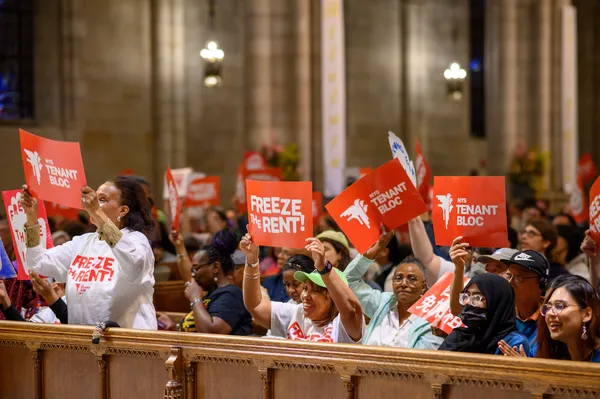
October 1st marked the beginning of a historic rent freeze won by New York City tenants, the fourth ever freeze under the system of rent stabilization and the first freeze on both one-year and two-year leases. The victory was made all the more momentous by delivering one of Zohran Mamdani’s major campaign promises. But amid celebrations of the freeze (and the beloved mayor himself), how exactly the tenant movement won is getting lost. This victory was the culmination of a campaign that the tenant movement started two years prior, when Mamdani’s election was unthinkable. The people driving the campaign had significant overlap with DSA but also significant distance. And the campaign was itself the continuation of a struggle that tenants fight every year. Ultimately, it was New York’s organized and independent tenant movement that won the rent freeze, not thanks to Mayor Mamdani but through his election and then parallel to the efforts of his administration.
As an organizer in New York’s tenant movement, I write this article to give an inside perspective on how we strategized, organized, and won. But I also hope to honestly capture the zigs and zags, the successes and failures in particular battles, and the messiness of organizing in a complex, interconnected ecosystem of nonprofits, grassroots tenant groups, and DSA. The two-year campaign for a rent freeze did not always go as we expected. Looking back, it’s hard to pinpoint which tactics ultimately brought about our victory. Causality is hard to determine in any historical analysis, but I hope this first-hand account of the dynamic campaign is accurate and, better yet, inspiring to tenant movements elsewhere.
This piece also traces how DSA as an organization engaged with on-the-ground movements before and after Mamdani’s election. In New York City, where every lefty is either a member of DSA or adjacent to the organization, there was natural overlap and interconnection between the independent tenant movement and DSA. Supporting the independent tenant movement was an easy choice for the small number of DSA electeds in the city and state legislatures. However, once a DSA cadre took charge of city government, the organization’s internal contradictions came to the fore, producing a split in the tenant movement that reflected the widening gulf between DSA’s left and right wings. The following history of this campaign makes clear, however, that the split didn’t weaken our fight for a rent freeze. On the contrary, maintaining the tenant movement’s independence from DSA was necessary to win the freeze.
To contextualize, the city’s system of rent stabilization provides two major protections to tenants living in roughly half the city’s rentals. The first is the right to renew one’s lease under virtually all circumstances. The second is a cap on rent increases set by the City’s Rent Guidelines Board (RGB). The nine members of the board, all appointed by the mayor to staggered terms, meet every summer to vote on caps on rent increases for both one-year lease renewals and two-year renewals. Though rare, the RGB could set caps of 0% (a “rent freeze,” which they passed three times, during Mayor Bill de Blasio’s progressive administration) or even a rent reduction (a “rollback,” which New York City never won but which Kingston’s RGB passed in 2022). The RGB’s decisions are based in part on research about landlords’ expenses like utility costs, taxes, and interest rates, compared to tenants’ cost of living. But they also hold public hearings across the boroughs to hear directly from tenants and landlords.
To leverage these hearings as opportunities for public pressure against the board, an alliance of nonprofits and grassroots tenant groups formed the Rent Justice Coalition (RJC) in the early aughts. Though unfunded and informal, RJC and its member groups have mobilized hundreds of tenants year after year to testify to the RGB and protest at their public votes. The coalition didn’t call for low increases but rather demanded rent freezes and rent rollbacks (and in some years, both), which became a consistent rallying cry for rent-stabilized tenants across the city. That is to say, the organized tenant movement, engaged in continual class struggle with the RGB, crystallized that struggle into the twin demands of “rent freeze” and “rent rollback.”
Every year, tenants gave powerful testimonies, and RJC organized newsworthy rallies, but whether they had any effect on the RGB’s decisions is known only by the board members themselves, whose real discussions occur behind closed doors. One can reasonably conjecture that public pressure may have lowered the rent increases by a half a percent here or there. And RJC’s organizing no doubt contributed to the three rent freezes during de Blasio’s administration. But in general, the RGB’s rent increases generally track with the mayor’s politics, and it has proven difficult to pressure the RGB to deviate. During the mayoral terms of billionaire Michael Bloomberg and Eric Adams (a landlord crony who once quipped, like a post-industrial Louis XIV, “I am real estate”), the board increased rents by an average of 3.3% and 3% per year, respectively, while under de Blasio, rents increased by an average of 0.75% per year. This correlation should be no surprise, since the mayor can appoint new board members when terms expire.
The mayor’s power to appoint presented a clear power map for the tenant movement: leapfrog the board and target the mayor instead. And in 2024, the tenant movement found a golden opportunity to do just that. The mayoral race was beginning to shape up for elections in 2025, and Mayor Adams’ chance of reelection crumbled under the weight of a federal corruption probe, leaving the race wide open. Candidates would be jockeying for votes by staking out bold policy positions. If the tenant movement were sufficiently organized, it could make the rent freeze demand a central issue of the election, push candidates to commit to a freeze in the hopes of gaining tenants’ votes, and then win a freeze from the new mayor’s RGB.
Parallel Campaigns
In the summer of 2024, RJC began discussing this strategy and elaborating a campaign plan. At the same time, the idea caught the interest of another coalition in the New York tenant movement called Housing Justice for All (HJ4A), itself a nonprofit with sizable foundation money and paid staff, who had notable overlap with the leadership of the NYC chapter of DSA. Together, RJC, HJ4A, and core nonprofits that were members of both coalitions came up with a campaign: organize thousands of rent-stabilized tenants to sign a petition demanding that mayoral candidates commit to a rent freeze, and then HJ4A’s significant communications capacity would leverage those tenant voters to push mayoral candidates to take up the demand. Both coalitions adopted the campaign in October.
As it happens, Mamdani’s campaign kicked off that same month with the official endorsement of NYC-DSA. He had already figured out his three major demands by the time of the endorsement forum: fast and free buses, universal free childcare, and a four-year rent freeze for rent-stabilized tenants. The tenant movement had crystallized the demand, and as any good socialist candidate should, he adopted it. But his chances of winning looked slim at the time. Many if not most DSA members at the endorsement forum assumed he would lose, but thought perhaps he would at least serve as a useful propaganda candidate, using the election to amplify socialist politics and move other candidates to the left. Nonetheless, DSA overwhelmingly voted to endorse him – and the rest is history.
Two campaigns thus emerged in parallel: Mamdani’s election campaign, driven by DSA cadres and its army of canvassers, and a petition campaign targeting all the mayoral candidates, driven by independent tenant groups with a longer view toward winning a rent freeze from the RGB. The overlap between HJ4A’s staff and DSA’s leadership might have served as a channel of communication between the two campaigns, and HJ4A’s executive director was Mamdani’s informal housing advisor. But in practice there was little to no coordination between the two campaigns, in part because the rent freeze campaign was initially organized by 501(c)(3) nonprofits who by law couldn’t make electoral endorsements. DSA’s official tenant organizing and housing arms were not involved in the rent freeze campaign, and there were no attempts to combine the two canvassing operations.
But zooming out, the two campaigns took on an almost dialectical relationship. On one hand, his campaign made the rent freeze itself more popular and feasible in the eyes of millions of voters and tenants, who by and large were not aware of RJC’s annual mobilizations against the RGB nor aware of the board itself. On the other hand, Mamdani used the rent freeze to help distinguish himself from other candidates, staking out the unique position of a four-year freeze. The demand undoubtedly became the most important of the three pillars of his affordability agenda. It took a movement to crystallize the housing crisis into a truly pro-tenant demand, and that demand was the foundation of his victory. In an alternative history where the tenant movement hadn’t been organized enough to formulate a clear demand with broad appeal, Mamdani might have chosen a wonky or even YIMBY housing policy instead, as his rival candidates Brad Lander and Scott Stringer did. One wonders whether Mamdani would have won in this scenario.
The rent freeze demand – and the petition campaign overall – did not, however, play out in the mayoral race as we expected. Internally, we set a goal to get 20,000 tenants to sign the petition, primarily through door-to-door canvassing. Organizers working for various nonprofits in the movement contributed, and HJ4A developed a small field campaign to coordinate volunteers. The slogan was immediately popular and exciting to broad swaths of tenants, who left their buildings to canvass across the city. But ultimately, we didn’t gather enough signatures fast enough for the petition to impact the election. We reached 10,000 signatures by April 2025, but the campaign didn’t leverage that number to pressure mayoral candidates to adopt the demand. By the time we reached 20,000 signatures in June, the Democratic primary election was right around the corner, so it was too late to move candidates.
In retrospect, we failed to use these milestones as opportunities for fanfare or signs of people power. When Tenant Bloc – HJ4A’s new 501(c)(4) sister organization, legally able to make electoral endorsements and established with that express purpose – undertook its endorsement process in May, the offer that we could mobilize thousands of signatories wasn’t part of the conversations with candidates. Furthermore, the campaign didn’t succeed in building a substantial organization of new members, as revealed by our own structure test: a rally with Mamdani in which almost everyone who attended was already part of a different tenant organization. The petition campaign built a long contact list but not an organization rich with internal relationships and new leaders that could mobilize for votes. Like any political struggle, we had our successes and failures.
But the rent freeze campaign did seriously impact the mayoral race, just not through the petition. Instead, HJ4A’s strength in working the media was instrumental in influencing the discourse (and literal debates) in the election. Since it established itself as the main organization driving pro-tenant legislation in New York State, HJ4A was seen by the media as representing the tenant movement as a whole and the go-to organization for quotes and interviews on housing issues. They used their good relationships with reporters to successfully place articles throughout the mayoral race, giving an outsized influence to a campaign of 20,000 signatories.
HJ4A also helped ensure that whether candidates would freeze the rent was a question in almost every mayoral debate by directly injecting it into the first two debates, one at the West Side Tenants Conference (organized by Housing Conservation Coordinators, a member organization of HJ4A) and the second at DC37. By calling the question on the candidates from the beginning, HJ4A turned the rent freeze question into a major litmus test in the election.
Though we changed the discourse, the petition and media work hardly moved the candidates in the end. As early as December 2024, at the first debate, Mamdani and two other candidates announced they would freeze the rent as mayor. But as the race continued, no other candidates adopted the same commitment, even candidates posturing as progressives like Brad Lander. By the time of the Democratic primary in June 2025, Lander and three other centrist candidates made only a symbolic gesture to support a rent freeze that year, when they had no power over the RGB, yet they made no commitments to freezing the rent in subsequent years if they were mayor. No doubt they were pushed left by the rent freeze campaign, the growing popularity of the demand, and pressure from Mamdani’s gradual ascent in the polls. So we successfully made the rent freeze a major question in the discourse and a litmus test for pro-tenant and pro-working-class politics. However, our failure to move candidates to actually adopt our demand (even Lander, whom Tenant Bloc endorsed) showed that our campaign didn’t build enough power.
Ultimately, getting other candidates on board didn’t matter, because Mamdani won. How he rose from single digits in the polls to two-time champion against establishment-favorite Andrew Cuomo, backed by all the forces of finance, real estate, and capital, is a question for countless academic studies. Nonetheless, the popularity of his affordability agenda, and first and foremost the rent freeze, was an essential factor in his victory. Whether the petition campaign itself, culminating in Tenant Bloc’s endorsement and its get-out-the-vote operation targeting the 20,000 signatories, moved the needle is impossible to say, though I think unlikely, especially compared to DSA’s impressive canvassing operation. But the tenant movement’s work in crystallizing a demand that deeply appealed to the one million New Yorkers who voted for Mamdani should not be understated.
One notable caveat to this narrative of mixed success in dialectically parallel campaigns was CAAAV’s more seamless fusion of the rent freeze campaign with electoral work. CAAAV is a nonprofit in Chinatown that organizes working-class Chinese tenants into the various struggles undertaken by the tenant movement, including the rent freeze campaign, of which CAAAV played a leading role. Despite alarmist reports about the rightward drift of Asian-Americans in election after election, CAAAV flipped the script by spending months organizing member leaders to gather thousands of signatures on the rent freeze petition. After using the bread-and-butter issue to move the neighborhood left on a deeply felt issue, they successfully switched gears to their 501(c)(4) outfit, CAAAV Voice, to get out the vote for Mamdani, who they endorsed early in the race. In the primary, he swept Chinatown, winning 60-70% of first-round votes in the neighborhood’s various electoral districts. Mamdani’s popularity among Asian immigrants and Asian-Americans became a much-celebrated result, but it was the result of hard on-the-ground organizing that flipped neighborhoods like Chinatown. The broad appeal of the rent freeze demand, mobilized by the petition campaign and CAAAV’s diligent organizing, was crucial in delivering thousands of Chinatown votes to Mamdani.
Phase Two
Winning the mayor’s office was one thing, but winning a rent freeze from the RGB was another. The first obstacle was that the outgoing mayor Eric Adams could stack the board before he left office on December 31, 2025. Due to the staggered terms of the RGB’s nine members, Adams could replace enough members to achieve five pro-landlord votes, who would last long enough to control the board during Mamdani’s first year and block at least one year of his promised four-year freeze.
After Mamdani’s victory in the November general election, the media was abuzz as it became clear that Adams was planning to sabotage the rent freeze. RJC swiftly released a statement calling on potential candidates to refuse an appointment to the RGB, and if they don’t, then “[t]hroughout that year, tenants will protest you every step of the way and make sure you never have a moment’s peace. So don’t make a deal with the devil or we’ll give you hell!” The threat of disruptive protest was covered by local policy-focused publication City Limits, so if any prospective appointees did their research before accepting the position, they would have been warned of the risks they faced.
Adams did try to make multiple last-minute appointments, but, as RJC hoped, almost all dropped out. On the 18th of December, just two weeks before Mamdani would take office, Adams reappointed two landlord-friendly members of the board in order to extend their terms, replaced a centrist professor with an unknown senior financial advisor at Merrill Lynch, and replaced a pro-tenant member (and the only rent-stabilized tenant on the board) with a tenant-side lawyer. If the lawyer was willing to betray the class interests of his clients, these appointments would give real estate the five out of nine votes they needed to block the rent freeze. But on New Year’s Eve, the Merrill Lynch financier chickened out. Adams filled his seat in the literal eleventh hour with a CEO of a nonprofit that supports homeownership. However, the latter announced two days later that she decided not to accept the appointment, aborting Adams’ plans to sabotage the rent freeze.
Of course, we’ll never know whether RJC’s statement was the principal cause behind this string of resignations. Given the abundant reporting in the last couple months of Adams’ term regarding the RGB’s future, one could reasonably expect that anyone considering a side job on the board would have known about RJC’s threats. Even if they hadn’t seen the statement, the decades of rowdy protests organized by RJC against the board were so predictable as to be part of the job description. The appointees who dropped out must have reckoned that the power they could wield on RGB wasn’t worth the heat, not only from the hours of testimony and vitriol that real estate’s lackeys on the board face every year from RJC, but also, externally, heightened protests potentially outside their homes and workplaces and, internally, putting up with a new left-wing mayor.
The resignations cleared the field for that mayor to appoint a majority of new members to the RGB. As a bonus, another pro-landlord appointee – a neoliberal policy analyst at the conservative think tank, the Manhattan Institute – resigned in February. Mamdani then appointed five new members to the board, including left-wing economists, progressive nonprofit executives, and a union leader, and he reappointed a tenant representative who had been one of the movement’s strongest advocates on the board. After a year-long petition campaign of zigs and zags, a long-shot bid for mayor, and a struggle against real estate’s last-ditch attempt to sabotage the victory, tenants now had a supermajority – six out of nine – of tenant-friendly votes on the board.
To be fair, mere appointment by Mamdani was no guarantee that the new board members would vote for a rent freeze. Many landlords expected (and many tenants hoped) that the new members would loyally deliver Mamdani’s campaign promise. But the RGB remained an independent body, charged with basing their decision on data and public testimony. Indeed, after the RGB passed the rent freeze, one board member – a neoliberal professor at New York University’s business school, no less – attested that the new mayor respected the board’s independence and didn’t interfere with their decision.
In retrospect, it’s clear that the new appointees were simply people who could read the data correctly. They weren’t blinded by neoliberal ideology, fealty to the profit rates of landlords and their mortgage-holders, or naked self-interest (prior board members included a real estate consultant and two landlord-side lawyers, who obviously benefitted from increasing their clients’ profits). Instead, Mamdani’s appointees were the type of people who understood that since landlords’ profits increased year after year (over 30% in three years) while tenants struggled to pay the rent despite working two jobs, New Yorkers were due for a rent freeze – at minimum.
In what became a crucial strategic maneuver, RJC decided to fight for more than just a rent freeze from the new board: they demanded a rent rollback, for three major reasons. First, many working-classes tenants, including many tenants who were members of organizations in RJC, already couldn’t afford their rent. A rent freeze wouldn’t ameliorate their struggle. Second, research by a former executive director of the RGB, Tim Collins, showed that due to all the rent increases granted by the board since 1990, landlords’ profits were already 30% higher than necessary to maintain their profit rate after adjusting for inflation. So a rollback would just redress this overcompensation.
Third, demanding a rollback was the best bargaining posture to push back against real estate’s demand for a rent increase. The landlord class was mobilizing a massive media campaign (including op-eds, news coverage, and even TikToks) to fabricate a new common sense that the sky would fall if rents were frozen. In light of this all-out lobbying effort in the public sphere and no doubt in internal discussions with the board, where landlords still had two staunch allies, the RGB might well have caved and voted for a small increase had RJC only demanded a rent freeze.
Notably, HJ4A and its sister organization Tenant Bloc only demanded a freeze, wanting to stay loyal to Mamdani’s campaign promise. This decision forced a split in the tenant movement, but RJC did not liquidate their demand for a rent rollback. They mobilized hundreds of tenants to testify about why they needed a rollback, which even convinced other speakers to change their demand from a freeze to a rollback. They also organized nearly 70 tenant organizations and allied groups, including all the major autonomous tenant unions in the city as well as NYC-DSA’s Tenant Organizing Working Group, to sign an open letter to the board making the case.
To bolster their demand for a rent freeze against the tenant movement’s call for a rollback, HJ4A staff leveraged their connections to the NYC-DSA chapter leadership, particularly through the right-wing, electorally focused Socialist Majority Caucus. In April, just two months before the RGB would vote, DSA officially joined the struggle. The Citywide Leadership Committee passed a resolution to support only a freeze (without consulting the Tenant Organizing Working Group, and thereby overriding them) and to mobilize DSA members to testify for a freeze at the board’s hearings and protest their public meetings.
This decision put DSA’s Socialists in Office in a bind. Many had close relationships to the tenant movement and participated in RJC’s rallies for a rent rollback in previous years. But they were discouraged from calling for a rollback this year because the chapter leadership opposed it, and because DSA insiders insinuated that if the RGB did vote for a rollback, then landlords could be riled into challenging the constitutionality of rent stabilization itself (though Kingston’s rent rollback was already deemed acceptable by New York State’s highest court). As it happens, landlords sued to overturn the rent freeze regardless, without challenging its constitutionality.
Despite the split in the movement, RJC kept the demand for a rent rollback loud and clear. Maintaining RJC’s independence proved to be crucial, because in the end, the demand for a rollback successfully counter-balanced landlords’ demand for higher profits. The most pro-landlord member of the RGB attested to this fact, recounting afterwards that “a week out, I was being told that we were under threat for a rent rollback. … The word to the other public members was, if you want to thwart a rollback, you need to vote for the freeze.” The board member proved that RJC’s strategy was correct: holding the RGB’s feet to the fire by demanding a rent rollback forced them to compromise at a freeze. The two-year-long rent freeze campaign finally won.
The path to victory wasn’t simple or even predictable. Rather than a straight line from the strategy’s inception to Mamdani’s victory to the RGB’s ultimate vote, the campaign was a series of zigs and zags by a movement that was not a monolith. We adapted to a shifting terrain, not least of which was a new mayor who had his own ramifications on the tenant movement and its overlap with DSA’s internal politics. But maintaining an organized movement independent from Mamdani’s electoral and then administrative apparatus, and DSA itself, proved to be essential in winning the rent freeze. Not only did RJC crystallize the demand that became Zohran’s most popular campaign promise, but also, RJC’s maneuverability enabled it to put outside pressure on Eric Adams’ last-minute appointees to resign, and its independent demand for a rent rollback forced the winning compromise. Mamdani’s election alone, without an external tenant movement, wouldn’t have been enough to win the freeze.
This analysis points the way for other social movements to win while Mamdani is still mayor, and it suggests how movements and DSA should organize under socialist executives. As Eric Blanc and Bhaskar Sunkara wrote when Mamdani took office, “New York’s left will need more popular depth and breadth” to win further reforms in the face of resistance from a centrist state government. “Without such a working-class movement, there’s a real danger that Zohran’s agenda will get blocked.” It’s telling that the other major pieces of his agenda – fast and free buses, universal free childcare, and taxing the rich to fund both – have indeed been blocked. The rent freeze has been the only success so far because it was backed by the organized tenant movement, rooted in ordinary people and independent from Mamdani himself. To win the rest of his agenda and even bigger goals, socialists should take a page from tenants and start organizing with ordinary people to build independent movements.
Liked it? Take a second to support Cosmonaut on Patreon! At Cosmonaut Magazine we strive to create a culture of open debate and discussion. Please write to us at submissions@cosmonautmag.com if you have any criticism or commentary you would like to have published in our letters section.