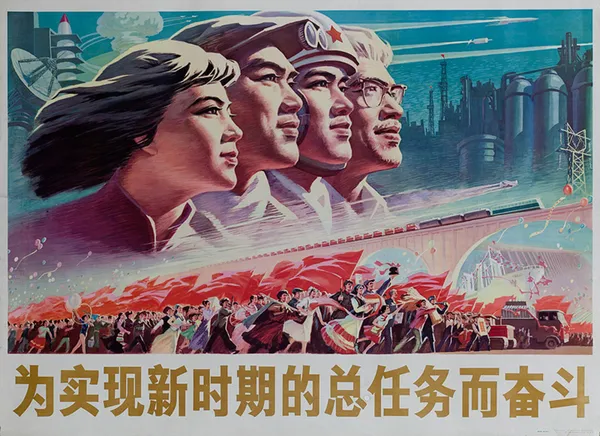
The first part of this series outlined the formation of workers’ representative institutions and their relation to the party-state. The second described the formation of autonomous workers’ organizations and their subsequent reincorporation into the state apparatus (or outright repression). This third and final section examines the development of Reform-and-Opening-Up from a market-socialist experiment within the confines of a state-owned economy to the wholesale restoration of capitalism. In the aftermath of the Cultural Revolution, Staff-and-Workers’ congresses were strengthened and once again empowered to play a role in management. The ways in which workers’ democracy interacted with marketization propelled China’s economy into a cul-de-sac from which capitalism was the only way forward that CPC leadership could conceive of.
Reform-and-Opening-Up
The first decade of the reform era pulled Staff-and-Worker’s Congresses (SWCs) into a dynamic which strengthened their role in factory management but gradually reduced the influence of rank-and-file workers. Moreover, the weakening of central planning both widened the SWC’s range of responsibilities while giving State-Owned-Enterprise (SOE) managers greater power over finance and investment decisions. As the Cultural Revolution came to a close and radicals were purged from the party, the first wave of market reforms weakened central planning and allowed factories to keep a greater portion of their surplus. This produced a rapid increase in wages and welfare that SOEs were able to provide. From 1978 to 1984, SWCs remained relatively democratic, and managerial power was still circumscribed by workers’ participatory institutions. Although party leaders presided over meetings and exercised a great deal of influence over the selection of representatives, workers were able to use SWCs as a platform to raise concerns and resist managerial authority.
After the failure of the Cultural Revolution to articulate an alternative form of social organization, Reform and Opening-Up could only imply a reorientation of the Communist Party away from its ostensible social base. As Deng Xiaoping sought to transform the CPC from a revolutionary party to a purely administrative apparatus, recruitment of workers and peasants plummeted. Intellectuals comprised 8 percent of the party in 1979 and 50 percent by 1985.[1] Wang Hui diagnosed the CPC’s post-reform trajectory as a movement from a party-state to a depoliticized “state-party.” Inverting the “party-state” compound word indicates that the party “no longer possessing its own distinctive evaluative standpoint or social goals, it can only have a ‘structural-functionalist’ relationship to the state apparatus.”[2] In other words, the relationship of the party and state is such that the party can no longer direct development towards a socialist horizon. It is structurally bound to uphold the interests of the bourgeoisie.
Wang Hui identifies three key elements underlying this depoliticization: firstly, the expansion of marketization changes the class composition of the party as the boundary between political elites and capitalists grows increasingly permeable. Secondly, China’s integration into multinational market institutions such as the WTO, which placed a certain degree of responsibility for economic policy outside the realm of national politics. Thirdly, “as both market and state are gradually neutralized or depoliticized, divisions over questions of development become technical disputes about market-adjustment mechanisms.”[3] Before large-scale privatization tore apart the old work-unit system, depoliticization would similarly transform SWCs from workers’ representative institutions to technocratic committees over which workers had no meaningful influence.
Reform and opening up can be separated into two major stages: the first phase, marketization, in which state enterprises were encouraged to retain profit and compete in a market economy, lasted from 1978-1991, and the second, privatization, followed Deng Xiaoping’s southern tour in 1992. The second stage not only resulted in private capitalists dominating the lion’s share of the GDP, but also fundamentally altered the class structure of the Communist Party by providing a number of cadres semi-legal avenues to enter the ranks of the bourgeoisie.[4] Jiang Zemin’s administration would procure post-hoc legal justification for this state of affairs and officially allow capitalists to join the party in 2001.[5] The second wave of reform and opening up therefore constitutes the primitive accumulation of Chinese capitalism, for which the weakening of the Staff-and-Workers Congresses was a necessary condition.
Nonetheless, Yueran Zhang’s study of class struggle in the post-Mao era complicates the picture of reform-and-opening up as nothing more than a slippery slope from market socialism towards capitalism. He maintains that workers’ lack of control over macroeconomic decisions inexorably drove them to use democratic management for economistic purposes, rather than expanding production. The state responded to economism by expanding managerial authority, which exacerbated the problem it was intended to solve by giving managers more avenues for withholding revenue from the state and misappropriating funds to placate workers in their firms. While the social formation that took shape in the wake of the SOE reforms of the 1990s and persists to this day is unambiguously capitalist, the initial trajectory of reform was not inevitably oriented towards the restoration of capitalism. To understand the relationship between the increasingly capitalist trajectory of reform and the demise of democratic management, the pre-capitalist stage of reform should be further separated into two stages, the latter of which rendered the restoration of capitalism all but inevitable.
In the first few years of reform, the role of SWCs and democratic management was strengthened as central planning gradually ceded decision-making to the enterprises. As marketization expanded, the formal responsibilities of SWCs gradually gave way to the need to transform China’s labor force into one amenable to capitalist work norms. In other words, while the institutions through which workers could participate in management were further solidified, effective power over these institutions was increasingly alienated from the working class. Decentralization and the expansion of the market economy also strengthened managerial power. Enterprise managers, now tasked with producing for profit, found themselves with the power to hire, fire, determine wage increases, and allocate housing; they could thus leverage their position to establish clientelist relationships with their workers as managers bought industrial peace with across-the-board wage increases as workplace democracy eroded.[6]
From 1978, when Reform and Opening Up was first promulgated, to 1988, SWC’s formal responsibilities were strengthened, even though their real power would be undermined by an increase of managerial authority and fiscal decentralization after 1984. According to China’s enterprise law, their responsibilities were to:
- Report the true situation inside factories to government organs and lodge criticisms and charges against enterprise leaders
- Put forward opinions and suggestions about the factory director’s reports on enterprise policies and long-term plans
- Endorse or reject programs for wage adjustments, bonus distribution, industrial safety, labor awards and penalties, and other rules and regulations, decide on plans for the use of enterprise welfare funds and the allocation of housing and other benefits
- Evaluate and supervise the leading administrative cadres and put forward suggestions for rewarding or punishing them and for their appointment or removal
- Elect the factory director, subject to the approval of the responsible government department.[7]
Although actual power rarely lived up to their legal description, the first half of the 1980s can reasonably be dubbed the golden age of the SWC. In addition to the devolution of decision-making, enterprises were allowed to keep a larger portion of their revenue, which they could spend on housing, childcare and healthcare for their employees, while workers enjoyed an identity as “masters of the factory.”[8] Workers in profitable consumer goods industries, such as distilleries, often saw their fortunes dramatically rise as a direct result of fiscal decentralization, which enabled the enterprise to allocate more funds for housing, for which workers in heavy industry had previously received preferential treatment. Chan and Unger’s case study of a state-owned distillery reveals that employees in the Mao-era may have had their basic needs met through the ration system, but lived “three generations of a family crammed into one or two small, dank rooms, without any kitchen space or nearby tap water,” but in the 1980s, management was able to use funds to improve employee living standards to an unprecedented degree.[9]
As industrial workers, particularly in light industry, were enjoying the benefits of fiscal decentralization, the central government received a steadily declining proportion of SOE revenue. The party elite saw the problem as one of excessive democracy and an iron rice bowl which allowed workers to resist pressure from above. It logically followed that managers needed the right to hire and fire workers enjoyed by their counterparts in capitalist countries. In 1983, when fiscal spending had declined from a height of 37 percent of GDP to 25 percent of GDP, Zhao Ziyang, who had championed democratic management in 1980, highlighted the difficulty of disciplining China’s workforce. “In our country, it’s easy to reward industriousness (industriousness can be faked), but difficult to punish laziness.”[10] In the words of Yueran Zhang, “China’s economic policymakers in 1983 saw the Party-state and workers as engaged in a zero-sum struggle over how to divide the national income: workers’ income growth was understood to come at the expense of fiscal revenue.” This was not just Zhao Ziyang’s personal view. Deng Xiaoping and Chen Yun also felt that economic growth was threatened by a zero-sum conflict between state revenue and workers’ income.[11] Zhao Ziyang’s obsession with disciplining the workforce demonstrates that momentum in the upper echelons of the party was against workers’ democracy, and consensus was building for imitating a capitalist labor market. Thus, SOE’s practice of permanent contracts and hiring employees’ relatives could not continue. Whereas 1978-85 had been a golden age of SWCs, the next five years would witness a steady diminution in the political and workplace status of China’s industrial working class in the face of deepening market reforms. Weakening workplace democracy would not, however, improve the state’s budgetary situation.
Throughout the first half of the 1980s, workers remained a majority on the SWCs, although an increasingly tenuous majority. As managers and technocrats exerted greater influence in selecting SWC representatives, shop-floor workers gave way to technocrats. In 1978, 74.8% of SWC members were ordinary workers. By 1984, the proportion of workers had declined to 56%.[12] The first move towards weakening job security and empowering management at the expense of labor came when the State Council decreed that SOEs would be permitted to hire new employees on a short-term contract basis.[13] With this reform, power dynamics within SWCs irrevocably shifted in favor of management. Cai He and Li Wanlian’s case study of Factory A, with a workforce of 6,000, indicates that prior to 1986 workers had the power to nominate and elect representatives. After 1986, however, “membership was determined by discussions between the union and the relevant departments before being passed by a show of hands at the SWC.”[14]
As the dynamic of reform pushed inexorably towards further marketization, the push to transform SOEs into quasi-capitalist enterprises would reshape the SWCs into mere figureheads. In 1984, factory management was further decentralized when individual firms were given the right to sell surplus products on the market at up to 20% above state procurement prices and choose whether to allocate the revenue to expansion of production, wages, or welfare.[15] Intended to solve the problem of economism, wherein firms would choose to pay out excessive bonuses rather than reinvest, this reform created perverse incentives that encouraged the behavior it was intended to prevent. Zhang Yueran points out that the factory director’s power over wages and bonuses incentivized clientelism and misallocation of funds, as directors frequently embezzled money and issued unsustainable bonus payments for all workers to purchase consent on the shop floor.[16] A 1988 revision of the Enterprise Law, which formally codified one-man management, further weakened workers’ institutions after “public enterprises were contracted out to their directors, who were deemed personally responsible for profits and losses.”[17] At the end of the 1980s, state-owned enterprises were trapped in an unsustainable situation. They still had obligations to their employees, and the work-units played an integral role in social reproduction, but they were beginning to become a drain on public resources. Although the problem was more to do with an absence of democracy than excessive workers’ control, the party’s solution would be to reshape SOEs along capitalist lines.
SOE Restructuring and Privatization
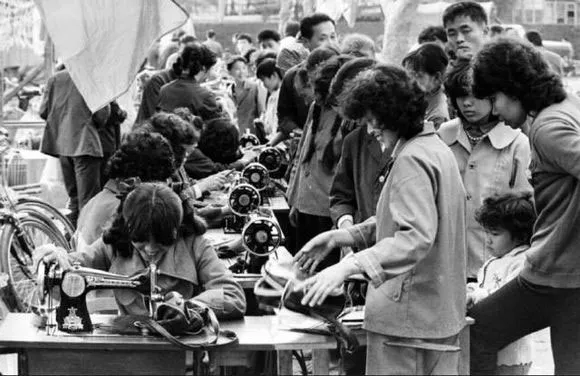
At the dawn of the 1990s, many New Left intellectuals hoped that reform-and-opening-up would lead to a new model of socialist development, or, at least, a developmental path that could provide an alternative to both state socialism and capitalism. Cui Zhiyuan, among others, believed that rural Township and Village Enterprises under the ownership of rural governments could form the basis of a cooperative economy.[18] That was not to be. While officially retaining its commitment to socialism, the CPC increasingly turned towards neoclassical economists to reshape its institutions while, in essence, gradually excising Marxism from China’s economic think-tanks.[19] Although the first decade of reform had succeeded in implementing market reforms within the context of a largely state-owned economy (albeit while incurring unsustainable inflation as a result of the aforementioned clientelism and across-the-board bonuses), SOE restructuring of the 1990s ushered in a wave of privatization while transforming the status of employees of remaining SOEs into employees whose managers had the right to hire and fire.
The process of building a Western-trained cadre of reform-oriented economists began in the initial stage of Reform-and-Opening-Up, and by the 1990s, had produced a pro-market, pro-privatization consensus among elite institutions. Although proponents of Russian-style “shock therapy” lost out, the consensus that emerged agreed on privatizing small-scale SOEs while converting large state enterprises into joint stock companies in which “’the government will only retain the role of overall management of society and the economy’ and would ‘no longer be the direct agent of public ownership, let alone interfere in the internal affairs of enterprises.’”[20] Although this view was considered extreme when it was first proposed in 1988, it serves as an apt description of the state of affairs following the second wave of Reform.
SOE restructuring threatened to unravel urban China’s social fabric as work-units, which had provided employment, housing, healthcare and education for employees of SOEs, were abolished. The reformers couched their goal in euphemistic, politically neutral language of “modernization” and “scientific management” while SOEs were restructured along capitalist lines, with accompanying layoffs impacting tens of millions of industrial workers.[21] With workers downgraded from “masters of the factory” to employees, whose managers now had the power to hire and fire, urban poverty in Sichuan, Guangdong, and Liaoning, once a center of heavy industry, quadrupled to 9-12 percent.[22] It is evident that this wave of reform created a massive reserve army of labor, and without guaranteed employment, the urban working class from then on constituted a proletariat in the orthodox Marxist sense of the term, having been alienated from the means of production and forced to sell their labor-power on the market to owners of capital.
Although SWCs are still fixtures of SOEs, they exert little influence on the day-to-day running of state enterprises. The SOE’s role in a political economy in which state enterprises are gradually restructured to emulate their privately-owned counterparts has little resemblance to the democratic management of Mao-era China or the role they played in the (in hindsight) tepid market reforms of the Deng Xiaoping era. Despite their diminished status, SWC responsibilities include approving worker reallocation plans. Although rank-and-file workers have been reduced to a handpicked minority, workers have occasionally been able to use SWCs to mitigate the worst of restructuring and wrest improved compensation out of their enterprises.[23] Workers at the Brilliant Glass Factory, which at its peak employed over 13,000 workers, could use SWC meetings to improve the severance package for laid-off workers as late as 2008. SWC meetings were suspended for nearly a decade. When the SWC was convened again in 2016, it was to approve another round of restructuring.[24]
The Afterlives of Mao-Era Industrial Organization
First stifled beneath a bureaucratic planning apparatus and subsequently disemboweled to make way for a market economy, SWCs, the Angang Constitution and democratic management would become recurring fixtures of New Left discourse. For the New Left, democratic management provides a concrete counterexample to the authoritarianism of the capitalist workplace. Meanwhile, for proponents of reform, institutions of democratic management were merely fig leaves for the rule of party cadre and the domination of the work unit over the individual worker. Moreover, the intellectual climate of the 1990s shifted defenses of democratic management away from orthodox Marxism. Proponents of economic democracy hoped to extend the power of SWCs within both state and private enterprises, but complaints of managers terminated this movement.[25] While work units, the pillars of industrial organization and urban social life, were demolished, proponents of Mao-era organizational innovations increasingly defended industrial democracy in terms of market performance. Above all, these debates pose the question of the organization of labor in relation to production relations. In advocating workers’ management disconnected from socialist planning, proponents of Democratic Management strongly resembled Western Marxists who view cooperatives such as Mondragon as a path to a post-capitalist society.
In the intellectual climate of the 1990s, the New Left largely left questions of production relations and state power by the wayside. In this context, certain Mao-era policies became a source of inspiration for intellectuals seeking a more egalitarian model of development than capitalism’s American or post-Soviet variants. Whether such a developmental path would constitute socialism or capitalism was not considered worth debating. As Cui Zhiyuan wrote, “Deng Xiaoping once said that ‘we do not know what Socialism is.’ In fact, we might add, we similarly ‘do not know what capitalism is.’”[26]
In the aftermath of capitalist transformation, memory of democratic management, however incomplete and constrained, could serve as a critique of capitalist management, although not necessarily from within a Marxist perspective. Lin Chun’s description of the Angang Constitution as “endorsing participation of workers in management and of cadres and technicians in shop floor labor, the short lived experiments pioneered a model of combining industrial democracy and post-Fordism: flexible teaming, liquid hierarchy, multiskills and cooperative competition in production; participatory planning, collective budgeting, equal pay for equal work, and profit-sharing in management” can be read as an endorsement of either socialism or democratic management within a capitalist framework.[27] Other post-mortems of participatory management, however, have examined industrial organization from a Maoist perspective, rejecting accommodation with the market and capitalist relations of production.
Cui Zhiyuan’s landmark study of the Angang Constitution defended this organizational experiment not only as an example of economic democracy in action, but also as an example of post-Fordism twenty years avant le letre. In the atmosphere of the 1990s, advocates of participatory management did not question the market-based framework or capitalist relations of production, and Cui Zhiyuan was no exception. Eliciting controversy from both the right and orthodox Maoists of the New Left, Cui Zhiyuan emphasized the similarities between the Angang method and Toyota’s “lean production,” which, in his view, replaces the rigidly hierarchical Fordist factory with a teamwork-based organizational structure.[28] He highlights key differences between Fordist and post-Fordist management: Firstly, Fordism implies a rigid division of labor, whereas post-Fordism necessitates a flexible division of labor. Secondly, Fordism implies deskilling, whereas post-Fordism imparts skills to workers. Thirdly, in organizational philosophy, Fordism addresses workers as passive recipients of management’s orders, whereas post-Fordist management is team-based. Most importantly for Cui Zhiyuan, post-Fordism is democratic, whereas Fordism is authoritarian. Cui Zhiyuan describes the relationship between workers and management in glowing terms, claiming “post-Fordism grants workers autonomy, and meets the challenges of economic fluctuations by stimulating the workers’ creativity.”[29]
The place of the Angang Constitution in Cui Zhiyuan’s analysis of post-Fordism centers on the role of Japanese firms, most significantly Toyota, and the way in which they supposedly transcended the hierarchical Fordist factory. According to Cui Zhiyan’s landmark article, delegates from Toyota observed Angang Iron and Steel’s team-based management and drew inspiration for their own managerial reforms.[30] Cui Zhiyuan thus legitimized the Angang Constitution by arguing for its role as an alleged progenitor of contemporary capitalist managerial practices. His defense of the Angang Constitution did not constitute a defense of socialism as such, but was part of an attempt on the part of the New Left to chart out a Chinese model in which the Angang Constitution would democratize labor, and the (yet-to-be-privatized) Township and Village Enterprises (TVEs) would form key elements in the search for a uniquely Chinese modernity.
Whereas 1990’s debates around management and SWCs revolved around the viability of democratic management divorced from the question of production relations, subsequent Marxist rebuttals to Cui Zhiyuan’s account provided a much-needed empirical description of post-Fordist managerial practices in addition to critiquing the theoretical basis for a conception of democratic management without socialism. Pao Yu-Ching, the author of From Victory to Defeat: China’s Socialist Road and Capitalist Reversal, brought an orthodox Maoist perspective, also informed by Harry Braverman, to bear on the question of democratic management and post-Fordism.
Pao Yu-Ching critiqued Cui Zhiyuan’s analysis from two theoretical angles. Firstly, she questions whether economic democracy is feasible under a system in which capitalists are forced to maximize relative surplus value under the whip of competition. Secondly, she corrects Cui’s excessive praise of post-Fordism by tracing the evolution of capitalist managerial practices from Taylorism to Toyota’s lean management. To this end, she employs Harry Braverman’s analysis of the labor process as a theoretical framework. Thus, her critique of Cui Zhiyuan brings to light the many theoretical deficiencies with an “economic democracy” detached from a socialist framework.
Braverman analyzed the deepening split between mental and manual labor under the Fordist managerial regime, in which workers enjoyed steadily rising wages at the cost of a rigid division of labor and frequent speed-ups. Taylorism, in Braverman’s analysis, standardized the labor process and imposed uniform discipline upon the workforce. Fordism, subsequently, utilized uniform, standardized components, broke down the labor process into a multitude of monotonous tasks, and in so doing, liberated capital from reliance on skilled workers. On this point, Cui Zhiyuan’s analysis of the Angang Constitution does not differ, as his article is very aware of the hierarchical nature of Fordist management. As Pao-Yu Ching demonstrates, however, labor fares little better under post-Fordist managerial regimes exemplified by Toyota’s ‘Lean Management.’
Written during the twilight of the Fordist accumulation regime, Braverman’s Labor and Monopoly Capital highlighted the speedups, weakening labor discipline, and diminishing rates of profit in the 1970s. Pao Yu-Ching’s critique of post-Fordism picks up where Braverman left off. Facing the stagflation crisis and ever-intensifying labor militancy which Fordist “scientific management” couldn’t manage, capital responded in two ways. Firstly, capital dealt with labor militancy at home by globalizing production. Secondly, by implementing lean management.
On the surface, lean management was largely successful in overcoming the stagnation of the Fordist factory. In contrast to the Big Three American auto manufacturers, which needed an average of 25 hours to manufacture one car, the average Japanese factory needed 17 hours of labor to produce one car, all while replacing the linear chain of command prevailing in the Fordist Factory with comparatively flexible and cost-effective team-based decision-making. “Democratic management” in the context of capitalist competition, under the auspices of multinational corporations, quickly revealed its inherent limitations. Democratic management may have played a role in company rhetoric, but it should be seen as a means by which to reduce overhead. Work teams are not compelled to work by managerial oversight. Rather, the threat of unemployment looms larger than in the comparatively secure environment of the Fordist factory. Under lean management, redundancy, whether in the form of warehouse inventory, excess spare parts, or excess workers, is not tolerated. Every team has a team leader who personally works to make up absences or tardiness and records each team-member’s attendance. When managerial oversight is replaced by the micromanagement of small teams, and even bathroom breaks are recorded.
Capitalist relations of production pit workers against capitalists, and managerial reforms, therefore, “cannot surpass the logic of reward and punishment. Capitalist management rhetorically advocates freedom and equality, but under strict factory management, workers cannot achieve freedom or equality with the managerial class.” In Pao-Yu Ching’s analysis, the Angang Constitution, when stripped from a consciously planned socialist economy, amounts to little more than band-aid remedies for disciplinary problems in capitalist economies, such as profit-sharing without altering the mode of production. Post-Fordism, whether in its Japanese or Swedish forms, has never been conducive to a democratic workplace. Rather, it has further alienated workers from control over the labor process.
If Cui Zhiyuan’s approach to post-Fordism was excessively rose-tinted, his right-wing critics relied on equally flawed assumptions. Chinese critics of democratic management held assumptions similar to Andrew Walder, who viewed the work units as a form of quasi-serfdom in which workers were subject to the whims of cadre and a minority of activists, who could disperse or withhold benefits at will, and broadly characterized the position of workers in the state-owned enterprise as “organized dependence.” Walder’s analysis was formulated at a time when policy had shifted to grant management unprecedented control over factory finance, and was therefore not representative of work units in the Mao-era. The power dynamic between workers and cadre was not static. The power of cadre and factory directors waxed and waned according to political campaigns and the increasing power of the market after the initial reforms. Through extensive interviews with retired workers, Li Huaiyin, Elizabeth Perry, Joel Andreas, and Anita Chan have demonstrated that workers exercised substantial influence over shop-floor policy. Nonetheless, Cui Zhiyuan’s attempt to subsume the Angang Constitution under the all-encompassing framework of “post-fordism” fails. If Maoist accounts of workplace democracy underestimate the deleterious effects of administrative, top-down planning, market socialism with limited shop-floor democracy has also proven itself to be a dead-end.
Apologists for the contemporary Communist Party of China maintain that the existence of capitalist exploitation, and even its dominance, does not negate the socialist character of the People’s Republic of China. After all, the state plays a crucial role in economic planning, and the working class, disempowerment in the workplace notwithstanding, exerts control over the means of production via the Communist Party and can ensure that the private sector serves the national economy.[31] What this optimistic picture of China neglects is the class character of the CPC. The connection of the Party to the working class is the core assumption undergirding the Dengist analysis of China. It is also empirically weak. The CPC’s official data offers a revealing picture of the class composition of the Communist Party, although it does not assess its membership in terms of Marxist class categories.
In both Rise of the Red Engineers and Disenfranchized, Joel Andreas noted that the party made a conscious effort to restructure itself as an efficient administrative apparatus, rather than a revolutionary organ, and gradually ceased to recruit cadre from the shop floor. Recent party statistics clearly indicate that this trend has not been reversed, and paint a dismal picture. Efforts to recruit industrial workers have fallen by the wayside, and, as of 2019, the number of workers (including skilled workers and technicians) stands at approximately 6.4 million out of 91.9 million total party members, in contrast to 14.4 million professional and technical personnel and 10.1 million managers.[32] The 25 million party members employed in agriculture, husbandry and fishing can no longer be assumed to come from small-scale agricultural households. Although the division of the people’s communes initially produced an egalitarian distribution of land, urbanization and declining profitability of small-scale agriculture have led to an accelerating concentration of land. Moreover, legal obstacles to land transfer have been progressively eroded as the Party gradually moves to encourage the consolidation of small-scale farms.[33] Based on Xu Zhun’s research on land concentration, rural party cadres have utilized relaxation in land tenure to become agricultural capitalists, which has far-reaching implications for the class structure of the CPC. In his analysis of household surveys and nationwide land-transfer data, Zhun Xu writes, “ a considerable number of rural cadres in 2013 were big farmers. Although sometimes casually referred to as the ‘new landlords’, the big farmers are closer to capitalist farmers than the old landlords...” and often own powerful agribusinesses.[34] Thus, rural party members can be inferred to disproportionately come from the rural petit-bourgeoisie and new agrarian capitalists, rather than the remaining middle-peasants or semi-proletarian migrant workers, colloquially called the ‘floating population,’ who are compelled by low rural incomes to sell their labor on the urban market. Having marginalized the proletariat, the CPC is now structured as an apolitical administrative apparatus rather than an organ of proletarian dictatorship.
Although hotly debated on the left, there is little ambiguity in the essence of “socialism with Chinese characteristics” if viewed in terms of relations of production. If “the deployment and reproduction of human labor-power according to the needs of profit maximization” is taken as the defining feature of capitalism, then China is indeed capitalist.[35] In contemporary China, the private sector is constrained by a labor law which was strengthened under both Hu Jintao and Xi Jinping. However, in practice, the labor law is very rarely enforced, and private sector workers often face nonpayment of wages and illegal overtime.[36] Conditions of labor have transformed from workplaces characterized by limited democracy in the context of top-down planning to a dynamic in which “the legal and ideological grounds for workers to consider themselves as ‘masters’ of their factories were completely lost; they once again stood in a relationship to capital identical to that of the working class of openly capitalist countries, becoming the ‘masters of their own labor’ only,”[37] and free in Marx’s dual sense of the term: free to sell her labor-power on as a commodity, and free from ownership of productive assets, and thus obligated to do so. With a ruling party in which the working class holds little real power, this is unlikely to change in the foreseeable future. The PRC’s efforts to search for a socialist managerial regime surpassed the USSR, but fell short of constructing a new social order capable of preventing the restoration of capitalism.
Liked it? Take a second to support Cosmonaut on Patreon! At Cosmonaut Magazine we strive to create a culture of open debate and discussion. Please write to us at submissions@cosmonautmag.com if you have any criticism or commentary you would like to have published in our letters section.
-
Joel Andreas, Rise of the Red Engineers: The Cultural Revolution and the Origins of China’s New Class, (Stanford University Press, 2009,) 235.
↩ -
Wang Hui, The End of the Revolution: China and the Limits of Modernity, (Verso, 2009,) 9.
↩ -
Ibid.
↩ -
Lin Thunghong and Wu Xiaogang, “The Transformation of the Chinese Class Structure, 1978–2005,” in Social Transformations in Chinese Societies, ed. Kwok-bun Chan, (Brill, 2009,) 108.
↩ -
Jiang Zemin, “Speech at the Meeting Celebrating the 80th Anniversary of the Founding of the Communist Party of China,” http://www.china.org.cn/e-speech/a.htm
↩ -
Yueran Zhang, Whither Socialism? Workers’ Democracy and the Class Politics of China’s Post-Mao Transition to Capitalism, (Dissertation, University of California, Berkeley, 2024,) 30.
↩ -
Andreas, Disenfranchised, 169.
↩ -
Ibid., 168.
↩ -
Anita Chan and Jonathan Unger, “A Chinese State Enterprise Under Reforms: What model of Capitalism?” The China Journal, no. 62, July 2009, 10.
↩ -
Yueran Zhang, Whither Socialism?, 141.
↩ -
Ibid., 143.
↩ -
Cai He and Li Wanliang, “Research Into the Implementation of the Staff and Workers Congress System in State-Owned Enterprises ,” 41.
↩ -
Andreas, Joel. Disenfranchized, 184.
↩ -
Cai He and Li Wanliang, “Research Into the Implementation of the Staff and Workers Congress System in State-Owned Enterprises ,” 39.
↩ -
Oiva Laaksonen, “Changes in Enterprise Management in China in the 1980s,” Southeast Asian Journal of Social Science, vol. 17, no. 2, (1989,), 64.
↩ -
Yueran Zhang, Whither Socialism, 171.
↩ -
Joel Andreas. Disenfranchised, 186.
↩ -
Alexander F. Day, The Peasant in Postsocialist China: History, Politics, and Capitalism, (Cambridge University Press, 2013,) 82.
↩ -
Shuhong Huo and Inderjeet Parmar. “’A New Type of Great Power Relationship’? Gramsci, Kautsky and the role of the Ford Foundation’s transformational elite knowledge networks in China,” Review of International Political Economy, Volume 27 Issue 2, (2020,) 6.
↩ -
Isabella M. Weber, How China Escaped Shock Therapy: The Market Reform Debate, (Routledge, 2020), 234.
↩ -
Minqi Li, Three Essays on China’s State-Owned Enterprises: Towards an Alternative to Privatization, PhD Dissertation, (University of Massachusetts, Amherst, 2002), 19.
↩ -
Wang Feng, Tai Tsui-o and Wang Youjuan, “Durable Inequality: Who are China’s New Urban Poor?”, in Social Stratification in Chinese Societies, ed. Kwok-bun Chan, (Brill, 2009), 64.
↩ -
Joel Andreas, Disenfranchised, 200.
↩ -
Ibid.
↩ -
Ibid., 169.
↩ -
Zhiyuan Cui, “Whither China? The Discourse on Property Rights Reform in China,” in Whither China? Intellectual Politics in Contemporary China, Ed. Xudong Zhang, (Duke University Press, 2001), 117.
↩ -
Lin Chun, China and Global Capitalism: Reflections on Marxism, History, and Contemporary Politics, (Palgrave MacMillan, 2013), 109.
↩ -
Zhiyuan Cui 崔之元 and Yang Tao 杨涛, “angang xianfa- hou futezhuyi he chanye zhuanxing shengji” 鞍钢宪法- 后福特主义和产业转型升级 [The Angang Constitution: Post-Fordism and Industrial Transformation and Upgrading], Tsinghua Business Review, Vol. 11 2019, 95.
↩ -
Zhiyuan Cui, 崔之元. “angang xianfa yu houfutezhuyi” 鞍钢宪法与后福特主义 [The Angang Constitution and Post-Fordism, Dushu 读书 003 (1996).
↩ -
Unfortunately, the author of this piece could not find any other sources to corroborate the influence of Mao-era management on Japanese post-Fordism.
↩ -
See the category of “political expropriation” advanced by Domenico Losurdo in “Reflections on China” (https://redsails.org/losurdo-on-china/). In addition to abandoning class struggle in favor of class-neutral national development, he makes a number of peculiar claims, such as that the late-Mao era economy was stagnant and that the Gang of Four attempted to justify this stagnation. For an informative economic history of modern China, see Chris Bramall’s China’s Economic Development.
↩ -
Xinhua News Agency, “(shouquan fabu) 2019 nian zhongguogongchandang dangnei tongji gongbao” (授权发布)2019 年中国共产党党内统计公报 [(authorized release) 2019 Statistical Bulletin on the Communist Party of China], June 30, 2020 https://www.xinhuanet.com/politics/2020-06/30/c_1126178928.htm
↩ -
Zhun Xu, “The Development of Capitalist Agriculture in China,” Review of Radical Political Economics, Vol. 49, Issue 4, (2017), 2.
↩ -
Zhun Xu, “Changing Farmland Distribution in China,” Journal of Peasant Studies, Vol. 51, Issue 1, (2024), 8.
↩ -
Yueran Zhang, Whither Socialism, 10.
↩ -
Anita Chan, “The Fallacy of Chinese Exceptionalism,” in Chinese Workers in Comparative Perspective, ed. Anita Chan, (Cornell University Press, 2015), 5.
↩ -
Li Huayin, The Master in Bondage, 254.
↩